

A Survey on the Use of Artificial Intelligence by Clinicians in Dentistry and Oral and Maxillofacial Surgery
Open accessThe DOI matches its Crossref record; 32 of the 32 references it cites were found in a registry or an index.
Abstract
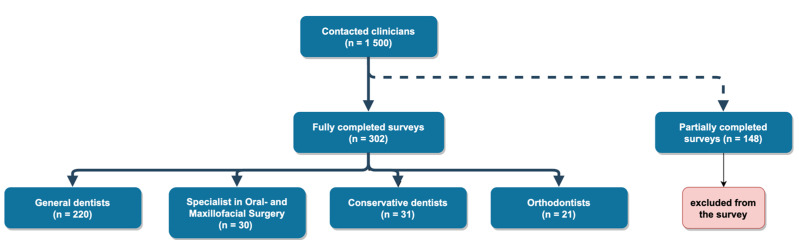
Background: Applications of artificial intelligence (AI) in medicine and dentistry have been on the rise in recent years. In dental radiology, deep learning approaches have improved diagnostics, outperforming clinicians in accuracy and efficiency. This study aimed to provide information on clinicians’ knowledge and perceptions regarding AI. Methods: A 21-item questionnaire was used to study the views of dentistry professionals on AI use in clinical practice. Results: In total, 302 questionnaires were answered and assessed. Most of the respondents rated their knowledge of AI as average (37.1%), below average (22.2%) or very poor (23.2%). The participants were largely convinced that AI would improve and bring about uniformity in diagnostics (mean Likert ± standard deviation 3.7 ± 1.27). Among the most serious concerns were the responsibility for machine errors (3.7 ± 1.3), data security or privacy issues (3.5 ± 1.24) and the divestment of healthcare to large technology companies (3.5 ± 1.28). Conclusions: Within the limitations of this study, insights into the acceptance and use of AI in dentistry are revealed for the first time.
Overview
The claims and statistics of this paper haven’t been checked yet.
Free: it reads the open-access text and checks the first 5 claims that cite a source we can check. Create a free account to check every claim.
Integrity signals
Registry
Cites
Statistics
Figures
Verification
Claims the paper makes
The claims and statistics of this paper haven’t been checked yet.
Free: it reads the open-access text and checks the first 5 claims that cite a source we can check. Create a free account to check every claim.
Claims other papers make about this one
Each is checked against this paper’s own text: does it say what the citing paper says it does?
The check wasn’t confident either way, so it gives no verdict — never disputed.
In the citing paper
“Ethical facilitators are seen insofar that AI systems would not discriminate against patients [44, 86] while also providing equal care to all which is evidence-based, ensuring that all patients receive fair and equitable treatment [54, 65].”
From Healthcare professionals’ perspectives on artificial intelligence in patient care: a systematic review of hindering and facilitating factors on different levels (2025) · cites this paper as [65]
Experimental — accuracy not yet measured
Self-check
Percentages, sums and reported differences re-computed from the paper’s own numbers.
The self-check needs the paper’s full text.
Citations
Cites
A survey on deep learning in medical image analysis
Litjens, G., Kooi, T., Bejnordi, B. E., Setio, A. A. A., Ciompi, F., Ghafoorian, M., van der Laak, J. A. W. M., van Ginneken, B., & Sánchez, C. I. (2017) · Medical Image Analysis · doi:10.1016/j.media.2017.07.005 · Cited by 15,332 · cited 1×
“Other studies showed similar results [15,16,22].”
Artificial Intelligence in Dentistry: Chances and Challenges
Schwendicke, F., Samek, W., & Krois, J. (2020) · Journal of Dental Research · doi:10.1177/0022034520915714 · Cited by 1,446 · cited 3×
“In machine learning, CNNs mimic human neurons [5], creating a network organized in layers that transfers complex input of data (e.”
BackgroundSelf-citationPesapane, F., Codari, M., & Sardanelli, F. (2018) · European Radiology Experimental · doi:10.1186/s41747-018-0061-6 · Cited by 833
Medical students' attitude towards artificial intelligence: a multicentre survey
Pinto dos Santos, D., Giese, D., Brodehl, S., Chon, S. H., Staab, W., Kleinert, R., Maintz, D., & Baeßler, B. (2019) · European Radiology · doi:10.1007/s00330-018-5601-1 · Cited by 754 · cited 4×
“Despite several serious concerns, clinicians in various surveys agree on the positive impact of AI on their profession [15,17,18,20,23,24].”
BackgroundResultInfluentialDeep Learning in Medical Image Analysis
Chan, H.-P., Samala, R. K., Hadjiiski, L. M., & Zhou, C. (2020) · Advances in Experimental Medicine and Biology · doi:10.1007/978-3-030-33128-3_1 · Cited by 747
Khanagar, S. B., Al-ehaideb, A., Maganur, P. C., Vishwanathaiah, S., Patil, S., Baeshen, H. A., Sarode, S. C., & Bhandi, S. (2021) · Journal of Dental Sciences · doi:10.1016/j.jds.2020.06.019 · Cited by 676 · cited 1×
“One of the reasons for the frequent use of AI in the dental workflow may be the spread of aligner therapy that includes AI-guided treatment planning [25] or intraoral scanning [26].”
BackgroundSit, C., Srinivasan, R., Amlani, A., Muthuswamy, K., Azam, A., Monzon, L., & Poon, D. S. (2020) · Insights into Imaging · doi:10.1186/s13244-019-0830-7 · Cited by 507 · cited 1×
“Despite several serious concerns, clinicians in various surveys agree on the positive impact of AI on their profession [15,17,18,20,23,24].”
BackgroundClear aligners in orthodontic treatment
Weir, T. (2017) · Australian Dental Journal · doi:10.1111/adj.12480 · Cited by 459 · cited 1×
“One of the reasons for the frequent use of AI in the dental workflow may be the spread of aligner therapy that includes AI-guided treatment planning [25] or intraoral scanning [26].”
BackgroundPhysician Confidence in Artificial Intelligence: An Online Mobile Survey
Oh, S., Kim, J. H., Choi, S.-W., Lee, H. J., Hong, J., & Kwon, S. H. (2019) · Journal of Medical Internet Research · doi:10.2196/12422 · Cited by 387
Gerke, S., Babic, B., Evgeniou, T., & Cohen, I. G. (2020) · npj Digital Medicine · doi:10.1038/s41746-020-0262-2 · Cited by 359
Cited by
Impact of Artificial Intelligence on Dental Education: A Review and Guide for Curriculum Update
Thurzo, A., Strunga, M., Urban, R., Surovková, J., & Afrashtehfar, K. I. (2023) · Education Sciences · doi:10.3390/educsci13020150 · Cited by 342
“The survey also raised several concerns about AI, including machine error, data security and privacy issues, and the potential for outsourcing healthcare to technology companies [50].”
BackgroundChatGPT in Dentistry: A Comprehensive Review
Alhaidry, H. M., Fatani, B., Alrayes, J. O., Almana, A. M., & Alfhaed, N. K. (2023) · Cureus · doi:10.7759/cureus.38317 · Cited by 126
“They allow for a reduction in the time spent on tasks, a decrease in missed findings, and the prevention of overtreatment [48].”
BackgroundHua, D., Petrina, N., Young, N., Cho, J., & Poon, S. K.-S. (2023) · Artificial Intelligence in Medicine · doi:10.1016/j.artmed.2023.102698 · Cited by 149
Roganović, J., Radenković, M., & Miličić, B. (2023) · Healthcare · doi:10.3390/healthcare11101480 · Cited by 76
“3% reported that it was excellent [20].”
Artificial intelligence for diagnostics in radiology practice: a rapid systematic scoping review
Lawrence, R., Dodsworth, E., Massou, E., Sherlaw-Johnson, C., Ramsay, A. I. G., Walton, H., O'Regan, T., Gleeson, F., Crellin, N., Herbert, K., et al. (2025) · eClinicalMedicine · doi:10.1016/j.eclinm.2025.103228 · Cited by 69
Scipion, C. E. A., Manchester, M., Federman, A. D., Wang, Y., & Arias, J. J. (2025) · BMJ Open · doi:10.1136/bmjopen-2024-092624 · Cited by 103
Henzler, D., Schmidt, S., Koçar, A., Herdegen, S., Lindinger, G. L., Maris, M. T., Bak, M. A. R., Willems, D. L., Tan, H. L., Lauerer, M., et al. (2025) · BMC Health Services Research · doi:10.1186/s12913-025-12664-2 · Cited by 54
“…[41, 65, 86], questions of liability and accountability in the face of clinical errors [30, 31, 61, 65, 70, 76, 80] concerns about data security and privacy of patient data [30, 38, 45, 46, 52, 65, 76, 91], and the lack of comprehensive regulatory policies governing AI in healthcare [45, 56, 64].”
InfluentialMurali, S., Bagewadi, A., Lokesh Kumar, S., Fernandes, A., Jayapriya, T., Panwar, A., & Keluskar, V. K. (2023) · Journal of Oral Medicine and Oral Surgery · doi:10.1051/mbcb/2023018 · Cited by 61
“This is achieved with the help of convolutional neural networks (CNNs) that mimic neuronal network of human brain where learning patterns from a specific dataset and performing autonomic tasks is attainable [4].”
BackgroundHegde, S., Nanayakkara, S., Jordan, A., Jeha, O., Patel, U., Luu, V., & Gao, J. (2024) · European Journal Of Dental Education · doi:10.1111/eje.13042 · Cited by 50
“Our findings are similar to those of other studies conducted in dental communities in other parts of the globe [33, 35, 46, 50, 51].”
Are skepticism and moderation dominating attitudes toward AI‐based technologies?
Oprea, S., Nica, I., Bârã, A., & Georgescu, I. A. (2024) · American Journal of Economics and Sociology · doi:10.1111/ajes.12565 · Cited by 45
Yılmaz, C., Erdem, R. Z., & Uygun, L. A. (2024) · BMC Medical Education · doi:10.1186/s12909-024-06106-6 · Cited by 44
“The development of the survey instrument was informed by a comprehensive literature review, with a detailed analysis of existing surveys by Eschert et al. [11] and Jeong et al. [12].”
MethodInfluentialShawli, L., Alsobhi, M. G., Chevidikunnan, M. F., Rosewilliam, S., Basuodan, R., & Khan, F. R. (2024) · Musculoskeletal Science and Practice · doi:10.1016/j.msksp.2024.103152 · Cited by 57
Özsarı, Ş., Kamburoğlu, K., Tamse, A., Yener, S. E., Tsesis, I., Yılmaz, F., & Rosen, E. (2025) · Dental Traumatology · doi:10.1111/edt.13027 · Cited by 23
Expert gaze as a usability indicator of medical AI decision support systems: a preliminary study
Castner, N., Arsiwala-Scheppach, L. T., Mertens, S., Krois, J., Thaqi, E., Kasneci, E., Wahl, S., & Schwendicke, F. (2024) · npj Digital Medicine · doi:10.1038/s41746-024-01192-8 · Cited by 25
Self-citationNeurology education in the era of artificial intelligence
Kedar, S., & Khazanchi, D. (2022) · Current Opinion in Neurology · doi:10.1097/wco.0000000000001130 · Cited by 27
“Concerns raised include accountability for medical errors [37,38], bias in algorithms [37], lack of guidelines for use of these technologies [37], data security and privacy [38], divestment of healthcare to large technological companies [38], and threats to medical professional identity [40].”
BackgroundPatients’ attitudes toward artificial intelligence in dentistry and their trust in dentists
Bahadır, H. S., Keskin, N. B., Çakmak, E. Ş. K., Güneç, H. G., Aydın, K. C., & Peker, F. (2024) · Oral Radiology · doi:10.1007/s11282-024-00775-1 · Cited by 23
“There has been much research [11, 16–19] on how dentistry and medical students perceive AI, but little research so far including patients [12].”
Second Opinion for Non-Surgical Root Canal Treatment Prognosis Using Machine Learning Models
Bennasar-Verger, C., García, I., González-Cid, Y., Pérez, F., & Jiménez, J. Q. (2023) · Diagnostics · doi:10.3390/diagnostics13172742 · Cited by 16
Artificial intelligence in dentistry : Knowledge and perceptions of Moroccan students
ELHIJAZI, M., & Benyahya, I. (2023) · Health Sciences · doi:10.56264/2658-865x.1083 · Cited by 14
Cozmescu, A. F., Cernega, A., Mincă, D. G., Didilescu, A. C., Imre, M. M., Totan, A., Pârvu, S., & Pițuru, S. (2025) · Dentistry Journal · doi:10.3390/dj13090390 · Cited by 15
“…findings from a study conducted in Germany (Eschert, 2022), where 23.2% of the surveyed dental practitioners evaluated their knowledge regarding digital technologies based on AI-driven tools as very poor, 37.1% assessed their knowledge as average, and 22.2% considered it above average [29].”
InfluentialPerspective Toward Machine Learning Implementation in Pediatric Medicine: Mixed Methods Study
Alexander, N., Aftandilian, C. C., Guo, L. L., Plenert, E., Posada, J., Fries, J., Fleming, S. L., Johnson, A. E. W., Shah, N. H., & Sung, L. (2022) · JMIR Medical Informatics · doi:10.2196/40039 · Cited by 11
“Compared with our findings, benefits and challenges associated with artificial intelligence were similar in ophthalmology, dermatology, radiology, optometry, and surgery [22,23].”
ResultPringle, A. J., Kumaran, V., Missier, M. S., & Nadar, A. S. P. (2024) · Journal of Pharmacy And Bioallied Sciences · doi:10.4103/jpbs.jpbs_1019_23 · Cited by 20
“[29] and Bisdas S et al .”
InfluentialBedia, A. S., Mulla, S. A., Patil, A., Bedia, S. V., Ghadage, M., & Mali, S. D. (2024) · Cureus · doi:10.7759/cureus.66836 · Cited by 10
“A similar contrast was found in a study by Eschert et al. [16].”
ResultFadilah, R. P. N., Rikmasari, R., Akbar, S., & Setiawan, A. S. (2025) · BMC Oral Health · doi:10.1186/s12903-025-07486-x · Cited by 7
“For instance, Eschert et al. emphasized that AI can significantly reduce the time required for diagnostic assessments, allowing clinicians to allocate more time to patient care, which is crucial for enhancing patient satisfaction [50].”
Altındağ, A., Uzun, S., Altındağ, Ö., & Orhan, K. (2026) · BMC Medical Education · doi:10.1186/s12909-026-09264-x · Cited by 8
“The questionnaire was developed de novo by combining and adapting items from previously published surveys investigating artificial intelligence in dentistry and dental education [3, 7, 11, 15].”
Mishra, P., Singh, A. V., Kar, P., & Chaturvedi, A. (2025) · Cureus · doi:10.7759/cureus.78882 · Cited by 11
“This would improve the integration of robotics and AI into dental care procedures by educating students, graduates, and professionals about the wide range of skills necessary to handle complex digital dentistry equipment [9].”
Comprehensive Scoping Review on Discrepancy in Accuracy of ChatGPT in Dental Health Practice
Bommanavar, S., Varma, S. R., & Karobari, M. I. (2025) · Human Behavior and Emerging Technologies · doi:10.1155/hbe2/1269498 · Cited by 4
Lima, K. D. C., Aguiar, H. C., Szönyi, V., Fernandes, M. H., Tirapelli, C., & Grosgogeat, B. (2026) · Digital Dentistry Journal · doi:10.1016/j.ddj.2026.100071 · Cited by 3
Ingle, N. A., AlOraini, R. A., Radhi, F. M., AlSaydalani, G. K., Mansour, A. M., AlHarkan, A. F., & Wadaan, A. M. (2025) · Journal of Pharmacy And Bioallied Sciences · doi:10.4103/jpbs.jpbs_1920_24 · Cited by 5
Arango, S. D., Flynn, J. C., Zeitlin, J. H., Payne, S. H., Miller, A. J., & Weir, T. B. (2025) · The Journal Of Hand Surgery · doi:10.1016/j.jhsa.2025.01.004 · Cited by 5
Nagyová, V., Blaňár, D., Kybic, J., Schwendicke, F., & Tichý, A. (2026) · International Dental Journal · doi:10.1016/j.identj.2026.109567 · Cited by 3
Self-citationGüler, R., Yalcin, E., & Gülsün, B. (2024) · Journal of Craniofacial Surgery · doi:10.1097/scs.0000000000010687 · Cited by 2
“24 With this, in recent years, many studies have been conducted on the use of AI in the fi elds of dentistry and craniomaxillofacial surgery for diagnostic and therapeutic purposes.”
What impact could artificial intelligence have on oral surgery in the next five years?
Sladden, R. (2024) · BDJ In Practice · doi:10.1038/s41404-024-2912-6 · Cited by 4
Advantages, Disadvantages, and Limitations of AI in Dental Health
Jagtap, R., Bayrakdar, S. K., & Orhan, K. (2023) · Springer eBooks · doi:10.1007/978-3-031-43827-1_14 · Cited by 5
Künstliche Intelligenz und Bildgebung in der MKG-Chirurgie
Vinayahalingam, S., & Thiem, D. G. E. (2025) · Die MKG-Chirurgie · doi:10.1007/s12285-024-00513-w · Cited by 1
Self-citationElburki, M. S., & Elareibi, A. A. (2025) · Journal of Primary Care Dentistry and Oral Health · doi:10.4103/jpcdoh.jpcdoh_57_24 · Cited by 2
Ünal, S. Y., Talmaç, A. G. Ö., Keser, G., & Pekiner, F. N. (2026) · BMC Medical Education · doi:10.1186/s12909-026-08900-w · Cited by 1
“On the clinical side, Eschert et al. documented the uptake of digital technologies in dentistry and maxillofacial surgery, reinforcing the need for student-level exposure to such applications [18].”
Efthymiou, G., Charalambous, M., & Soteriades, E. S. (2026) · BMC Oral Health · doi:10.1186/s12903-026-09081-0 · Cited by 1
“Knowledge level and prior AI exposure strongly influence attitudes, with greater familiarity correlating with trust and optimism [4, 13].”
Cozmescu, A. F., Cernega, A., Didilescu, A. C., Imre, M. M., Funieru, C., & Pițuru, S.-M. (2026) · Dentistry Journal · doi:10.3390/dj14090572 · Cited by 1
“A growing body of survey research has examined dental professionals’ readiness, attitudes, knowledge, and perceived barriers regarding AI adoption [13–16], whereas the patient’s perspective has remained comparatively underexplored.”
Applications of Artificial Intelligence in Dentistry
Jaju, P. P., Bayrakdar, İ. Ş., Jaju, S. P., Shah, V., Orhan, K., & Jagtap, R. (2023) · Springer eBooks · doi:10.1007/978-3-031-43827-1_4 · Cited by 4
Kuzhivilayil, S. A., George Skariah, P., & Dilna, S. (2025) · BULLETIN OF STOMATOLOGY AND MAXILLOFACIAL SURGERY · doi:10.58240/1829006x-2025.21.5-333 · Cited by 1
Мазур, І. П., Антонишин, І. В., Hasiuk, N. V., & Радчук, В. Б. (2025) · Oral and General Health · doi:10.22141/ogh.6.2.2025.223 · Cited by 1
Use of artificial intelligence in oral radiology: a multicenter cross-sectional study in Egypt
Saif, N., Elkoumi, A., & Shaalan, A. (2025) · BMC Oral Health · doi:10.1186/s12903-025-07269-4 · Cited by 4
“As AI continues to advance and find applications in various aspects of dental practice, there is a growing consensus that education and training in AI-related concepts should be incorporated into dental education to prepare students for the evolving landscape of their profession [14, 23, 28, 29].”
Li, C., Pataer, P., & Gong, Z. (2023) · PubMed Central · doi:10.7518/hxkq.2023.2023198
Perspektiven zur Nutzung von KI in der Praxis
Gaudin, R., & Buley, F. (2025) · Die MKG-Chirurgie · doi:10.1007/s12285-024-00509-6
Boissin, C., Blom, L., Taha, Z., Wallis, L. A., Allorto, N. L., & Laflamme, L. (2025) · JMIR Human Factors · doi:10.2196/56300 · Cited by 1
“Further, maxillofacial surgeons, ophthalmologists, dermatologists, and radiation oncologists acknowledged the need to be trained before implementation and to have well-defined responsibilities among all users involved in the implementation process, especially if errors were to happen [10,11].”
Elkhyatt, Y., Hijab, M. H. F., & Al‐Thani, D. (2026) · Frontiers in Education · doi:10.3389/feduc.2026.1762382 · Cited by 1
Usability of a deep learning platform for detecting radiographic bone loss and furcation involvement
Lee, C., Kabir, T., Alsaffar, A., Nelson, J., Sheng, S., Meng, H., Qali, M., Walji, M. F., Jiang, X., & Shams, S. (2026) · Journal of Periodontology · doi:10.1002/jper.70106
Park, S. H., Choi, Y., Park, H. J., Huh, J., & Park, W. (2026) · Journal of implantology and applied sciences · doi:10.32542/implantology.2026002
Flores, A. S. R., Jaramillo, S. D. C., Mugmal, M. M. A., & Bastidas, C. E. C. (2026) · Esprint Investigación · doi:10.61347/ei.v5i1.278
Mansi, Z. M., Alshami, M. L., & Al-Kubaisi, M. W. (2026) · JADA Foundational Science · doi:10.1016/j.jfscie.2026.100076
Bilgili, E., Tokgöz, E., Ayaz, N. D., Derinsu, G., & Güneş, G. (2026) · Healthcare · doi:10.3390/healthcare14131907
“Across studies from Türkiye, India, Brazil, South Korea, Saudi Arabia, and elsewhere, dental students and practitioners have generally expressed positive views about AI while also showing meaningful variation tied to educational background and seniority [8–22 , 31– 33].”
Efes, B. G., Menekşe, İ., & Şahin, H. S. (2026) · Cumhuriyet Dental Journal · doi:10.7126/cumudj.1804523
Retzlaff, M., Hollborn, H., Omara, M., & Schierz, O. (2026) · Scientific Reports · doi:10.1038/s41598-026-59505-8 · Cited by 1
Metadata
- Authors
- Eschert, T., Schwendicke, F., Krois, J., Bohner, L., Vinayahalingam, S., & Hanisch, M.
- Affiliations
- University of Münster (DE)
- Charité – Universitätsmedizin Berlin (DE)
- Radboud University Nijmegen (NL)
- Corresponding author
- Vinayahalingam, Shankeeth
- Hanisch, Marcel
- Venue
- Medicina
- Publisher
- MDPI AG
- Published
- 2022-08-05
- Volume
- 58
- Issue
- 8
- Pages
- 1059
- ISSN
- 1010-660X (ISSN-L)
- 1648-9144
- PMC
- PMC9412897
- OpenAlex
- W4290720430
- Cited by
- 53
- References
- 32
- Citations by year
- 2026: 14 · 2025: 17 · 2024: 10 · 2023: 10 · 2022: 2
- FWCI
- 2.94
- Type
- journal article
- Language
- en
- Open access
- gold
- doi.org
- Licence
- Locations
- Medicina (publishedVersion, cc-by)
- PubMed Central (publishedVersion, cc-by)
- PubMed (publishedVersion)
- DOAJ (DOAJ: Directory of Open Access Journals) (submittedVersion, cc-by-sa)
- Radboud Repository (Radboud University) (submittedVersion)
- Radboud Repository (Radboud University) (submittedVersion, other-oa)
- Topics
- Health Sciences › Medicine › Health Informatics › Artificial Intelligence in Healthcare and Education
- Health Sciences › Dentistry › Oral Surgery › Dental Radiography and Imaging
- Physical Sciences › Computer Science › Artificial Intelligence › Artificial Intelligence Applications
- Keywords
- artificial intelligence in dentistry, clinicians' perceptions, AI knowledge, AI acceptance, dental radiology, data security and privacy, maxillofacial surgery
- MeSH terms
- Artificial Intelligence, Humans, Surveys and Questionnaires, Surgery, Oral
About these checks
Registry, retraction, Cites and statistics results are computed, not judged, with one exception: a printed reference that no index lists is read once by a model before it counts as a citation error. Claims are extracted by a model and kept only when their quote appears verbatim in the text; each cited source is then checked, with a model’s help, for whether it says what the claim relies on. Those verdicts can be wrong — read the claim’s quote and the cited source before relying on one.
Statistics and arithmetic are recomputed, not judged.
Confidence bands are shown only for fields calibrated on our annotated test set. None is calibrated yet, so no band is shown.
What counts as a claim ›How we measure confidence ›How we check this ›
Are you an author, or do you see a problem with this page? Request a review
Data sources
Bibliographic data: Semantic Scholar, OpenAlex, Crossref.
Contains information from the Semantic Scholar Academic Graph Datasets, made available under the ODC Attribution License (ODC-BY 1.0).
Semantic Scholar’s data is described in: Kinney, R., et al. (2023). The Semantic Scholar Open Data Platform. arXiv:2301.10140.
