

Adherence to the Mediterranean Diet during Pregnancy: Associations with Sociodemographic and Anthropometric Parameters, Perinatal Outcomes, and Breastfeeding Practices
Open accessThe DOI matches its Crossref record; 62 of the 62 references it cites were found in a registry or an index.
Abstract
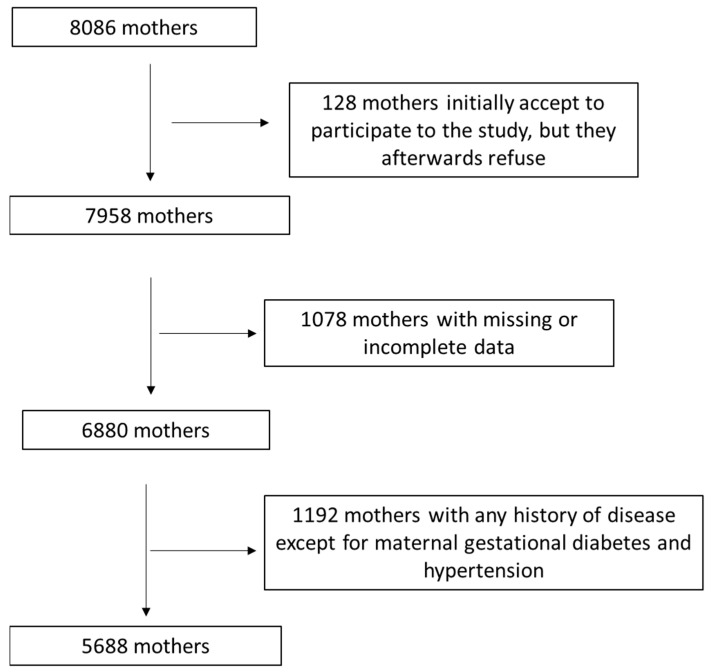
Background and Objectives: The Mediterranean diet (MD) has been recognized as a beneficial nutritional pattern that promotes human health, decreasing the risks of a variety of human disorders and pathological states, including adverse pregnancy outcomes. In this aspect, the current survey aimed to assess the potential association of compliance with the MD during gestation with various sociodemographic and anthropometric parameters, perinatal outcomes, and breastfeeding practices. Materials and Methods: This was a cross-sectional study performed on 5688 pregnant women from 10 distinctive Greek areas. Face-to-face interviews with qualified questionnaires and thorough retrievals of medical records were performed to collect data concerning the participants’ sociodemographic and anthropometric parameters, perinatal outcomes, and breastfeeding practices. Results: Elevated compliance with the MD during pregnancy was independently related with older age, higher educational status, and better economic status as well as decreased incidences of pre-pregnancy overweight/obesity and excess gestational weight gain and a lower likelihood of gestational diabetes. Moreover, greater adherence to the MD was independently associated with an increased prevalence of delivering vaginally and a greater prevalence of exclusive breastfeeding for at least 16 weeks postpartum. Conclusions: A higher level of compliance with the MD for the period of gestation was associated with several favorable lifestyle factors that may promote maternal health. Further studies with a prospective design as well as studies exploring the potential effects of maternal compliance with the MD for the period of pregnancy on the health of children should be performed. Future studies should also be extended beyond the MD by assessing the potential beneficial effects of adopting a Mediterranean lifestyle on maternal and child health.
Overview
The claims and statistics of this paper haven’t been checked yet.
Free: it reads the open-access text and checks the first 5 claims that cite a source we can check. Create a free account to check every claim.
Integrity signals
Registry
Cites
Statistics
Figures
Verification
Claims the paper makes
The claims and statistics of this paper haven’t been checked yet.
Free: it reads the open-access text and checks the first 5 claims that cite a source we can check. Create a free account to check every claim.
Claims other papers make about this one
Each is checked against this paper’s own text: does it say what the citing paper says it does?
The source backs part of the claim, not all of it — or backs it for a different population, condition or comparison.
In the citing paper
“Amongst the seven studies, five studies examined the risk of GDM [56,57,59,60,62], four studies examined the risk of preeclampsia [57,58,61,62], and three studies examined the risk of eGWG [56,61,62].”
From Impact of Mediterranean Diet Adherence During Pregnancy on Preeclampsia, Gestational Diabetes Mellitus, and Excessive Gestational Weight Gain: A Systematic Review of Observational Studies and Randomized Controlled Trials (2025) · cites this paper as [56]
Experimental — accuracy not yet measuredThe source backs part of the claim, not all of it — or backs it for a different population, condition or comparison.
In the citing paper
“one cross-sectional study (OR: 2.32; 95% CI 2.13 to 2.57 for a 1-point decrease in the dietary score) [56]”
From Impact of Mediterranean Diet Adherence During Pregnancy on Preeclampsia, Gestational Diabetes Mellitus, and Excessive Gestational Weight Gain: A Systematic Review of Observational Studies and Randomized Controlled Trials (2025) · cites this paper as [56]
Experimental — accuracy not yet measuredThe source backs part of the claim, not all of it — or backs it for a different population, condition or comparison.
In the citing paper
“one cross-sectional study (OR: 1.78; 95% CI 1.51 to 2.02 for a 1-point decrease in the MD score).”
From Impact of Mediterranean Diet Adherence During Pregnancy on Preeclampsia, Gestational Diabetes Mellitus, and Excessive Gestational Weight Gain: A Systematic Review of Observational Studies and Randomized Controlled Trials (2025) · cites this paper as [56]
Experimental — accuracy not yet measuredThe cited source says what the claim attributes to it.
In the citing paper
“Four [56,59,60,62] out of the five studies that examined the risk of GDM reported an inverse association between high MD adherence in pregnancy and low risk of GDM, but not in the US cohort study [57].”
Self-check
Percentages, sums and reported differences re-computed from the paper’s own numbers.
The self-check needs the paper’s full text.
Citations
Cites
(2004) · The Lancet · doi:10.1016/s0140-6736(03)15268-3 · Cited by 12,717
THE DIET AND 15-YEAR DEATH RATE IN THE SEVEN COUNTRIES STUDY
KEYS, A., MIENOTTI, A., KARVONEN, M. J., ARAVANIS, C., BLACKBURN, H., BUZINA, R., DJORDJEVIC, B. S., DONTAS, A. S., FIDANZA, F., KEYS, M. H., et al. (1986) · American Journal of Epidemiology · doi:10.1093/oxfordjournals.aje.a114480 · Cited by 1,790 · cited 1×
“The MD was primarily invented by Ancel Keys in 1960 [1]; it has been considered one of the most-investigated and broadly admired diets and has reasonably attracted the worldwide interest of the scientific community [2].”
BackgroundMaternal obesity and pregnancy outcome: a study of 287 213 pregnancies in London
Sebire, N., Jolly, M., Harris, J., Wadsworth, J., Joffe, M., Beard, R., Regan, L., & Robinson, S. (2001) · International Journal of Obesity · doi:10.1038/sj.ijo.0801670 · Cited by 1,743 · cited 1×
“Diet and the state of nourishment have been considered crucial factors for the health of both pregnant women and their fetuses during gestation [12].”
BackgroundPanagiotakos, D. B., Pitsavos, C., & Stefanadis, C. (2006) · Nutrition, Metabolism and Cardiovascular Diseases · doi:10.1016/j.numecd.2005.08.006 · Cited by 996 · cited 4×
“The sum of the eleven responses results in a score between 0 and 55; a greater score represents a higher level of adherence to the MD [44,45].”
BackgroundMethodInfluentialde Onis, M., & Habicht, J. (1996) · The American Journal of Clinical Nutrition · doi:10.1093/ajcn/64.4.650 · Cited by 961
The Mediterranean diet and health: a comprehensive overview
Guasch‐Ferré, M., & Willett, W. C. (2021) · Journal of Internal Medicine · doi:10.1111/joim.13333 · Cited by 940
Parikh, N. I., Gonzalez, J. M., Anderson, C. A. M., Judd, S. E., Rexrode, K. M., Hlatky, M. A., Gunderson, E. P., Stuart, J. J., Vaidya, D., & On behalf of the American Heart Association Council on Epidemiology and Prevention; Council on Arteriosclerosis, T. A. V. B. C. O. C. A. S. N. A. T. S. C. (2021) · Circulation · doi:10.1161/cir.0000000000000961 · Cited by 743
Cancer and Mediterranean Diet: A Review
Mentella, M. C., Scaldaferri, F., Ricci, C., Gasbarrini, A., & Miggiano, G. A. D. (2019) · Nutrients · doi:10.3390/nu11092059 · Cited by 478
Advanced Maternal Age: Adverse Outcomes of Pregnancy, A Meta-Analysis
Pinheiro, R. L., Areia, A. L., Mota Pinto, A., & Donato, H. (2019) · Acta Médica Portuguesa · doi:10.20344/amp.11057 · Cited by 335
Maternal dietary patterns and preterm delivery: results from large prospective cohort study
Englund-Ogge, L., Brantsaeter, A. L., Sengpiel, V., Haugen, M., Birgisdottir, B. E., Myhre, R., Meltzer, H. M., & Jacobsson, B. (2014) · BMJ · doi:10.1136/bmj.g1446 · Cited by 240
Cited by
Jacovides, C., Papadopoulou, S. Κ., Pavlidou, E., Dakanalis, A., Alexatou, O., Vorvolakos, T., Lechouritis, E., Papacosta, E., Chrysafi, M., Mitsiou, M., et al. (2024) · Journal of Clinical Medicine · doi:10.3390/jcm13072096 · Cited by 16
“This study supported evidence that a higher level of MD adherence during pregnancy was related to various beneficial lifestyle characteristics that could promote mothers’ health [86].”
ResultSelf-citationSharma, S., Esposito, S., Di Castelnuovo, A., Gialluisi, A., De Domenico, P., de Gaetano, G., Bonaccio, M., & Iacoviello, L. (2025) · Nutrients · doi:10.3390/nu17101723 · Cited by 9
“…from a larger FFQ and Mediterranean-style diet score (MSDS) score ( 4– 38 ), Amongst cross-sectional and case-control studies, the studies were conducted in Greece [56] and Iran [59], respectively, and comprised 463 to 5688 participants recruited from an online survey and hospital centers [56,59].”
InfluentialJacovides, C., Pritsa, A. A., Chrysafi, M., Papadopoulou, S. Κ., Kapetanou, M. G., Lechouritis, E., Martin, M., Papadopoulou, V. G., Tsourouflis, G. S., Migdanis, A., et al. (2024) · Pediatric Reports · doi:10.3390/pediatric16040102 · Cited by 8
Self-citationDeligiannidou, G.-E., Papadimitriou, K., Louka, A., Papadopoulou, S. Κ., Mentzelou, M., Grammatikopoulou, M. G., Psara, E., Kontogiorgis, C. A., Alexatou, O., & Giaginis, C. (2025) · Epidemiologia · doi:10.3390/epidemiologia6030032 · Cited by 7
“…by the mothers, and exclusive breastfeeding for ≥ 4 months was used as a defined reference point for dietary transitions (gradually introducing pulp foods to the feeding practices at the end of the 4th month and the beginning of the 5th month) to minimize potential recall bias [29,36].”
Self-citationMediterranean Diet Outcomes Across the Mother–Milk–Infant Triad: A Narrative Review
Bağlayici, R., Hamułka, J., & Zielinska-Pukos, M. A. (2025) · Nutrients · doi:10.3390/nu17111760 · Cited by 7
“In the study conducted by Antasouras et al., mothers with high adherence to the MED in the last trimester of pregnancy had a higher rate of exclusively breastfeeding their infants for at least four months [49].”
Dietary patterns during pregnancy in relation to maternal dietary intake: The Mutaba’ah Study
Almulla, A. A., Augustin, H., Ahmed, L. A., & Bärebring, L. (2024) · PLoS ONE · doi:10.1371/journal.pone.0312442 · Cited by 5
“There is a risk for recall bias when using self-reported questionnaires such as an FFQ. Self-reported Self-reported data have however been widely utilized in epidemiological studies, demonstrating strong consistency and validity in predicting various outcomes [62].”
Papadimitriou, K., Mentzelou, M., Papadopoulou, S. Κ., Antasouras, G., Deligiannidou, G.-E., Alexatou, O., Ntovoli, A., Psara, E., Papadopoulou, V. G., & Giaginis, C. (2025) · Life · doi:10.3390/life15060968 · Cited by 6
“On the other hand, mothers who breastfed for shorter intervals were not able to respond with sufficient confidence regarding the exact breastfeeding interval [28,29].”
Self-citationIbrahim, H. A., Alshahrani, M. S., & Elgzar, W. T. (2024) · Nutrients · doi:10.3390/nu16152561 · Cited by 3
“A study conducted in Greece on 5688 pregnant women by Antasouras et al. found that higher adherence to the MD was associated with higher economic status [33].”
BackgroundResultInfluentialTayyem, R., Yadak, A., Al-Kuran, O., & Allehdan, S. (2024) · Nutrition and Health · doi:10.1177/02601060241289759 · Cited by 2
“…the women coming with enhanced compliance to the Mediterranean diet, 41.5% of them delivered by SC, but this frequency was signi fi cantly raised among the women presenting with extremely low levels of adherence to the Mediterranean diet as 66.5% of them delivered via CS (Antasouras et al., 2023).”
InfluentialMentzelou, M., Louka, A., Vorvolakos, T., Kapetanou, M. G., Seradri, A., Antasouras, G., Kontogiorgis, C. A., Deligiannidou, G.-E., Chrysafi, M., & Giaginis, C. (2025) · Metabolites · doi:10.3390/metabo15060345 · Cited by 2
“…exclusive breastfeeding in the first months of their life as well as in those with low levels of physical activity during the initial stages of their life also had a substantial increased risk of developing overweight/obesity, as previously reported by our research group and others [46,53,83–85].”
Self-citationAlmulla, A. A., Augustin, H., Ahmed, L. A., & Bärebring, L. (2025) · Nutrition & Metabolism · doi:10.1186/s12986-025-00950-z · Cited by 2
“However, self-reported data has been widely used in epidemiological studies and shows strong consistency and validity in predicting various outcomes [66].”
Al-Naqbi, S. A., Asmar, R. E., AlQutub, R., Masaad, A. A., Dheir, N. A., Qiyas, S. A., & Papandreou, D. (2024) · doi:10.2174/9789815305333124010011 · Cited by 2
Self-citationÖzkan, H. D., & Güney, H. D. (2024) · International Journal of Gynecology & Obstetrics · doi:10.1002/ijgo.15992 · Cited by 1
Callegaro, S., DALL’ASTA, A., Kaihura, C. T., Scazzina, F., & Rosi, A. (2026) · European Journal of Nutrition · doi:10.1007/s00394-026-03958-0 · Cited by 1
Tajra, R. S., Batista, A. S. M., & de Souza, F. D. C. (2025) · Editora Omnis Scietia eBooks · doi:10.47094/978-65-284-0043-0/743-754
Gonzalez-Nahm, S., Griffith, E. H., Maguire, R. L., Jadallah, H. G., & Hoyo, C. (2026) · Childhood Obesity · doi:10.1177/21532176261420979
“A greater adherence to a Mediterranean-style diet pattern has been associated with a lower risk of gestational diabetes in pregnancy, 31 a lower risk of preterm birth, 17 and greater likelihood of breastfeeding postpartum, 32 which may be related to healthier weight status in childhood.”
Breastfeeding and dietary habits in childhood and adolescence: the PASOS study
García, S., Ródenas-Munar, M., Carmona-Rosado, L., Sevilla-Sánchez, M., Gusi, N., Gómez, S. F., González‐Gross, M., Wärnberǵ, J., Aznar, S., Pulgar, S., et al. (2026) · International Breastfeeding Journal · doi:10.1186/s13006-026-00851-8
Oncina-Cánovas, A., Gabucio, L. M. C., Collado, L. T., García-Novoa, A., Guxens, M., Júlvez, J., Murcia, M., Ballester, F., Arregi, A., Oleagoitia, M. B. Z., et al. (2026) · European Journal of Nutrition · doi:10.1007/s00394-026-04104-6
Metadata
- Authors
- Antasouras, G., Papadopoulou, S., Alexatou, O., Papandreou, D., Mentzelou, M., Migdanis, A., Psara, E., Migdanis, I., Chrysafi, M., Tyrovolas, S., Louka, A., & Giaginis, C.
- Affiliations
- University of the Aegean (GR)
- International Hellenic University (GR)
- University of Sharjah (AE)
- University of Thessaly (GR)
- Hong Kong Polytechnic University (HK)
- Corresponding author
- Papadopoulou, Sousana
- ORCID
- Venue
- Medicina
- Publisher
- MDPI AG
- Published
- 2023-08-25
- Volume
- 59
- Issue
- 9
- Pages
- 1547
- ISSN
- 1010-660X (ISSN-L)
- 1648-9144
- PMC
- PMC10536474
- OpenAlex
- W4386221004
- Cited by
- 17
- References
- 62
- Citations by year
- 2026: 4 · 2025: 6 · 2024: 7
- FWCI
- 4.35
- Type
- journal article
- Language
- en
- Open access
- gold
- doi.org
- Licence
- Locations
- Medicina (publishedVersion, cc-by)
- PubMed Central (publishedVersion, cc-by)
- PubMed (publishedVersion)
- PolyU Institutional Research Archive (Hong Kong Polytechnic University) (submittedVersion, cc-by)
- DOAJ (DOAJ: Directory of Open Access Journals) (submittedVersion, cc-by-sa)
- Topics
- Health Sciences › Medicine › Public Health, Environmental and Occupational Health › Nutritional Studies and Diet
- Health Sciences › Medicine › Pediatrics, Perinatology and Child Health › Maternal and Neonatal Healthcare
- Health Sciences › Medicine › Obstetrics and Gynecology › Gestational Diabetes Research and Management
- Keywords
- Mediterranean diet, dietary adherence, pregnancy, perinatal outcomes, gestational diabetes mellitus, gestational weight gain, pre-pregnancy obesity, vaginal delivery, exclusive breastfeeding, maternal anthropometry, sociodemographic factors, maternal health, child health
- MeSH terms
- Anthropometry, Breast Feeding, Child, Cross-Sectional Studies, Female, Humans, Pregnancy, Diet, Mediterranean, Postpartum Period
About these checks
Registry, retraction, Cites and statistics results are computed, not judged, with one exception: a printed reference that no index lists is read once by a model before it counts as a citation error. Claims are extracted by a model and kept only when their quote appears verbatim in the text; each cited source is then checked, with a model’s help, for whether it says what the claim relies on. Those verdicts can be wrong — read the claim’s quote and the cited source before relying on one.
Statistics and arithmetic are recomputed, not judged.
Confidence bands are shown only for fields calibrated on our annotated test set. None is calibrated yet, so no band is shown.
What counts as a claim ›How we measure confidence ›How we check this ›
Are you an author, or do you see a problem with this page? Request a review
Data sources
Bibliographic data: Semantic Scholar, OpenAlex, Crossref.
Contains information from the Semantic Scholar Academic Graph Datasets, made available under the ODC Attribution License (ODC-BY 1.0).
Semantic Scholar’s data is described in: Kinney, R., et al. (2023). The Semantic Scholar Open Data Platform. arXiv:2301.10140.
