

The DOI matches its Crossref record; 37 of the 39 references it cites were found in a registry or an index, and 2 are not checked yet.
Coping Strategies Among Healthcare Workers During the COVID-19 Pandemic: Emotional Responses, Challenges, and Adaptive Practices
Open accessAbstract
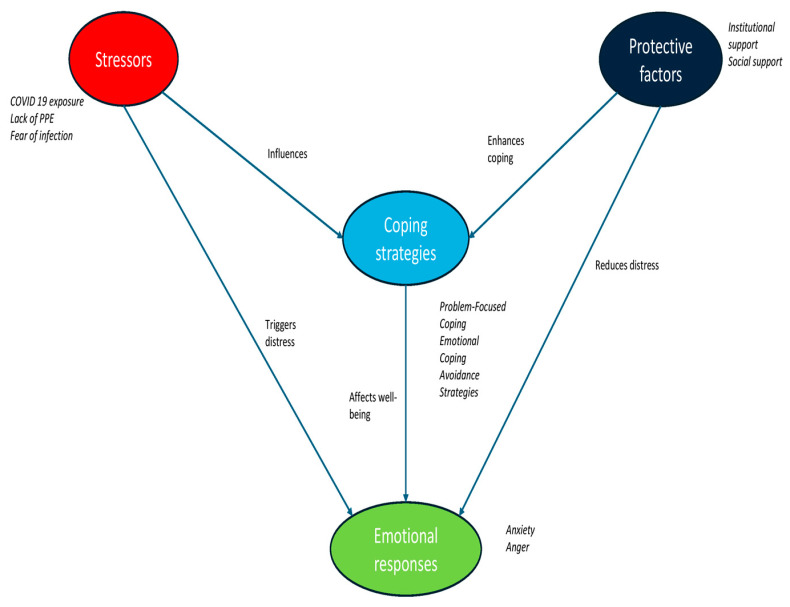
Background and Objectives: The COVID-19 pandemic has posed unprecedented challenges to healthcare workers, leading to significant psychological distress, altered health-related behaviors, and reliance on various coping mechanisms. Understanding these impacts is critical for developing targeted interventions to support healthcare professionals. This study aimed to evaluate the psychological stressors, emotional responses, changes in healthy behaviors, and coping mechanisms employed by healthcare workers during the COVID-19 pandemic. The study further examined differences across demographic and professional groups and explored correlations between stressors, coping strategies, and emotional outcomes. Materials and Methods: A cross-sectional survey was conducted among 338 healthcare workers, including physicians and nurses, in urban and rural healthcare settings during the pandemic. Data were collected using validated instruments to measure emotional responses (anxiety and anger), lifestyle behaviors (dietary habits, sleep patterns, physical activity, and smoking), and coping strategies. Statistical analyses included descriptive, inferential, and correlation techniques to assess relationships between variables. Results: Fear of infecting family members (M = 3.36, SD = 0.86) and concerns about inadequate protective equipment (M = 2.80, SD = 0.95) were the most significant stressors, strongly associated with heightened anxiety and anger. Changes in healthy behaviors were observed: 69.2% maintained a healthy meal schedule, 56.5% reported disrupted sleep patterns, and only 39.6% engaged in regular physical activity. Among smokers (27.5%), 31.1% increased smoking as a maladaptive coping strategy, while 21.1% reduced smoking. Nurses predominantly relied on emotion-focused strategies, such as religious coping and venting, whereas physicians favored problem-focused strategies like planning and active coping. Social support emerged as a protective factor, mitigating stress and facilitating adaptive coping. Conclusions: The study revealed significant psychological and behavioral impacts on healthcare workers during the COVID-19 pandemic. Key stressors included the fear of infecting family members, concerns about inadequate protective measures, and the prolonged uncertainty of the pandemic, which contributed to heightened levels of anxiety and anger. Changes in healthy behaviors, such as disrupted sleep patterns, decreased physical activity, and increased reliance on maladaptive coping mechanisms, further underscored the multifaceted challenges faced by healthcare professionals. Although the acute phase of the pandemic has passed, the long-term consequences on the mental health and well-being of healthcare workers remain critical concerns. Further research is essential to develop effective strategies for monitoring, preventing, and addressing psychological distress among healthcare professionals, ensuring their preparedness for future public health crises.
Overview
The claims and statistics of this paper haven’t been checked yet.
Run the check — free, no account needed. It reads the open-access text and checks the sources it cites.
Integrity signals
Registry
Cites
Statistics
Figures
Verification
Claims the paper makes
The claims and statistics of this paper haven’t been checked yet.
Run the check — free, no account needed. It reads the open-access text and checks the sources it cites.
Claims other papers make about this one
Each is checked against this paper’s own text: does it say what the citing paper says it does?
The source backs part of the claim, not all of it — or backs it for a different population, condition or comparison.
In the citing paper
“Similarly, findings from Romania and Ireland reinforced that maladaptive management strategies such as denial, venting, self-distraction, disengagement, and substance use were associated with poorer mental health outcomes (42, 43).”
From Management strategies for healthcare worker burnout in Sub-Saharan Africa: an integrative review (2026) · cites this paper as [42]
Experimental — accuracy not yet measured
Self-check
Percentages, sums and reported differences re-computed from the paper’s own numbers.
The self-check needs the paper’s full text.
Citations
Cites
You want to measure coping but your protocol’ too long: Consider the brief cope
Carver, C. S. (1997) · International Journal of Behavioral Medicine · doi:10.1207/s15327558ijbm0401_6 · Cited by 7,361
Eating habits and lifestyle changes during COVID-19 lockdown: an Italian survey.
Di Renzo, L., Gualtieri, P., Pivari, F., Soldati, L., Attinà, A., Cinelli, G., Leggeri, C., Caparello, G., Barrea, L., Scerbo, F., et al. (2020) · Journal of Translational Medicine · doi:10.1186/s12967-020-02399-5 · Cited by 2,234
Psychological impact of the COVID-19 pandemic on health care workers in Singapore
Tan, B. Y. Q., Chew, N. W. S., Lee, G. K. H., Jing, M., Goh, Y., Yeo, L. L. L., Zhang, K., Chin, H.-K., Ahmad, A., Khan, F. A., et al. (2020) · Annals of Internal Medicine · doi:10.7326/m20-1083 · Cited by 1,279
Huang, L. J., Lei, W., Xu, F., Liu, H., & Yu, L. (2020) · PLoS ONE · doi:10.1371/journal.pone.0237303 · Cited by 900
Preti, E., Mattei, V. E. D., Perego, G., Ferrari, F., Mazzetti, M., Taranto, P., Pierro, R. D., Madeddu, F., & Calati, R. (2020) · Current Psychiatry Reports · doi:10.1007/s11920-020-01166-z · Cited by 788
State-Trait Anger Expression Inventory
Spielberger, C. D. (1988) · PsycTESTS Dataset · doi:10.1037/t29496-000 · Cited by 535
Billings, J., Ching, B. C. F., Gkofa, V., Greene, T., & Bloomfield, M. (2021) · BMC Health Services Research · doi:10.1186/s12913-021-06917-z · Cited by 524
Kulkarni, A. P., Khasne, R. W., Dhakulkar, B. S., & Mahajan, H. C. (2020) · Indian Journal of Critical Care Medicine · doi:10.5005/jp-journals-10071-23518 · Cited by 325
Zheng, C., Huang, Y., Sheridan, S. E., Sit, C. H. P., Chen, X., & Wong, S. H. (2020) · International Journal of Environmental Research and Public Health · doi:10.3390/ijerph17176035 · Cited by 321
Healthcare worker resilience during the COVID‐19 pandemic: An integrative review
Baskin, R., & BARTLETT, R. L. (2021) · Journal of Nursing Management · doi:10.1111/jonm.13395 · Cited by 306
d’Ettorre, G., Ceccarelli, G., Santinelli, L., Vassalini, P., Innocenti, G. P., Alessandri, F., Koukopoulos, A. E., Russo, A., d’Ettorre, G., & Tarsitani, L. (2021) · International Journal of Environmental Research and Public Health · doi:10.3390/ijerph18020601 · Cited by 270
Busch, I. M., Moretti, F., Mazzi, M., Wu, A. W., & Rimondini, M. (2021) · Psychotherapy and Psychosomatics · doi:10.1159/000513733 · Cited by 204
Covid-19 effects on the workload of Iranian healthcare workers
Shoja, E., Aghamohammadi, V., Bazyar, H., Moghaddam, H. R., Nasiri, K., Dashti, M., Choupani, A., Garaee, M., Aliasgharzadeh, S., & Asgari, A. (2020) · BMC Public Health · doi:10.1186/s12889-020-09743-w · Cited by 150
Tahara, M., Mashizume, Y., & Takahashi, K. (2020) · International Journal of Environmental Research and Public Health · doi:10.3390/ijerph18010131 · Cited by 141
Wozniak, H., Benzakour, L., Moullec, G., Buetti, N., Nguyen, A. Q. H., Corbaz-Kurth, S., Roos, P., Vieux, L., Suard, J.-C., Weissbrodt, R., et al. (2021) · Annals of Intensive Care · doi:10.1186/s13613-021-00900-x · Cited by 86
Tabur, A., Elkefi, S., Emhan, A., Mengenci, C., Bez, Y., & Asan, O. (2022) · Healthcare · doi:10.3390/healthcare10030525 · Cited by 79
Huang, J., Huang, Z.-T., Sun, X.-C., Chen, T., & Wu, X.-T. (2024) · PLoS ONE · doi:10.1371/journal.pone.0289454 · Cited by 71
Perceived stress and anxiety among medical students at Helwan University: A cross-sectional study
Ebrahim, O. S., Sayed, H. A. E., Rabei, S., & Hegazy, N. (2024) · Journal of Public Health Research · doi:10.1177/22799036241227891 · Cited by 67
Sims, M. D., Maine, G. N., Childers, K. L., Podolsky, R. H., Voss, D. R., Berkiw-Scenna, N., Oh, J., Heinrich, K., Keil, H., Kennedy, R. H., et al. (2020) · Clinical Infectious Diseases · doi:10.1093/cid/ciaa1684 · Cited by 67
Collantoni, E., Saieva, A. M., Meregalli, V., Girotto, C., Carretta, G., Boemo, D. G., Bordignon, G., Capizzi, A., Contessa, C., Nesoti, M. V., et al. (2021) · Journal of Clinical Medicine · doi:10.3390/jcm10071465 · Cited by 63
COVID-19 pandemic brings a sedentary lifestyle: a cross-sectional and longitudinal studyPreprint
Zheng, C., Huang, Y., Sheridan, S. E., et al. (2020) · medRxiv · doi:10.1101/2020.05.22.20110825 · Cited by 62
Simón, E. J. L., Puerta, J. G., Malagón, M. C. G., & Gijón, M. K. (2024) · Education Sciences · doi:10.3390/educsci14121367 · Cited by 57
Trottier, K., Monson, C. M., Kaysen, D. L., Wagner, A. C., Liebman, R. E., & Abbey, S. E. (2022) · Translational Psychiatry · doi:10.1038/s41398-022-01965-3 · Cited by 32
Gambaro, E., Gramaglia, C. M., Marangon, D., Probo, M., Rudoni, M., & Zeppegno, P. (2023) · International Journal of Environmental Research and Public Health · doi:10.3390/ijerph20126087 · Cited by 32
Shi, H., & Goulias, K. G. (2023) · Journal of Transport & Health · doi:10.1016/j.jth.2023.101730 · Cited by 28
Zhao, Y., Ding, Y., Chekired, H., & Wu, Y. (2022) · PLoS ONE · doi:10.1371/journal.pone.0279711 · Cited by 25
Müller, M., Baillés, E., Blanch, J., Torres, X., Rousaud, A., Cañizares, S., Teruel, M. C., Conti, C. M., Dunne, P. J., Stănculete, M. F., et al. (2022) · Journal of Psychosomatic Research · doi:10.1016/j.jpsychores.2022.111102 · Cited by 24
Hwang, S., & Lee, J. (2023) · Frontiers in Psychology · doi:10.3389/fpsyg.2023.1168243 · Cited by 23
Physician Posttraumatic Stress Disorder During COVID-19
Kamra, M., Dhaliwal, S., Li, W., Acharya, S., Wong, A., Zhu, A., Vemulakonda, J., Wilson, J., Gibb, M. A., Maskerine, C., et al. (2024) · JAMA Network Open · doi:10.1001/jamanetworkopen.2024.23316 · Cited by 17
Kunno, J., Yubonpunt, P., Supawattanabodee, B., Sumanasrethakul, C., & Wiriyasirivaj, B. (2022) · BMC Pregnancy and Childbirth · doi:10.1186/s12884-022-04612-3 · Cited by 14
Jin, L., Zhang, N., & Zhu, J. (2022) · Current Psychology · doi:10.1007/s12144-022-03562-5 · Cited by 14
Colón‐López, A., Meese, K. A., Montgomery, A. P., Patrician, P. A., Rogers, D. A., & Burkholder, G. (2022) · Journal of Hospital Management and Health Policy · doi:10.21037/jhmhp-21-69 · Cited by 10
Coping Strategies and Dysfunctional Cognitions as Predictors of Irritable Bowel Syndrome Diagnosis
Stănculete, M. F., Dumitrascu, D. L., Pojoga, C., & Nedelcu, L. D. (2015) · Journal of Evidence-Based Psychotherapies · Cited by 8
Olivencia-Carrión, M. A., Olivencia-Carrión, M. D., Fernández-Daza, M. P., Cogollo, S. J. Z., Castro, G. P., & Jiménez-Torres, M. G. (2023) · Healthcare · doi:10.3390/healthcare11060844 · Cited by 4
Baldovino, J. R. (2024) · Journal of interdisciplinary perspectives · doi:10.69569/jip.2024.0056 · Cited by 2
ISLAMIC RELIGIOUS COPING STRATEGY FOR HEALTHCARE WORKER IN COVID-19 PANDEMIC: A LITERATURE REVIEW
Nopa, I., & Siregar, P. P. (2021) · International Journal of Islamic and Complementary Medicine · doi:10.55116/ijim.v1i1.23 · Cited by 1
Challenges of Women Healthcare Providers during Covid-19 Pandemic in Aizawl City, Mizoram, India
Lalrinzuala, & Elizabeth, H. (2021) · International Journal of Science and Healthcare Research · doi:10.52403/ijshr.20210738 · Cited by 1
Rotaru, T., Cojocaru, D., Cojocaru, Ş., Alexinschi, O., Puia, A., & Oprea, L. (2024) · Healthcare · doi:10.3390/healthcare12020161 · Cited by 1
Self-citation
Research works printed but not linked: 1
- Spielberger, C.D., Gorsuch, R.L., Lushene, R.E., Vagg, P.R., and Jacobs, G.A. (1983). State-Trait Anxiety Inventory (STAI), Consulting Psychologists Press.
Cited by
Sorted by citations
Staying afloat in the storm: coping with work-related stress in healthcare professions
Riemma, F., Buonocore, F., & de Gennaro, D. (2025) · Personnel Review · doi:10.1108/pr-04-2025-0387 · Cited by 21
Short- and long-term psychiatric complications of COVID-19
Ahmed, G. K., Ramadan, H. K., & Khedr, E. M. (2025) · The Egyptian Journal of Neurology Psychiatry and Neurosurgery · doi:10.1186/s41983-025-00972-7 · Cited by 5
Petrușan, A. M., Feier, C. V. I., Muntean, C., Gaborean, V., Petrusan, A. S., Morariu, D. Ș., Faur, I. F., Faur, A. M., & Achimaș-Cădariu, P. (2026) · Diseases · doi:10.3390/diseases14040131 · Cited by 3
Alkabaa, A. S., Taylan, O., Alqabbaa, H. S., & Güloğlu, B. (2025) · Healthcare · doi:10.3390/healthcare13141745 · Cited by 2
Zakaria, N. H., Zakaria, N., & Lee, K. Y. (2025) · Scientific Reports · doi:10.1038/s41598-025-14036-6 · Cited by 2
Metadata
- Authors
- Puia, A., Pop, S. R., Manzat, B. O. C., Pintea, S., Puia, I. C., & Fadgyas-Stanculete, M.
- Affiliations
- Iuliu Hațieganu University of Medicine and Pharmacy (RO)
- Department of Community Medicine, “Iuliu Hațieganu” University of Medicine and Pharmacy, 400347 Cluj-Napoca, Romania
- Babeș-Bolyai University (RO)
- Department of Neurosciences, Discipline of Psychiatry and Pediatric Psychiatry, “Iuliu Hatieganu” University of Medicine and Pharmacy, 400012 Cluj-Napoca, Romania
- Corresponding author
- Pop, Sorina Rodica
- Venue
- Medicina
- Publisher
- MDPI AG
- Published
- 2025-02-11
- Volume
- 61
- Issue
- 2
- Pages
- 311
- ISSN
- 1010-660X (ISSN-L)
- 1648-9144
- PMC
- PMC11857654
- OpenAlex
- W4407354325
- Cited by
- 16
- References
- 37
- Citations by year
- 2026: 10 · 2025: 6
- FWCI
- 18.91
- Type
- journal article
- Language
- en
- Open access
- gold
- doi.org
- Licence
- Locations
- Medicina (publishedVersion, cc-by)
- PubMed Central (publishedVersion, cc-by)
- PubMed (publishedVersion)
- DOAJ (DOAJ: Directory of Open Access Journals) (submittedVersion)
- Topics
- Social Sciences › Psychology › Clinical Psychology › COVID-19 and Mental Health
- Health Sciences › Health Professions › General Health Professions › Healthcare professionals’ stress and burnout
- Health Sciences › Medicine › Public Health, Environmental and Occupational Health › Occupational Health and Burnout
- Keywords
- COVID-19 pandemic, healthcare workers, coping strategies, psychological stress, anxiety, anger, healthy lifestyle behaviors, sleep disruption, physical activity, smoking, social support, emotion-focused coping, problem-focused coping, nurses, physicians, workplace mental health, religious coping, venting, demographic differences, occupational differences
- MeSH terms
- COVID-19, SARS-CoV-2, Coping Skills, Adaptation, Psychological, Adult, Anger, Anxiety, Cross-Sectional Studies, Emotions, Female, Health Personnel, Humans, Male, Middle Aged, Surveys and Questionnaires, Stress, Psychological, Health Behavior, Pandemics
About these checks
Registry, retraction, Cites and statistics results are computed, not judged, with one exception: a printed reference that no index lists is read once by a model before it counts as a citation error. Claims are extracted by a model and kept only when their quote appears verbatim in the text; each cited source is then checked, with a model’s help, for whether it says what the claim relies on. Those verdicts can be wrong — read the claim’s quote and the cited source before relying on one.
Statistics and arithmetic are recomputed, not judged.
Confidence bands are shown only for fields calibrated on our annotated test set. None is calibrated yet, so no band is shown.
What counts as a claim ›How we measure confidence ›How we check this ›
Are you an author, or do you see a problem with this page? Request a review
