

The DOI matches its Crossref record; 46 of the 46 references it cites were found in a registry or an index.
Magnesium: The Forgotten Electrolyte—A Review on Hypomagnesemia
Open accessAbstract
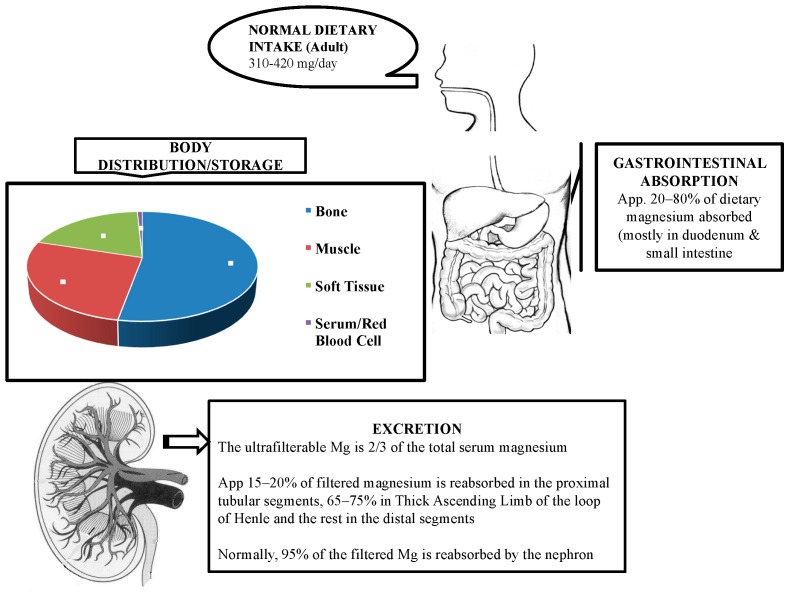
Magnesium is the fourth most abundant cation in the body and the second most abundant intracellular cation. It plays an important role in different organ systems at the cellular and enzymatic levels. Despite its importance, it still has not received the needed attention either in the medical literature or in clinical practice in comparison to other electrolytes like sodium, potassium, and calcium. Hypomagnesemia can lead to many clinical manifestations with some being life-threatening. The reported incidence is less likely than expected in the general population. We present a comprehensive review of different aspects of magnesium physiology and hypomagnesemia which can help clinicians in understanding, identifying, and treating this disorder.
Overview
The claims and statistics of this paper haven’t been checked yet.
Run the check — free, no account needed. It reads the open-access text and checks the sources it cites.
Integrity signals
Registry
Cites
Statistics
Figures
Verification
Claims the paper makes
The claims and statistics of this paper haven’t been checked yet.
Run the check — free, no account needed. It reads the open-access text and checks the sources it cites.
Claims other papers make about this one
Each is checked against this paper’s own text: does it say what the citing paper says it does?
The cited source says what the claim attributes to it.
In the citing paper
“Magnesium deficiency may contribute to hypokalemia by enhancing renal potassium loss via disinhibition of renal outer medullary potassium channel (ROMK) in the distal nephron [41].”
From Thyrotoxic Hypokalemic Periodic Paralysis: Pathophysiological Mechanisms (2025) · cites this paper as [41]
Self-check
Percentages, sums and reported differences re-computed from the paper’s own numbers.
The self-check needs the paper’s full text.
Citations
Cites
A Clinical Trial of the Effects of Dietary Patterns on Blood Pressure
Appel, L. J., Moore, T. J., Obarzanek, E., Vollmer, W. M., Svetkey, L. P., Sacks, F. M., Bray, G. A., Vogt, T. M., Cutler, J. A., Windhauser, M. M., et al. (1997) · New England Journal of Medicine · doi:10.1056/nejm199704173361601 · Cited by 5,981
By the American Geriatrics Society 2015 Beers Criteria Update Expert Panel (2015) · Journal of the American Geriatrics Society · doi:10.1111/jgs.13702 · Cited by 2,609
Magnesium in man: implications for health and disease
de Baaij, J. H. F., Hoenderop, J. G. J., & Bindels, R. J. M. (2015) · Physiological Reviews · doi:10.1152/physrev.00012.2014 · Cited by 1,726
Altman, D. G., Carroli, G., Duley, L., Farrell, B., Moodley, J., Neilson, J., & Smith, D. (2002) · The Lancet · doi:10.1016/s0140-6736(02)08778-0 · Cited by 1,488
USDA National Nutrient Database for Standard Reference, Release 22
(2018) · Cited by 1,284
Jahnen-Dechent, W., & Ketteler, M. (2012) · Clinical Kidney Journal · doi:10.1093/ndtplus/sfr163 · Cited by 1,054
Schlingmann, K. P., Weber, S., Peters, M. M. C. G., Nejsum, L. N., Vitzthum, H., Klingel, K., Kratz, M., Haddad, É., Ristoff, E., Dinour, D., et al. (2002) · Nature Genetics · doi:10.1038/ng889 · Cited by 785
Magnesium: physiology and pharmacology
Fawcett, W. J., Haxby, E. J., & Male, D. A. (1999) · British Journal of Anaesthesia · doi:10.1093/bja/83.2.302 · Cited by 716
Magnesium and Osteoporosis: Current State of Knowledge and Future Research Directions
Castiglioni, S., Cazzaniga, A., Albisetti, W., & Maier, J. A. M. (2013) · Nutrients · doi:10.3390/nu5083022 · Cited by 544
The importance of the refeeding syndrome
Crook, M. A., Hally, V., & Panteli, J. V. (2001) · Nutrition · doi:10.1016/s0899-9007(01)00542-1 · Cited by 488
Research works printed but not linked: 2
- Institute of Medicine (IOM) (1997). Food and Nutrition Board. Dietary Reference Intakes: Calcium, Phosphorus, Magnesium, Vitamin D and Fluoride, National Academy Press.
- McCarthy, 1999, Divalent cation metabolism: Magnesium, The Schrier Atlas of Diseases of the Kidney, Volume 1, 1
Cited by
Sorted by citations
Ashique, S., Kumar, S., Hussain, A., Mishra, N., Garg, A. K., Gowda, B. H. J., Farid, A., Gupta, G., Dua, K., & Taghizadeh‐Hesary, F. (2023) · Journal of Health Population and Nutrition · doi:10.1186/s41043-023-00423-0 · Cited by 167
“Conversely, a small fraction of Mg2+, less than 1–2%, is present in the bloodstream and extracellular fluids [1].”
Background‘Magnesium’-the master cation-as a drug—possibilities and evidences
Mathew, A. A., & Panonnummal, R. (2021) · BioMetals · doi:10.1007/s10534-021-00328-7 · Cited by 131
“The process is regulated by small transmembrane proteins referred as ‘Claudins’ (Schuchardt and Hahn 2017; Ahmed and Mohammed 2019; Gröber et al. 2015).”
BackgroundInfluentialRecommendation on an updated standardization of serum magnesium reference ranges
Rosanoff, A., West, C., Elin, R. J., Micke, O., Baniasadi, S., Barbagallo, M., Campbell, E., Cheng, F., Costello, R. B., Gamboa‐Gómez, C. I., et al. (2022) · European Journal of Nutrition · doi:10.1007/s00394-022-02916-w · Cited by 97
“These clinical manifestations include metabolic issues (hypokalemia and hypocalcemia), neuromuscular-central nervous system symptoms (hyperexcitability, muscle weakness, tremors, seizures, tetany, headaches, and fatigue), cardiovascular abnormalities (tachycardia, arrhythmias such as torsade de pointes, ventricular fi…”
BackgroundHypermagnesemia in Clinical Practice
AalHamad, A. H., Alawi, A. M. A., Kashoub, M. S., & Falhammar, H. (2023) · Medicina · doi:10.3390/medicina59071190 · Cited by 89
Ponzo, V., Pellegrini, M., Cioffi, I., Scaglione, L., & Bo, S. (2020) · Internal and Emergency Medicine · doi:10.1007/s11739-020-02525-7 · Cited by 78
Metadata
- Authors
- Ahmed, F., & Mohammed, A.
- Affiliations
- OSF Saint Anthony Medical Center (US)
- Advocate Illinois Masonic Medical Center (US)
- Corresponding author
- Ahmed, Faheemuddin
- ORCID
- Mohammed, Abdul
- Venue
- Medical Sciences
- Publisher
- MDPI AG
- Published
- 2019-04-04
- Volume
- 7
- Issue
- 4
- Pages
- 56
- ISSN
- 2076-3271 (ISSN-L)
- PMC
- PMC6524065
- OpenAlex
- W2926579042
- Cited by
- 186
- References
- 46
- Citations by year
- 2026: 14 · 2025: 28 · 2024: 31 · 2023: 32 · 2022: 28 · 2021: 29 · 2020: 24
- FWCI
- 2.75
- Type
- journal article
- Language
- en
- Open access
- gold
- dx.doi.org
- Licence
- Locations
- Medical Sciences (publishedVersion, cc-by)
- PubMed Central (publishedVersion, cc-by)
- PubMed (publishedVersion)
- DOAJ (DOAJ: Directory of Open Access Journals) (submittedVersion, cc-by-sa)
- Topics
- Health Sciences › Nursing › Nutrition and Dietetics › Magnesium in Health and Disease
- Physical Sciences › Materials Science › Biomaterials › Magnesium Alloys: Properties and Applications
- Physical Sciences › Materials Science › Materials Chemistry › Magnesium Oxide Properties and Applications
- Keywords
- magnesium, hypomagnesemia, magnesium physiology, electrolytes, intracellular cations, clinical features, incidence, treatment
About these checks
Registry, retraction, Cites and statistics results are computed, not judged, with one exception: a printed reference that no index lists is read once by a model before it counts as a citation error. Claims are extracted by a model and kept only when their quote appears verbatim in the text; each cited source is then checked, with a model’s help, for whether it says what the claim relies on. Those verdicts can be wrong — read the claim’s quote and the cited source before relying on one.
Statistics and arithmetic are recomputed, not judged.
Confidence bands are shown only for fields calibrated on our annotated test set. None is calibrated yet, so no band is shown.
What counts as a claim ›How we measure confidence ›How we check this ›
Are you an author, or do you see a problem with this page? Request a review
