

Electrodialysis Applications in Wastewater Treatment for Environmental Protection and Resources Recovery: A Systematic Review on Progress and Perspectives
Open accessThe DOI matches its Crossref record; 574 of the 574 references it cites were found in a registry or an index.
Abstract
This paper presents a comprehensive review of studies on electrodialysis (ED) applications in wastewater treatment, outlining the current status and the future prospect. ED is a membrane process of separation under the action of an electric field, where ions are selectively transported across ion-exchange membranes. ED of both conventional or unconventional fashion has been tested to treat several waste or spent aqueous solutions, including effluents from various industrial processes, municipal wastewater or salt water treatment plants, and animal farms. Properties such as selectivity, high separation efficiency, and chemical-free treatment make ED methods adequate for desalination and other treatments with significant environmental benefits. ED technologies can be used in operations of concentration, dilution, desalination, regeneration, and valorisation to reclaim wastewater and recover water and/or other products, e.g., heavy metal ions, salts, acids/bases, nutrients, and organics, or electrical energy. Intense research activity has been directed towards developing enhanced or novel systems, showing that zero or minimal liquid discharge approaches can be techno-economically affordable and competitive. Despite few real plants having been installed, recent developments are opening new routes for the large-scale use of ED techniques in a plethora of treatment processes for wastewater.
Overview
The claims and statistics of this paper haven’t been checked yet.
Free: it reads the open-access text and checks the first 5 claims that cite a source we can check. Create a free account to check every claim.
Integrity signals
Registry
Cites
Statistics
Figures
Verification
Claims the paper makes
The claims and statistics of this paper haven’t been checked yet.
Free: it reads the open-access text and checks the first 5 claims that cite a source we can check. Create a free account to check every claim.
Self-check
Percentages, sums and reported differences re-computed from the paper’s own numbers.
The self-check needs the paper’s full text.
Citations
Cites
Conceptualizing the circular economy: An analysis of 114 definitions
Kirchherr, J., Reike, D., & Hekkert, M. (2017) · Resources, Conservation and Recycling · doi:10.1016/j.resconrec.2017.09.005 · Cited by 8,550
New trends in removing heavy metals from industrial wastewater
Barakat, M. A. (2011) · Arabian Journal of Chemistry · doi:10.1016/j.arabjc.2010.07.019 · Cited by 3,094
Review of technologies for oil and gas produced water treatment
Fakhru’l-Razi, A., Pendashteh, A., Abdullah, L. C., Biak, D. R. A., Madaeni, S. S., & Abidin, Z. Z. (2009) · Journal of Hazardous Materials · doi:10.1016/j.jhazmat.2009.05.044 · Cited by 2,250
The state of desalination and brine production: A global outlook
Jones, E., Qadir, M., van Vliet, M. T. H., Smakhtin, V., & Kang, S.-M. (2019) · Science of The Total Environment · doi:10.1016/j.scitotenv.2018.12.076 · Cited by 1,971
Logan, B. E., & Rabaey, K. (2012) · Science · doi:10.1126/science.1217412 · Cited by 1,877
Electrodialysis, a mature technology with a multitude of new applications
Strathmann, H. (2010) · Desalination · doi:10.1016/j.desal.2010.04.069 · Cited by 1,545
Membrane Technologies in Wastewater Treatment: A Review
Obotey Ezugbe, E., & Rathilal, S. (2020) · Membranes · doi:10.3390/membranes10050089 · Cited by 1,434
Ion exchange membranes: State of their development and perspective
Xu, T. (2005) · Journal of Membrane Science · doi:10.1016/j.memsci.2005.05.002 · Cited by 1,364
Rose, C., Parker, A., Jefferson, B., & Cartmell, E. (2015) · Critical Reviews in Environmental Science and Technology · doi:10.1080/10643389.2014.1000761 · Cited by 1,233
Oren, Y. (2008) · Desalination · doi:10.1016/j.desal.2007.08.005 · Cited by 1,180
Research works printed but not linked: 7
- Strathmann, H. (2004). Ion.-Exchange Membrane Separation Processes, Elsevier. [1st ed.].
- Tanaka, Y. (2007). Ion. Exchange Membranes: Fundamentals and Applications, Elsevier.
- Basile, A., Curcio, E., and Inamuddin, I. (2019). The REAPower Project: Power Production From Saline Waters and Concentrated Brines. Current Trends and Future Developments on (Bio-) Membranes-Membrane Desalination Systems: The Next Generation, Elsevier.
- Helfferich, F. (1962). Ion. Exchange, McGraw-Hill.
- Kharkats, 1985, Mechanism of “supralimiting” currents at ion-exchange mebrane/electrolyte interfaces, Sov. Electrochem., 21, 917
- Basile, A., Curcio, E., and Inamuddin, I. (2019). Membrane Desalination in Shale Gas Industry: Applications and Perspectives. Current Trends and Future Developments on (Bio-) Membranes, Elsevier.
- Baker, R.W. (2012). Membrane Technology and Applications, John Wiley & Sons, Ltd.
Cited by
Electrochemical Methods for Water Purification, Ion Separations, and Energy Conversion
Alkhadra, M. A., Su, X., Suss, M. E., Tian, H., Guyes, E. N., Shocron, A. N., Conforti, K. M., de Souza, J. P., Kim, N., Tedesco, M., et al. (2022) · Chemical Reviews · doi:10.1021/acs.chemrev.1c00396 · Cited by 661
Khan, F. S. A., Mubarak, N. M., Tan, Y. H., Khalid, M., Karri, R. R., Walvekar, R., Abdullah, E. C., Nizamuddin, S., & Mazari, S. A. (2021) · Journal of Hazardous Materials · doi:10.1016/j.jhazmat.2021.125375 · Cited by 371
Challenges and Solutions for Global Water Scarcity
Shemer, H., Wald, S., & Semiat, R. (2023) · Membranes · doi:10.3390/membranes13060612 · Cited by 360
Comprehensive review of industrial wastewater treatment techniques
Kato, S., & Kansha, Y. (2024) · Environmental Science and Pollution Research · doi:10.1007/s11356-024-34584-0 · Cited by 345
Electrodialysis for metal removal and recovery: A review
Arana Juve, J.-M., Christensen, F. M. S., Wang, Y., & Wei, Z. (2022) · Chemical Engineering Journal · doi:10.1016/j.cej.2022.134857 · Cited by 338
Ion-capture electrodialysis using multifunctional adsorptive membranes
Uliana, A. A., Bui, N. T., Kamcev, J., Taylor, M. K., Urban, J. J., & Long, J. R. (2021) · Science · doi:10.1126/science.abf5991 · Cited by 320
A comprehensive review on the synthesis and applications of ion exchange membranes
Jiang, S., Sun, H., Wang, H., Ladewig, B. P., & Yao, Z. (2021) · Chemosphere · doi:10.1016/j.chemosphere.2021.130817 · Cited by 232
Patel, S. K., Biesheuvel, P. M., & Elimelech, M. (2021) · ACS ES&T Engineering · doi:10.1021/acsestengg.0c00192 · Cited by 217
The Twelve Principles of Circular Hydrometallurgy
Binnemans, K., & Jones, P. T. (2023) · Journal of Sustainable Metallurgy · doi:10.1007/s40831-022-00636-3 · Cited by 197
Kumar, V., & Dwivedi, S. K. (2021) · Journal of Cleaner Production · doi:10.1016/j.jclepro.2021.126229 · Cited by 192
Sedighi, M., Behvand Usefi, M. M., Ismail, A. F., & Ghasemi, M. (2023) · Desalination · doi:10.1016/j.desal.2022.116319 · Cited by 179
Recent advances in hydrochar application for the adsorptive removal of wastewater pollutants
Ighalo, J. O., Rangabhashiyam, S., Dulta, K., Umeh, C. T., Iwuozor, K. O., Aniagor, C. O., Eshiemogie, S. O., Iwuchukwu, F. U., & Igwegbe, C. A. (2022) · Chemical Engineering Research and Design · doi:10.1016/j.cherd.2022.06.028 · Cited by 174
Sustainable adsorbents for the removal of pharmaceuticals from wastewater: A review
Vinayagam, V., Murugan, S., Kumaresan, R., Narayanan, M., Sillanpää, M. E. T., Vo, D. N., Kushwaha, O. S., Jenis, P., Potdar, P., & Gadiya, S. (2022) · Chemosphere · doi:10.1016/j.chemosphere.2022.134597 · Cited by 172
Mir, N., & Biçer, Y. (2021) · Journal of Environmental Management · doi:10.1016/j.jenvman.2021.112496 · Cited by 171
A critical review on lead removal from industrial wastewater: Recent advances and future outlook
Kumar, V., Dwivedi, S. K., & Oh, S. (2022) · Journal of Water Process Engineering · doi:10.1016/j.jwpe.2021.102518 · Cited by 164
A review of technologies for direct lithium extraction from low Li+ concentration aqueous solutions
Murphy, O., & Haji, M. N. (2022) · Frontiers in Chemical Engineering · doi:10.3389/fceng.2022.1008680 · Cited by 157
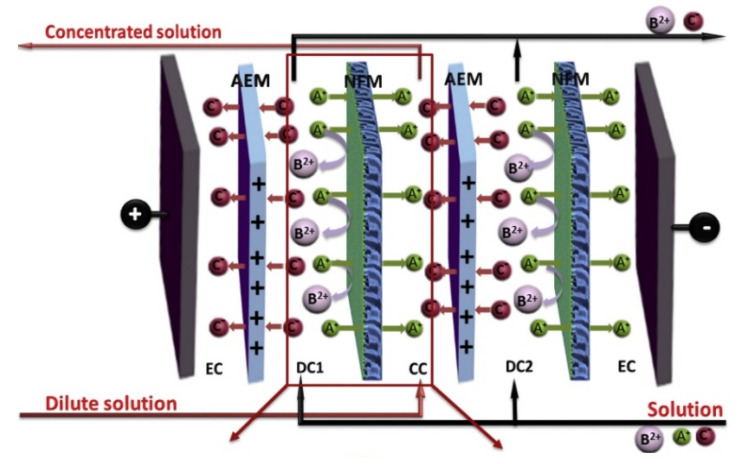
“Electrodialysis (ED) is an electrochemical membrane separation process that utilizes an ion-selective membrane and an electric potential gradient for ion separation from aqueous solutions(Gurreri et al., 2020).”
BackgroundSymbiosis of microalgae and bacteria consortium for heavy metal remediation in wastewater
Zhao, D., Cheah, W. Y., Lai, S. H., Ng, E., Khoo, K. S., Show, P. L., & Ling, T. C. (2023) · Journal of environmental chemical engineering · doi:10.1016/j.jece.2023.109943 · Cited by 148
Recent Advances in Detection and Removal of Heavy Metals from Contaminated Water
Punia, P., Naagar, M., Dhar, R., Thakur, P., & Thakur, A. (2022) · ChemBioEng Reviews · doi:10.1002/cben.202100053 · Cited by 142
Recovery of rare earth elements from waste streams using membrane processes: An overview
Elbashier, E., Mussa, A., Hafiz, M., & Hawari, A. H. (2021) · Hydrometallurgy · doi:10.1016/j.hydromet.2021.105706 · Cited by 141
Gahrouei, A. E., Rezapour, A., Pirooz, M., & Pourebrahimi, S. (2024) · Desalination and Water Treatment · doi:10.1016/j.dwt.2024.100446 · Cited by 136
Ionic Mobility in Ion-Exchange Membranes
Стенина, И. А., & Yaroslavtsev, A. B. (2021) · Membranes · doi:10.3390/membranes11030198 · Cited by 121
A comprehensive multi-scale model for bipolar membrane electrodialysis (BMED)
Culcasi, A., Gurreri, L., Cipollina, A., Tamburini, A., & Micale, G. (2022) · Chemical Engineering Journal · doi:10.1016/j.cej.2022.135317 · Cited by 121
Self-citationLuo, Y., Liu, Y., Shen, J., & der Bruggen, B. V. (2022) · Membranes · doi:10.3390/membranes12090829 · Cited by 119
Li, J., Dong, X., Liu, X., Xu, X., Duan, W., Park, J., Gao, L., & Lu, Y. (2022) · Sustainability · doi:10.3390/su142315579 · Cited by 118
Kavitha, E., Poonguzhali, E., Dayanandan, N., Kapoor, A., Arthanareeswaran, G., & Prabhakar, S. (2021) · Chemosphere · doi:10.1016/j.chemosphere.2021.132690 · Cited by 106
Kabir, M. M., Sabur, G. M., Akter, M. M., Nam, S. Y., Im, K. S., Tijing, L. D., & Shon, H. K. (2023) · Desalination · doi:10.1016/j.desal.2023.117041 · Cited by 106
Saud, A., Gupta, S., Allal, A., Preud’homme, H., Shomar, B., & Zaidi, S. M. J. (2024) · ACS Omega · doi:10.1021/acsomega.3c08883 · Cited by 103
Agarwal, C., & Pandey, A. K. (2023) · Environmental Science Advances · doi:10.1039/d3va00112a · Cited by 101
Electrochemical Wastewater Refining: A Vision for Circular Chemical Manufacturing
Miller, D. M., Abels, K., Guo, J., Williams, K. S., Liu, M. J., & Tarpeh, W. A. (2023) · Journal of the American Chemical Society · doi:10.1021/jacs.3c01142 · Cited by 100
de Boer, S. R., González-Rodríguez, J., Conde, J. J., & Moreira, M. T. (2022) · Journal of Water Process Engineering · doi:10.1016/j.jwpe.2022.102587 · Cited by 94
A Review of Membrane-Based Desalination Systems Powered by Renewable Energy Sources
Shahid, M. K., Mainali, B., Rout, P. R., Lim, J. W., Aslam, M., Al‐Rawajfeh, A. E., & Choi, Y. (2023) · Water · doi:10.3390/w15030534 · Cited by 94
Paul, J., Qamar, A., Ahankari, S. S., Thomas, S., & Dufresne, A. (2024) · Carbohydrate Polymers · doi:10.1016/j.carbpol.2024.122198 · Cited by 91
Kumar, P., Gacem, A., Ahmad, M. T., Yadav, V. K., Singh, S., Yadav, K. K., Alam, M. M., Dawane, V., Piplode, S., Maurya, P., et al. (2022) · Frontiers in Environmental Science · doi:10.3389/fenvs.2022.949581 · Cited by 90
Recent advances of thin film composite nanofiltration membranes for Mg2+/Li+ separation
Peng, H. Y., Lau, S. K., & Yong, W. F. (2024) · Advanced Membranes · doi:10.1016/j.advmem.2024.100093 · Cited by 89
Cobalt Nanoferrites: a Review on Synthesis, Characterization, and Applications
Thakur, P., Gahlawat, N., Punia, P., Kharbanda, S., Ravelo, B., & Thakur, A. (2022) · Journal of Superconductivity and Novel Magnetism · doi:10.1007/s10948-022-06334-1 · Cited by 87
Kumar, R., Awino, E., Njeri, D. W., Basu, A., Chattaraj, S., Nayak, J., Roy, S., Khan, G. A., Jeon, B., Ghosh, A. K., et al. (2024) · Journal of Water Process Engineering · doi:10.1016/j.jwpe.2024.104838 · Cited by 85
Rosentreter, H., Scope, C., Oddoy, T., Lerch, A., & Meier‐Haack, J. (2024) · Desalination · doi:10.1016/j.desal.2024.118412 · Cited by 83
Electro-deionization (EDI) technology for enhanced water treatment and desalination: A review
Khan, Z. U., Moronshing, M., Shestakova, M. V., Al-Othman, A. A. S., Sillanpää, M. E. T., Zhan, Z., Song, B., & Lei, Y. (2022) · Desalination · doi:10.1016/j.desal.2022.116254 · Cited by 80
Review: Brine Solution: Current Status, Future Management and Technology Development
Backer, S. N., Bouaziz, I., Nabeela, K., Thomas, R. T., Preethikumar, G., Takriff, M. S., Laoui, T., & Atieh, M. A. (2022) · Sustainability · doi:10.3390/su14116752 · Cited by 78
Methanesulfonic acid (MSA) in clean processes and applications: a tutorial review
Binnemans, K., & Jones, P. T. (2024) · Green Chemistry · doi:10.1039/d4gc02031f · Cited by 78
Kamalesh, R., Karishma, S., Saravanan, A., & Yaashikaa, P. R. (2024) · Sustainable Chemistry for the Environment · doi:10.1016/j.scenv.2024.100183 · Cited by 76
Total Dissolved Solids and Their Removal Techniques
Pushpalatha, N., Sreeja, V., Karthik, R., & Saravanan, G. (2022) · International Journal of Environmental Sustainability and Protection · doi:10.35745/ijesp2022v02.02.0002 · Cited by 74
Advanced membrane-based high-value metal recovery from wastewater
Gebreslassie, G., Desta, H. G., Dong, Y., Zheng, X., Zhao, M., & Lin, B. (2024) · Water Research · doi:10.1016/j.watres.2024.122122 · Cited by 74
Yakamercan, E., Bhatt, P., Aygün, A., Adesope, A. W., & Şimşek, H. (2023) · Environmental Pollution · doi:10.1016/j.envpol.2023.121680 · Cited by 73
Electrical waste management: Recent advances challenges and future outlook
Naik, S., & Eswari, S. (2022) · Total Environment Research Themes · doi:10.1016/j.totert.2022.100002 · Cited by 72
Malinović, B. N., Markelj, J., Gotvajn, A. Ž., Cigić, I. K., & Prosen, H. (2022) · Environmental Chemistry Letters · doi:10.1007/s10311-022-01497-8 · Cited by 72
Electrochemical Separation and Clean Energy Applications of Rare Earth Elements
Ghosh, B., Vapnik, H., Kim, H., Kim, Y., Birawat, R. K., Lu, Y., Su, X., & Yang, H. (2025) · Chemical Reviews · doi:10.1021/acs.chemrev.5c00103 · Cited by 71
2024 roadmap on membrane desalination technology at the water-energy nexus
Politano, A., Al-Juboori, R. A., Alnajdi, S., Alsaati, A. A., Athanassiou, A., Bar‐Sadan, M., Beni, A. N., Campi, D., Cupolillo, A., D’Olimpio, G., et al. (2024) · Journal of Physics Energy · doi:10.1088/2515-7655/ad2cf2 · Cited by 69
Self-citationMembrane technology for a sustainable copper mining industry: The Chilean paradigm
Santoro, S., Estay, H., Avci, A. H., Pugliese, L., Ruby‐Figueroa, R., García, A., Aquino, M., Nasirov, S., Straface, S., & Curcio, E. (2021) · Cleaner Engineering and Technology · doi:10.1016/j.clet.2021.100091 · Cited by 68
Culcasi, A., Gurreri, L., Zaffora, A., Cosenza, A., Tamburini, A., & Micale, G. (2020) · Applied Energy · doi:10.1016/j.apenergy.2020.115576 · Cited by 68
Self-citationCournoyer, A., & Bazinet, L. (2023) · Membranes · doi:10.3390/membranes13020205 · Cited by 67
Produced Water Treatment Technologies: A Review
Abdelhamid, C., Latrach, A., Rabiei, M., & Venugopal, K. (2024) · Energies · doi:10.3390/en18010063 · Cited by 67
Pärnamäe, R., Gurreri, L., Post, J. W., van Egmond, W. J., Culcasi, A., Saakes, M., Cen, J., Goosen, E., Tamburini, A., Vermaas, D. A., et al. (2020) · Membranes · doi:10.3390/membranes10120409 · Cited by 66
Self-citationSakr, A. K., Aal, M. M. A., El-Rahem, K. A. A., Allam, E. M., Dayem, S. M. A. E., Elshehy, E. A., Hanfi, M. Y., Alqahtani, M. S., & Cheira, M. F. (2022) · Nanomaterials · doi:10.3390/nano12213866 · Cited by 62
Influence of Wooden Sawdust Treatments on Cu(II) and Zn(II) Removal from Water
Kováčová, Z., Demčák, Š., Bálintová, M., Pla, C., & Zinicovscaia, I. I. (2020) · Materials · doi:10.3390/ma13163575 · Cited by 60
Saavedra, A., Valdés, H., Mahn, A., & Acosta, O. (2021) · Membranes · doi:10.3390/membranes11030180 · Cited by 59
Nitrate-Polluted Waterbodies Remediation: Global Insights into Treatments for Compliance
Fernández-López, J. A., Alacid, M., Obón, J. M., Martínez-Vives, R., & Angosto, J. M. (2023) · Applied Sciences · doi:10.3390/app13074154 · Cited by 58
An, B. M., Aung, S. L., Choi, J., Cha, H., Cho, J., Byambaa, B., & Song, K. G. (2023) · Desalination · doi:10.1016/j.desal.2022.116361 · Cited by 57
Advancements in Bipolar Membrane Electrodialysis Techniques for Carbon Capture
Khoiruddin, K., Wenten, I. G., & Siagian, U. W. R. (2024) · Langmuir · doi:10.1021/acs.langmuir.3c03873 · Cited by 56
Treatment and Recovery of High-Value Elements from Produced Water
Miranda, M. A., Ghosh, A., Mahmodi, G., Xie, S., Shaw, M., Kim, S., Krzmarzick, M. J., Lampert, D. J., & Aichele, C. P. (2022) · Water · doi:10.3390/w14060880 · Cited by 56
Sim, G., Pishnamazi, M., Seo, D., Kong, S. R., Lee, J., Park, Y., & Chae, S.-R. (2024) · Chemical Engineering Journal · doi:10.1016/j.cej.2024.154640 · Cited by 54
A state-of-the-art review on microbial desalination cells
Gujjala, L. K. S., Dutta, D., Sharma, P., Kundu, D., Vo, D. N., & Kumar, S. (2021) · Chemosphere · doi:10.1016/j.chemosphere.2021.132386 · Cited by 54
Wang, Y., Xue, Y., & Zhang, C. (2021) · Green Chemistry · doi:10.1039/d1gc01462e · Cited by 52
Treatment Technologies for Cooling Water Blowdown: A Critical Review
Soliman, M. N., Eljack, F., Kazi, M.-K., AlMomani, F. A., Ahmed, E., & Jack, Z. E. (2021) · Sustainability · doi:10.3390/su14010376 · Cited by 51
Mareev, S. A., Gorobchenko, A., Ivanov, D. A., Anokhin, D. V., & Nikonenko, V. (2022) · International Journal of Molecular Sciences · doi:10.3390/ijms24010034 · Cited by 51
Othman, N. H., Kabay, N., & Güler, E. (2021) · Reviews in Chemical Engineering · doi:10.1515/revce-2020-0070 · Cited by 50
Teng, M., Yuan, J., Li, Y., Shi, C., Zheng, X., Ma, C., Yang, L., Zhang, C., Gao, J., & Li, Y. (2023) · Journal of Colloid and Interface Science · doi:10.1016/j.jcis.2023.10.041 · Cited by 49
Nutrient recovery from digestate: Pilot test experiments
Proskynitopoulou, V., Garagounis, I., Vourros, A., Toursidis, P. D., Lorentzou, S., Zouboulis, A. I., & Panopoulos, K. D. (2024) · Journal of Environmental Management · doi:10.1016/j.jenvman.2024.120166 · Cited by 49
Energy Harvesting by Waste Acid/Base Neutralization via Bipolar Membrane Reverse Electrodialysis
Zaffora, A., Culcasi, A., Gurreri, L., Cosenza, A., Tamburini, A., Santamaria, M., & Micale, G. (2020) · Energies · doi:10.3390/en13205510 · Cited by 49
Self-citationA review on recent advances in electrodeionization for various environmental applications
Rathi, B. S., Kumar, P. S., & Parthiban, R. (2021) · Chemosphere · doi:10.1016/j.chemosphere.2021.133223 · Cited by 49
Das, S., Singh, C. K., Sodhi, K. K., & Singh, V. K. (2023) · Environment Development and Sustainability · doi:10.1007/s10668-023-04183-z · Cited by 48
Deivayanai, V. C., Karishma, S., Thamarai, P., Yaashikaa, P. R., & Saravanan, A. (2023) · Desalination · doi:10.1016/j.desal.2023.117098 · Cited by 47
Dischinger, S. M., Miller, D. J., Vermaas, D. A., & Kingsbury, R. (2024) · ACS ES&T Engineering · doi:10.1021/acsestengg.3c00475 · Cited by 47
Permselectivity of Cation Exchange Membranes Modified by Polyaniline
Falina, I. V., Loza, N. V., Loza, S. A., Titskaya, E., & Romanyuk, N. (2021) · Membranes · doi:10.3390/membranes11030227 · Cited by 47
Carmona, B., & Abejón, R. (2023) · Membranes · doi:10.3390/membranes13040385 · Cited by 47
Concentration Polarization in Membrane Systems
Apel, P. Y., Biesheuvel, P. M., Бобрешова, О. В., Леонидович, Б. И., Vasil’eva, V. I., Volkov, V. V., Grushevenko, E. A., Nikonenko, V., Паршина, А. В., Pismenskaya, N. D., et al. (2024) · Membranes and Membrane Technologies · doi:10.1134/s2517751624600390 · Cited by 46
Vineyard, D. L., Hicks, A., Karthikeyan, K. G., Davidson, C. L., & Barak, P. (2021) · Cleaner Environmental Systems · doi:10.1016/j.cesys.2021.100026 · Cited by 44
Donnan Membrane Process for the Selective Recovery and Removal of Target Metal Ions—A Mini Review
Asante-Sackey, D., Rathilal, S., Tetteh, E. K., Ezugbe, E. O., & Pillay, L. V. (2021) · Membranes · doi:10.3390/membranes11050358 · Cited by 44
Marathe, D., Singh, A., Raghunathan, K., Thawale, P. R., & Kumari, K. (2021) · Water Environment Research · doi:10.1002/wer.1633 · Cited by 43
Heavy Metal Ion Removal: A Global Review of Wastewater Treatment Technologies
Nemeş, N. S., Negrea, A., Ciopec, M., Negrea, P., Duţeanu, N., & Duda-Seiman, D. M. (2026) · International Journal of Molecular Sciences · doi:10.3390/ijms27041741 · Cited by 42
Multi-electrode scale-up strategy and parametric investigation of redox-flow desalination systems
Kim, H., Kim, S., Kim, N., Su, X., & Kim, C. (2022) · Desalination · doi:10.1016/j.desal.2022.116350 · Cited by 42
Gurreri, L., Filingeri, A., Ciofalo, M., Cipollina, A., Tedesco, M., Tamburini, A., & Micale, G. (2021) · Desalination · doi:10.1016/j.desal.2021.115001 · Cited by 40
Self-citationXu, X., He, Q., Ma, G., Wang, H., Nirmalakhandan, N. N., & Xu, P. (2021) · Membranes · doi:10.3390/membranes11050333 · Cited by 38
Căprărescu, S., Modrogan, C., Purcar, V., Dăncilă, A. M., & Orbuleţ, O. D. (2021) · Polymers · doi:10.3390/polym13111875 · Cited by 38
El‐badawy, T., Othman, M. H. D., Matsuura, T., Bilad, M. R., Adam, M. R., Tai, Z. S., Ravi, J., Ismail, A. F., Rahman, M. A., Jaafar, J., et al. (2021) · Separation and Purification Technology · doi:10.1016/j.seppur.2021.119494 · Cited by 38
Zawadzki, P., Kończak, B., & Smoliński, A. (2023) · Measurement · doi:10.1016/j.measurement.2023.112928 · Cited by 37
Wang, L. A., Patel, S. K., & Elimelech, M. (2021) · Desalination · doi:10.1016/j.desal.2021.115089 · Cited by 37
Kovalenko, A. V., Weßling, M., Nikonenko, V., Mareev, S. A., Moroz, I. A., Evdochenko, E., & Urtenov, M. (2021) · Journal of Membrane Science · doi:10.1016/j.memsci.2021.119583 · Cited by 37
Leong, Z. Y., Zhang, J., Vafakhah, S., Ding, M., Guo, L., & Yang, H. Y. (2021) · Desalination · doi:10.1016/j.desal.2021.115374 · Cited by 37
Gurreri, L., Cerva, M. L., Moreno, J., Goossens, B., Trunz, A., & Tamburini, A. (2022) · Desalination · doi:10.1016/j.desal.2021.115541 · Cited by 37
Self-citationChheang, M., Hongprasith, N., Ratanatawanate, C., & Lohwacharin, J. (2022) · Membranes · doi:10.3390/membranes12030280 · Cited by 37
Ogundele, O. D., Oyegoke, D. A., & Anaun, T. E. (2023) · Acadlore Transactions on Geosciences · doi:10.56578/atg020203 · Cited by 36
Zhang, C., Jiang, Y., Zou, X., Xing, L., Liu, W., Huang, Z., Feng, Y., & Wang, J. (2023) · ACS Applied Polymer Materials · doi:10.1021/acsapm.3c02022 · Cited by 36
Kumari, A., Nithya, K., Selvaraj, R., & Rasana, N. (2025) · Environmental Monitoring and Assessment · doi:10.1007/s10661-025-13904-y · Cited by 36
Culcasi, A., Gurreri, L., Micale, G., & Tamburini, A. (2021) · Journal of Environmental Management · doi:10.1016/j.jenvman.2021.112319 · Cited by 36
Self-citationPismenskaya, N. D., Tsygurina, K., & Nikonenko, V. (2022) · Membranes · doi:10.3390/membranes12050497 · Cited by 35
Impact of Ion–Ion Correlated Motion on Salt Transport in Solvated Ion Exchange Membranes
Marioni, N., Zhang, Z., Zofchak, E. S., Sachar, H. S., Kadulkar, S., Freeman, B. D., & Ganesan, V. (2022) · ACS Macro Letters · doi:10.1021/acsmacrolett.2c00361 · Cited by 35
Asadi, A., Kang, D., Harandi, H. B., Jung, J. C., & Sui, P. (2024) · Separation and Purification Technology · doi:10.1016/j.seppur.2024.126989 · Cited by 35
Water Splitting and Transport of Ions in Electromembrane System with Bilayer Ion-Exchange Membrane
Melnikov, S., Bondarev, D., Nosova, E., Melnikova, E., & Zabolotskiy, V. (2020) · Membranes · doi:10.3390/membranes10110346 · Cited by 34
Pascariu, P., Cojocaru, C., Homocianu, M., & Samoilă, P. (2022) · Journal of Environmental Management · doi:10.1016/j.jenvman.2022.115317 · Cited by 34
Metadata
- Authors
- Gurreri, L., Tamburini, A., Cipollina, A., & Micale, G.
- Affiliations
- University of Palermo (IT)
- Corresponding author
- Tamburini, Alessandro
- Venue
- Membranes
- Publisher
- MDPI AG
- Published
- 2020-07-09
- Volume
- 10
- Issue
- 7
- Pages
- 146
- ISSN
- 2077-0375 (ISSN-L)
- PMC
- PMC7408617
- OpenAlex
- W3042024604
- Cited by
- 492
- References
- 574
- Citations by year
- 2026: 62 · 2025: 98 · 2024: 101 · 2023: 82 · 2022: 77 · 2021: 64 · 2020: 8
- FWCI
- 4.83
- Type
- journal article
- Language
- en
- Open access
- gold
- dx.doi.org
- Licence
- Locations
- Membranes (publishedVersion, cc-by)
- PubMed Central (publishedVersion, cc-by)
- PubMed (publishedVersion)
- DOAJ (DOAJ: Directory of Open Access Journals) (submittedVersion, cc-by-sa)
- Nova Science Publishers (Nova Science Publishers, Inc.) (submittedVersion, other-oa)
- Funders
- Horizon 2020 (685579, 731187)
- Topics
- Physical Sciences › Chemical Engineering › Filtration and Separation › Membrane-based Ion Separation Techniques
- Physical Sciences › Environmental Science › Water Science and Technology › Membrane Separation Technologies
- Physical Sciences › Environmental Science › Environmental Engineering › Electrokinetic Soil Remediation Techniques
- Keywords
- electrodialysis, wastewater treatment, desalination, ion exchange membranes, resource recovery, heavy metal recovery, nutrient recovery, zero liquid discharge, industrial wastewater, municipal wastewater, energy recovery, membrane separation
About these checks
Registry, retraction, Cites and statistics results are computed, not judged, with one exception: a printed reference that no index lists is read once by a model before it counts as a citation error. Claims are extracted by a model and kept only when their quote appears verbatim in the text; each cited source is then checked, with a model’s help, for whether it says what the claim relies on. Those verdicts can be wrong — read the claim’s quote and the cited source before relying on one.
Statistics and arithmetic are recomputed, not judged.
Confidence bands are shown only for fields calibrated on our annotated test set. None is calibrated yet, so no band is shown.
What counts as a claim ›How we measure confidence ›How we check this ›
Are you an author, or do you see a problem with this page? Request a review
Data sources
Bibliographic data: Semantic Scholar, OpenAlex, Crossref.
Contains information from the Semantic Scholar Academic Graph Datasets, made available under the ODC Attribution License (ODC-BY 1.0).
Semantic Scholar’s data is described in: Kinney, R., et al. (2023). The Semantic Scholar Open Data Platform. arXiv:2301.10140.
