

A Comprehensive Membrane Process for Preparing Lithium Carbonate from High Mg/Li Brine
Open accessThe DOI matches its Crossref record; 37 of the 37 references it cites were found in a registry or an index.
Abstract
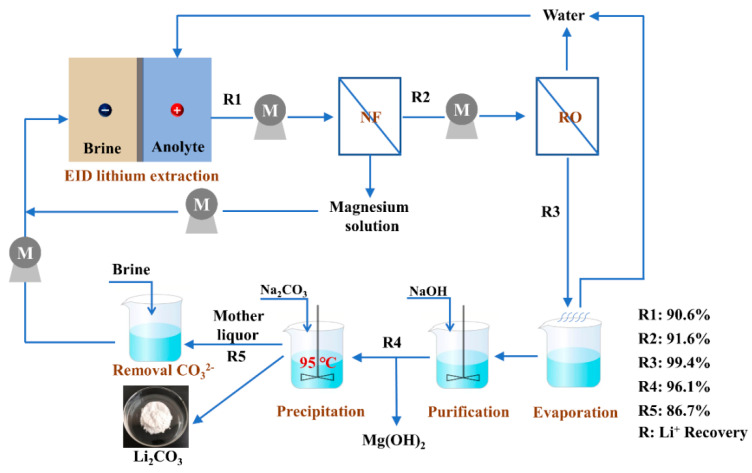
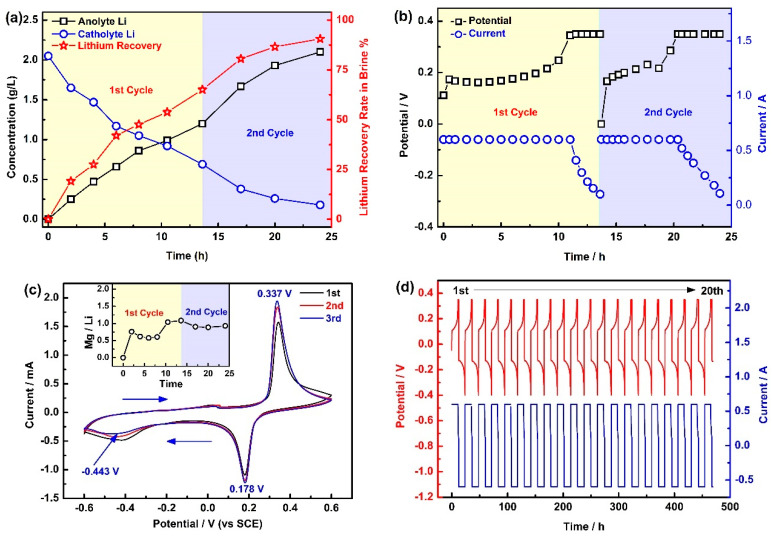
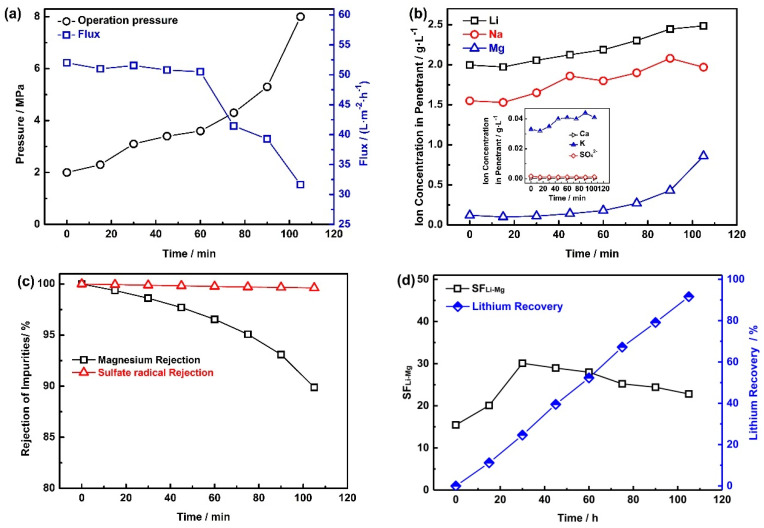
The preparation of Li2CO3 from brine with a high mass ratio of Mg/Li is a worldwide technology problem. Membrane separation is considered as a green and efficient method. In this paper, a comprehensive Li2CO3 preparation process, which involves electrochemical intercalation-deintercalation, nanofiltration, reverse osmosis, evaporation, and precipitation, was constructed. Concretely, the electrochemical intercalation-deintercalation method shows excellent separation performance of lithium and magnesium, and the mass ratio of Mg/Li decreased from the initial 58.5 in the brine to 0.93 in the obtained lithium-containing anolyte. Subsequently, the purification and concentration are performed based on nanofiltration and reverse osmosis technologies, which remove mass magnesium and enrich lithium, respectively. After further evaporation and purification, industrial-grade Li2CO3 can be prepared directly. The direct recovery of lithium from the high Mg/Li brine to the production of Li2CO3 can reach 68.7%, considering that most of the solutions are cycled in the system, the total recovery of lithium will be greater than 85%. In general, this new integrated lithium extraction system provides a new perspective for preparing lithium carbonate from high Mg/Li brine.
Overview
The claims and statistics of this paper haven’t been checked yet.
Free: it reads the open-access text and checks the first 5 claims that cite a source we can check. Create a free account to check every claim.
Integrity signals
Registry
Cites
Statistics
Figures
Verification
Claims the paper makes
The claims and statistics of this paper haven’t been checked yet.
Free: it reads the open-access text and checks the first 5 claims that cite a source we can check. Create a free account to check every claim.
Claims other papers make about this one
Each is checked against this paper’s own text: does it say what the citing paper says it does?
The source backs part of the claim, not all of it — or backs it for a different population, condition or comparison.
In the citing paper
“DLE technologies, completing a lithium concentration cycle in less than 24 h, are significantly more efficient and less dependent on environmental conditions than solar evaporation, which requires 12 to 18 months [50-52].”
From Pathways to Greener Primary Lithium Extraction for a Really Sustainable Energy Transition: Environmental Challenges and Pioneering Innovations (2024) · cites this paper as [50]
Experimental — accuracy not yet measured
Self-check
Percentages, sums and reported differences re-computed from the paper’s own numbers.
The self-check needs the paper’s full text.
Citations
Cites
Armand, M., & Tarascon, J.-M. (2008) · Nature · doi:10.1038/451652a · Cited by 19,612
Challenges for Rechargeable Li Batteries
Goodenough, J. B., & Kim, Y. (2010) · Chemistry of Materials · doi:10.1021/cm901452z · Cited by 10,943
Global lithium resources: relative importance of pegmatite, brine and other deposits
Kesler, S. E., Gruber, P. W., Medina, P. A., Keoleian, G. A., Everson, M. P., & Wallington, T. J. (2012) · Ore Geology Reviews · doi:10.1016/j.oregeorev.2012.05.006 · Cited by 1,140 · cited 3×
“Nowadays, lithium resources mainly exist in solid ore (such as spodumene and lepidolite) and brine, and over 70% of exploitable lithium in the world existed in the brine [8,9].”
BackgroundGrosjean, C., Miranda, P. H., Perrin, M., & Poggi, P. (2012) · Renewable and Sustainable Energy Reviews · doi:10.1016/j.rser.2011.11.023 · Cited by 847
Flexer, V., Baspineiro, C. F., & Galli, C. I. (2018) · Science of the Total Environment · doi:10.1016/j.scitotenv.2018.05.223 · Cited by 768 · cited 3×
“Most lithium resources in continental brines are found in a small region in South America, often referred to as the “Lithium Triangle” [9,10].”
BackgroundLithium market research – global supply, future demand and price development
Martin, G., Rentsch, L., Höck, M., & Bertau, M. (2017) · Energy Storage Materials · doi:10.1016/j.ensm.2016.11.004 · Cited by 740
Removal of heavy metal ions by nanofiltration
Al-Rashdi, B. A. M., Johnson, D. J., & Hilal, N. (2013) · Desalination · doi:10.1016/j.desal.2012.05.022 · Cited by 562 · cited 1×
“The retention of cations by the anion membrane is mainly due to the charge repulsion of the fixed cationic groups of the membrane itself to the cations in the solution [36,37].”
BackgroundRecovery of lithium from Uyuni salar brine
An, J. W., Kang, D. J., Tran, K. T., Kim, M. J., Lim, T., & Tran, T. (2012) · Hydrometallurgy · doi:10.1016/j.hydromet.2012.02.008 · Cited by 509
Somrani, A., Hamzaoui, A. H., & Pontie, M. (2013) · Desalination · doi:10.1016/j.desal.2013.03.009 · Cited by 388
Yaksic, A., & Tilton, J. E. (2009) · Resources Policy · doi:10.1016/j.resourpol.2009.05.002 · Cited by 328 · cited 2×
“Most lithium resources in continental brines are found in a small region in South America, often referred to as the “Lithium Triangle” [9,10].”
Background
Research works printed but not linked: 2
- 38. Speight, J.G. Land's Handbook of Chemistry, 16th ed.; McGraw-Hill: New York, NY, USA, 2005.
- 41. Feng, W.X. The Research on Separation of Magnesium and Lithium from Brine by Electrodialysis. Ph.D. Thesis, Hebei University of Technology, Tianjin, China, 2016.
Cited by
Lithium Recovery Using Electrochemical Technologies: Advances and Challenges
Wu, L., Zhang, C., Kim, S., Hatton, T. A., Mo, H., & Waite, T. D. (2022) · Water Research · doi:10.1016/j.watres.2022.118822 · Cited by 214
Xu, W., He, L., & Zhao, Z. (2021) · Desalination · doi:10.1016/j.desal.2021.114935 · Cited by 209
Self-citationFeng, Y., Peng, H., & Zhao, Q. (2022) · Separation and Purification Technology · doi:10.1016/j.seppur.2021.119848 · Cited by 169
Electrochemical methods contribute to the recycling and regeneration path of lithium-ion batteries
Li, X., Liu, S., Yang, J., He, Z., Zheng, J., & Li, Y. (2022) · Energy storage materials · doi:10.1016/j.ensm.2022.12.022 · Cited by 138
Extraction of lithium from salt lake brines by granulated adsorbents
Luo, Q., Dong, M., Nie, G.-L., Liu, Z., Wu, Z., & Li, J. (2021) · Colloids and Surfaces A Physicochemical and Engineering Aspects · doi:10.1016/j.colsurfa.2021.127256 · Cited by 112
Butylskii, D. Y., Troitskiy, V. A., Smirnova, N. V., Pismenskaya, N. D., Wang, Y., Jiang, C., Xu, T., & Nikonenko, V. (2024) · Desalination · doi:10.1016/j.desal.2024.117826 · Cited by 100
Li, J., Luo, Q., Dong, M., Nie, G.-L., Liu, Z., & Wu, Z. (2022) · Hydrometallurgy · doi:10.1016/j.hydromet.2022.105828 · Cited by 89
Review of recent advances in lithium extraction from subsurface brines
Disu, B., Rafati, R., Haddad, A. S., Mendoza‐Roca, J. A., Iborra–Clar, M. I., & Bakhtiari, S. S. E. (2024) · Geoenergy Science and Engineering · doi:10.1016/j.geoen.2024.213189 · Cited by 96
Liu, D., Zhao, Z., Xu, W., Xiong, J., & He, L. (2021) · Desalination · doi:10.1016/j.desal.2021.115302 · Cited by 83
Self-citationLi, R., Wang, Y., Duan, W., Du, C., Tian, S., Ren, Z., & Zhou, Z. (2023) · Desalination · doi:10.1016/j.desal.2023.116543 · Cited by 62
Butt, F. S., Lewis, A., Chen, T., Mazlan, N. A., Wei, X., Hayer, J., Chen, S., Han, J., Yang, Y., Yang, S., et al. (2022) · Membranes · doi:10.3390/membranes12040373 · Cited by 50
Facet engineered Li3PO4 for lithium recovery from brines
Liu, D., Li, Z., He, L., & Zhao, Z. (2021) · Desalination · doi:10.1016/j.desal.2021.115186 · Cited by 54
Self-citationJiang, Y., Zhang, G., Zhou, K., Peng, C., Salih, K. A. M., Zhou, H., Wu, Y., & Chen, W. Q. (2023) · Separation and Purification Technology · doi:10.1016/j.seppur.2023.125907 · Cited by 40
Polymer Inclusion Membranes with P507-TBP Carriers for Lithium Extraction from Brines
Zeng, X., Xu, L., Deng, T., Zhang, C., Xu, W., & Zhang, W. (2022) · Membranes · doi:10.3390/membranes12090839 · Cited by 40
“However, due to their similar ionic properties, the efficient separation of Li+ and Mg2+ in the brines with a high Mg/Li ratio is the main obstacle to exploring lithium resources in salt lakes [6,7].”
BackgroundSelf-citationEnhanced lithium separation from brines using nanofiltration (NF) technology: A review
Sajna, M. S., Elmakki, T., Zavahir, S., Tariq, H., Abdulhameed, A., Park, H., Shon, H. K., & Han, D. S. (2024) · Desalination · doi:10.1016/j.desal.2024.118148 · Cited by 58
Sustainable lithium extraction from liquid ores using membrane-based technologies: a review
Kumar, R., Choi, K.-W., Khan, M. A., Biswas, G. G., Cho, S., Chakrabortty, S., Tripathy, S. K., Kim, K., & Jeon, B. (2025) · Environmental Chemistry Letters · doi:10.1007/s10311-025-01871-2 · Cited by 38
Ruberti, M. (2024) · Sustainability · doi:10.3390/su17010160 · Cited by 35
Lithium recovery from brine by PEG-modified porous LiFePO4/FePO4 electrode system
Yin, R.-X., Zhao, Z., Zhu, W., Liu, X., He, L., Xu, W., & Zhao, Z. (2024) · Separation and Purification Technology · doi:10.1016/j.seppur.2024.126375 · Cited by 31
Self-citationLithium extraction from carbonate‐rich Salt Lake brine using HBTA/TBP system
Ji, L., Shi, D., Peng, X., Xie, S., Li, J., Zhang, Y., Zhang, L., Niu, Y., Chen, G., & Li, L. (2024) · Rare Metals · doi:10.1007/s12598-024-02760-3 · Cited by 30
“As a result, the proton exchange with Li ? is facilitated [40, 48].”
Ounissi, T., Ammar, R. B., Larchet, C., Chaabane, L., Baklouti, L., Dammak, L., & Hmida, E. S. B. H. (2022) · Membranes · doi:10.3390/membranes12020244 · Cited by 29
Selective Recovery of Lithium from Salt Lake Brine by Using Ion-Imprinted Polymers
Cao, Z., Qi, D., Liu, X., Zhou, Z., Du, C., & Ren, Z. (2024) · Industrial & Engineering Chemistry Research · doi:10.1021/acs.iecr.3c03397 · Cited by 25
Advances in electrochemical recovery of valuable metals: A focus on lithium
Suu, L., Lim, J., Lee, J., Choi, Y., & Choi, J.-S. (2025) · Desalination · doi:10.1016/j.desal.2025.118960 · Cited by 24
Lee, J., & Chung, E. (2022) · Geothermics · doi:10.1016/j.geothermics.2022.102388 · Cited by 25
Olea, F., Durán, G., Díaz, G., Villarroel, E., Araya‐López, C., Cabezas, R., Merlet, G., Romero, J., & Quijada‐Maldonado, E. (2022) · Minerals · doi:10.3390/min12020190 · Cited by 21
“More than half of the world’s lithium deposits as brine water are located in the triangle of South America, which comprises Chile, Bolivia, and Argentina [3,4].”
BackgroundGolmohammadi, M., Boroumand, Y., Arshadi, F., Asadnia, M., & Razmjou, A. (2025) · Industrial & Engineering Chemistry Research · doi:10.1021/acs.iecr.4c03046 · Cited by 20
Reactive Crystallization Process of Li2CO3 from LiCl and Na2CO3 Mechanism and Modeling
Graber, T. A., Taboada, M. E., Cortés, L., Piceros, E. C., Meruane, G., & Aguilar, P. (2024) · Industrial & Engineering Chemistry Research · doi:10.1021/acs.iecr.3c04109 · Cited by 18
Application of membrane processes in mining and mineral processing
Panayotova, M., & Panayotov, V. (2021) · E3S Web of Conferences · doi:10.1051/e3sconf/202128008016 · Cited by 19
“Very recently a comprehensive technology for preparation of Li2CO3, has been proposed [52].”
BackgroundJu, K., Liu, D., Zhao, Z., He, L., & Xu, W. (2023) · Separation and Purification Technology · doi:10.1016/j.seppur.2023.124643 · Cited by 17
Self-citationNieto, C. H. D., & Flexer, V. (2022) · Current Opinion in Electrochemistry · doi:10.1016/j.coelec.2022.101087 · Cited by 18
The Effect of Silicate Ions on the Separation of Lithium From Geothermal Fluid
Lee, J., & Chung, E. (2022) · Frontiers in Chemical Engineering · doi:10.3389/fceng.2022.741281 · Cited by 15
Xia, Y., Liu, K., Xiang, Y., Chen, X., Zhou, K., Zeng, Y., Yi, S., & Zeng, G. (2025) · Desalination · doi:10.1016/j.desal.2025.118895 · Cited by 12
Hao, J., Hao, J., Liu, C., Liu, D., Ren, G., Zhao, Z., & Xu, W. (2025) · Separation and Purification Technology · doi:10.1016/j.seppur.2025.134005 · Cited by 11
Self-citationXu, Y., Chen, Q., Gao, Y., Wang, J., Fan, H., & Zhao, F. (2022) · Chinese Journal of Chemical Engineering · doi:10.1016/j.cjche.2022.11.013 · Cited by 11
Xiong, S., Lu, H., Tang, K., Yang, J., Yang, C., Liang, S., Jiang, J., & Tang, A. (2025) · Industrial & Engineering Chemistry Research · doi:10.1021/acs.iecr.5c02340 · Cited by 13
Preparation of Battery Grade Li2CO3from Defective Product by the Carbonation‐Decomposition Method
Zhou, M. Y. (2022) · Crystal Research and Technology · doi:10.1002/crat.202200112 · Cited by 10
Shan, W., Cao, G., Gu, T., Liu, X., Sun, D., Fu, R., Liu, Z., Jiang, C., & Xu, T. (2024) · AIChE Journal · doi:10.1002/aic.18675 · Cited by 12
Impact of Circular Economy Indicators on the Lithium Supply Chain: A Case Study in Mexico
Vega-Muratalla, V. O., Serrano-Arévalo, T. I., Márquez, C. R., Lira‐Barragán, L. F., & Ponce‐Ortega, J. M. (2025) · Industrial & Engineering Chemistry Research · doi:10.1021/acs.iecr.4c04951 · Cited by 10
Lee, J., Mangiri, R., Jang, G., Jbari, O., Lee, Y., & Chung, E. (2025) · Desalination · doi:10.1016/j.desal.2025.119498 · Cited by 10
González, A., Choque, G., Grágeda, M., & Ushak, S. (2025) · Membranes · doi:10.3390/membranes15020050 · Cited by 12
“Similarly, Xu et al. [29] used an electrochemical intercalation and deintercalation process with a brine that had a Mg/Li ratio of 58.5, which was reduced to 0.93 in the anolyte.”
InfluentialAbdulazeez, I., Salhi, B., Baig, N., & Peng, Q. (2021) · Membranes · doi:10.3390/membranes11120940 · Cited by 9
Pervov, A. G., & Spitsov, D. (2023) · Water · doi:10.3390/w15162970 · Cited by 8
Electromembrane Processes: Experiments and Modelling
Gurreri, L., Tamburini, A., & Micale, G. (2021) · Membranes · doi:10.3390/membranes11020149 · Cited by 8
Ma, Z., Ma, X., Ma, D., Li, Y., Liu, X., Zhu, G., Wei, Q., Ma, Y., Hussain, S. A., & Lu, C. D. (2025) · PLoS ONE · doi:10.1371/journal.pone.0336483 · Cited by 6
Microwave-assisted extraction of lithium from hectorite clay
Amarasekara, A. S., Leday, L. J., & Wang, D. (2024) · Geosystem Engineering · doi:10.1080/12269328.2024.2338087 · Cited by 6
“…Zhang, Hu, Wang, et al., 2019), ion-imprinted hierarchical mesoporous materials (X. Xu et al., 2018), solvent extraction (Song et al., 2017), membrane-based technologies (Luo et al., 2022; W. Xu et al., 2020, 2021), and electrochemical-battery technologies (Sun et al., 2020; Zhang et al., 2021).”
BackgroundWang, J., Chen, Y., Wang, L., He, M., Wang, X., Lv, Y., Wang, J., & Miao, R. (2024) · Journal of Water Process Engineering · doi:10.1016/j.jwpe.2024.106322 · Cited by 6
Lithium Extraction in Confined Channels
Dai, L., Guan, K., & Matsuyama, H. (2025) · Small · doi:10.1002/smll.202511917 · Cited by 5
Fan, W., Ma, L., Pan, W., Zeng, X., Li, Z., Su, H., Zhang, P. F., & Zhao, Y. (2025) · Desalination · doi:10.1016/j.desal.2025.119260 · Cited by 6
Zakari, R. S. B., & Giwa, A. (2026) · Separation and Purification Technology · doi:10.1016/j.seppur.2026.136917 · Cited by 6
Zhang, J.-C., Gu, B., Huo, H.-Q., Shen, Y., Yin, M., & An, Q. (2026) · Journal of Membrane Science · doi:10.1016/j.memsci.2026.125173 · Cited by 4
Membrane-based extraction of critical materials from spent batteries and other mineral wastes
Matebese, F., Raseala, M. J., & Moutloali, R. M. (2026) · Frontiers in Membrane Science and Technology · doi:10.3389/frmst.2026.1766669 · Cited by 6
Chen, Z., Chen, Y., Jiang, Y., Liu, C.-L., & Yu, J. (2025) · CrystEngComm · doi:10.1039/d4ce01106f · Cited by 4
Machado, P. G., Ribeiro, C. D. O., & do Nascimento, C. A. O. (2023) · International Journal of Energy and Water Resources · doi:10.1007/s42108-023-00261-0 · Cited by 4
“Furthermore, studies indicate that, through membrane nanofiltration, it is possible to achieve Li recovery rates from brine up to 92% (Xu et al., 2020; Zhao et al., 2020).”
BackgroundPurification of saturated LiNO3 solution using titanium phosphate ion-exchanger: Equilibrium study
Иваненко, В. И., Маслова, М. В., Евгеньевна, Е. П., & Gerasimova, L. G. (2023) · Transactions of Nonferrous Metals Society of China · doi:10.1016/s1003-6326(23)66280-6 · Cited by 3
Wang, J., Chen, Y., Wang, L., He, M., Wang, X., Lv, Y., Wang, J., & Miao, R. (2025) · Journal of environmental chemical engineering · doi:10.1016/j.jece.2024.115135 · Cited by 3
Chen, Y., Wang, J., Wang, L., He, M., Wang, X., Lv, Y., Wang, J., & Miao, R. (2025) · Separation and Purification Technology · doi:10.1016/j.seppur.2025.134214 · Cited by 3
Online monitoring of solubility of Li 2 CO 3 in the NaCl–KCl–Na 2 SO 4 system
Gao, L., Liu, Y., Ran, J., Li, S., Yin, S., & Zhang, L. (2024) · Canadian Metallurgical Quarterly · doi:10.1080/00084433.2024.2378258 · Cited by 2
“Finally, Li 2 CO 3 is precipitated by the addition of Na 2 CO 3 [6].”
Zhang, C., Xie, T., Qu, H., Li, G., Zhao, Z., Zhou, W., Shiai, X. U., & Li, Z. (2025) · Separation and Purification Technology · doi:10.1016/j.seppur.2025.133135 · Cited by 2
Self-citationConstruction of gradient hydrogel-based lithium ion channels enhanced by Hofmeister effects
Song, Z., Wang, C., Wang, Q., Sui, K., Hou, J., & Qi, P. (2025) · Chemical Engineering Journal · doi:10.1016/j.cej.2025.166653 · Cited by 2
Zhao, P., Wei, J., Wang, F., Luo, Y., Peng, J., Dang, N., & Yang, L. (2025) · Nanoscale Advances · doi:10.1039/d5na00748h · Cited by 2
Dougher, M., Lair, L., Ouimet, J. A., Phillip, W. A., Tarka, T. J., & Dowling, A. W. (2024) · Systems and Control Transactions · doi:10.69997/sct.127504 · Cited by 3
Control over the Ratio between Mono- and Divalent Ions in Drinking Water Treatment by Nanofiltration
Spitsov, D., Pervov, A. G., & Абросимова, И. А. (2024) · Theoretical Foundations of Chemical Engineering · doi:10.1134/s0040579524602024 · Cited by 1
“It is not uncommon that the concentration of some monovalent ions (such as lithium) can be 20–24 times higher than WHO normative values [12, 13].”
A Comparative Study of Lithium Carbonate Precipitation in Chloride and Sulfate Environments
Kia, A. K., Moemeni, M., Nozaeim, A. A., Mortaheb, H. R., & Salehi, M. B. (2026) · Journal of Sustainable Metallurgy · doi:10.1007/s40831-026-01494-z · Cited by 1
“…for exploitation of lithium ultimately lead to separation from an aqueous phase using purification methods such as adsorption [24–27], ion exchange [28, 29], solvent extraction [30– 32], and membrane separation [33, 34] from aqueous solutions followed by a precipitation process [9, 16, 35–39].”
Progress and prospects of forward osmosis membranes for lithium extraction and recovery: a review
Suresh, D., Goh, P.-S., Ahmad, M. N., Ismail, A. F., Guo, T., & Guo, Q. (2026) · AQUA - Water Infrastructure Ecosystems and Society · doi:10.2166/aqua.2026.129 · Cited by 1
Aung, H. Y., Spitsov, D., & Pervov, A. G. (2023) · E3S Web of Conferences · doi:10.1051/e3sconf/202345702002 · Cited by 1
“A lot of applications with RO are used to reject monovalent pollutants, such as ammonia and lithium [12,13].”
BackgroundMu, J., Liu, Y., Guo, Y., & Zhou, Q. (2024) · Gospodarka Surowcami Mineralnymi - Mineral Resources Management · doi:10.24425/gsm.2024.152718 · Cited by 2
“In recent years, the demand for lithium has dramatically increased due to the fast development of the new energy vehicle industry, portable electronic products, and energy storage industry (Xu et al. 2020).”
CTAB-ASSISTED SYNTHESIS OF MONODISPERSE SPHERICAL LiCO3 MICROCRYSTALS WITH AN ION-EXCHANGE METHOD
Wu, Z., & Wu, Z. (2025) · Materiali in tehnologije · doi:10.17222/mit.2024.1341 · Cited by 1
Electromembrane Processes: Experiments and Modelling
Gurreri, L., Tamburini, A., & Micale, G. (2021) · MDPI eBooks · doi:10.3390/books978-3-0365-1529-8 · Cited by 1
Aljarrah, S., Al‐Rawajfeh, A. E., Shahid, M. K., & Islam, Q. U. (2023) · Recent Innovations in Chemical Engineering (Formerly Recent Patents on Chemical Engineering) · doi:10.2174/0124055204266229230927035347 · Cited by 2
Spitsov, D., Pervov, A. G., & Абросимова, И. А. (2023) · Vestnik MGSU · doi:10.22227/1997-0935.2023.12.1989-2003
Application of nanofiltration to produce water for drinking and industrial needs of urban economy
Spitsov, D. (2024) · BIO Web of Conferences · doi:10.1051/bioconf/202410703002
Wang, J., Wang, L., Chen, Y., He, M., Wang, X., Lv, Y., Wang, J., & Miao, R. (2024) · SSRN Electronic Journal · doi:10.2139/ssrn.4876103
Wang, J., Wang, L., & Chen, Y. (2024) · SSRN Electronic Journal · doi:10.2139/ssrn.4901705
Li, Y., Cheng, H., He, Y., & Zhao, J. (2025) · Molecules · doi:10.3390/molecules30040776
“High-purity lithium carbonate is a crucial raw material due to its distinct advantages [1], especially in the new energy industry, as an important support for lithium-ion battery materials [2,3].”
The Adsorption Capacity and Binding of Titanium‐Based Lithium Adsorbent H 2 TiO 3 to Li +
Wang, Y., Zhao, J. J., Zeng, W., Liu, Z., Hu, J. J., & Jiang, C. (2025) · ChemistrySelect · doi:10.1002/slct.202502513 · Cited by 2
Zhou, S., Liu, D., Zhao, T., Huang, H., & Zhao, Z. (2026) · Desalination · doi:10.1016/j.desal.2026.120121
Self-citationChao, K., Toriumi, K., Tokoro, C., Iwai, H., Miyamoto, R., Minegishi, S., & Takaya, Y. (2026) · Process Safety and Environmental Protection · doi:10.1016/j.cherd.2026.04.042
From salt lake brine to battery-grade lithium carbonate: A case study
Wang, Q., Li, Y., Lei, Z., Zhu, Y., Zhang, X., Xiong, F., Low, Z.-X. N., Zhong, Z., & Xing, W. (2026) · Desalination · doi:10.1016/j.desal.2026.120667
Yue, T., Li, H., Chen, X., Xiao, S., Wu, Y., & Yu, S. (2026) · Journal of Materials Science · doi:10.1007/s10853-026-13820-7
“When the increase in MLR is accompanied by a higher Mg 2+ concentration, the resulting increase in ionic strength and concentration polarization may further weaken electrostatic exclusion [128].”
Metadata
- Authors
- Xu, W., Liu, D., He, L., & Zhao, Z.
- Affiliations
- Central South University (CN)
- Corresponding author
- He, Lihua
- Zhao, Zhongwei
- Venue
- Membranes
- Publisher
- MDPI AG
- Published
- 2020-11-26
- Volume
- 10
- Issue
- 12
- Pages
- 371
- ISSN
- 2077-0375 (ISSN-L)
- PMC
- PMC7759982
- OpenAlex
- W3109231560
- Cited by
- 76
- References
- 37
- Citations by year
- 2026: 8 · 2025: 20 · 2024: 18 · 2023: 9 · 2022: 12 · 2021: 9
- FWCI
- 3.69
- Type
- journal article
- Language
- en
- Open access
- gold
- doi.org
- Licence
- Locations
- Membranes (publishedVersion, cc-by)
- PubMed Central (publishedVersion, cc-by)
- PubMed (publishedVersion)
- DOAJ (DOAJ: Directory of Open Access Journals) (submittedVersion, cc-by-sa)
- Funders
- Major Program of National Natural Science Foundation of China (51934010)
- National Science Foundation of Hunan province (2019JJ40377)
- Innovation-Driven Project of Central South University (2020CX026)
- Topics
- Physical Sciences › Materials Science › Metals and Alloys › Extraction and Separation Processes
- Physical Sciences › Environmental Science › Water Science and Technology › Membrane Separation Technologies
- Physical Sciences › Chemical Engineering › Filtration and Separation › Membrane-based Ion Separation Techniques
- Keywords
- lithium carbonate, lithium recovery, nanofiltration, reverse osmosis, evaporation, lithium-magnesium separation, brine purification
About these checks
Registry, retraction, Cites and statistics results are computed, not judged, with one exception: a printed reference that no index lists is read once by a model before it counts as a citation error. Claims are extracted by a model and kept only when their quote appears verbatim in the text; each cited source is then checked, with a model’s help, for whether it says what the claim relies on. Those verdicts can be wrong — read the claim’s quote and the cited source before relying on one.
Statistics and arithmetic are recomputed, not judged.
Confidence bands are shown only for fields calibrated on our annotated test set. None is calibrated yet, so no band is shown.
What counts as a claim ›How we measure confidence ›How we check this ›
Are you an author, or do you see a problem with this page? Request a review
Data sources
Bibliographic data: Semantic Scholar, OpenAlex, Crossref.
Contains information from the Semantic Scholar Academic Graph Datasets, made available under the ODC Attribution License (ODC-BY 1.0).
Semantic Scholar’s data is described in: Kinney, R., et al. (2023). The Semantic Scholar Open Data Platform. arXiv:2301.10140.
