

Operation of Three-Stage Process of Lithium Recovery from Geothermal Brine: Simulation
Open accessThe DOI matches its Crossref record; 64 of the 66 references it cites were found in a registry or an index.
Abstract
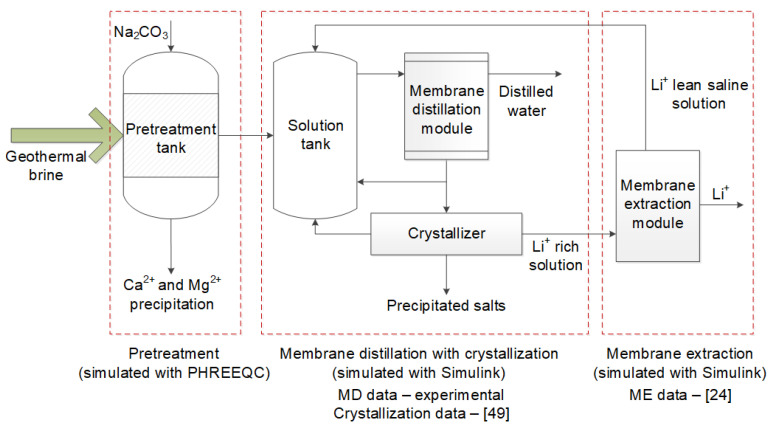
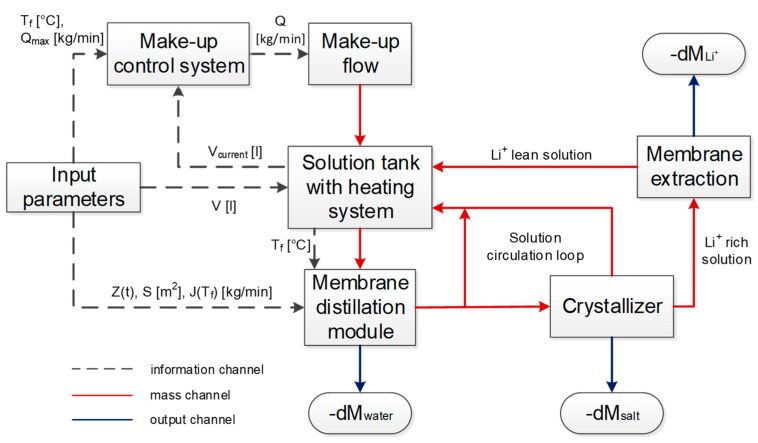
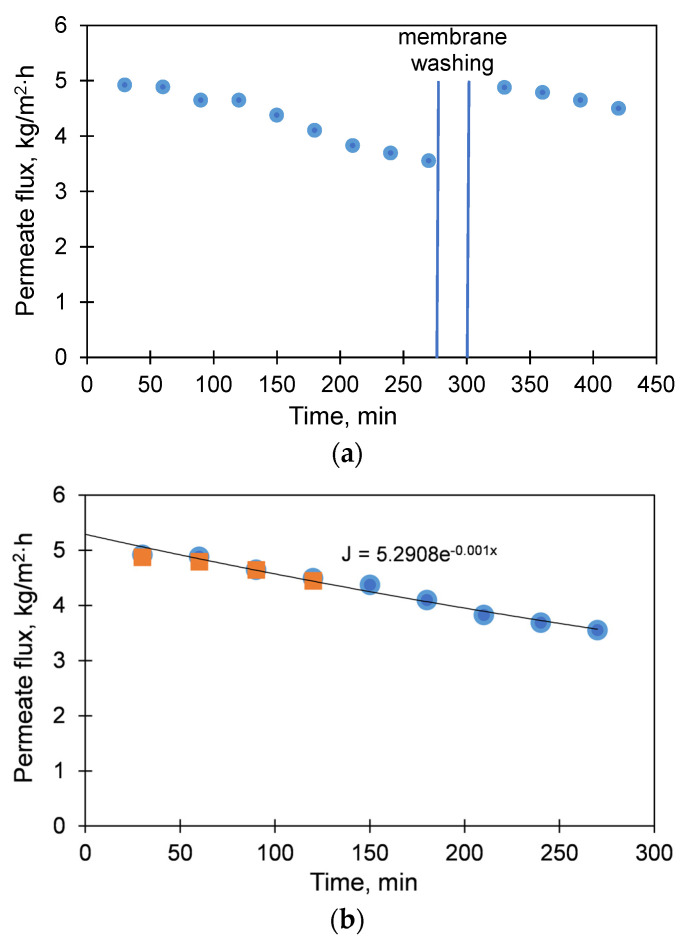
Lithium-rich geothermal waters are considered as an alternative source, and further concentration of lithium is required for its effective recovery. In this work, we have simulated a three-stage lithium recovery process including the brine softening by precipitation Ca2+/Mg2+ cations with sodium carbonate (calculated in PHREEQC), followed by an integrated system consisting of membrane distillation unit (water evaporation), crystallizer (NaCl precipitation), and membrane extraction (Li+ recovery), which was simulated in Simulink/MATLAB. It was shown that the deterioration of membrane performance in time due to scaling/fouling plays a critical role in the performance of the system resulting in the dramatic increase of the replaced membrane modules by a factor of 5. Low cost membranes are required. The process simulation based on the experimental and literature data on the high salinity solutions with the membrane distillation revealed that the specific productivity can be achieved in the range of 9.9–880 g (Li+) per square meter of membranes in the module used before its replacement. The increase of energy efficiency is needed. The mass-flow-rate of saline solution circulated to the crystallizer was set at its almost minimum value as 6.5 kg/min to enable its successful operation at the given parameters of the membrane distillation unit. In other words, the operation of the integrated system having 140 kg of saline solution in the loop and a membrane module of 2.5 m2 for concentration of lithium presence from 0.11 up to 2.3 g/kg would be associated with the circulation of about of 259 tons of saline solution per month between the distillation unit (60 °C) and the crystallizer (15 °C) to yield of up to 1.4 kg of lithium ions. The comprehensive summary and discussion are presented in the conclusions section.
Overview
The claims and statistics of this paper haven’t been checked yet.
Free: it reads the open-access text and checks the first 5 claims that cite a source we can check. Create a free account to check every claim.
Integrity signals
Registry
Cites
Statistics
Figures
Verification
Claims the paper makes
The claims and statistics of this paper haven’t been checked yet.
Free: it reads the open-access text and checks the first 5 claims that cite a source we can check. Create a free account to check every claim.
Claims other papers make about this one
Each is checked against this paper’s own text: does it say what the citing paper says it does?
The cited source says what the claim attributes to it.
In the citing paper
“They emphasized the need for low-cost membranes to alleviate the financial burden associated with frequent replacements.”
From Pathways to Greener Primary Lithium Extraction for a Really Sustainable Energy Transition: Environmental Challenges and Pioneering Innovations (2024) · cites this paper as [176]
The cited source says what the claim attributes to it.
In the citing paper
“Kalmykov et al. [176] identified membrane fouling and dirt accumulation as significant factors reducing system efficiency during lithium extraction from geothermal brines.”
From Pathways to Greener Primary Lithium Extraction for a Really Sustainable Energy Transition: Environmental Challenges and Pioneering Innovations (2024) · cites this paper as [176]
Self-check
Percentages, sums and reported differences re-computed from the paper’s own numbers.
The self-check needs the paper’s full text.
Citations
Cites
Plummer, L. N., & Busenberg, E. (1982) · Geochimica et Cosmochimica Acta · doi:10.1016/0016-7037(82)90056-4 · Cited by 1,886
Recovery and recycling of lithium: a review
Swain, B. (2017) · Separation and Purification Technology · doi:10.1016/j.seppur.2016.08.031 · Cited by 1,713
Membranes and theoretical modeling of membrane distillation: A review
Khayet, M. (2011) · Advances in Colloid and Interface Science · doi:10.1016/j.cis.2010.09.005 · Cited by 1,247 · cited 1×
“In this thermally-driven process, the membrane acts as a non-selective barrier that provides high fluxes of water vapors through the pores of the membrane and high selectivity since the saline water as the non-wetting liquid for hydrophobic membrane remains in the feed compartment [37,38].”
BackgroundTarascon, J.-M. (2010) · Nature Chemistry · doi:10.1038/nchem.680 · Cited by 1,157
Global lithium resources: relative importance of pegmatite, brine and other deposits
Kesler, S. E., Gruber, P. W., Medina, P. A., Keoleian, G. A., Everson, M. P., & Wallington, T. J. (2012) · Ore Geology Reviews · doi:10.1016/j.oregeorev.2012.05.006 · Cited by 1,140 · cited 1×
“The recovery of lithium from a different kind of natural brines such as geothermal brine is complicated by high water salinity 200–500 g/L and the presence of hardness ions, especially magnesium ions [13,14].”
BackgroundMembrane distillation: Recent developments and perspectives
Drioli, E., Ali, A., & Macedonio, F. (2015) · Desalination · doi:10.1016/j.desal.2014.10.028 · Cited by 1,107 · cited 1×
“The membrane distillation (MD) can be considered one of the effective approaches for the concentration of different kinds of brines with moderate or high salinity [36].”
BackgroundMembrane distillation at the water-energy nexus: limits, opportunities, and challenges
Deshmukh, A., Boo, C., Karanikola, V., Lin, S., Straub, A. P., Tong, T., Warsinger, D. M., & Elimelech, M. (2018) · Energy & Environmental Science · doi:10.1039/c8ee00291f · Cited by 1,090
Meshram, P., Pandey, B. D., & Mankhand, T. R. (2014) · Hydrometallurgy · doi:10.1016/j.hydromet.2014.10.012 · Cited by 982
Lithium availability and future production outlooks
Vikström, H., Davidsson, S., & Höök, M. (2013) · Applied Energy · doi:10.1016/j.apenergy.2013.04.005 · Cited by 926
Flexer, V., Baspineiro, C. F., & Galli, C. I. (2018) · Science of the Total Environment · doi:10.1016/j.scitotenv.2018.05.223 · Cited by 768 · cited 1×
“Due to its chemical activity, lithium can be found in nature only in the form of salts presented in more than 150 different minerals, solid ores (spodumene, petalite, and lepidolite), and salt brines (salt lakes and geothermal brines) [10].”
Background
Research works printed but not linked: 3
- 4. Martinet, S.; Le Cras, F.; Rouault, H.; Poinso, J.Y. Nouvelles voies dans les accumulateurs lithium et les électrolytes de batteries. Clefs CEA 2004, 50-51, 130.
- 12. Munk, L.; Hynek, S.; Bradley, D.C.; Boutt, D.; Labay, K.A.; Jochens, H. Lithium Brines: A Global Perspective, Chapter 14. In Rare Earth and Critical Elements in Ore Deposits;
- 25. Ryabtsev, A.D. Hydromineral raw materials-An inexhaustible source of lithium in the XXI century. Bull. Tomsk Polytech. Univ. Geo Assets Eng. 2004, 307, 64-70. (In Russian)
Cited by
Recent advances in lithium extraction from salt lake brine using coupled and tandem technologies
Zhang, J., Cheng, Z., Qin, X., Gao, X., Wang, M., & Xiang, X. (2023) · Desalination · doi:10.1016/j.desal.2022.116225 · Cited by 195
Nikkhah, H., Ipekçi, D., Xiang, W., Stoll, Z., Xu, P., Li, B., McCutcheon, J. R., & Beykal, B. (2024) · Chemical Engineering Journal · doi:10.1016/j.cej.2024.155349 · Cited by 154
Review of recent advances in lithium extraction from subsurface brines
Disu, B., Rafati, R., Haddad, A. S., Mendoza‐Roca, J. A., Iborra–Clar, M. I., & Bakhtiari, S. S. E. (2024) · Geoenergy Science and Engineering · doi:10.1016/j.geoen.2024.213189 · Cited by 96
Fouling and Membrane Degradation in Electromembrane and Baromembrane Processes
Apel, P. Y., Велизаров, С., Волков, А. В., Елисеева, Т. В., Nikonenko, V., Паршина, А. В., Pismenskaya, N. D., Popov, K., & Yaroslavtsev, A. B. (2022) · Membranes and Membrane Technologies · doi:10.1134/s2517751622020032 · Cited by 84
Zhao, X., Gong, Y., Gao, K., Wang, Y., & Yang, H. Y. (2023) · Chemical Engineering Journal · doi:10.1016/j.cej.2023.145975 · Cited by 78
Miao, J., Zhao, K., Guo, F., Xu, L., Xie, Y., & Deng, T. (2021) · Desalination · doi:10.1016/j.desal.2022.115570 · Cited by 70
Enhanced lithium separation from brines using nanofiltration (NF) technology: A review
Sajna, M. S., Elmakki, T., Zavahir, S., Tariq, H., Abdulhameed, A., Park, H., Shon, H. K., & Han, D. S. (2024) · Desalination · doi:10.1016/j.desal.2024.118148 · Cited by 58
Raiguel, S., Bogaert, L. V., Balcaen, T., & Binnemans, K. (2024) · Green Chemistry · doi:10.1039/d4gc04760e · Cited by 40
Hu, J., Harandi, H. B., Chen, Y., Zhang, L., Yin, H., & He, T. (2023) · Water Research · doi:10.1016/j.watres.2023.120513 · Cited by 38
“It has been extensively researched in geothermal brine concentration for lithium extraction technology (Afsari et al., 2023; Kalmykov et al., 2021; Li et al., 2019; Quilaqueo et al., 2022).”
Self-citationSustainable lithium extraction from liquid ores using membrane-based technologies: a review
Kumar, R., Choi, K.-W., Khan, M. A., Biswas, G. G., Cho, S., Chakrabortty, S., Tripathy, S. K., Kim, K., & Jeon, B. (2025) · Environmental Chemistry Letters · doi:10.1007/s10311-025-01871-2 · Cited by 38
Ruberti, M. (2024) · Sustainability · doi:10.3390/su17010160 · Cited by 35
Wagner-Wenz, R., Teppala, D. T., Necke, T., Brückner, F., Fabian, A., Horn, D. W., Woth, J., Zimmermann, J., Balke‐Grünewald, B., Weidenkaff, A., et al. (2024) · Water Research · doi:10.1016/j.watres.2024.122476 · Cited by 28
Tsivadze, A. Y., Bezdomnikov, A. A., Баулин, В. Е., Демина, Л. И., Birin, K. P., Баулин, Д. В., & Rogacheva, Y. I. (2022) · Molecules · doi:10.3390/molecules27103051 · Cited by 29
Lithium based battery systems: technological and environmental challenges and opportunities
Barbosa, J. C., Pinto, R. S., Serra, J. P., Costa, C. M., Lanceros-Méndez, S., & Gonçalves, R. (2025) · Journal of Materials Chemistry A · doi:10.1039/d5ta05419b · Cited by 25
Rogener, F., & Tetampel, L. (2022) · Membranes · doi:10.3390/membranes12111142 · Cited by 24
Wagh, P., Islam, S. Z., Lamichhane, T. N., Bhave, R. R., & Paranthaman, M. P. (2023) · ACS Omega · doi:10.1021/acsomega.3c05009 · Cited by 20
Harandi, H. B., Hu, J., Asadi, A., Sui, P., Zhang, L., & He, T. (2023) · Journal of Membrane Science · doi:10.1016/j.memsci.2023.122001 · Cited by 19
Self-citationRadi, M. A., Al-Isawi, O. A., Abdelghafar, A. A., Qiyas, A. F. A., AlMallahi, M. N., Khanafer, K., & Assad, M. E. H. (2022) · Arabian Journal of Geosciences · doi:10.1007/s12517-022-10115-4 · Cited by 25
Zhang, J., Chen, T., Ma, L., Hai, C., Sun, Y., Dong, S., He, X., Xu, Q., Chen, J., Su, H., et al. (2025) · Desalination · doi:10.1016/j.desal.2025.118570 · Cited by 19
Wolters, L., & Brusselaers, J. (2024) · The Extractive Industries and Society · doi:10.1016/j.exis.2024.101498 · Cited by 16
Bezdomnikov, A. A., Демина, Л. И., Баулин, В. Е., Sharov, V. E., Tarakanova, E. G., & Tsivadze, A. Y. (2024) · Desalination · doi:10.1016/j.desal.2024.117446 · Cited by 15
Evaporation–Extraction Membrane Process for the Extraction of Lithium from Salt Lakes
Kalmykov, D. O., Makaev, S. V., Golubev, G. S., & Волков, А. В. (2022) · Membranes and Membrane Technologies · doi:10.1134/s2517751622040059 · Cited by 12
Self-citationZeng, Y., Cao, X., Liu, J., Shao, S., Xu, J., Liao, K., Qiu, J., Jiang, L., & Li, W. (2026) · Water Research · doi:10.1016/j.watres.2026.125351 · Cited by 7
Selective Extraction of Lithium from Mineral, Hydromineral, and Secondary Raw Materials
Tsivadze, A. Y., Баулин, В. Е., Костикова, Г. В., & Bezdomnikov, A. A. (2023) · Herald of the Russian Academy of Sciences · doi:10.1134/s1019331623040068 · Cited by 6
“Recently, much attention has been paid to membrane technologies for lithium extraction; methods have already been developed to simultaneously separate lithium and obtain potable water [15].”
Lithium extraction methods and its application prospects: a review
Yersaiynova, A., Karshyga, Z., Muhammad, N. A. А., Idris, U. P. S., Yessengaziyev, A., & Orynbayev, B. (2025) · Kompleksnoe Ispolzovanie Mineralnogo Syra = Complex Use of Mineral Resources · doi:10.31643/2026/6445.21 · Cited by 8
Zakari, R. S. B., & Giwa, A. (2026) · Separation and Purification Technology · doi:10.1016/j.seppur.2026.136917 · Cited by 6
Wu, B. F., Li, T., & Ding, A. (2025) · Journal of environmental chemical engineering · doi:10.1016/j.jece.2025.117499 · Cited by 2
Huang, X., Neil, C. W., Ahmmed, B., Mehana, M. Z., Bhattacharya, S., Nicot, J., & Elliott, B. A. (2026) · Energy Conversion and Management X · doi:10.1016/j.ecmx.2026.101671 · Cited by 6
Wu, S., Zhao, T., Lan, D., Sun, J., Zhang, X., Liu, D., Xu, W., Ren, G., & Zhao, Z. (2026) · Advanced Materials · doi:10.1002/adma.73237 · Cited by 6
“Therefore, in many cases, temperature regulation of these high-temperature brines is required prior to lithium extraction, which can lead to increased processing time and operational cost [127, 128].”
Pretreatment Strategies for Direct Lithium Extraction from Brines: A Systematic Review
MacDonald, L., Camarillo, M. K., Stringfellow, W., & Busse, M. M. (2026) · Mineral Processing and Extractive Metallurgy Review · doi:10.1080/08827508.2026.2690395 · Cited by 2
Makaev, S. V., Kalmykov, D. O., Golubev, G. S., Eremeev, I. S., Hoang, T. L., Nguyen, T. D., & Волков, А. В. (2021) · Membranes and Membrane Technologies · doi:10.1134/s2517751621060056 · Cited by 2
Self-citationKalmykov, D. O., Anokhina, T., Леонидович, Б. И., Long, H. T., Nguyen, T. D., & Волков, А. В. (2023) · Membranes · doi:10.3390/membranes13020163 · Cited by 1
“The principle of operation of the FD-PC installation model was described in detail in previous articles by a team of authors on the subject of membrane and film distillation [11,17,27].”
MethodSelf-citationMusa, M. A., Suharyanto, A., Lalasari, L. H., Ichlas, Z. T., & Mubarok, M. Z. (2026) · Journal of Sustainable Metallurgy · doi:10.1007/s40831-026-01541-9 · Cited by 1
Lahav, O., Nativ, P., Kantemnidis, D., Tsirigoti, A., Birnhack, L., Aviezer, Y., & Dagan-Jaldety, C. (2026) · International Conference on Efficient & Sustainable Water Systems Management toward Worth Living Development (EWaS) · doi:10.3390/eesp2026044048 · Cited by 1
Selective extraction of lithium from mineral, hydromineral, and secondary raw materials
Tsivadze, A. Y., Баулин, В. Е., Костикова, Г. В., & Bezdomnikov, A. A. (2023) · Вестник Российской академии наук · doi:10.31857/s0869587323070101 · Cited by 3
THE LITHIUM BOOM: LITHIUM SOURCES AND PROSPECTS FOR THE RUSSIAN LITHIUM INDUSTRY
Tsivadze, A. Y., Bezdomnikov, A. A., & Костикова, Г. В. (2023) · Геология рудных месторождений · doi:10.31857/s001677702305009x · Cited by 1
Tao, G., Zhou, X., Chen, B., Jiang, Z., Cao, R., Li, Z., Ma, J., & Wang, Y. (2026) · Physics and Chemistry of the Earth Parts A/B/C · doi:10.1016/j.pce.2026.104409
Mutli-scale analysis of the impact of lithium on microorganisms
Fierling, N. (2024) · theses.fr (ABES) · doi:10.70675/dbd508f6z8b85z464azb7a2zc3207c4a7dfe
Metadata
- Authors
- Kalmykov, D., Makaev, S., Golubev, G., Eremeev, I., Vasilevsky, V., Song, J., He, T., & Volkov, A.
- Affiliations
- A.V. Topchiev Institute of Petrochemical Synthesis (RU)
- Chinese Academy of Sciences (CN)
- A.V.Topchiev Institute of Petrochemical Synthesis RAS, 29 Leninsky prospekt, 119991 Moscow, Russia
- ORCID
- Venue
- Membranes
- Publisher
- MDPI AG
- Published
- 2021-02-28
- Volume
- 11
- Issue
- 3
- Pages
- 175
- ISSN
- 2077-0375 (ISSN-L)
- PMC
- PMC8001782
- OpenAlex
- W3135380462
- Cited by
- 37
- References
- 66
- Citations by year
- 2026: 8 · 2025: 5 · 2024: 8 · 2023: 8 · 2022: 6 · 2021: 2
- FWCI
- 1.78
- Type
- journal article
- Language
- en
- Open access
- gold
- doi.org
- Licence
- Locations
- Membranes (publishedVersion, cc-by)
- PubMed Central (publishedVersion, cc-by)
- PubMed (publishedVersion)
- DOAJ (DOAJ: Directory of Open Access Journals) (submittedVersion, cc-by-sa)
- Funders
- Russian Foundation for Basic Research (20-58-53038)
- National Natural Science Foundation of China (52011530031)
- CAS International Collaboration (GJHZ2080)
- Topics
- Physical Sciences › Environmental Science › Water Science and Technology › Membrane Separation Technologies
- Physical Sciences › Materials Science › Metals and Alloys › Extraction and Separation Processes
- Physical Sciences › Chemical Engineering › Filtration and Separation › Membrane-based Ion Separation Techniques
- Keywords
- lithium recovery, geothermal brine, membrane distillation, membrane fouling, membrane scaling, sodium carbonate precipitation, crystallizer, NaCl precipitation, membrane extraction, lithium content, energy efficiency
About these checks
Registry, retraction, Cites and statistics results are computed, not judged, with one exception: a printed reference that no index lists is read once by a model before it counts as a citation error. Claims are extracted by a model and kept only when their quote appears verbatim in the text; each cited source is then checked, with a model’s help, for whether it says what the claim relies on. Those verdicts can be wrong — read the claim’s quote and the cited source before relying on one.
Statistics and arithmetic are recomputed, not judged.
Confidence bands are shown only for fields calibrated on our annotated test set. None is calibrated yet, so no band is shown.
What counts as a claim ›How we measure confidence ›How we check this ›
Are you an author, or do you see a problem with this page? Request a review
Data sources
Bibliographic data: Semantic Scholar, OpenAlex, Crossref.
Contains information from the Semantic Scholar Academic Graph Datasets, made available under the ODC Attribution License (ODC-BY 1.0).
Semantic Scholar’s data is described in: Kinney, R., et al. (2023). The Semantic Scholar Open Data Platform. arXiv:2301.10140.
