

Carbohydrate and Fat Oxidation in Muscle Assessed with Exercise Calorimetry in 6465 Subjects
Open accessThe DOI matches its Crossref record; 46 of the 47 references it cites were found in a registry or an index, and 1 are not checked yet; 28 of the 89 sources its claims cite were checked for support.
Abstract
Background/Objectives: Exercise calorimetry provides a means to quantify the relative contributions of lipid and carbohydrate (CHO) oxidation across a range of exercise intensities. This study aimed to investigate determinants of fat and CHO oxidation in 6465 subjects, including sex differences.
Verified 2026-11-22 · 1 reference not checked yet
Overview
CoChat Summary
## TL;DR
This retrospective single-center study of 6,465 people used exercise calorimetry to map fat and carbohydrate oxidation during graded cycling exercise. It found that sex, age, adiposity, and muscle mass all shape substrate use, and that carbohydrate oxidation rises with age and fat mass while maximal fat oxidation is higher relative to body size in women.
## Key findings
- The cohort included 6,465 individuals (4,561 women, 1,904 men), with mean age 46.45 ± 0.58 years and mean BMI 33.6 kg/m²; 70.2% of women and 67.8% of men were in the obesity range.
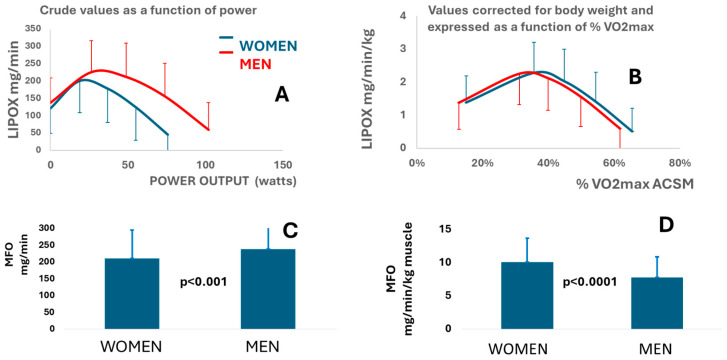
- For maximal lipid oxidation, women had a +30% higher value when corrected for muscle mass (10.10 ± 0.16 vs. 7.78 ± 0.20, p < 0.001) and reached the peak at a +9.2% higher fraction of VO2max (45.62% ± 0.01 vs. 41.73% ± 0.01, p < 0.001).
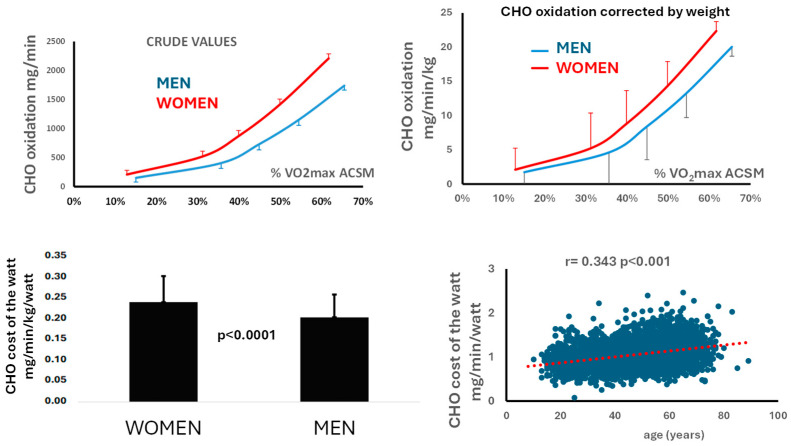
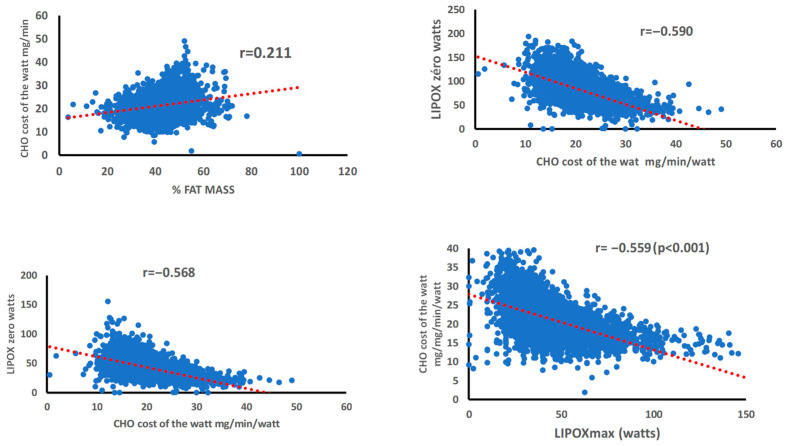
- The carbohydrate cost of the watt (CCW) was 17.8% higher in women than men (0.24 ± 0.004 vs. 0.21 ± 0.005 mg min−1 kg−1 W−1, p < 0.001) and was positively correlated with age (r = 0.343, p < 0.001).
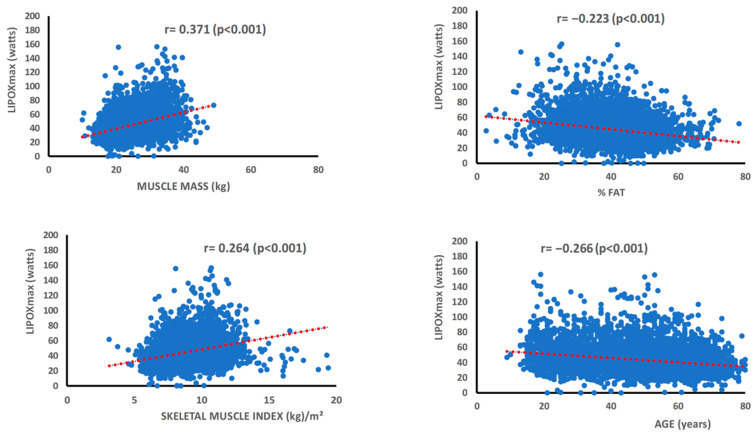
- In correlations, LIPOXmax was positively associated with lean/muscle mass and negatively associated with fat mass and age; the reported correlations included r = 0.371 with muscle mass, r = −0.223 with fat mass percentage, r = −0.266 with age, and r = −0.544 with CCW, all p < 0.001.
- Regression models explained a limited share of variance for lipid-oxidation endpoints: 15.4% for LIPOXmax in watts, 5.5% for LIPOXmax as %VO2max, and 10.8% for maximal fat oxidation; the CCW model explained 36.4%, and the LIPOXzero model 62.2%.
## Methods
- Design/sample: Retrospective, cross-sectional analysis of a single-center database of exercise calorimetry tests collected since 2004; tests stopped prematurely were excluded.
- Measurements/protocol: Participants fasted overnight and performed five 6-minute steady-state cycling stages at about 20, 30, 40, 50, and 60% of predicted maximal power; VO2 and VCO2 were recorded to calculate fat and carbohydrate oxidation.
- Analysis: The paper derived LIPOXmax, LIPOXzero, crossover point (COP), and CCW; statistical analysis used ANOVA, t-tests, correlations, and stepwise multiple regression with Bonferroni/Tukey adjustments.
## Limitations
- The authors explicitly state the study is retrospective and cross-sectional, the cohort is predominantly obese, and there was no information on diet, medication use, or training status; diabetes and dyslipidemia data were not available for the whole cohort.
- The regression models had low to modest adjusted R² values for some outcomes, and the authors note heteroscedasticity was violated in the regression models for LIPOXmax, MFO, CCW, and LIPOXzero.
- The text also makes evident that the sample was single-center and underrepresented endurance-trained athletes; the authors note the absence of sex-stratified/sex-adjusted analyses may limit interpretability.
Model-written summary. Check it against the paper before relying on it.
Integrity signals
Registry
Cites
Statistics
Figures
Verification
Claims the paper makes
20 Valid · 1 Not valid · 29 Not checked · 112 Own results and interpretations
The cited sources support only part of this claim — read each source’s verdict below.
In the paper
“Because exercise calorimetry remains insufficiently implemented in routine practice, most published studies are based on relatively small sample sizes [6,7,8,9,10].”
§ Carbohydrate and Fat Oxidation in Muscle Assessed with Exercise Calorimetry in 6465 Subjects > 1. Introduction
What the sources say
- Not checked — no full text of the sourcecites [6] Brun J.F. Jean E. Ghanassia E. Flavier S. Mercier J. Metabolic training: New paradigms of exercise training for metabolic diseases with exercise calorimetry targeting individuals Ann. Readapt. Med. Phys. 2007 50 528 534 10.1016/j.annrmp.2007.04.008 17521770 source
- Not checked — no full text of the sourcecites [7] Brun J.F. Romain A.J. Mercier J. Maximal lipid oxidation during exercise (Lipoxmax): From physiological measurements to clinical applications. Facts and uncertainties Sci. Sports 2011 26 57 71 10.1016/j.scispo.2011.02.001 source
- Partly supportedcites [8] Brun J.F. Varlet-Marie E. Romain A.J. Mercier J. Measurement and physiological relevance of the maximal lipid oxidation rate during exercise (LIPOXmax) Sports Medicine and Sports Injuries INTECH Hong Kong, China 2011 sourceExperimental — accuracy not yet measured
Section 3.4 (page unavailable) describes exercise-calorimetry reliability studies with 10 and 14 subjects, supporting that some published studies had small samples. The paper does not establish that most published exercise-calorimetry studies had relatively small samples. (LLM, conf=0.78)
- Not checked — no full text of the sourcecites [9] Brun J.F. Malatesta D. Sartorio A. Maximal lipid oxidation during exercise: A target for individualizing endurance training in obesity and diabetes? J. Endocrinol. Investig. 2012 35 686 691 22732137 doi:10.3275/8466
- Partly supportedcites [10] Brun J.F. Myzia J. Varlet-Marie E. Raynaud de Mauverger E. Mercier J. Beyond the Calorie Paradigm: Taking into Account in Practice the Balance of Fat and Carbohydrate Oxidation during Exercise? Nutrients 2022 14 1605 10.3390/nu14081605 35458167 PMC9027421 sourceExperimental — accuracy not yet measured
The paper’s Table 2 (shown in the Figure 10 passage; page unavailable) lists several LIPOXmax-training studies with small samples, including 21, 14, 7, and 8 participants. Those examples support the observation for this subset, but the paper does not establish that most published exercise-calorimetry studies have small samples. (LLM, conf=0.80)
plainstates a cause- Asserted: passes — The authors put it forward as true.
- Checkable: passes — It can be checked against evidence.
- Load-bearing: passes — The paper’s conclusions depend on it.
- Based: passes — The paper gives a reason why it holds.
The sources with a verdict support this claim; the rest weren’t checked yet, have no full text we could read, or their verdicts aren’t rated yet.
In the paper
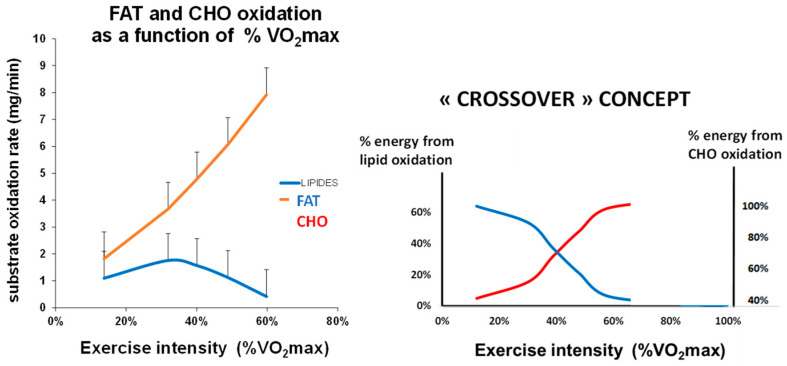
“and subsequently declines, becoming nearly extinguished at higher intensities referred to as LIPOXzero [8] or FATmin [5], typically above 60% of maximal aerobic capacity”
§ Carbohydrate and Fat Oxidation in Muscle Assessed with Exercise Calorimetry in 6465 Subjects > 1. Introduction
What the sources say
- Supportedcites [8] Brun J.F. Varlet-Marie E. Romain A.J. Mercier J. Measurement and physiological relevance of the maximal lipid oxidation rate during exercise (LIPOXmax) Sports Medicine and Sports Injuries INTECH Hong Kong, China 2011 source
Section 3.1 (Methodological aspects) identifies LIPOXzero as the point where lipids are no longer oxidized, at 85–90% of VO₂max—above the claimed 60% threshold. Section 5.3 also describes lipid oxidation as close to zero above the LIPOXmax zone. The separate term FATmin is attached to another citation in the citing sentence. (LLM, conf=0.88)
- Not checked — no full text of the sourcecites [5] Achten J. Gleeson M. Jeukendrup A.E. Determination of the exercise intensity that elicits maximal fat oxidation Med. Sci. Sports Exerc. 2002 34 92 97 10.1097/00005768-200201000-00015 11782653 source
plainstates a cause- Asserted: passes — The authors put it forward as true.
- Checkable: passes — It can be checked against evidence.
- Load-bearing: unclear — It is unclear whether the paper’s conclusions depend on it.
- Based: passes — The paper gives a reason why it holds.
- Supported
The cited sources support only part of this claim — read each source’s verdict below.
In the paper
“Therefore, the LIPOXmax calculation is only an application of the equation of lipid oxidation used in calorimetry and is model-independent [8].”
§ Carbohydrate and Fat Oxidation in Muscle Assessed with Exercise Calorimetry in 6465 Subjects > 2. Material and Methods > 2.4. Exercise Calorimetry
What the sources say
- Partly supportedcites [8] Brun J.F. Varlet-Marie E. Romain A.J. Mercier J. Measurement and physiological relevance of the maximal lipid oxidation rate during exercise (LIPOXmax) Sports Medicine and Sports Injuries INTECH Hong Kong, China 2011 sourceExperimental — accuracy not yet measured
Section 3.1 says LIPOXmax is calculated from the classical lipid-oxidation equation used in calorimetry, supporting the first part of the citing sentence. It also describes smoothing the oxidation curve to locate its maximum and discusses an alternative mathematical model; it does not establish that the calculation is model-independent. No page number is available in our copy. (LLM, conf=0.82)
plain- Asserted: passes — The authors put it forward as true.
- Checkable: passes — It can be checked against evidence.
- Load-bearing: unclear — It is unclear whether the paper’s conclusions depend on it.
- Based: passes — The paper gives a reason why it holds.
- Partly supported
The cited sources support only part of this claim — read each source’s verdict below.
In the paper
“Because exercise calorimetry remains insufficiently implemented in routine practice”
§ Carbohydrate and Fat Oxidation in Muscle Assessed with Exercise Calorimetry in 6465 Subjects > 1. Introduction
What the sources say
- Not checked — no full text of the sourcecites [6] Brun J.F. Jean E. Ghanassia E. Flavier S. Mercier J. Metabolic training: New paradigms of exercise training for metabolic diseases with exercise calorimetry targeting individuals Ann. Readapt. Med. Phys. 2007 50 528 534 10.1016/j.annrmp.2007.04.008 17521770 source
- Not checked — no full text of the sourcecites [7] Brun J.F. Romain A.J. Mercier J. Maximal lipid oxidation during exercise (Lipoxmax): From physiological measurements to clinical applications. Facts and uncertainties Sci. Sports 2011 26 57 71 10.1016/j.scispo.2011.02.001 source
- Could not verifycites [8] Brun J.F. Varlet-Marie E. Romain A.J. Mercier J. Measurement and physiological relevance of the maximal lipid oxidation rate during exercise (LIPOXmax) Sports Medicine and Sports Injuries INTECH Hong Kong, China 2011 sourceExperimental — accuracy not yet measured
Section 3.3 (page unavailable) discusses the reliability of exercise-calorimetry protocols, not how often calorimetry is implemented. Section 5.2 (page unavailable) says usual exercise recommendations for diabetes do not account for individual metabolic background, but does not establish that exercise calorimetry is insufficiently implemented in routine practice. Searches for routine clinical use and underuse found no passage addressing that claim. (LLM, conf=0.72)
- Not checked — no full text of the sourcecites [9] Brun J.F. Malatesta D. Sartorio A. Maximal lipid oxidation during exercise: A target for individualizing endurance training in obesity and diabetes? J. Endocrinol. Investig. 2012 35 686 691 22732137 doi:10.3275/8466
- Partly supportedcites [10] Brun J.F. Myzia J. Varlet-Marie E. Raynaud de Mauverger E. Mercier J. Beyond the Calorie Paradigm: Taking into Account in Practice the Balance of Fat and Carbohydrate Oxidation during Exercise? Nutrients 2022 14 1605 10.3390/nu14081605 35458167 PMC9027421 sourceExperimental — accuracy not yet measured
The Introduction (section 1; page unavailable) says that exercise training guided by lipid or carbohydrate oxidation did not reach a wide audience and that most exercise studies instead prescribed intensity as a percentage of aerobic capacity. This supports limited uptake of the approach, but it does not establish how widely exercise calorimetry is implemented in routine practice. (LLM, conf=0.82)
plain- Asserted: passes — The authors put it forward as true.
- Checkable: passes — It can be checked against evidence.
- Load-bearing: passes — The paper’s conclusions depend on it.
- Based: passes — The paper gives a reason why it holds.
Every source the paper cites for this claim was checked and supports it.
In the paper
“This asymmetric, bell-shaped lipid oxidation profile exhibits substantial interindividual and interpopulation variability”
§ Carbohydrate and Fat Oxidation in Muscle Assessed with Exercise Calorimetry in 6465 Subjects > 1. Introduction
What the sources say
- Supportedcites [10] Brun J.F. Myzia J. Varlet-Marie E. Raynaud de Mauverger E. Mercier J. Beyond the Calorie Paradigm: Taking into Account in Practice the Balance of Fat and Carbohydrate Oxidation during Exercise? Nutrients 2022 14 1605 10.3390/nu14081605 35458167 PMC9027421 source
The Gender section says that the point of maximum lipid oxidation and the amount of fat oxidized are widely variable among subjects. It also reports differences by sex, age, and obesity, supporting variability across populations. The paper describes the lipid-oxidation curve as asymmetrical and dome-shaped in §3.3; page numbers are unavailable in our copy. (LLM, conf=0.93)
plain- Asserted: passes — The authors put it forward as true.
- Checkable: passes — It can be checked against evidence.
- Load-bearing: unclear — It is unclear whether the paper’s conclusions depend on it.
- Based: passes — The paper gives a reason why it holds.
- Supported
81 more claims · 5 with their cited sources checked
Create a free account to see all 162 claims and to verify the 5 references still open.
- Probably not a substantial claim. 39
- It may state two separate claims as one. 50
Citations
Cites
Romijn, J. A., Coyle, E. F., Sidossis, L. S., Gastaldelli, A., Horowitz, J. F., Endert, E., & Wolfe, R. R. (1993) · American Journal of Physiology-Endocrinology and Metabolism · doi:10.1152/ajpendo.1993.265.3.e380 · Cited by 1,747 · cited 1×
“This method, which relies on the measurement of respiratory gas exchange, enables the quantification of carbohydrate and lipid oxidation rates during physical exertion [1–5].”
Estimation of skeletal muscle mass by bioelectrical impedance analysis
Janssen, I., Heymsfield, S. B., Baumgartner, R. N., & Ross, R. (2000) · Journal of Applied Physiology · doi:10.1152/jappl.2000.89.2.465 · Cited by 1,482
The role of estrogens in control of energy balance and glucose homeostasis
Mauvais-Jarvis, F., Clegg, D. J., & Hevener, A. L. (2013) · Endocrine Reviews · doi:10.1210/er.2012-1055 · Cited by 1,329 · cited 1×
“Additional experimental work further supports the role of estrogens in promoting lipolysis and lipid oxidation in both humans and cultured muscle cells [38–40].”
Measurement of substrate oxidation during exercise by means of gas exchange measurements
Jeukendrup, A. E., & Wallis, G. A. (2005) · International Journal of Sports Medicine · doi:10.1055/s-2004-830512 · Cited by 799 · cited 1×
“There has been controversy about the best duration of the steps, and many authors prefer to use shorter steps [23].”
Determination of the exercise intensity that elicits maximal fat oxidation
ACHTEN, J., GLEESON, M., & JEUKENDRUP, A. E. (2002) · Medicine & Science in Sports & Exercise · doi:10.1097/00005768-200201000-00015 · Cited by 551
Skeletal muscle fat oxidation: Timing and flexibility are everything
Kelley, D. E. (2005) · Journal of Clinical Investigation · doi:10.1172/jci25758 · Cited by 298 · cited 1×
“Impaired metabolic flexibility is associated with insulin resistance and type 2 diabetes [42] and can be improved through lifestyle interventions [43–45].”
San-Millán, I., & Brooks, G. A. (2018) · Sports Medicine · doi:10.1007/s40279-017-0751-x · Cited by 264 · cited 1×
“Impaired metabolic flexibility is associated with insulin resistance and type 2 diabetes [42] and can be improved through lifestyle interventions [43–45].”
Respiratory gas-exchange ratios during graded exercise in fed and fasted trained and untrained men
Bergman, B. C., & Brooks, G. A. (1999) · Journal of Applied Physiology · doi:10.1152/jappl.1999.86.2.479 · Cited by 262
Principles of Exercise Testing and Interpretation
Wasserman, K., Hansen, J. E., Sue, D. Y., Whipp, B. J., & Froelicher, V. F. (1987) · Journal of Cardiopulmonary Rehabilitation · doi:10.1097/00008483-198704000-00014 · Cited by 237
Balance of substrate oxidation during submaximal exercise in lean and obese people.
Pérez‐Martin, A., Dumortier, M., de Mauverger, É. R., Brun, J. ‐., Fédou, C., Bringer, J., & Mercier, J. G. (2001) · PubMed · Cited by 220
Self-citation
Research works printed but not linked: 1
- Perez-Martin A. Mercier J. Stress tests and exercise training program for diabetics—Initial metabolic evaluation Ann. Endocrinol. 2001 62 291 293
Cited by
Interactions Between Exercise Physiology and Metabolism
Gong, L., Xu, C., & Zhang, E. (2026) · Metabolites · doi:10.3390/metabo16040229
Metadata
- Authors
- Brun, J.-F., Varlet, E., Myzia, J., Varlet-Marie, E., Raynaud de Mauverger, E., & Mercier, J.
- Affiliations
- Université de Montpellier (FR)
- UFR des Sciences Pharmaceutiques et Biologiques, Laboratoire du Département de Physicochimie et Biophysique, Institut des Biomolécules Max Mousseron (IBMM), Université de Montpellier, 34093 Montpellier, France
- Unité d’Explorations Métaboliques et Musculaires (UEMM), Département de Physiologie Clinique, Hôpital Lapeyronie-CHU de Montpellier, Université de Montpellier, 34295 Montpellier, France
- Corresponding author
- Brun, Jean-Frédéric
- Venue
- Metabolites
- Publisher
- MDPI AG
- Published
- 2026-02-09
- Volume
- 16
- Issue
- 2
- Pages
- 121
- ISSN
- 2218-1989 (ISSN-L)
- PMC
- PMC12942149
- OpenAlex
- W7128441046
- Cited by
- 1
- References
- 40
- Citations by year
- 2026: 1
- FWCI
- 10.59
- Type
- journal article
- Language
- en
- Open access
- gold
- doi.org
- Licence
- Locations
- Metabolites (publishedVersion, cc-by)
- PubMed (publishedVersion)
- PubMed Central (publishedVersion, cc-by)
- HAL (submittedVersion, cc-by)
- DOAJ (DOAJ: Directory of Open Access Journals) (submittedVersion)
- Topics
- Health Sciences › Medicine › Physiology (medical) › Cardiovascular and exercise physiology
- Health Sciences › Nursing › Nutrition and Dietetics › Muscle metabolism and nutrition
- Health Sciences › Medicine › Orthopedics and Sports Medicine › Sports Performance and Training
- Keywords
- fat oxidation, carbohydrate oxidation, substrate utilization, body composition, adiposity, sex differences, age effects, lean body mass, fat mass, metabolic flexibility, obesity, exercise-induced hypoglycemia, crossover point
About these checks
Registry, retraction, Cites and statistics results are computed, not judged, with one exception: a printed reference that no index lists is read once by a model before it counts as a citation error. Claims are extracted by a model and kept only when their quote appears verbatim in the text; each cited source is then checked, with a model’s help, for whether it says what the claim relies on. Those verdicts can be wrong — read the claim’s quote and the cited source before relying on one.
The claim verdicts this report counts are experimental: their accuracy is not yet measured.
A language model drew the claims from the paper on 2026-09-28, under version 3 of the claim definition (model deepseek-v4.1-flash, prompt extract-v3).
A second model labelled each claim on 2026-09-28 (model jev-1.13-20260917, definition revision gold-guideline-v0.2).
Cited sources are checked with a language model’s help (gpt-6-sol).
Statistics and arithmetic are recomputed, not judged.
Confidence bands are shown only for fields calibrated on our annotated test set. None is calibrated yet, so no band is shown.
What counts as a claim ›How we measure confidence ›How we check this ›
Are you an author, or do you see a problem with this page? Request a review
Data sources
Bibliographic data: Semantic Scholar, OpenAlex, Crossref.
Contains information from the Semantic Scholar Academic Graph Datasets, made available under the ODC Attribution License (ODC-BY 1.0).
Semantic Scholar’s data is described in: Kinney, R., et al. (2023). The Semantic Scholar Open Data Platform. arXiv:2301.10140.
