

The DOI matches its Crossref record; 24 of the 25 references it cites were found in a registry or an index.
Evaluation of the Effects of Mitragyna speciosa Alkaloid Extract on Cytochrome P450 Enzymes Using a High Throughput Assay
Open accessAbstract
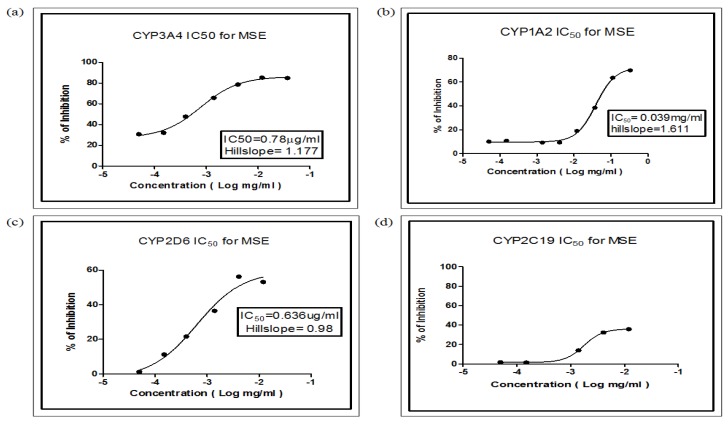
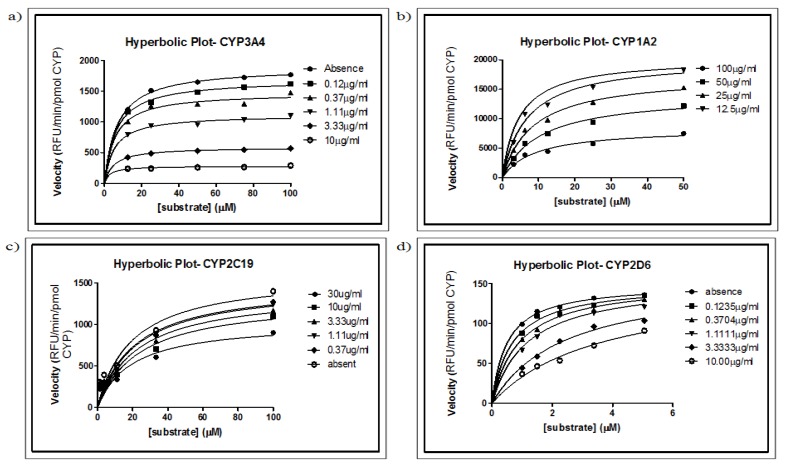
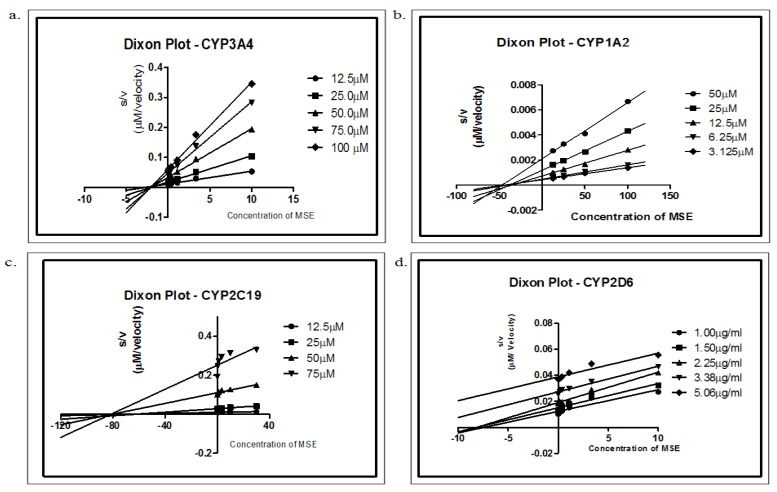
The extract from Mitragyna speciosa has been widely used as an opium substitute, mainly due to its morphine-like pharmacological effects. This study investigated the effects of M. speciosa alkaloid extract (MSE) on human recombinant cytochrome P450 (CYP) enzyme activities using a modified Crespi method. As compared with the liquid chromatography-mass spectrometry method, this method has shown to be a fast and cost-effective way to perform CYP inhibition studies. The results indicated that MSE has the most potent inhibitory effect on CYP3A4 and CYP2D6, with apparent half-maximal inhibitory concentration (IC50) values of 0.78 µg/mL and 0.636 µg/mL, respectively. In addition, moderate inhibition was observed for CYP1A2, with an IC50 of 39 µg/mL, and weak inhibition was detected for CYP2C19. The IC50 of CYP2C19 could not be determined, however, because inhibition was < 50%. Competitive inhibition was found for the MSE-treated CYP2D6 inhibition assay, whereas non-competitive inhibition was shown in inhibition assays using CYP3A4, CYP1A2 and CYP2C19. Quinidine (CYP2D6), ketoconazole (CYP3A4), tranylcypromine (CYP2C19) and furafylline (CYP1A2) were used as positive controls throughout the experiments. This study shows that MSE may contribute to an herb-drug interaction if administered concomitantly with drugs that are substrates for CYP3A4, CYP2D6 and CYP1A2.
Overview
The claims and statistics of this paper haven’t been checked yet.
Run the check — free, no account needed. It reads the open-access text and checks the sources it cites.
Integrity signals
Registry
Cites
Statistics
Figures
Verification
Claims the paper makes
The claims and statistics of this paper haven’t been checked yet.
Run the check — free, no account needed. It reads the open-access text and checks the sources it cites.
Claims other papers make about this one
Each is checked against this paper’s own text: does it say what the citing paper says it does?
The source backs part of the claim, not all of it — or backs it for a different population, condition or comparison.
In the citing paper
“According to Kong et al. [21], the potency of a test compound can be classified according to its IC50 values, as potent, if IC50 ≤ 20 μg/mL or ≤10 μM, moderate if IC50 20–100 μg/mL or 10–50 μM, or weak if IC50 ≥ 100 μg/mL or ≥50 μM.”
From Inhibition of Human Cytochrome P450 Enzymes by Bacopa monnieri Standardized Extract and Constituents (2014) · cites this paper as Kong et al. [21]
Experimental — accuracy not yet measured
Self-check
Percentages, sums and reported differences re-computed from the paper’s own numbers.
The self-check needs the paper’s full text.
Citations
Cites
Cornish-Bowden, A. J. (1974) · Biochemical Journal · doi:10.1042/bj1370143 · Cited by 944
Microtiter Plate Assays for Inhibition of Human, Drug-Metabolizing Cytochromes P450
Crespi, C. L., Miller, V. P., & Penman, B. W. (1997) · Analytical Biochemistry · doi:10.1006/abio.1997.2145 · Cited by 406
St John's wort ( Hypericum perforatum ): drug interactions and clinical outcomes
Henderson, L., Yue, Q., Bergquist, C., Gerdén, B., & Arlett, P. R. (2002) · British Journal of Clinical Pharmacology · doi:10.1046/j.1365-2125.2002.01683.x · Cited by 380
Drug Interactions Due to Cytochrome P450
Ogu, C. C., & Maxa, J. L. (2000) · Baylor University Medical Center Proceedings · doi:10.1080/08998280.2000.11927719 · Cited by 370 · cited 1×
“For example, ketoconazole and quinidine are well-known CYP3A4 inhibitors that can induce life-threatening heart rhythm disorders when co-administered with other substrates of CYP3A4, such as erythromycin [7,8].”
BackgroundInhibition and induction of human cytochrome P450 (CYP) enzymes
Pelkonen, O., MÄEENPÄEÄ, J., Taavitsainen, P., Rautio, A., & Raunio, H. (1998) · Xenobiotica · doi:10.1080/004982598238886 · Cited by 358
Effects of ginseng components on c-DNA-expressed cytochrome P450 enzyme catalytic activity
Henderson, G. L., Harkey, M. R., Gershwin, M. E., Hackman, R. M., Stern, J. S., & Stresser, D. M. (1999) · Life Sciences · doi:10.1016/s0024-3205(99)00407-5 · Cited by 274
Matsumoto, K., Horie, S., Ishikawa, H., Takayama, H., Aimi, N., Ponglux, D., & Watanabe, K. (2004) · Life Sciences · doi:10.1016/j.lfs.2003.09.054 · Cited by 229
Opioid receptors and legal highs:Salvia divinorumand Kratom
Babu, K. M., McCurdy, C. R., & Boyer, E. W. (2008) · Clinical Toxicology · doi:10.1080/15563650701241795 · Cited by 222
Donato, M. T., Jiménez, N., Castell, J. V., & Gómez-Lechón, M. J. (2004) · Drug Metabolism and Disposition · doi:10.1124/dmd.32.7.699 · Cited by 214
Effects of herbal components on cDNA-expressed cytochrome P450 enzyme catalytic activity
Zou, L., Harkey, M. R., & Henderson, G. L. (2002) · Life Sciences · doi:10.1016/s0024-3205(02)01913-6 · Cited by 204
Fowler, S. M., & Zhang, H. (2008) · The AAPS Journal · doi:10.1208/s12248-008-9042-7 · Cited by 183
Ito, K., Ogihara, K., Kanamitsu, S.-I., & Itoh, T. (2003) · Drug Metabolism and Disposition · doi:10.1124/dmd.31.7.945 · Cited by 151
Drug-Related Side Effects of Long-term Intrathecal Morphine Therapy
Ruan, X. (2007) · Pain Physician · doi:10.36076/ppj.2007/10/357 · Cited by 135
Suchitra, T., Matsumoto, K., Tohda, M., Takayama, H., Aimi, N., Sakai, S., & Watanabe, H. (1998) · Life Sciences · doi:10.1016/s0024-3205(98)00075-7 · Cited by 135
Philipp, A. A., Wissenbach, D. K., Zoerntlein, S. W., Klein, O. N., Kanogsunthornrat, J., & Maurer, H. H. (2009) · Journal of Mass Spectrometry · doi:10.1002/jms.1607 · Cited by 119
Chittrakarn, S., Sawangjaroen, K., Prasettho, S., Janchawee, B., & Keawpradub, N. (2007) · Journal of Ethnopharmacology · doi:10.1016/j.jep.2007.11.032 · Cited by 81
Reanmongkol, W., Keawpradub, N., & Sawangjaroen, K. (2007) · PSU Knowledge Bank (Prince of Songkla University) · Cited by 67
Azizi, J., Ismail, S., Mordi, M. N., Ramanathan, S., Said, M. I. M., & Mansor, S. M. (2010) · Molecules · doi:10.3390/molecules15010432 · Cited by 66
Alkaloids from Mitragyna speciosa
Houghton, P. J., Latiff, A. A., & Said, I. M. (1991) · Phytochemistry · doi:10.1016/0031-9422(91)84152-i · Cited by 59
Saxena, A., Tripathi, K. P., Roy, S., Khan, F., & Sharma, A. K. (2008) · Bioinformation · doi:10.6026/97320630003198 · Cited by 58
Alkaloids from Mitragyna speciosa (Korth.)
Beckett, A. H., Shellard, E. J., Phillipson, J. D., & Lee, C. M. (1965) · Journal of Pharmacy and Pharmacology · doi:10.1111/j.2042-7158.1965.tb07599.x · Cited by 49
Hanapi, N. A., Azizi, J., Ismail, S. B., & Mansor, S. M. (2010) · International Journal of Pharmacology · doi:10.3923/ijp.2010.494.499 · Cited by 32
Saidin, N. A., & Gooderham, N. J. (2007) · Toxicology · doi:10.1016/j.tox.2007.06.045 · Cited by 9
Limited applicability of 7-methoxy-4-trifluoromethylcoumarin as a CYP2C9-selective substrate.
Porrogi, P., Kob́ori, L., Köhalmy, K., Gulyás, J., Vereczkey, L., & Monostory, K. (2008) · PubMed · Cited by 8
Cited by
Sorted by citations
Kruegel, A. C., & Grundmann, O. (2017) · Neuropharmacology · doi:10.1016/j.neuropharm.2017.08.026 · Cited by 234
Kruegel, A. C., Uprety, R., Grinnell, S. G., Langreck, C. B., Pekarskaya, E. A., Rouzic, V. L., Ansonoff, M. A., Gassaway, M. M., Pintar, J. E., Pasternak, G. W., et al. (2019) · ACS Central Science · doi:10.1021/acscentsci.9b00141 · Cited by 230
The pharmacology and toxicology of kratom: from traditional herb to drug of abuse
Warner, M. L., Kaufman, N. C., & Grundmann, O. (2015) · International Journal of Legal Medicine · doi:10.1007/s00414-015-1279-y · Cited by 211
Kratom—Pharmacology, Clinical Implications, and Outlook: A Comprehensive Review
Eastlack, S. C., Cornett, E. M., & Kaye, A. D. (2020) · Pain and Therapy · doi:10.1007/s40122-020-00151-x · Cited by 190
Pharmacokinetics of mitragynine in man
Wananukul, W., Trakulsrichai, S., Sathirakul, K., Auparakkitanon, S., Krongvorakul, J., Sueajai, J., Noumjad, N., & Sukasem, C. (2015) · Drug Design Development and Therapy · doi:10.2147/dddt.s79658 · Cited by 140
Metadata
- Authors
- Kong, W. M., Chik, Z., Ramachandra, M., Subramaniam, U., Aziddin, R. E. R., & Mohamed, Z.
- Affiliations
- University of Malaya (MY)
- Aurigene Discovery Technologies (India) (IN)
- Aurigene Discovery Technologies (M) Sdn. Bhd, Malaysia, 57000 Bukit Jalil, Kuala Lumpur, Malaysia
- Hospital Kuala Lumpur (MY)
- Corresponding author
- Kong, Wai Mun
- Venue
- Molecules
- Publisher
- MDPI AG
- Published
- 2011-08-29
- Volume
- 16
- Issue
- 9
- Pages
- 7344-7356
- ISSN
- 1420-3049 (ISSN-L)
- PMC
- PMC6264431
- OpenAlex
- W2122692346
- Cited by
- 88
- References
- 25
- Citations by year
- 2026: 4 · 2025: 1 · 2024: 5 · 2023: 5 · 2022: 9 · 2021: 10 · 2020: 8 · 2019: 10 · 2018: 2 · 2017: 8 · 2016: 11 · 2015: 5 · 2014: 6 · 2013: 1 · 2012: 3
- FWCI
- 3.37
- Type
- journal article
- Language
- en
- Open access
- gold
- doi.org
- Licence
- Locations
- Molecules (publishedVersion, cc-by)
- Europe PMC (PubMed Central) (publishedVersion, other-oa)
- PubMed Central (publishedVersion, cc-by)
- PubMed (publishedVersion)
- DOAJ (DOAJ: Directory of Open Access Journals) (submittedVersion, cc-by-sa)
- Funders
- Universiti Malaya
- Topics
- Life Sciences › Pharmacology, Toxicology and Pharmaceutics › Pharmacology › Pharmacogenetics and Drug Metabolism
- Life Sciences › Pharmacology, Toxicology and Pharmaceutics › Pharmacology › Alkaloids: synthesis and pharmacology
- Life Sciences › Pharmacology, Toxicology and Pharmaceutics › Toxicology › Forensic Toxicology and Drug Analysis
- Keywords
- Mitragyna speciosa, kopi, alkaloid extract, cytochrome P450 inhibition, CYP3A4, CYP2D6, CYP1A2, CYP2C19, herb-drug interactions, competitive inhibition, non-competitive inhibition, high-throughput assay
- MeSH terms
- Alkaloids, Aryl Hydrocarbon Hydroxylases, Humans, Kinetics, Plant Extracts, Recombinant Proteins, Plant Leaves, Mitragyna, Enzyme Assays, High-Throughput Screening Assays
About these checks
Registry, retraction, Cites and statistics results are computed, not judged, with one exception: a printed reference that no index lists is read once by a model before it counts as a citation error. Claims are extracted by a model and kept only when their quote appears verbatim in the text; each cited source is then checked, with a model’s help, for whether it says what the claim relies on. Those verdicts can be wrong — read the claim’s quote and the cited source before relying on one.
Statistics and arithmetic are recomputed, not judged.
Confidence bands are shown only for fields calibrated on our annotated test set. None is calibrated yet, so no band is shown.
What counts as a claim ›How we measure confidence ›How we check this ›
Are you an author, or do you see a problem with this page? Request a review
