

The DOI matches its Crossref record; 46 of the 46 references it cites were found in a registry or an index; 9 of the 28 sources its claims cite were checked for support.
A Novel DLLME Method Involving a Solidifying Hydrophobic Deep Eutectic Solvent Using Hydrophilic Deep Eutectic Solvent as the Dispersant for the Determination of Polychlorinated Biphenyls in Water Samples
Open accessAbstract
This paper presents a novel dispersive liquid–liquid microextraction (DLLME) method that employs solidified hydrophobic deep eutectic solvent (DES) with hydrophilic DES acting as the dispersant. The aim is to enrich polychlorinated biphenyls (PCBs) from water samples for subsequent determination by gas chromatography–mass spectrometry. The effects of both the hydrophobic DES as the extractant and the hydrophilic DES as the dispersant were thoroughly investigated. Optimization of the key factors influencing extraction efficiency was performed, and the method was subsequently validated. Specifically, a hydrophobic DES called DES2, prepared by combining thymol and decanoic acid in a molar ratio of 3:2, was selected as the extraction solvent. Meanwhile, a hydrophilic DES named DES6, prepared from choline chloride and acetic acid in a molar ratio of 1:2, was chosen as a dispersant. Under the optimal extraction conditions, the developed method exhibited excellent linearity over the concentration range of 0.01–5.0 µg/L, low limits of detection ranging from 3.0 to 5.1 ng/L, relative standard deviations less than 4.1%, and enrichment factors between 182 and 204 for PCBs. Finally, the effectiveness of the developed method was successfully demonstrated through residue determination of PCBs in water samples.
Overview
CoChat Summary
TL;DR
The paper develops a DLLME method using a solidifying hydrophobic DES (thymol:decanoic acid 3:2) as extractant and a hydrophilic DES (ChCl:acetic acid 1:2) as dispersant for GC-MS determination of seven indicator PCBs in water. Under optimized conditions it reports low LODs (3.0–5.1 ng/L), high enrichment factors (182–204), and satisfactory recovery from spiked water samples.
Key findings
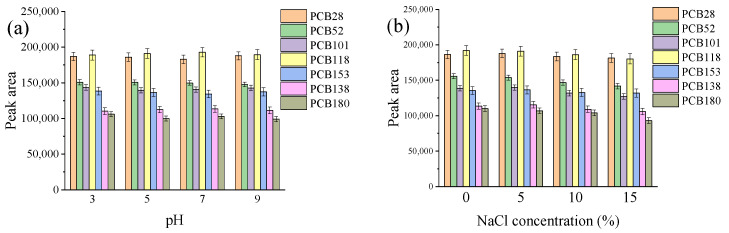
- DES2 (thymol:decanoic acid, 3:2) was selected as extractant and DES6 (ChCl:acetic acid, 1:2) as dispersant; optimal conditions used 50 µL DES2, 300 µL DES6, and 2 min ultrasonication, with no pH adjustment or salt addition needed.
- Method validation showed linearity over 0.01–5.0 µg/L (R² ≥ 0.9985), LODs of 3.0–5.1 ng/L, LOQs of 10.1–17.0 ng/L, RSDs below 4.1% at 0.1 µg/L (n = 5), and enrichment factors of 182–204 for the seven PCBs.
- In tap water, river water, and industrial wastewater spiked at 0.1 and 1 µg/L, recoveries ranged from 92.58% to 103.9%, with RSDs between 2.1% and 4.5%.
- Compared with other reported microextraction methods, the developed method gave comparable or lower LODs and used extractant/dispersant reported as more environmentally friendly.
Methods
- Design: A DLLME-SFOD variant using a hydrophobic DES extractant and hydrophilic DES dispersant, coupled to GC-MS in SIM mode for seven indicator PCBs (congeners 28, 52, 101, 118, 138, 153, and 180).
- Sample/procedure: A 12 mL water sample was mixed with 50 µL DES2 and 300 µL DES6, ultrasonicated for 2 min, centrifuged at 4000 rpm for 5 min, frozen at −20 °C for 5 min to solidify the upper layer, then 1 µL of melted extract was injected.
- Analysis: GC-MS with an Agilent DB-5ms column and helium carrier gas at 1.2 mL/min; validation included linearity, R², LOD, LOQ, precision, and enrichment factors, followed by spiked real-water recovery tests.
Limitations
- The paper does not state explicit limitations.
- Evident from the text: validation and real-sample application are limited to seven indicator PCBs and water matrices (tap water, river water, industrial wastewater); no non-water matrices were tested.
- Evident from the text: hydrophilic DES decomposition was observed after water addition and proposed to aid dispersion, but the decomposition products or mechanism were not characterized in this paper.
Model-written summary. Check it against the paper before relying on it.
Integrity signals
Registry
Cites
Statistics
Figures




Verification
Claims the paper makes
6 Valid · 2 Not valid · 4 Not checked · 29 Own results and interpretations
Every source the paper cites for this claim was checked and supports it.
In the paper
“This decomposition of the hydrophilic DES could facilitate dispersion of the extractant, leading to enhanced extraction efficiency [32].”
§ A Novel DLLME Method Involving a Solidifying Hydrophobic Deep Eutectic Solvent Using Hydrophilic Deep Eutectic Solvent as the Dispersant for the Determination of Polychlorinated Biphenyls in Water Samples > 2. Results and Discussion > 2.2. Optimization of the DLLME-SHDES-HDESD Procedure
What the sources say
- Supportedcites [32] Shishov, 2018, Deep eutectic solvents as a new kind of dispersive solvent for dispersive liquid–liquid microextraction, RSC Adv. source
The paper reports that the DES mixes with the aqueous phase and that its dissolution and decomposition disperse the extraction solvent (passages 3–4, section labeled Abstract). It also links DES-assisted dispersion to improved extraction efficiency (passages 2 and 5, section labeled Abstract). (LLM, conf=0.93)
hedgedstates a cause- Asserted: passes — The authors put it forward as true.
- Checkable: passes — It can be checked against evidence.
- Load-bearing: passes — The paper’s conclusions depend on it.
- Based: passes — The paper gives a reason why it holds.
- Supported
Every source the paper cites for this claim was checked and supports it.
In the paper
“Hence, a smaller extractant volume is usually preferable to increase analyte enrichment [15].”
§ A Novel DLLME Method Involving a Solidifying Hydrophobic Deep Eutectic Solvent Using Hydrophilic Deep Eutectic Solvent as the Dispersant for the Determination of Polychlorinated Biphenyls in Water Samples > 2. Results and Discussion > 2.2. Optimization of the DLLME-SHDES-HDESD Procedure
What the sources say
- Supportedcites [15] El-Deen, A.K., and Shimizu, K. (2021). Deep eutectic solvents as promising green solvents in dispersive liquid–liquid microextraction based on solidification of floating organic droplet: Recent applications, challenges and future perspectives. Molecules, 26. source
Section 4.2 states that increasing extractant volume lowers the enrichment factor through dilution and that lower volumes are preferred in DLLME-SFOD. It also says that using a lower volume boosts the enrichment factor, while noting that the volume must remain sufficient for analysis. (LLM, conf=0.91)
plainstates a cause- Asserted: passes — The authors put it forward as true.
- Checkable: passes — It can be checked against evidence.
- Load-bearing: passes — The paper’s conclusions depend on it.
- Based: passes — The paper gives a reason why it holds.
- Supported
A result the paper reports from its own data — it cites no other source for it, so there is none to check. The quote shows it is in the paper.
In the paper
“each hydrophobic DES has a lower melting point compared with its pure components (Figure S3).”
§ A Novel DLLME Method Involving a Solidifying Hydrophobic Deep Eutectic Solvent Using Hydrophilic Deep Eutectic Solvent as the Dispersant for the Determination of Polychlorinated Biphenyls in Water Samples > 2. Results and Discussion > 2.1. Characterization of DESs
plain- Asserted: passes — The authors put it forward as true.
- Checkable: passes — It can be checked against evidence.
- Load-bearing: passes — The paper’s conclusions depend on it.
- Based: passes — The paper gives a reason why it holds.
A result the paper reports from its own data — it cites no other source for it, so there is none to check. The quote shows it is in the paper.
In the paper
“The results presented in Figure 2a indicate that DES6 yielded a higher extraction efficiency compared to the other dispersants.”
§ A Novel DLLME Method Involving a Solidifying Hydrophobic Deep Eutectic Solvent Using Hydrophilic Deep Eutectic Solvent as the Dispersant for the Determination of Polychlorinated Biphenyls in Water Samples > 2. Results and Discussion > 2.2. Optimization of the DLLME-SHDES-HDESD Procedure
hedgedstates a cause- Asserted: passes — The authors put it forward as true.
- Checkable: passes — It can be checked against evidence.
- Load-bearing: passes — The paper’s conclusions depend on it.
- Based: passes — The paper gives a reason why it holds.
A result the paper states — it cites no source for it, so there is none to check. The quote shows it is in the paper.
In the paper
“The results showed that a larger peak area of the PCBs was obtained when 50 μL of DES2 was used (Figure 1b).”
§ A Novel DLLME Method Involving a Solidifying Hydrophobic Deep Eutectic Solvent Using Hydrophilic Deep Eutectic Solvent as the Dispersant for the Determination of Polychlorinated Biphenyls in Water Samples > 2. Results and Discussion > 2.2. Optimization of the DLLME-SHDES-HDESD Procedure
plainstates an association- Asserted: passes — The authors put it forward as true.
- Checkable: passes — It can be checked against evidence.
- Load-bearing: passes — The paper’s conclusions depend on it.
- Based: passes — The paper gives a reason why it holds.
25 more claims
Create a free account to see all 41 claims and every source verdict.
- Probably not a substantial claim. 7
- It may state two separate claims as one. 4
- The quote only partly states this claim. 1
Claims other papers make about this one
Each is checked against this paper’s own text: does it say what the citing paper says it does?
The cited source says what the claim attributes to it.
In the citing paper
“Among these, DLLME-based methods are still widely adopted due to their fast extraction kinetics, reduced solvent usage, simple sample handling, and high preconcentration capability [46,47,57,63,66,67,71,81,83,85,87,89,90].”
From Eco-Friendly Deep Eutectic Solvent-Based Extraction Technologies: A Comprehensive Review of Principles, Applications, and Comparative Insights (2026) · cites this paper as [85]
In the citing paper
“Solidification-based approaches, such as DLLME-SFOD and floating organic drop microextraction, overcome a key limitation of liquid-phase microextraction techniques, particularly the difficulty associated with post-extraction solvent recovery [49,57,60,62,69,80,85,97].”
From Eco-Friendly Deep Eutectic Solvent-Based Extraction Technologies: A Comprehensive Review of Principles, Applications, and Comparative Insights (2026) · cites this paper as [85]
Citations
Cites
Determination of organic compounds in water using dispersive liquid–liquid microextraction
Rezaee, M., Assadi, Y., Milani Hosseini, M.-R., Aghaee, E., Ahmadi, F., & Berijani, S. (2006) · Journal of Chromatography A · doi:10.1016/j.chroma.2006.03.007 · Cited by 3,402
Application of deep eutectic solvents in analytical chemistry. A review
Shishov, A., Bulatov, A., Locatelli, M., Carradori, S., & Andruch, V. (2017) · Microchemical Journal · doi:10.1016/j.microc.2017.07.015 · Cited by 617 · cited 1×
“Moreover, some DESs are cost-effective, have low toxicity, and are biodegradable, making them attractive alternatives to traditional organic solvents in microextraction [18–20].”
BackgroundApplications of polychlorinated biphenyls
Erickson, M. D., & Kaley, R. G. (2011) · Environmental Science and Pollution Research · doi:10.1007/s11356-010-0392-1 · Cited by 454 · cited 1×
“Polychlorinated biphenyls (PCBs) are a group of human-made chlorinated chemical compounds that were extensively used in various industrial sectors owing to their exceptional physicochemical properties [1].”
BackgroundLeong, M.-I., & Huang, S.-D. (2008) · Journal of Chromatography A · doi:10.1016/j.chroma.2008.09.111 · Cited by 413 · cited 1×
“DLLME based on solidification of floating organic droplets (DLLME-SFOD) is a more recent variant of DLLME; by this method, the floating solvent used for extraction can be easily collected from the aqueous phase after solidifying at low temperatures [14].”
MethodMakoś, P., Przyjazny, A., & Boczkaj, G. (2018) · Journal of Chromatography A · doi:10.1016/j.chroma.2018.07.070 · Cited by 342
Status and advances of deep eutectic solvents for metal separation and recovery
Yuan, Z., Liu, H., Yong, W. F., She, Q., & Esteban, J. (2022) · Green Chemistry · doi:10.1039/d1gc03851f · Cited by 329
Beyond dispersive liquid–liquid microextraction
Leong, M.-I., Fuh, M.-R., & Huang, S.-D. (2014) · Journal of Chromatography A · doi:10.1016/j.chroma.2014.02.021 · Cited by 241 · cited 1×
“The extractant must possess specific properties such as immiscibility with water, a density lower than water, a melting point near room temperature, and a high partition coefficient for the analytes [15,16].”
BackgroundPatterson, Jr., Wong, L.-Y., Turner, W. E., Caudill, S. P., DiPietro, E. S., McClure, P. C., Cash, T. P., Osterloh, J. D., Pirkle, J. L., Sampson, E. J., et al. (2009) · Environmental Science & Technology · doi:10.1021/es801966w · Cited by 201
Polychlorinated biphenyls: New evidence from the last decade
Faroon, O., & Ruiz, P. (2016) · Toxicology and Industrial Health · doi:10.1177/0748233715587849 · Cited by 171 · cited 2×
“However, due to their inertness and potential threats to public health, PCBs are classed as persistent organic pollutants according to the Stockholm Convention [2,3].”
BackgroundDeep eutectic solvent-based dispersive liquid-liquid microextraction
Farajzadeh, M. A., Afshar Mogaddam, M. R., & Aghanassab, M. (2016) · Analytical Methods · doi:10.1039/c5ay03189c · Cited by 141
Use of green alternative solvents in dispersive liquid‐liquid microextraction: A review
Grau, J., Azorín, C., Benedé, J. L., Chisvert, A., & Salvador, A. (2022) · Journal of Separation Science · doi:10.1002/jssc.202100609 · Cited by 131 · cited 1×
“The application of DESs in DLLME was firstly reported by Farajzadeh et al. in 2016 for analysis of pesticides in foods [21,22].”
MethodNon-conventional solvents in liquid phase microextraction and aqueous biphasic systems
An, J., Trujillo-Rodríguez, M. J., Pino, V., & Anderson, J. L. (2017) · Journal of Chromatography A · doi:10.1016/j.chroma.2017.04.012 · Cited by 128 · cited 1×
“DESs can be customized for different analytes by carefully choosing the appropriate HBD and HBA, as well as their molar ratio [15,17].”
BackgroundJouyban, A., Farajzadeh, M. A., & Afshar Mogaddam, M. R. (2020) · Talanta · doi:10.1016/j.talanta.2019.120169 · Cited by 122
Ozcan, S., Tor, A., & Aydin, M. E. (2009) · Analytica Chimica Acta · doi:10.1016/j.aca.2009.06.037 · Cited by 113
Ferrone, V., Genovese, S., Carlucci, M., Tiecco, M., Germani, R., Preziuso, F., Epifano, F., Carlucci, G., & Taddeo, V. A. (2018) · Food Chemistry · doi:10.1016/j.foodchem.2017.10.135 · Cited by 112 · cited 2×
“…can have an impact on the charged state of analytes and the distribution coe ffi cient of the analytes between two phases, which in turn a ff ects their solubility in the extraction solvent [36,37]. study, the effect of different volumes of DES6 (150, 300, 450 and 600 L) on efficiency was evaluated.”
BackgroundMethodOthman, N., Ismail, Z., Selamat, M. I., et al. (2022) · International Journal of Environmental Research and Public Health · doi:10.3390/ijerph192113923 · Cited by 104 · cited 1×
“PCBs have the ability to readily migrate through different environmental media, leading to numerous ecotoxicological concerns [2,4,5].”
BackgroundGaluch, M. B., Magon, T., da Silveira, R., Nicácio, A. E., Pizzo, J. S., Bonafé, E. G., Maldaner, L., Santos, O. O., & Visentainer, J. V. (2019) · Food Chemistry · doi:10.1016/j.foodchem.2018.12.114 · Cited by 102
Li, T., Song, Y., Li, J., Zhang, M., Shi, Y., & Fan, J. (2020) · Food Chemistry · doi:10.1016/j.foodchem.2019.125752 · Cited by 96
Toxicity of polychlorinated biphenyls in aquatic environments – A review
Ngoubeyou, P. S. K., Wolkersdorfer, C., Ndibewu, P. P., & Augustyn, W. A. (2022) · Aquatic Toxicology · doi:10.1016/j.aquatox.2022.106284 · Cited by 96 · cited 2×
“Among these concerns, water pollution caused by PCBs is particularly alarming [5–7].”
BackgroundEl-Deen, A. K., & Shimizu, K. (2019) · Microchemical Journal · doi:10.1016/j.microc.2019.103988 · Cited by 93
Wazeer, I., Hizaddin, H. F., Hashim, M. A., & Hadj-Kali, M. K. (2022) · Journal of environmental chemical engineering · doi:10.1016/j.jece.2022.108574 · Cited by 93
Wang, X.-C., Shu, B., Li, S., Yang, Z.-G., & Qiu, B. (2017) · Talanta · doi:10.1016/j.talanta.2016.09.069 · Cited by 91
Microextraction Techniques with Deep Eutectic Solvents
Plastiras, O.-E., Andreasidou, E., & Samanidou, V. (2020) · Molecules · doi:10.3390/molecules25246026 · Cited by 84
Dai, L., Cheng, J., Matsadiq, G., Liu, L., & Li, J.-K. (2010) · Analytica Chimica Acta · doi:10.1016/j.aca.2010.06.023 · Cited by 69 · cited 1×
“The percentage RSD (%RSD) of the developed method was comparable to that of the LDS-USAEME and SSME methods but lower than that of other methods [42–45].”
ResultLu, W., Liu, S., & Wu, Z. (2020) · Critical Reviews in Analytical Chemistry · doi:10.1080/10408347.2020.1808947 · Cited by 69 · cited 1×
“In this study, the focus is on monitoring seven indicator PCBs, specifically congener numbers 28, 52, 101, 118, 138, 153, and 180.”
BackgroundZhang, K., Wang, Y., Li, S., & Zhu, G. (2021) · Food Chemistry · doi:10.1016/j.foodchem.2021.129106 · Cited by 66 · cited 1×
“This change might have been due to a subtle change in the force constant that was caused by the decreased electron cloud density [34,35].”
BackgroundJovanović, M. S., Krgović, N., Živković, J., Stević, T. R., Zdunić, G. M., Bigović, D., & Šavikin, K. (2022) · Plants · doi:10.3390/plants11202680 · Cited by 65
Solvent-terminated dispersive liquid-liquid microextraction: a tutorial
Mansour, F. R., & Danielson, N. D. (2018) · Analytica Chimica Acta · doi:10.1016/j.aca.2018.02.005 · Cited by 64 · cited 2×
“Sample preparation is an important step in most analytical procedures, as it helps to minimize matrix effects and concentrate the target analytes [8–10].”
BackgroundMethodShishov, A., Volodina, N., Nechaeva, D., Gagarinova, S., & Bulatov, A. (2018) · RSC Advances · doi:10.1039/c8ra07300g · Cited by 63 · cited 2×
“Effect of Dispersant Type and Dispersant Volume The selection of an appropriate dispersant is essential for carrying out This decomposition of the hydrophilic DES could facilitate dispersion of the extractant, leading to enhanced extraction e ffi ciency [32]. an DLLME procedure.”
BackgroundMethodEl-Deen, A. K., & Shimizu, K. (2021) · Molecules · doi:10.3390/molecules26237406 · Cited by 58 · cited 4×
“Hence, a extractant volume is usually preferable to increase analyte enrichment [15].”
BackgroundInfluentialYang, Y., Xie, Q., Liu, X., et al. (2015) · Ecotoxicology and Environmental Safety · doi:10.1016/j.ecoenv.2015.02.006 · Cited by 54 · cited 1×
“Among these concerns, water pollution caused by PCBs is particularly alarming [5–7].”
BackgroundLin, Z., Zhang, Y., Zhao, Q., Chen, A., & Jiao, B. (2021) · Journal of Separation Science · doi:10.1002/jssc.202100590 · Cited by 47 · cited 1×
“Moreover, various techniques were proposed to facilitate the dispersion of the DESs, including vortex-assisted and ultrasound-assisted diffusion [23,24].”
MethodDeep eutectic solvents for biotechnology applications
Morozova, O. V., Vasil’eva, I. S., Shumakovich, G. P., Zaitseva, E. A., & Yaropolov, A. I. (2023) · Biochemistry (Moscow) · doi:10.1134/s0006297923140092 · Cited by 41 · cited 1×
“Moreover, some DESs are cost-effective, have low toxicity, and are biodegradable, making them attractive alternatives to traditional organic solvents in microextraction [18–20].”
BackgroundBian, Y., Wang, Y., Yu, J., Zheng, S., Qin, F., & Zhao, L. (2021) · Journal of Pharmaceutical and Biomedical Analysis · doi:10.1016/j.jpba.2021.113889 · Cited by 38 · cited 1×
“Several hydrophilic DESs have been reported to be effective as dispersants in DLLME [30–32].”
BackgroundPolychlorinated Biphenyls Water Pollution along the River Nile, Egypt
Megahed, A. M., Dahshan, H. M., Abd-El-Kader, M. A., et al. (2015) · The Scientific World JOURNAL · doi:10.1155/2015/389213 · Cited by 36
Wu, B., Guo, Z., Li, X., Huang, X., Teng, C., Chen, Z., Jing, X., & Zhao, W. (2021) · Analytical Methods · doi:10.1039/d0ay02121k · Cited by 35 · cited 2×
“…can have an impact on the charged state of analytes and the distribution coe ffi cient of the analytes between two phases, which in turn a ff ects their solubility in the extraction solvent [36,37]. study, the effect of different volumes of DES6 (150, 300, 450 and 600 L) on efficiency was evaluated.”
BackgroundMethodSelf-citationRecent Advances in Dispersive Liquid-Liquid Microextraction for Pharmaceutical Analysis
Tay, K. S. J., & See, H. H. (2024) · Critical Reviews in Analytical Chemistry · doi:10.1080/10408347.2023.2299280 · Cited by 35 · cited 1×
“Due to its easy operation, high sensitivity, and reduced consumption of organic solvents, DLLME has gained popularity as a sample preparation method, and it is often employed for isolating and concentrating analytes from water matrices [10,12,13].”
MethodYurdakok-Dikmen, B., Kuzukiran, O., Filazi, A., & Kara, E. (2016) · Journal of Water and Health · doi:10.2166/wh.2015.177 · Cited by 23
Machado, I., & Tissot, F. (2020) · Talanta · doi:10.1016/j.talanta.2020.120783 · Cited by 21
Challenging DESs and ILs in the valorization of food waste: a case study
Mero, A., Moody, N. R., Husanu, E., Mezzetta, A., D’Andrea, F., Pomelli, C. S., Bernaert, N., Paradisi, F., & Guazzelli, L. (2023) · Frontiers in Chemistry · doi:10.3389/fchem.2023.1270221 · Cited by 14 · cited 1×
“In recent years, DESs applied in DLLME-SFOD as extractants are found to be applicable, and certain hydrophobic DESs have been successfully employed as extractants in DLLME-SFOD for the extraction of different analytes, such as metals, lignin, and environmental pollutants [25–29].”
MethodLi, S., Qi, J., Zhou, B., Guo, J., Tong, Y., Zhou, Q., Jiang, L., Yang, R., Chen, C., Zhang, Y., et al. (2022) · Chemosphere · doi:10.1016/j.chemosphere.2022.134185 · Cited by 13
Wang, C., Li, S., Sun, P., Yu, Z., & Yang, X. (2023) · Analytical and Bioanalytical Chemistry · doi:10.1007/s00216-023-05073-z · Cited by 12 · cited 1×
“Moreover, various techniques were proposed to facilitate the dispersion of the DESs, including vortex-assisted and ultrasound-assisted diffusion [23,24].”
MethodShin, H. (2022) · Biomedical Chromatography · doi:10.1002/bmc.5360 · Cited by 11 · cited 1×
“Due to its easy operation, high sensitivity, and reduced consumption of organic solvents, DLLME has gained popularity as a sample preparation method, and it is often employed for isolating and concentrating analytes from water matrices [10,12,13].”
MethodGao, X., Si, X., Yuan, Y., et al. (2020) · Journal of Chromatographic Science · doi:10.1093/chromsci/bmaa083 · Cited by 10 · cited 1×
“Sample preparation is an important step in most analytical procedures, as it helps to minimize matrix effects and concentrate the target analytes [8–10].”
BackgroundPeng, C., Hu, J., & Li, X. (2023) · Water · doi:10.3390/w15142579 · Cited by 8 · cited 2×
“The”
ResultSelf-citationTemerdashev, Z., Chervonnaya, T., Musorina, T., & Shpigun, O. (2023) · Microchemical Journal · doi:10.1016/j.microc.2023.109321 · Cited by 4 · cited 3×
“The LOD achieved by the developed method was found to be comparable to or lower than those of other extraction methods [42–46].”
MethodResult
Cited by
Alahmadi, S. M., & Abu-Dief, A. M. (2026) · Sustainable Chemistry · doi:10.3390/suschem7030033 · Cited by 1
“Among these, DLLME-based methods are still widely adopted due to their fast extraction kinetics, reduced solvent usage, simple sample handling, and high preconcentration capability [46,47,57,63,66,67,71,81,83,85,87,89,90].”
One Health water-based epidemiology: The chemical perspective
Byrnes, N. A., Beaney, J., Ceolotto, N., Elabbadi, D., Elliss, H., Faill, B., Hawkins, E., Ranathunge, B., & Kasprzyk‐Hordern, B. (2026) · TrAC Trends in Analytical Chemistry · doi:10.1016/j.trac.2026.119051
Wang, X., Wu, P., Liu, J., Huang, R., Yin, J., Zhang, S., & Yu, Y. (2026) · Chemical Engineering Science · doi:10.1016/j.ces.2026.123884 · Cited by 1
Self-citationТритерпеноиды: природные соединения с высоким фармацевтическим потенциалом
Denisov, M. S. (2025) · Perm Scientific Center Journal · doi:10.7242/2658-705x/2024.4.1
Metadata
- Authors
- Peng, C., Zhang, S., & Li, X.
- Affiliations
- Taizhou University (CN)
- Corresponding author
- Li, Xin
- Venue
- Molecules
- Publisher
- MDPI AG
- Published
- 2024-07-25
- Volume
- 29
- Issue
- 15
- Pages
- 3480
- ISSN
- 1420-3049 (ISSN-L)
- PMC
- PMC11314396
- OpenAlex
- W4400982956
- Cited by
- 5
- References
- 46
- Citations by year
- 2026: 4 · 2025: 1
- FWCI
- 0.86
- Type
- journal article
- Language
- en
- Open access
- gold
- doi.org
- Licence
- Locations
- Molecules (publishedVersion, cc-by)
- PubMed Central (publishedVersion, cc-by)
- PubMed (publishedVersion)
- DOAJ (DOAJ: Directory of Open Access Journals) (submittedVersion, cc-by-sa)
- Funders
- Zhejiang Provincial Basic Public Welfare Research Project (LGF20C030002, 202310350070)
- National College Students’ innovation and entrepreneurship training program (LGF20C030002, 202310350070)
- Topics
- Physical Sciences › Chemistry › Analytical Chemistry › Analytical chemistry methods development
- Physical Sciences › Chemistry › Physical and Theoretical Chemistry › Ionic liquids properties and applications
- Physical Sciences › Chemistry › Analytical Chemistry › Analytical Chemistry and Chromatography
- Keywords
- dispersive liquid-liquid microextraction, deep eutectic solvents, polychlorinated biphenyls, water samples, preconcentration, environmental pollutants
About these checks
Registry, retraction, Cites and statistics results are computed, not judged, with one exception: a printed reference that no index lists is read once by a model before it counts as a citation error. Claims are extracted by a model and kept only when their quote appears verbatim in the text; each cited source is then checked, with a model’s help, for whether it says what the claim relies on. Those verdicts can be wrong — read the claim’s quote and the cited source before relying on one.
The claim verdicts this report counts are experimental: their accuracy is not yet measured.
A language model drew the claims from the paper on 2026-09-29, under version 3 of the claim definition (model deepseek-v4.1-flash, prompt extract-v3).
A second model labelled each claim on 2026-09-29 (model jev-1.13-20260917, definition revision gold-guideline-v0.2).
Cited sources are checked with a language model’s help (gpt-6-sol).
Statistics and arithmetic are recomputed, not judged.
Confidence bands are shown only for fields calibrated on our annotated test set. None is calibrated yet, so no band is shown.
What counts as a claim ›How we measure confidence ›How we check this ›
Are you an author, or do you see a problem with this page? Request a review
Data sources
Bibliographic data: Semantic Scholar, OpenAlex, Crossref.
Contains information from the Semantic Scholar Academic Graph Datasets, made available under the ODC Attribution License (ODC-BY 1.0).
Semantic Scholar’s data is described in: Kinney, R., et al. (2023). The Semantic Scholar Open Data Platform. arXiv:2301.10140.
