

The DOI matches its Crossref record; 65 of the 65 references it cites were found in a registry or an index; 64 of the 138 sources its claims cite were checked for support.
Pea Protein Isolates: From Extraction to Functionality.
Open accessAbstract
have emerged as strategic ingredients at the interface of nutrition, sustainability, and functional food design. This review synthesizes advances linking isolation procedures with molecular structure and techno-functional performance. We compare alkaline extraction-isoelectric precipitation with wet and dry fractionation, as well as green/fermentation-assisted methods, highlighting the purity-functionality trade-offs driven by denaturation, aggregation, and the removal of anti-nutritional factors. We relate globulin composition (vicilin/legumin ratio), secondary/tertiary structure, and disulfide chemistry to interfacial activity, solubility, gelation thresholds, and long-term emulsion stability. Structure-guided engineering strategies are critically evaluated, including enzymatic hydrolysis, deamidation, transglutaminase cross-linking, ultrasound, high-pressure homogenization, pH shifting, cold plasma, and selected chemical/glycation approaches. Application case studies cover high-moisture texturization for meat analogues, emulsion and Pickering systems, fermented dairy alternatives, edible films, and bioactive peptide-oriented nutraceuticals. We identify bottlenecks-weak native gel networks, off-flavors, acidic pH performance, and batch variability-and outline process controls and synergistic modifications that close functionality gaps relative to animal proteins. Finally, we discuss sustainability and biorefinery opportunities that valorize soluble peptide streams alongside globulin-rich isolates. By integrating extraction, structure, and function, the review provides a roadmap for designing PPI with predictable, application-specific performance.
Overview
CoChat Summary
# TL;DR
This is a narrative review of pea protein isolates (PPIs) that connects extraction method, protein structure, and functionality across food applications. It argues that the main trade-off is purity versus native structure: harsher isolation can raise protein purity but often damages solubility, gelation, and emulsification, so targeted physical, enzymatic, and chemical modifications are needed.
# Key findings
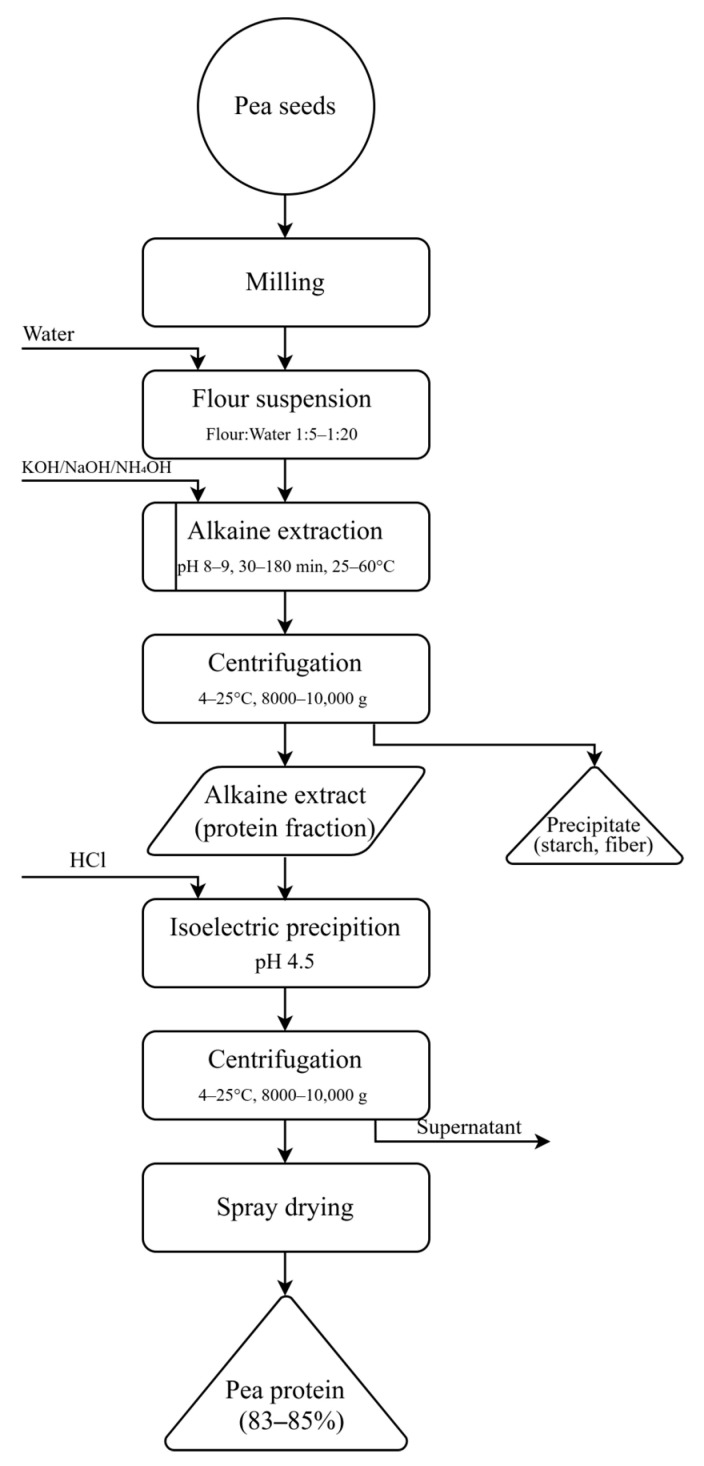
- Conventional alkaline extraction–isoelectric precipitation (AE–IEP) is described as the industrial standard, with optimized protein purity reported at 83.33–84.67% dry weight basis (dwb); however, high alkalinity and heat can cause irreversible denaturation and polymerization.
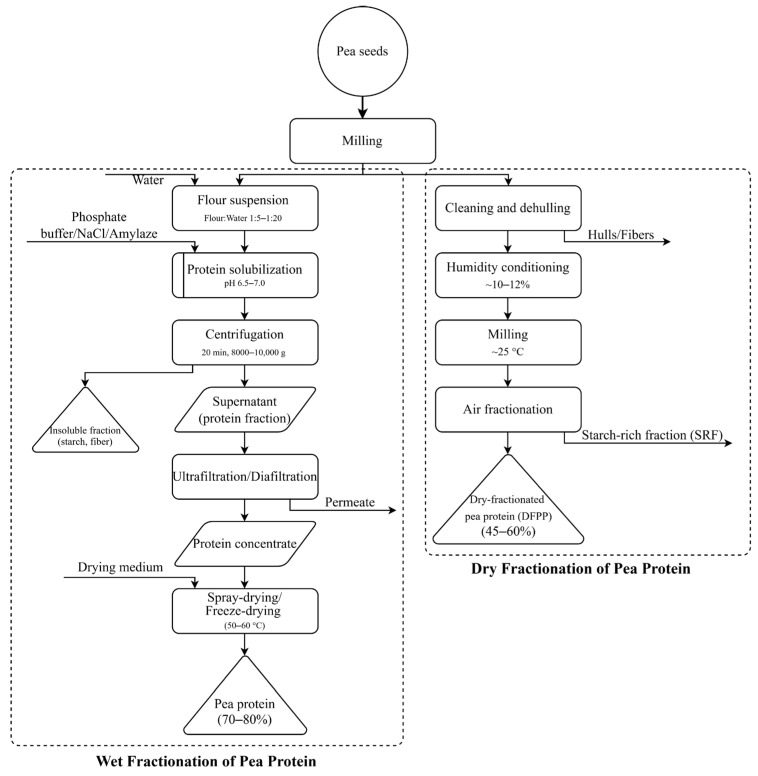
- Wet fractionation methods can yield isolates with approximately 80% protein content, while aqueous fractionation/ultrafiltration can produce concentrates around 75% purity; dry fractionation via air classification is described as retaining native structure better but giving about 50% protein content.
- Native PPI gels are weak: strong hydrogels require G’ > 10^3 Pa, >90% water retention, at least 20% w/w protein, pH far from the isoelectric point, and ionic strength above 0.6 M; reported maximum linear viscoelastic strain is only 0.74–1.26%.
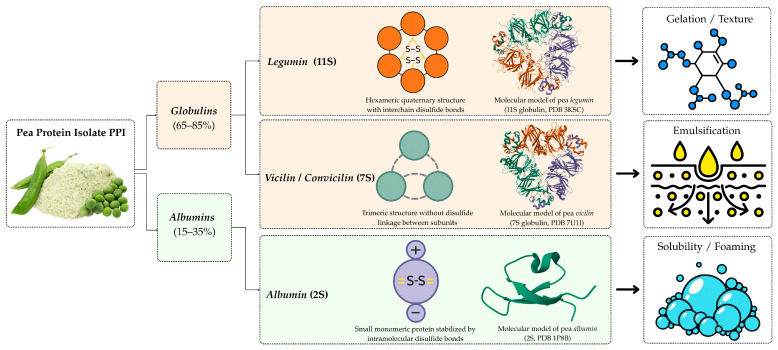
- Foaming and emulsification are strongly structure-dependent: albumin fractions can reach foam overrun up to 258% with >270 min stability, whereas globulin-rich fractions show <81% foam overrun and <70 min stability; for emulsions, the paper notes that EAI correlates strongly with solubility, while ESI does not.
# Methods
- This is a review article, synthesizing prior studies rather than presenting new experimental data.
- It covers literature on pea protein extraction/isolation, structural characterization (composition, secondary/tertiary structure, denaturation, aggregation), modification strategies (enzymatic, physical, chemical), and food applications (meat analogues, emulsions, films, dairy alternatives, nutraceuticals).
- The main analysis is comparative and mechanistic, linking extraction and modification conditions to reported functionality metrics such as purity, solubility, gel strength, emulsifying activity, foaming behavior, and stability.
# Limitations
- The paper states that pea proteins still face poor solubility and emulsification under acidic conditions, off-flavor/pea-like bitterness, and batch-to-batch variability from cultivar and process differences.
- It also states that many modification methods face scale-up, cost, regulatory, and consumer-acceptance barriers, especially for clean-label applications.
- Evident from the text: this is a narrative review, so the conclusions depend on the cited literature rather than a single controlled dataset, and the paper does not report a unified meta-analytic effect size or standardized pooled estimate.
Model-written summary. Check it against the paper before relying on it.
Integrity signals
Registry
Cites
Statistics
Figures
Verification
Claims the paper makes
49 Valid · 8 Not valid · 56 Not checked · 46 Own results and interpretations
Every source the paper cites for this claim was checked and supports it.
In the paper
“Peptides derived from pea protein exhibit potent antioxidant capabilities, acting to scavenge free radicals and thereby reducing oxidative stress [3].”
§ Pea Protein Isolates: From Extraction to Functionality > 1. Introduction
What the sources say
- Supportedcites [3] Zhao, D., and Liu, X. (2023). Purification, Identification, and Evaluation of Antioxidant Peptides from Pea Protein Hydrolysates. Molecules, 28. source
Results and Discussion §2.2 reports strong free-radical scavenging by the isolated pea-protein peptides. The Conclusions report that the three peptides reduced ROS levels and protected H2O2-damaged LO2 cells; these findings are from in vitro and cell experiments. (LLM, conf=0.90)
boostedstates a cause- Asserted: passes — The authors put it forward as true.
- Checkable: passes — It can be checked against evidence.
- Load-bearing: unclear — It is unclear whether the paper’s conclusions depend on it.
- Based: passes — The paper gives a reason why it holds.
- Supported
The cited sources support only part of this claim — read each source’s verdict below.
In the paper
“The protein digestibility corrected amino acid score (PDCAAS) for pea protein ranges between 0.83 and 0.91 [1,6].”
§ Pea Protein Isolates: From Extraction to Functionality > 1. Introduction
What the sources say
- Partly supportedcites [1] Hertzler, S.R., Lieblein-Boff, J.C., Weiler, M., and Allgeier, C. (2020). Plant Proteins: Assessing Their Nutritional Quality and Effects on Health and Physical Function. Nutrients, 12. sourceExperimental — accuracy not yet measured
Section 3, “The Quality of Plant Proteins” (page unavailable), says pea protein has a PDCAAS of at least 0.75. It does not give the claimed range of 0.83–0.91; searches for both endpoints found no matching passage in our copy. (LLM, conf=0.85)
- Could not verifycites [6] Powers, S., and Thavarajah, D. (2019). Checking agriculture’s pulse: Field pea (Pisum sativum L.), sustainability, and phosphorus use efficiency. Front. Plant Sci., 10. sourceExperimental — accuracy not yet measured
The Biofortification Potential of Legumes section describes field pea’s protein content and amino acid profiles, but gives no PDCAAS value. Searches for PDCAAS, protein digestibility, and the 0.83–0.91 range found no passage in our copy that verifies the claimed range; page numbers are unavailable. (LLM, conf=0.72)
plain- Asserted: passes — The authors put it forward as true.
- Checkable: passes — It can be checked against evidence.
- Load-bearing: unclear — It is unclear whether the paper’s conclusions depend on it.
- Based: passes — The paper gives a reason why it holds.
- Partly supported
The cited sources support only part of this claim — read each source’s verdict below.
In the paper
“Traditional pea protein extraction predominantly employs this approach, which solubilizes proteins under alkaline conditions, typically utilizing pH levels between 8 and 9, to separate the protein fraction from insoluble components like starch and fiber [26,27].”
§ Pea Protein Isolates: From Extraction to Functionality > 2. Isolation Technologies > 2.1. Alkaline Extraction–Isoelectric Precipitation
What the sources say
- Partly supportedcites [26] Hansen, L., Bu, F., and Ismail, B.P. (2022). Structure-Function Guided Extraction and Scale-Up of Pea Protein Isolate Production. Foods, 11. sourceExperimental — accuracy not yet measured
The Introduction says commercial pea protein isolate is mostly produced by alkaline solubilization to separate protein from starch and fiber, followed by isoelectric precipitation. Section 3.1 describes reported alkaline extraction conditions as pH 8–10, not typically pH 8–9; the narrower typical range is not established by this paper. (LLM, conf=0.86)
- Not checked yetcites [27] Verkempinck, 2024, Pea Protein Extraction Method Impacts the Protein (Micro)structural Organisation and in Vitro Digestion Kinetics, Food Funct. source
Checked before — its earlier verdict is held back until a new check runs.
plainstates a cause- Asserted: passes — The authors put it forward as true.
- Checkable: passes — It can be checked against evidence.
- Load-bearing: unclear — It is unclear whether the paper’s conclusions depend on it.
- Based: passes — The paper gives a reason why it holds.
- Partly supported
Every source the paper cites for this claim was checked and supports it.
In the paper
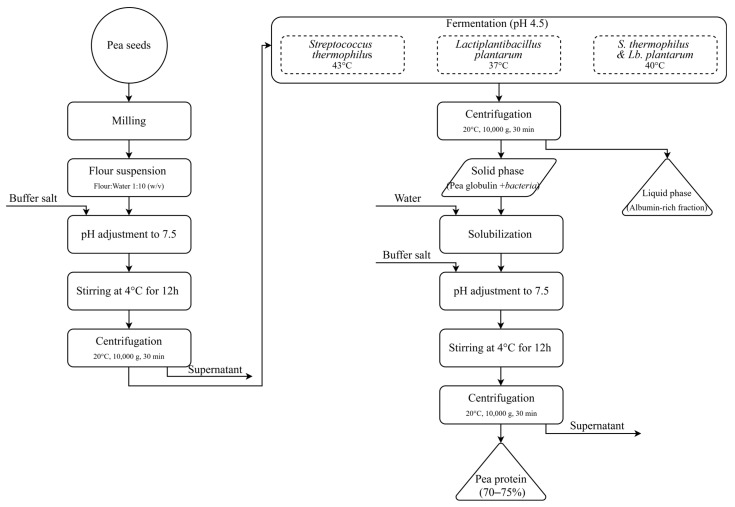
“This process significantly reduces anti-nutritional compounds, including trypsin inhibitor activity and phytic acid.”
§ Pea Protein Isolates: From Extraction to Functionality > 2. Isolation Technologies > 2.3. Green and Fermentation-Assisted Extraction
What the sources say
- Supportedcites [23] Emkani, M., Moundanga, S., Oliete, B., and Saurel, R. (2023). Protein Composition and Nutritional Aspects of Pea Protein Fractions Obtained by a Modified Isoelectric Precipitation Method Using Fermentation. Front. Nutr., 10. source
The Abstract states that lactic acid fermentation significantly reduced trypsin inhibitor activity and phytic acid content in the pea albumin fraction compared with the control. The Trypsin inhibitor activity and Phytic acid results sections report lower values in fermented samples. (LLM, conf=0.93)
plainstates a cause- Asserted: passes — The authors put it forward as true.
- Checkable: passes — It can be checked against evidence.
- Load-bearing: unclear — It is unclear whether the paper’s conclusions depend on it.
- Based: passes — The paper gives a reason why it holds.
- Supported
The cited sources support only part of this claim — read each source’s verdict below.
In the paper
“Differences in critical process variables—including the specific pH level used (e.g., pH 8.5, 9.0, or 9.5), holding time, and drying conditions—all contribute to variations in the final protein profile and functional outcome [26,28].”
§ Pea Protein Isolates: From Extraction to Functionality > 2. Isolation Technologies > 2.1. Alkaline Extraction–Isoelectric Precipitation
What the sources say
- Partly supportedcites [26] Hansen, L., Bu, F., and Ismail, B.P. (2022). Structure-Function Guided Extraction and Scale-Up of Pea Protein Isolate Production. Foods, 11. sourceExperimental — accuracy not yet measured
The Introduction states that differences in pH treatment, holding time, and drying conditions affect protein profile, structure, and functionality. However, the cited paper’s Results and Discussion §3.1 compares extraction at pH 7, 7.5, and 8; it does not support the citing sentence’s specific examples of pH 8.5, 9.0, and 9.5. The supplied passages have no page numbers. (LLM, conf=0.87)
- Partly supportedcites [28] Patil, 2025, A Review on Sustainable Non-Thermal Approaches for Pea Protein: Pre-Treatment, Extraction, Modification, and Applications, Food Chem. X sourceExperimental — accuracy not yet measured
The Wet extraction section reports that changing extraction pH from 8.5 to 9.5 altered protein recovery, aggregation and solubility, and discusses a sensory difference at pH 9.0. The High-pressure modification section says processing time can influence protein modifications. The copy does not establish that differences in drying conditions alter the final protein profile and functional outcome; the Dry fraction section links additional drying steps only to lower moisture content. Page numbers were not provided. (LLM, conf=0.85)
plainstates a cause- Asserted: passes — The authors put it forward as true.
- Checkable: passes — It can be checked against evidence.
- Load-bearing: passes — The paper’s conclusions depend on it.
- Based: passes — The paper gives a reason why it holds.
- Partly supported
85 more claims · 29 with their cited sources checked
Create a free account to see all 159 claims and to verify the 27 references still open.
- It may state two separate claims as one. 60
- Probably not a substantial claim. 13
Self-check
Percentages, sums and reported differences re-computed from the paper’s own numbers.
Self-check results appear here once an independent check has confirmed them.
Cited works that were retracted
Works this paper cites that were later retracted, from the retraction notices publishers deposit. Major when the notice came out before this paper was published.
Rated major: it would touch a result — a value a result rests on, reported and recomputed p-values on opposite sides of the significance level, two passages that conflict with no sign which is right, or a cited work retracted before this paper was published.
In the paper
“Differences in critical process variables—including the specific pH level used (e.g., pH 8.5, 9.0, or 9.5), holding time, and drying conditions—all contribute to variations in the final protein profile and functional outcome [26,28].”
Cited work 10.1016/j.fochx.2025.102608 · retracted 2025-07-01 · notice 10.1016/j.fochx.2025.102608 · this paper published 2025-12-03
Citations
Cites
1 retracted
Patil, N. D., Kumar, A., Bains, A., Fareed, M., Dhull, S. B., Nagraik, R., & Chawla, P. (2025) · Food Chemistry: X · doi:10.1016/j.fochx.2025.102608 · Cited by 15 · cited 4×
“Differences in critical process variables—including the specific pH level used (e.g., pH 8.5, 9.0, or 9.5), holding time, and drying conditions—all contribute to variations in the final protein profile and functional outcome [26,28].”
InfluentialRetractedPlant Proteins: Assessing Their Nutritional Quality and Effects on Health and Physical Function
Hertzler, S. R., Lieblein-Boff, J. C., Weiler, M., & Allgeier, C. (2020) · Nutrients · doi:10.3390/nu12123704 · Cited by 594
A review on plant-based proteins from soybean: Health benefits and soy product development
Qin, P., Wang, T., & Luo, Y. (2022) · Journal of Agriculture and Food Research · doi:10.1016/j.jafr.2021.100265 · Cited by 578
O'Sullivan, J., Murray, B., Flynn, C., & Norton, I. (2016) · Food Hydrocolloids · doi:10.1016/j.foodhyd.2015.02.009 · Cited by 558
Profile and Functional Properties of Seed Proteins from Six Pea (Pisum sativum) Genotypes
Barac, M., Cabrilo, S., Pesic, M., Stanojevic, S., Zilic, S., Macej, O., & Ristic, N. (2010) · International Journal of Molecular Sciences · doi:10.3390/ijms11124973 · Cited by 368
Plant Proteins for Future Foods: A Roadmap
Sim, S. Y. J., SRV, A., Chiang, J. H., & Henry, C. J. (2021) · Foods · doi:10.3390/foods10081967 · Cited by 352
Ge, J., Sun, C., Corke, H., Gul, K., Gan, R., & Fang, Y. (2020) · Comprehensive Reviews in Food Science and Food Safety · doi:10.1111/1541-4337.12573 · Cited by 318
Gelation properties of salt-extracted pea protein induced by heat treatment
Sun, X. D., & Arntfield, S. D. (2010) · Food Research International · doi:10.1016/j.foodres.2009.09.039 · Cited by 304
Mession, J.-L., Sok, N., Assifaoui, A., & Saurel, R. (2013) · Journal of Agricultural and Food Chemistry · doi:10.1021/jf303739n · Cited by 233 · cited 3×
“Studies utilizing reducing agents, such as dithiothreitol, have shown that disrupting these linkages results in the formation of partially insoluble macroaggregates [33].”
InfluentialZhao, H., Shen, C., Wu, Z., Zhang, Z., & Xu, C. (2020) · Journal of Food Biochemistry · doi:10.1111/jfbc.13157 · Cited by 220 · cited 2×
“Comparative analyses reveal differences between pea proteins and traditional dairy proteins like whey, with plant proteins generally forming larger droplets and less stable emulsions under certain conditions [9,37].”
Cited by
Wolffia globosa as an Emerging Plant-Based Protein Source for Functional and Nutraceuticals
Venkatachalam, K., Phongthai, S., Puttha, R., Wongsa, J., & Charoenphun, N. (2026) · Foods · doi:10.3390/foods15030543 · Cited by 8
Oxidation Mechanism in Bigels and Emulgels—Challenges and Solutions
Juchniewicz, S., & Harasym, J. (2026) · Molecules · doi:10.3390/molecules31060970 · Cited by 3
Self-citationZhang, X., Chen, W., & Chen, H. (2026) · Foods · doi:10.3390/foods15122241 · Cited by 3
Bartkuvienė, I., Eisinaitė, V., Gölge, E., Petrikaitė, V., & Leskauskaitė, D. (2026) · Gels · doi:10.3390/gels12040342 · Cited by 4
Plant proteins modulate m6A RNA methylation via the regulation of gut microbiota
Zhou, Y., Qin, Y., He, R., Cao, Y., Ye, H., Xu, W., & Peng, Y. (2026) · International Journal of Biological Macromolecules · doi:10.1016/j.ijbiomac.2026.151641 · Cited by 3
Metadata
- Authors
- Harasym, J., Paroń, O., & Pejcz, E.
- Affiliations
- Wroclaw University of Economics and Business (PL)
- Corresponding author
- Pejcz, Ewa
- Venue
- Molecules
- Publisher
- MDPI AG
- Published
- 2025-12-03
- Volume
- 30
- Issue
- 23
- Pages
- 4650
- ISSN
- 1420-3049 (ISSN-L)
- PMC
- PMC12693553
- OpenAlex
- W4416956495
- Cited by
- 18
- References
- 52
- Citations by year
- 2026: 18
- FWCI
- 1.47
- Type
- journal article
- Language
- en
- Open access
- gold
- doi.org
- Licence
- Locations
- Molecules (publishedVersion, cc-by)
- PubMed (publishedVersion)
- PubMed Central (publishedVersion, cc-by)
- DOAJ (DOAJ: Directory of Open Access Journals) (submittedVersion, cc-by-sa)
- Funders
- Wroclaw University of Economics and Business Internal Project Open Science
- Topics
- Life Sciences › Agricultural and Biological Sciences › Food Science › Proteins in Food Systems
- Life Sciences › Agricultural and Biological Sciences › Food Science › Protein Hydrolysis and Bioactive Peptides
- Life Sciences › Biochemistry, Genetics and Molecular Biology › Molecular Biology › Protein purification and stability
- Keywords
- pea protein isolate, protein extraction, vicilin, legumin, protein denaturation, protein aggregation, antinutritional factors, protein secondary and tertiary structure, disulfide bonds, interfacial activity, protein solubility, gelation, emulsion stability, Pickering emulsions, enzymatic hydrolysis, deamidation, transglutaminase cross-linking, high-pressure homogenization, ultrasound, non-thermal plasma, glycation, meat substitutes, edible films, bioactive peptides, nutraceuticals, biorefinery, sustainable food ingredients
- MeSH terms
- Pea Proteins, Pisum sativum
About these checks
Registry, retraction, Cites and statistics results are computed, not judged, with one exception: a printed reference that no index lists is read once by a model before it counts as a citation error. Claims are extracted by a model and kept only when their quote appears verbatim in the text; each cited source is then checked, with a model’s help, for whether it says what the claim relies on. Those verdicts can be wrong — read the claim’s quote and the cited source before relying on one.
The claim verdicts this report counts are experimental: their accuracy is not yet measured.
A language model drew the claims from the paper on 2026-10-10, under version 3 of the claim definition (model deepseek-v4.1-flash, prompt extract-v3).
A second model labelled each claim on 2026-10-10 (model jev-1.13-20260917, definition revision gold-guideline-v0.2).
Cited sources are checked with a language model’s help (gpt-6-sol).
Statistics and arithmetic are recomputed, not judged.
Confidence bands are shown only for fields calibrated on our annotated test set. None is calibrated yet, so no band is shown.
What counts as a claim ›How we measure confidence ›How we check this ›
Are you an author, or do you see a problem with this page? Request a review
How to cite
Cite CoChat for the checks on this page, and the paper for its own findings.
- This page
- CoChat. (2026). Citation check: Pea Protein Isolates: From Extraction to Functionality. https://app.cochat.ai/papers/10.3390/molecules30234650
- The paper
- Harasym, J., Paroń, O., & Pejcz, E. (2025). Pea Protein Isolates: From Extraction to Functionality. Molecules. https://doi.org/10.3390/molecules30234650
Data sources
Bibliographic data: Semantic Scholar, OpenAlex, Crossref.
Contains information from the Semantic Scholar Academic Graph Datasets, made available under the ODC Attribution License (ODC-BY 1.0).
Semantic Scholar’s data is described in: Kinney, R., et al. (2023). The Semantic Scholar Open Data Platform. arXiv:2301.10140.
