

Structure-Function Guided Extraction and Scale-Up of Pea Protein Isolate Production
Open accessThe DOI matches its Crossref record; 55 of the 57 references it cites were found in a registry or an index; 3 of the 78 sources its claims cite were checked for support.
Abstract
The lack of adequate guidance and control of the extraction conditions as well as the gap between bench- and industrial-scale production, contributes to the poor functionality of commercial pea protein isolate (cPPI). Therefore, pea protein extraction conditions were evaluated and scaled up to maximize protein purity and yield, while maintaining structural integrity, following mild alkaline solubilization with isoelectric precipitation and salt solubilization coupled with membrane filtration. Both extraction methods resulted in high protein yield (>64%) and purity (>87%). Structure-function characterization illustrated the preserved structural integrity of PPI samples and their superior solubility, gelation, and emulsification properties compared to cPPI. Results confirmed, for the first time, that double solubilization at mild pH (7.5) can replace single solubilization at high alkalinity and achieve a similar yield while preserving structural integrity. Additionally, this study demonstrated, the scalability of the benchtop salt extraction coupled with ultrafiltration/diafiltration. Scaling up the production eliminated some structural and functional differences between the salt-extracted PPI and pH-extracted PPI. Scaling-up under mild and controlled conditions resulted in partial denaturation and a low degree of polymerization, coupled with the superior functionality of the produced isolates compared to cPPI. Results of this work can be used as a benchmark to guide the industrial production of functional pea protein ingredients.
Overview
CoChat Summary
## TL;DR
This study optimized and scaled two pea protein isolate (PPI) extraction routes—mild pH extraction and salt extraction with membrane filtration—to preserve structure while improving yield and functionality. The authors report high yields (>64%) and purities (>87%), with the mild pH double-solubilization route able to match harsher alkaline extraction while better preserving protein structure.
## Key findings
- Double solubilization for 1 h at pH 7.5 increased protein yield from 58.1% to 69.9% and reduced residual protein in the discarded pellet by 10%, leading the authors to select pH 7.5 and pH 4.5 precipitation for scaled-up pH extraction.
- For salt extraction, combining ultrafiltration (UF) + dialysis gave the highest protein purity and lowest ash content among the tested purification treatments, and the authors then used 3 kDa membrane filtration for scale-up.
- In pilot production, final PPI purities were 88.7% for SU-pH PPI and 92.4% for SU-salt PPI; ash content was 2.94% for SU-pH PPI and 1.66% for SU-salt PPI.
- Both scaled-up PPIs had superior solubility, gelation, and emulsification properties compared with commercial pea protein isolate (cPPI); in the conclusions, they were also reported to have comparable solubility to commercial SPI at pH 7 and superior solubility at pH 3.4, but inferior gelation and emulsification relative to cSPI.
## Methods
- The study compared benchtop and pilot-plant scaled-up pea protein extraction workflows: a mild alkaline pH-extraction with isoelectric precipitation and a salt solubilization followed by membrane filtration route.
- Benchtop experiments varied solubilization pH (7, 7.5, 8), precipitation pH (4.5 or 5), solubilization time (1 or 2 h), number of solubilizations, and dialysis/UF options; pilot-scale processing used industrially relevant steps including decanter centrifugation, UF/diafiltration, pasteurization, homogenization, and spray drying.
- Protein structure was analyzed using SDS-PAGE, SE-HPLC, DSC, zeta potential, and surface hydrophobicity; functionality was assessed by solubility, gel strength, and emulsification (EC, EAI, ES), with triplicate measurements and ANOVA / t-tests / Tukey–Kramer HSD.
## Limitations
- The paper does not report a formal limitations section; this is not stated in the paper.
- The authors note that some benchtop equipment had no direct pilot-plant analog, requiring changes such as UF/diafiltration instead of dialysis, pasteurization, and spray drying, so some benchtop-to-scale differences may reflect processing substitutions rather than scale alone; this is evident from the text.
- The final conclusions section is truncated in the provided text, so any statements beyond what appears here are not stated in the paper.
Model-written summary. Check it against the paper before relying on it.
Integrity signals
Registry
Cites
Statistics
Figures
Verification
Claims the paper makes
2 Valid · 4 Not valid · 39 Not checked · 155 Own results and interpretations
The cited sources that could be checked couldn’t confirm or dispute this claim.
In the paper
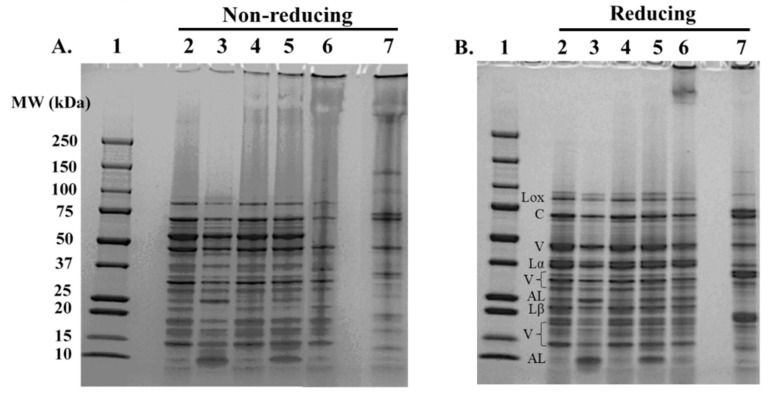
“Protein bands corresponding to lipoxygenase (~94 kDa), convicilin (~72 kDa), vicilin (~50 kDa), and legumin (~60 kDa) (Figure 1A) were apparent in all extracted PPIs, similar to previous reports [29,39,40].”
§ Structure-Function Guided Extraction and Scale-Up of Pea Protein Isolate Production > 3. Results and Discussion > 3.4. Effect of Extraction Conditions and Scaling up on Protein Profile
What the sources say
- Not checked — no full text of the sourcecites [29] Barac, 2012, Functional properties of protein hydrolysates from pea (Pisum sativum, L.) seeds, Int. J. Food Sci. Technol. source
- Could not verifycites [39] Tzitzikas, 2006, Genetic Variation in Pea Seed Globulin Composition, J. Agric. Food Chem. sourceExperimental — accuracy not yet measured
Our copy of Tzitzikas et al. (2006) contains only the repository/bibliographic record (title, authors, journal, keywords, citation blocks — 'Abstract' section, no page numbers); no results or figure text is present. Searches for 'lipoxygenase', 'legumin acidic and basic subunits', 'SDS-PAGE subunit relative molecular mass kDa', and 'convicilin vicilin legumin protein bands' returned only that metadata, whose keyword list includes vicilin, convicilin and glycinin but never lipoxygenase nor any molecular masses. Hence nothing in our copy states or contradicts the claim that bands at ~94, ~72, ~50 and ~60 kDa were apparent in all extracted pea protein isolates. (LLM, conf=0.65)
- Not checked — no full text of the sourcecites [40] Mession, 2015, Effect of globular pea proteins fractionation on their heat-induced aggregation and acid cold-set gelation, Food Hydrocolloid source
plain- Asserted: passes — The authors put it forward as true.
- Checkable: passes — It can be checked against evidence.
- Load-bearing: unclear — It is unclear whether the paper’s conclusions depend on it.
- Based: passes — The paper gives a reason why it holds.
Every source the paper cites for this claim was checked and supports it.
In the paper
“Similarly, Hoang [25] did not observe significant increase in pea protein extraction yield with increasing solubilization duration from 15 to 45 min.”
§ Structure-Function Guided Extraction and Scale-Up of Pea Protein Isolate Production > 3. Results and Discussion > 3.1. Effect of Different pH Extraction Conditions on the Efficiency of PPI Production
What the sources say
- Supportedcites [25] Hoang, H.D. (2012). Evaluation of Pea Protein and Modified Pea Protein as Egg Replacers. [Ph.D. Thesis, North Dakota State University].
Section 1.5, “Extraction time,” states that extraction time did not significantly affect pea protein yield over the studied range of 15–45 minutes. This result was obtained under the paper’s optimized extraction conditions, including pH 10. (LLM, conf=0.94)
plain- Asserted: passes — The authors put it forward as true.
- Checkable: passes — It can be checked against evidence.
- Load-bearing: unclear — It is unclear whether the paper’s conclusions depend on it.
- Based: passes — The paper gives a reason why it holds.
- Supported
The sources with a verdict support this claim; the rest weren’t checked yet, have no full text we could read, or their verdicts aren’t rated yet.
In the paper
“Proteins that have flexible structures and good solubility have relatively high EAI [26,58,59].”
§ Structure-Function Guided Extraction and Scale-Up of Pea Protein Isolate Production > 3. Results and Discussion > 3.7. Protein Functionality as Impacted by the Extraction Method and Scale
What the sources say
- Not checked — no full text of the sourcecites [26] Feyzi, 2018, Grass Pea (Lathyrus sativus L.) Protein Isolate: The Effect of Extraction Optimization and Drying Methods on the Structure and Functional Properties, Food Hydrocolloid source
- Not checked — no full text of the sourcecites [58] Nakai, 1983, Structure-function relationships of food proteins: With an emphasis on the importance of protein hydrophobicity, J. Agric. Food Chem. source
- Supportedcites [59] Barac, 2010, Profile and Functional Properties of Seed Proteins from Six Pea (Pisum sativum) Genotypes, Int. J. Mol. Sci. source
Section 3.5 reports a strong positive correlation between protein solubility and EAI (0.80, p < 0.05). It also explains that reduced solubility decreased protein flexibility and the ability to form efficient interfacial membranes. These passages support the paraphrase in the context of the pea proteins studied. (LLM, conf=0.88)
plainstates an association- Asserted: passes — The authors put it forward as true.
- Checkable: passes — It can be checked against evidence.
- Load-bearing: passes — The paper’s conclusions depend on it.
- Based: passes — The paper gives a reason why it holds.
A result the paper reports from its own data — it cites no other source for it, so there is none to check. The quote shows it is in the paper.
In the paper
“The smearing and the intensity of the high molecular weight bands at the top of the lanes in the SU PPI samples were markedly less visible under reducing conditions (Figure 1B, lanes 4&5), indicating that these aggregates were formed primarily through disulfide linkages due to the thermal treatment during pilot plant production (pasteurization and spray drying).”
§ Structure-Function Guided Extraction and Scale-Up of Pea Protein Isolate Production > 3. Results and Discussion > 3.4. Effect of Extraction Conditions and Scaling up on Protein Profile
plain- Asserted: passes — The authors put it forward as true.
- Checkable: passes — It can be checked against evidence.
- Load-bearing: passes — The paper’s conclusions depend on it.
- Based: passes — The paper gives a reason why it holds.
A result the paper reports from its own data — it cites no other source for it, so there is none to check. The quote shows it is in the paper.
In the paper
“Scaling-up under mild and controlled conditions resulted in partial denaturation and a low degree of polymerization, coupled with the superior functionality of the produced isolates compared to cPPI.”
§ Structure-Function Guided Extraction and Scale-Up of Pea Protein Isolate Production > Abstract
plainstates a cause- Asserted: passes — The authors put it forward as true.
- Checkable: passes — It can be checked against evidence.
- Load-bearing: passes — The paper’s conclusions depend on it.
- Based: passes — The paper gives a reason why it holds.
111 more claims
Create a free account to see all 200 claims and to verify the 7 references still open.
- It may state two separate claims as one. 74
- Probably not a substantial claim. 16
Claims other papers make about this one
Each is checked against this paper’s own text: does it say what the citing paper says it does?
The source backs part of the claim, not all of it — or backs it for a different population, condition or comparison.
In the citing paper
“Differences in critical process variables—including the specific pH level used (e.g., pH 8.5, 9.0, or 9.5), holding time, and drying conditions—all contribute to variations in the final protein profile and functional outcome [26,28].”
From Pea Protein Isolates: From Extraction to Functionality. (2025) · cites this paper as [26]
Experimental — accuracy not yet measuredThe source backs part of the claim, not all of it — or backs it for a different population, condition or comparison.
In the citing paper
“Traditional pea protein extraction predominantly employs this approach, which solubilizes proteins under alkaline conditions, typically utilizing pH levels between 8 and 9, to separate the protein fraction from insoluble components like starch and fiber [26,27].”
From Pea Protein Isolates: From Extraction to Functionality. (2025) · cites this paper as [26]
Experimental — accuracy not yet measuredThe source backs part of the claim, not all of it — or backs it for a different population, condition or comparison.
In the citing paper
“Optimized AE-IEP protocols yield high protein purity, often reported in the range of 83.33–84.67% on a dry weight basis (dwb) [26,28].”
From Pea Protein Isolates: From Extraction to Functionality. (2025) · cites this paper as [26]
Experimental — accuracy not yet measuredThe cited source says what the claim attributes to it.
In the citing paper
“The alkaline extraction followed by isoelectric precipitation (AE-IEP) method represents the industrial standard for commercial PPI production [26].”
From Pea Protein Isolates: From Extraction to Functionality. (2025) · cites this paper as [26]
The cited source says what the claim attributes to it.
In the citing paper
“High alkalinity, particularly when coupled with adverse heat treatment during processing, can induce irreversible protein denaturation and polymerization [26].”
From Pea Protein Isolates: From Extraction to Functionality. (2025) · cites this paper as [26]
Citations
Cites
Cleavage of Structural Proteins during the Assembly of the Head of Bacteriophage T4
LAEMMLI, U. K. (1970) · Nature · doi:10.1038/227680a0 · Cited by 249,961
Raza, H., John, A., & Nemmar, A. (2013) · Cellular Physiology and Biochemistry · doi:10.1159/000350087 · Cited by 47,221
Karaca, A. C., Low, N., & Nickerson, M. (2011) · Food Research International · doi:10.1016/j.foodres.2011.06.012 · Cited by 871
Boye, J. I., Aksay, S., Roufik, S., Ribéreau, S., Mondor, M., Farnworth, E., & Rajamohamed, S. H. (2010) · Food Research International · doi:10.1016/j.foodres.2009.07.021 · Cited by 825
Stone, A. K., Karalash, A., Tyler, R. T., Warkentin, T. D., & Nickerson, M. T. (2015) · Food Research International · doi:10.1016/j.foodres.2014.11.017 · Cited by 644
Composition, physicochemical properties of pea protein and its application in functional foods
Lu, Z. X., He, J. F., Zhang, Y. C., & Bing, D. J. (2020) · Critical Reviews in Food Science and Nutrition · doi:10.1080/10408398.2019.1651248 · Cited by 529
Food protein functionality: A comprehensive approach
Foegeding, E. A., & Davis, J. P. (2011) · Food Hydrocolloids · doi:10.1016/j.foodhyd.2011.05.008 · Cited by 486
Physicochemical and textural properties of heat-induced pea protein isolate gels
Shand, P. J., Ya, H., Pietrasik, Z., & Wanasundara, P. K. J. P. D. (2007) · Food Chemistry · doi:10.1016/j.foodchem.2006.06.060 · Cited by 443
Nakai, S. (1983) · Journal of Agricultural and Food Chemistry · doi:10.1021/jf00118a001 · Cited by 421
Soybean proteins. Their functional, chemical, and physical properties
Wolf, W. J. (1970) · Journal of Agricultural and Food Chemistry · doi:10.1021/jf60172a025 · Cited by 394
Research works printed but not linked: 5
- Nadathur, S.R., Wanasundara, J.P.D., and Scanlin, L. (2017). Chapter 9—Pea: A Sustainable Vegetable Protein Crop. Sustainable Protein Sources, Academic Press.
- Hensley, 1979, Economic evaluation of soy isolate production by a membrane isolation process, Food Technol., 33, 46
- Phillips, G.O., and Williams, P.A. (2011). Handbook of Food Proteins, Elsevier. · DOI · Paper page
- Damodaran, S., and Parkin, K.L. (2017). Amino acids, peptides, and proteins. Fennema’s Food Chemistry, CRC Press.
- 2001, Legume and oilseed proteins, Chem. Funct. Prop. Food Proteins, 2, 407
Cited by
Pea Protein and Starch: Functional Properties and Applications in Edible Films
Farshi, P., Mirmohammadali, S. N., Rajpurohit, B., Smith, J. S., & Li, Y. (2024) · Journal of Agriculture and Food Research · doi:10.1016/j.jafr.2023.100927 · Cited by 78
Role of the pea protein aggregation state on their interfacial properties
Grasberger, K. F., Lund, F. W., Simonsen, A. C., Hammershøj, M., Fischer, P., & Corredig, M. (2023) · Journal of Colloid and Interface Science · doi:10.1016/j.jcis.2023.12.068 · Cited by 81
Pea protein globulins: Does their relative ratio matter?
Husband, H., Ferreira, S., Bu, F., Feyzi, S., & Ismail, B. (2023) · Food Hydrocolloids · doi:10.1016/j.foodhyd.2023.109429 · Cited by 85
Self-citationAsen, N. D., Aluko, R. E., Martynenko, A. I., Utioh, A. C., & Bhowmik, P. (2023) · Foods · doi:10.3390/foods12213978 · Cited by 74
Hanafi, M. A., Anwar, F., & Saari, N. (2024) · Food Frontiers · doi:10.1002/fft2.389 · Cited by 67
Metadata
- Authors
- Hansen, L., Bu, F., & Ismail, B. P.
- Affiliations
- University of Minnesota (US)
- Corresponding author
- Ismail, Baraem P.
- Venue
- Foods
- Publisher
- MDPI AG
- Published
- 2022-11-23
- Volume
- 11
- Issue
- 23
- Pages
- 3773
- ISSN
- 2304-8158 (ISSN-L)
- PMC
- PMC9793753
- OpenAlex
- W4309847933
- Cited by
- 82
- References
- 57
- Citations by year
- 2026: 32 · 2025: 28 · 2024: 10 · 2023: 12
- FWCI
- 6.65
- Type
- journal article
- Language
- en
- Open access
- gold
- doi.org
- Licence
- Locations
- Foods (publishedVersion, cc-by)
- PubMed Central (publishedVersion, cc-by)
- PubMed (publishedVersion)
- DOAJ (DOAJ: Directory of Open Access Journals) (submittedVersion, cc-by-sa)
- Funders
- United States Department of Agriculture/Agriculture Research Station—Pulse Crop Health Initiative (58-3060-8-024)
- Topics
- Life Sciences › Agricultural and Biological Sciences › Food Science › Proteins in Food Systems
- Life Sciences › Agricultural and Biological Sciences › Food Science › Protein Hydrolysis and Bioactive Peptides
- Life Sciences › Biochemistry, Genetics and Molecular Biology › Molecular Biology › Protein purification and stability
- Keywords
- pea protein isolate, protein extraction, alkaline solubilization, isoelectric precipitation, salt extraction, ultrafiltration, diafiltration, protein structural integrity, protein denaturation, protein functional properties, solubility, gelation, emulsification, scale-up, plant proteins
About these checks
Registry, retraction, Cites and statistics results are computed, not judged, with one exception: a printed reference that no index lists is read once by a model before it counts as a citation error. Claims are extracted by a model and kept only when their quote appears verbatim in the text; each cited source is then checked, with a model’s help, for whether it says what the claim relies on. Those verdicts can be wrong — read the claim’s quote and the cited source before relying on one.
The claim verdicts this report counts are experimental: their accuracy is not yet measured.
A language model drew the claims from the paper on 2026-10-10, under version 3 of the claim definition (model deepseek-v4.1-flash, prompt extract-v3).
A second model labelled each claim on 2026-10-10 (model jev-1.13-20260917, definition revision gold-guideline-v0.2).
Cited sources are checked with a language model’s help (qwen3.8-omni-flash and gpt-6-sol).
Statistics and arithmetic are recomputed, not judged.
Confidence bands are shown only for fields calibrated on our annotated test set. None is calibrated yet, so no band is shown.
What counts as a claim ›How we measure confidence ›How we check this ›
Are you an author, or do you see a problem with this page? Request a review
How to cite
Cite CoChat for the checks on this page, and the paper for its own findings.
- This page
- CoChat. (2026). Citation check: Structure-Function Guided Extraction and Scale-Up of Pea Protein Isolate Production. https://app.cochat.ai/papers/10.3390/foods11233773
- The paper
- Hansen, L., Bu, F., & Ismail, B. P. (2022). Structure-Function Guided Extraction and Scale-Up of Pea Protein Isolate Production. Foods. https://doi.org/10.3390/foods11233773
Data sources
Bibliographic data: Semantic Scholar, OpenAlex, Crossref.
Contains information from the Semantic Scholar Academic Graph Datasets, made available under the ODC Attribution License (ODC-BY 1.0).
Semantic Scholar’s data is described in: Kinney, R., et al. (2023). The Semantic Scholar Open Data Platform. arXiv:2301.10140.
