

Exercise Effects on Bone Mineral Density in Men
Open accessThe DOI matches its Crossref record; 47 of the 47 references it cites were found in a registry or an index.
Abstract
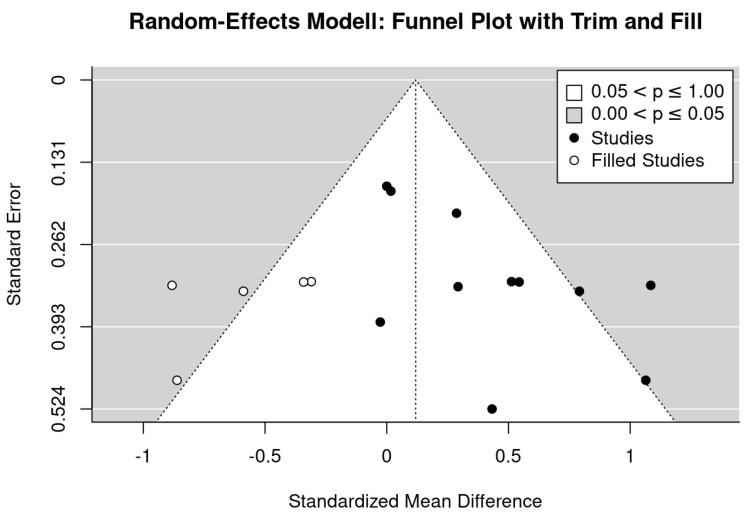
In contrast to postmenopausal women, evidence for a favorable effect of exercise on Bone Mineral Density (BMD) is still limited for men. This might be due to the paucity of studies, but also to the great variety of participants and study characteristics that may dilute study results. The aim of the present systematic review and meta-analysis was to evaluate the effect of exercise on BMD changes with rational eligibility criteria. A comprehensive search of six electronic databases up to 15 March 2021 was conducted. Briefly, controlled trials ≥6 months that determined changes in areal BMD in men >18 years old, with no apparent diseases or pharmacological therapy that relevantly affect bone metabolism, were included. BMD changes (standardized mean differences: SMD) of the lumbar spine (LS) and femoral neck (FN) were considered as outcomes. Twelve studies with 16 exercise and 12 control groups were identified. The pooled estimate of random-effect analysis was SMD = 0.38, 95%-CI: 0.14–0.61 and SMD = 0.25, 95%-CI: 0.00–0.49, for LS and FN, respectively. Heterogeneity between the trials was low–moderate. Funnel plots and rank and regression correlation tests indicate evidence for small study publication bias for LS but not FN-BMD. Subgroup analyses that focus on study length, type of exercise and methodologic quality revealed no significant difference between each of the three categories. In summary, we provided further evidence for a low but significant effect of exercise on BMD in men. However, we are currently unable to give even rough exercise recommendations for male cohorts.
Overview
The claims and statistics of this paper haven’t been checked yet.
Free: it reads the open-access text and checks the first 5 claims that cite a source we can check. Create a free account to check every claim.
Integrity signals
Registry
Cites
Statistics
Figures




Verification
Claims the paper makes
The claims and statistics of this paper haven’t been checked yet.
Free: it reads the open-access text and checks the first 5 claims that cite a source we can check. Create a free account to check every claim.
Claims other papers make about this one
Each is checked against this paper’s own text: does it say what the citing paper says it does?
The source backs part of the claim, not all of it — or backs it for a different population, condition or comparison.
In the citing paper
“any type of exercise provides an additional benefit in these patients to maintain bone mineral density [122,123].”
From Lifestyle Medicine for Obesity in the Era of Highly Effective Anti-Obesity Treatment (2025) · cites this paper as [122]
Experimental — accuracy not yet measuredThe check wasn’t confident either way, so it gives no verdict — never disputed.
In the citing paper
“Patients with a history of bariatric surgery may also be at increased risk of osteoporosis.”
From Lifestyle Medicine for Obesity in the Era of Highly Effective Anti-Obesity Treatment (2025) · cites this paper as [122]
Experimental — accuracy not yet measured
Self-check
Percentages, sums and reported differences re-computed from the paper’s own numbers.
The self-check needs the paper’s full text.
Citations
Cites
The Cochrane Collaboration's tool for assessing risk of bias in randomised trials
Higgins, J. P. T., Altman, D. G., Gotzsche, P. C., Juni, P., Moher, D., Oxman, A. D., Savovic, J., Schulz, K. F., Weeks, L., Sterne, J. A. C., et al. (2011) · BMJ · doi:10.1136/bmj.d5928 · Cited by 33,817
PRISMA-P Group, Moher, D., Shamseer, L., Clarke, M., Ghersi, D., Liberati, A., Petticrew, M., Shekelle, P., & Stewart, L. A. (2015) · Systematic Reviews · doi:10.1186/2046-4053-4-1 · Cited by 26,223
Dermyshi, E., Wang, Y., Yan, C., Hong, W., Qiu, G., Gong, X., & Zhang, T. (2017) · Neonatology · doi:10.1159/000454668 · Cited by 24,451
Conducting Meta-Analyses in R with the metafor Package
Viechtbauer, W. (2010) · Journal of Statistical Software · doi:10.18637/jss.v036.i03 · Cited by 20,464
Reliability of the PEDro Scale for Rating Quality of Randomized Controlled Trials
Maher, C. G., Sherrington, C., Herbert, R. D., Moseley, A. M., & Elkins, M. (2003) · Physical Therapy · doi:10.1093/ptj/83.8.713 · Cited by 4,808
A Nonparametric “Trim and Fill” Method of Accounting for Publication Bias in Meta-Analysis
Duval, S., & Tweedie, R. (2000) · Journal of the American Statistical Association · doi:10.1080/01621459.2000.10473905 · Cited by 2,955
Bauer, J., Biolo, G., Cederholm, T., Cesari, M., Cruz-Jentoft, A. J., Morley, J. E., Phillips, S., Sieber, C., Stehle, P., Teta, D., et al. (2013) · Journal of the American Medical Directors Association · doi:10.1016/j.jamda.2013.05.021 · Cited by 2,553 · cited 1×
“As per recent recommendations [32], total protein intake in this study based on dietary protocols averaged 1.”
Self-citationA new improved graphical and quantitative method for detecting bias in meta-analysis
Furuya-Kanamori, L., Barendregt, J. J., & Doi, S. A. R. (2018) · International Journal of Evidence-Based Healthcare · doi:10.1097/xeb.0000000000000141 · Cited by 1,160
A Nonparametric "Trim and Fill" Method of Accounting for Publication Bias in Meta-Analysis
Duval, S., & Tweedie, R. L. (2000) · Journal of the American Statistical Association · doi:10.2307/2669529 · Cited by 694
Doi, S. A. R., Barendregt, J. J., Khan, S., Thalib, L., & Williams, G. M. (2015) · Contemporary Clinical Trials · doi:10.1016/j.cct.2015.05.009 · Cited by 581
Smart, N. A., Waldron, M., Ismail, H., Giallauria, F., Vigorito, C., Cornelissen, V., & Dieberg, G. (2015) · International Journal of Evidence-Based Healthcare · doi:10.1097/xeb.0000000000000020 · Cited by 499 · cited 5×
“The methodological quality of the studies was rated using the PEDro and the TESTEX scale, both particularly dedicated to exercise studies.”
MethodInfluentialIs There Any Practical Application of Meta-Analytical Results in Strength Training?
Gentil, P., Arruda, A., Souza, D., Giessing, J., Paoli, A., Fisher, J., & Steele, J. (2017) · Frontiers in Physiology · doi:10.3389/fphys.2017.00001 · Cited by 309
Meta-analysis of walking for preservation of bone mineral density in postmenopausal women
Martyn-St James, M., & Carroll, S. (2008) · Bone · doi:10.1016/j.bone.2008.05.012 · Cited by 293
Woo, J., Hong, A., Lau, E., & Lynn, H. (2007) · Age and Ageing · doi:10.1093/ageing/afm005 · Cited by 273 · cited 5×
“, [15,16,20,22]), the control group was split into two smaller groups for comparison against each intervention group [26].”
BackgroundMethodInfluentialMcCartney, N., Hicks, A. L., Martin, J., & Webber, C. E. (1995) · The Journals of Gerontology Series A: Biological Sciences and Medical Sciences · doi:10.1093/gerona/50a.2.b97 · Cited by 248
Shojaa, M., Von Stengel, S., Schoene, D., Kohl, M., Barone, G., Bragonzoni, L., Dallolio, L., Marini, S., Murphy, M. H., Stephenson, A., et al. (2020) · Frontiers in Physiology · doi:10.3389/fphys.2020.00652 · Cited by 223
Self-citationHigh-intensity resistance training and postmenopausal bone loss: a meta-analysis
Martyn-St James, M., & Carroll, S. (2006) · Osteoporosis International · doi:10.1007/s00198-006-0083-4 · Cited by 215
Shojaa, M., von Stengel, S., Kohl, M., Schoene, D., & KEMMLER, W. K. (2020) · Osteoporosis International · doi:10.1007/s00198-020-05441-w · Cited by 164
Self-citationKemmler, W., Shojaa, M., Kohl, M., & von Stengel, S. (2020) · Calcified Tissue International · doi:10.1007/s00223-020-00744-w · Cited by 161
Self-citationThe effect of physical exercise on bone density in middle-aged and older men: A systematic review
Bolam, K. A., van Uffelen, J. G. Z., & Taaffe, D. R. (2013) · Osteoporosis International · doi:10.1007/s00198-013-2346-1 · Cited by 158
Stengel, S. V., Kemmler, W., Pintag, R., Beeskow, C., Weineck, J., Lauber, D., Kalender, W. A., & Engelke, K. (2005) · Journal of Applied Physiology · doi:10.1152/japplphysiol.01260.2004 · Cited by 157
Self-citationIs Bone Tissue Really Affected by Swimming? A Systematic Review
Gómez-Bruton, A., Gónzalez-Agüero, A., Gómez-Cabello, A., Casajús, J. A., & Vicente-Rodríguez, G. (2013) · PLoS ONE · doi:10.1371/journal.pone.0070119 · Cited by 125
Recreational football improves bone mineral density and bone turnover marker profile in elderly men
Helge, E. W., Andersen, T. R., Schmidt, J. F., Jørgensen, N. R., Hornstrup, T., Krustrup, P., & Bangsbo, J. (2014) · Scandinavian Journal of Medicine & Science in Sports · doi:10.1111/sms.12239 · Cited by 121
Kukuljan, S., Nowson, C. A., Sanders, K. M., Nicholson, G. C., Seibel, M. J., Salmon, J., & Daly, R. M. (2011) · The Journal of Clinical Endocrinology & Metabolism · doi:10.1210/jc.2010-2284 · Cited by 116
Cycling and bone health: a systematic review
Olmedillas, H., González-Agüero, A., Moreno, L. A., Casajus, J. A., & Vicente-Rodríguez, G. (2012) · BMC Medicine · doi:10.1186/1741-7015-10-168 · Cited by 115
Meta-analysis in evidence-based healthcare: a paradigm shift away from random effects is overdue
Doi, S. A. R., Furuya-Kanamori, L., Thalib, L., & Barendregt, J. J. (2017) · International Journal of Evidence-Based Healthcare · doi:10.1097/xeb.0000000000000125 · Cited by 100
Allison, S. J., Folland, J. P., Rennie, W. J., Summers, G. D., & Brooke-Wavell, K. (2013) · Bone · doi:10.1016/j.bone.2012.12.045 · Cited by 98
Huuskonen, J., Väisänen, S., Kröger, H., Jurvelin, J. S., ALHAVA, E. M., & Rauramaa, R. (2001) · Osteoporosis International · doi:10.1007/s001980170101 · Cited by 91
Kemmler, W., Kohl, M., Jakob, F., Engelke, K., & von Stengel, S. (2020) · Nutrients · doi:10.3390/nu12082341 · Cited by 81
Self-citationHarding, A. T., Weeks, B. K., Lambert, C., Watson, S. L., Weis, L. J., & Beck, B. R. (2020) · Journal of Bone and Mineral Research · doi:10.1002/jbmr.4008 · Cited by 72
Bjerre, E. D., Brasso, K., Jørgensen, A. B., Petersen, T. H., Eriksen, A., Tolver, A., Christensen, J. F., Poulsen, M. H., Madsen, S. S., Østergren, P. B., et al. (2018) · Sports Medicine · doi:10.1007/s40279-018-1031-0 · Cited by 68
Uth, J., Hornstrup, T., Christensen, J. F., Christensen, K. B., Jørgensen, N. R., Helge, E. W., Schmidt, J. F., Brasso, K., Helge, J. W., Jakobsen, M. D., et al. (2015) · European Journal of Applied Physiology · doi:10.1007/s00421-015-3301-y · Cited by 66
Whiteford, J., Ackland, T. R., Dhaliwal, S. S., James, A. P., Woodhouse, J. J., Price, R. I., Prince, R. L., & Kerr, D. A. (2010) · Osteoporosis International · doi:10.1007/s00198-009-1132-6 · Cited by 65
Jones, K., Baker, K., Speight, R. A., Thompson, N. P., & Tew, G. A. (2020) · Alimentary Pharmacology & Therapeutics · doi:10.1111/apt.16002 · Cited by 64
Functional Outcomes and Quality of Life After Ankle Fracture Surgically Treated: A Systematic Review
de Ávila, V. R., Bento, T., Gomes, W. F., Leitão, J. C., & Sousa, N. (2017) · Journal of Sport Rehabilitation · doi:10.1123/jsr.2016-0199 · Cited by 60
Bolam, K. A., Skinner, T. L., Jenkins, D. G., Galvão, D. A., & Taaffe, D. R. (2016) · Gerontology · doi:10.1159/000435837 · Cited by 44
Kim, S. H., Seong, D. H., Yoon, S. M., Choi, Y. D., Choi, E., Song, Y., & Song, H. (2017) · Cancer Nursing · doi:10.1097/ncc.0000000000000530 · Cited by 42
Clara, S., Fernhall, B., Baptista, F., Mendes, M., & Sardinha, L. B. (2003) · Metabolism · doi:10.1016/s0026-0495(03)00320-2 · Cited by 39
Kemmler, W., Shojaa, M., Kohl, M., & von Stengel, S. (2018) · Osteoporosis International · doi:10.1007/s00198-018-4482-0 · Cited by 35
Self-citationSouza, D., Barbalho, M., Ramírez‐Campillo, R., Martins, W. R., & Gentil, P. (2020) · Experimental Gerontology · doi:10.1016/j.exger.2020.110973 · Cited by 33
Physical Activity and Bone Health in Men: A Systematic Review and Meta-Analysis
Ashe, M. C., dos Santos, Í. K., Edward, N. Y., Burnett, L. A., Barnes, R., Fleig, L., Puyat, J. H., Sale, J. E. M., McKay, H. A., & Giangregorio, L. (2021) · Journal of Bone Metabolism · doi:10.11005/jbm.2021.28.1.27 · Cited by 29
The Role of Exercise on Fracture Reduction and Bone Strengthening
KEMMLER, W. K., & von Stengel, S. (2018) · Elsevier eBooks · doi:10.1016/b978-0-12-814593-7.00020-7 · Cited by 28
Self-citationGhayomzadeh, M., Earnest, C. P., Hackett, D. A., SeyedAlinaghi, S., Navalta, J. W., Gholami, M. H., Rouzbahani, N. H., Mohraz, M., & Voltarelli, F. A. (2020) · Scandinavian Journal of Medicine and Science in Sports · doi:10.1111/sms.13871 · Cited by 28
Kim, T. J., & Koo, K. C. (2020) · Cancers · doi:10.3390/cancers12061529 · Cited by 24
Hamilton, B., Staines, K. A., Kelley, G. A., Kelley, K. S., Kohrt, W. M., Pitsiladis, Y. P., & Guppy, F. M. (2021) · Calcified Tissue International · doi:10.1007/s00223-021-00893-6 · Cited by 23
Shojaa, M., von Stengel, S., Schoene, D., Kohl, M., & KEMMLER, W. K. (2020) · Osteologie/Osteology · doi:10.1055/a-1180-0594 · Cited by 4
Self-citationHamilton, B., Staines, K. A., Kelley, G. A., Kelley, K. S., Kohrt, W. M., Pitsiladis, Y. P., & Guppy, F. M. (2021) · SportRxiv (OSF Preprints) · doi:10.31236/osf.io/63a7g · Cited by 3
Research works printed but not linked: 1
- Kemmler, 2013, Meta-analysis and exercise related sports medicine [Meta-Analysen im trainingswissenschaftlichen und sportmedizinischen Spannungsfeld], Dt. Ztschr. Sportmedizin., 64, 96
Cited by
Hoffmann, I., Shojaa, M., Kohl, M., von Stengel, S., Becker, C., Gosch, M., Jakob, F. J., Kerschan‐Schindl, K., Kladny, B., Clausen, J., et al. (2020) · Journal of Bone and Mineral Research · doi:10.1002/jbmr.4683 · Cited by 60
Self-citationHoffmann, I., Kohl, M., von Stengel, S., Jakob, F., Kerschan-Schindl, K., Lange, U., Peters, S., Schoene, D., Sieber, C., Thomasius, F., et al. (2023) · Osteoporosis International · doi:10.1007/s00198-022-06592-8 · Cited by 49
Self-citationXu, Y., Liu, Q., Pang, J., Zeng, C., Ma, X., Li, P., Ma, L., Huang, J., & Xie, H. (2024) · Journal of Multidisciplinary Healthcare · doi:10.2147/jmdh.s477452 · Cited by 37
Lifestyle Medicine for Obesity in the Era of Highly Effective Anti-Obesity Treatment
Sannidhi, D., Abeles, R., Andrew, W., Bonnet, J. P., Vitale, K., Niranjan, V., Gulati, M., Pauly, K., Moran, R., Alexander, L., et al. (2025) · Nutrients · doi:10.3390/nu17142382 · Cited by 29
“While society guidelines focus on weight-bearing and resistance exercise to prevent osteoporosis [26], any type of exercise provides an additional benefit in these patients to maintain bone mineral density [122,123].”
Dimai, H. P., Muschitz, C., Amrein, K., Bauer, R., Cejka, D., Gasser, R. W., Gruber, R., Haschka, J., Hasenoehrl, T., Kainberger, F. M., et al. (2024) · Wiener klinische Wochenschrift · doi:10.1007/s00508-024-02441-2 · Cited by 32
Self-citation
Metadata
- Authors
- Mages, M., Shojaa, M., Kohl, M., von Stengel, S., Becker, C., Gosch, M., Jakob, F., Kerschan-Schindl, K., Kladny, B., Klöckner, N., Lange, U., Middeldorf, S., Peters, S., Schoene, D., Sieber, C., Tholen, R., Thomasius, F., Uder, M., & Kemmler, W.
- Affiliations
- Friedrich-Alexander-Universität Erlangen-Nürnberg (DE)
- Furtwangen University (DE)
- Institute of Medical Physics, Friedrich-Alexander University Erlangen-Nürnberg, 91052 Erlangen, Germany
- Robert Bosch Hospital (DE)
- Nuremberg Hospital (DE)
- University of Würzburg (DE)
- Austrian Society for Bone and Mineral Research (ÖGKM), A-1090 Wien, Austria
- German Society for Orthopaedics and Trauma (DGOU), 10623 Berlin, Germany
- Deutsche Rheuma-Liga (DE)
- German Society for Physical and Rehabilitative Medicine (DGMPR), 01067 Dresden, Germany
- International Musculoskeletal Pain Society (IGOST), 88212 Ravensburg, Germany
- Deutscher Verband für Gesundheitssport und Sporttherapie e. V. (DVGS), 50354 Hürth, Germany
- Deutscher Verband für Physiotherapie (ZVK) e.V., 50679 Cologne, Germany
- Osteology Umbrella Association Germany (DVO), 67659 Kaiserslautern, Germany
- Corresponding author
- Kemmler, Wolfgang
- ORCID
- Venue
- Nutrients
- Publisher
- MDPI AG
- Published
- 2021-11-26
- Volume
- 13
- Issue
- 12
- Pages
- 4244
- ISSN
- 2072-6643 (ISSN-L)
- PMC
- PMC8707095
- OpenAlex
- W3216860453
- Cited by
- 28
- References
- 46
- Citations by year
- 2026: 3 · 2025: 7 · 2024: 8 · 2023: 5 · 2022: 4
- FWCI
- 0.90
- Type
- journal article
- Language
- en
- Open access
- gold
- doi.org
- Licence
- Locations
- Nutrients (publishedVersion, cc-by)
- PubMed Central (publishedVersion, cc-by)
- PubMed (publishedVersion)
- DOAJ (DOAJ: Directory of Open Access Journals) (submittedVersion, cc-by-sa)
- Online Publication Service of Würzburg University (Würzburg University) (submittedVersion, cc-by)
- Repository of Futwangen University of Applied Sciences (Furtwangen University) (submittedVersion, cc-by)
- OPUS FAU (Kooperativer Bibliotheksverbund Berlin-Brandenburg (KOBV), on behalf of the Universitätsbibliothek Erlangen-Nürnberg) (submittedVersion, cc-by)
- Funders
- Elsbeth Bonhoff Foundation (Project-Number 219)
- Topics
- Health Sciences › Medicine › Orthopedics and Sports Medicine › Bone health and osteoporosis research
- Health Sciences › Medicine › Public Health, Environmental and Occupational Health › Physical Activity and Health
- Health Sciences › Medicine › Infectious Diseases › HIV-related health complications and treatments
- Keywords
- physical activity, bone mineral density, men, osteoporosis prevention, lumbar spine, femoral neck, exercise type, publication bias
- MeSH terms
- Adult, Femur Neck, Humans, Lumbar Vertebrae, Male, Middle Aged, Exercise, Bone Density, Men's Health, Young Adult
About these checks
Registry, retraction, Cites and statistics results are computed, not judged, with one exception: a printed reference that no index lists is read once by a model before it counts as a citation error. Claims are extracted by a model and kept only when their quote appears verbatim in the text; each cited source is then checked, with a model’s help, for whether it says what the claim relies on. Those verdicts can be wrong — read the claim’s quote and the cited source before relying on one.
Statistics and arithmetic are recomputed, not judged.
Confidence bands are shown only for fields calibrated on our annotated test set. None is calibrated yet, so no band is shown.
What counts as a claim ›How we measure confidence ›How we check this ›
Are you an author, or do you see a problem with this page? Request a review
Data sources
Bibliographic data: Semantic Scholar, OpenAlex, Crossref.
Contains information from the Semantic Scholar Academic Graph Datasets, made available under the ODC Attribution License (ODC-BY 1.0).
Semantic Scholar’s data is described in: Kinney, R., et al. (2023). The Semantic Scholar Open Data Platform. arXiv:2301.10140.
