

Intermittent Fasting versus Continuous Calorie Restriction: Which Is Better for Weight Loss?
Open accessThe DOI matches its Crossref record; 60 of the 60 references it cites were found in a registry or an index.
Abstract
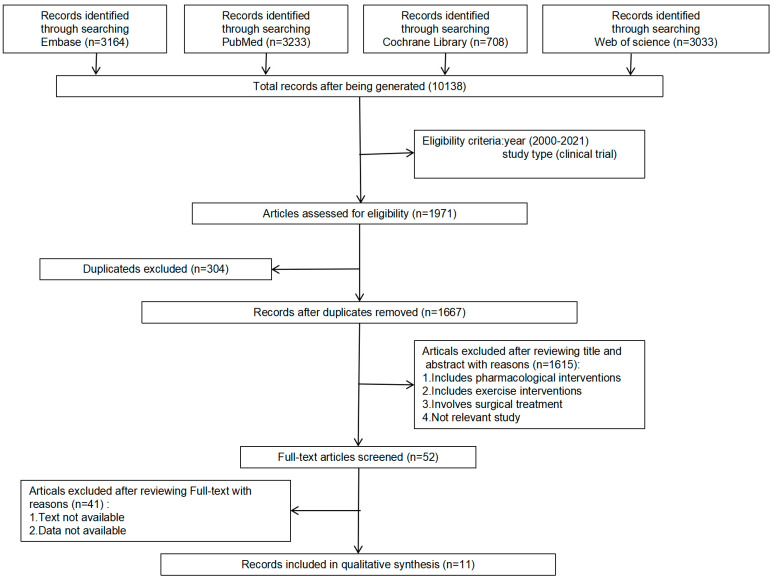
We conducted a systematic review and meta-analysis of randomized clinical trials and pilot trial studies to compare the effectiveness of intermittent fasting (IF) and continuous calorie restriction (CCR) in overweight and obese people. The parameters included body mass index (BMI), body weight, and other metabolism-related indicators. A systematic search in PubMed, Embase, Cochrane Library, and Web of Science was conducted up to January 2022. Standardized mean differences (SMDs) with 95% confidence intervals (CIs) were used to measure the effectiveness. Publication bias was assessed using Egger’s test. The stability of the results was evaluated using sensitivity analyses. The significance of body weight change (SMD = −0.21, 95% CI (−0.40, −0.02) p = 0.028) was more significant after IF than CCR. There was no significant difference in BMI (SMD = 0.02, 95% CI (−0.16, 0.20) p = 0.848) between IF and CCR. These findings suggest that IF may be superior to CCR for weight loss in some respects.
Overview
The claims and statistics of this paper haven’t been checked yet.
Free: it reads the open-access text and checks the first 5 claims that cite a source we can check. Create a free account to check every claim.
Integrity signals
Registry
Cites
Statistics
Figures


Verification
Claims the paper makes
The claims and statistics of this paper haven’t been checked yet.
Free: it reads the open-access text and checks the first 5 claims that cite a source we can check. Create a free account to check every claim.
Claims other papers make about this one
Each is checked against this paper’s own text: does it say what the citing paper says it does?
The source backs part of the claim, not all of it — or backs it for a different population, condition or comparison.
In the citing paper
“IF may provide benefits comparable to those of continuous energy restriction (CER) in body weight, glycemic control, and cardiometabolic health, and may be more feasible for certain populations (10).”
From Intermittent fasting versus continuous energy restriction in MASLD: a systematic review and meta-analysis (2026) · cites this paper as [10]
Experimental — accuracy not yet measuredThe cited source says what the claim attributes to it.
In the citing paper
“To date, existing systematic reviews and meta-analyses have conducted pairwise comparisons, such as STF versus CER [22], IER versus CER [23], and STF versus CER [24, 25]. However, these studies have not yielded conclusive evidence regarding the optimal regimen.”
From Comparing caloric restriction regimens for effective weight management in adults: a systematic review and network meta-analysis (2024) · cites this paper as [24]
Self-check
Percentages, sums and reported differences re-computed from the paper’s own numbers.
The self-check needs the paper’s full text.
Citations
Cites
Bias in meta-analysis detected by a simple, graphical test
Egger, M., Smith, G. D., Schneider, M., & Minder, C. (1997) · BMJ · doi:10.1136/bmj.315.7109.629 · Cited by 56,722
The Cochrane Collaboration's tool for assessing risk of bias in randomised trials
Higgins, J. P. T., Altman, D. G., Gotzsche, P. C., Juni, P., Moher, D., Oxman, A. D., Savovic, J., Schulz, K. F., Weeks, L., Sterne, J. A. C., et al. (2011) · BMJ · doi:10.1136/bmj.d5928 · Cited by 33,817
PRISMA-P Group, Moher, D., Shamseer, L., Clarke, M., Ghersi, D., Liberati, A., Petticrew, M., Shekelle, P., & Stewart, L. A. (2015) · Systematic Reviews · doi:10.1186/2046-4053-4-1 · Cited by 26,223 · cited 1×
“Our meta-analysis was based on the Preferred Reporting Items for Systematic Reviews and Meta-analyses guidelines [18].”
MethodDermyshi, E., Wang, Y., Yan, C., Hong, W., Qiu, G., Gong, X., & Zhang, T. (2017) · Neonatology · doi:10.1159/000454668 · Cited by 24,451
Operating characteristics of a rank correlation test for publication bias
Begg, C. B., & Mazumdar, M. (1994) · Biometrics · doi:10.2307/2533446 · Cited by 16,955 · cited 1×
“Publication bias was assessed using Begg’s test [21] and Egger’s test [22].”
MethodThe metabolic phenotype in obesity: Fat mass, body fat distribution, and adipose tissue function
Goossens, G. H. (2017) · Obesity Facts · doi:10.1159/000471488 · Cited by 8,481
Eckel, R. H., Alberti, K., Grundy, S. M., & Zimmet, P. Z. (2010) · The Lancet · doi:10.1016/s0140-6736(09)61794-3 · Cited by 6,295
Eckel, R. H., Grundy, S. M., & Zimmet, P. Z. (2005) · The Lancet · doi:10.1016/s0140-6736(05)66378-7 · Cited by 5,550
Kopelman, P. G. (2000) · Nature · doi:10.1038/35007508 · Cited by 4,795
2013 AHA/ACC/TOS Guideline for the Management of Overweight and Obesity in Adults
Jensen, M. D., Ryan, D. H., Apovian, C. M., Ard, J. D., Comuzzie, A. G., Donato, K. A., Hu, F. B., Hubbard, V. S., Jakicic, J. M., Kushner, R. F., et al. (2014) · Journal of the American College of Cardiology · doi:10.1016/j.jacc.2013.11.004 · Cited by 4,058
Cited by
Kamarul Zaman, M., Teng, N. I. M. F., Kasim, S. S., Juliana, N., & Alshawsh, M. A. (2023) · World Journal of Cardiology · doi:10.4330/wjc.v15.i7.354 · Cited by 38
Siles-Guerrero, V., Romero-Márquez, J. M., García-Pérez, R. N., Novo-Rodríguez, C., Guardia-Baena, J. M., Hayón-Ponce, M., Tenorio-Jiménez, C., López-de-la-Torre-Casares, M., & Muñoz-Garach, A. (2024) · Nutrients · doi:10.3390/nu16203533 · Cited by 25
Huang, J., Li, Y., Chen, M., Cai, Z., Cai, Z., & Jiang, Z. (2024) · International Journal of Behavioral Nutrition and Physical Activity · doi:10.1186/s12966-024-01657-9 · Cited by 25
“To date, existing systematic reviews and meta-analyses have conducted pairwise comparisons, such as STF versus CER [22], IER versus CER [23], and STF versus CER [24, 25].”
Fulgoni, V. L., Agler, A., Ricciuto, L., DiFrancesco, L., Williams, D., & Hertzler, S. R. (2024) · The Journal of Nutrition · doi:10.1016/j.tjnut.2024.07.022 · Cited by 8
Li, H., & Li, T. (2026) · Frontiers in nutrition · doi:10.3389/fnut.2026.1833688 · Cited by 1
Metadata
- Authors
- Zhang, Q., Zhang, C., Wang, H., Ma, Z., Liu, D., Guan, X., Liu, Y., Fu, Y., Cui, M., & Dong, J.
- Affiliations
- Qingdao University (CN)
- Corresponding author
- Dong, Jing
- Venue
- Nutrients
- Publisher
- MDPI AG
- Published
- 2022-04-24
- Volume
- 14
- Issue
- 9
- Pages
- 1781
- ISSN
- 2072-6643 (ISSN-L)
- PMC
- PMC9099935
- OpenAlex
- W4224318250
- Cited by
- 53
- References
- 60
- Citations by year
- 2026: 10 · 2025: 14 · 2024: 17 · 2023: 11 · 2022: 1
- FWCI
- 1.48
- Type
- journal article
- Language
- en
- Open access
- gold
- doi.org
- Licence
- Locations
- Nutrients (publishedVersion, cc-by)
- PubMed Central (publishedVersion, cc-by)
- PubMed (publishedVersion)
- Funders
- National Natural Science Foundation of China (No. 31872791)
- Natural Science Foundation of Shandong Province (No. ZR2019MC046)
- Topics
- Health Sciences › Medicine › Physiology (medical) › Dietary Effects on Health
- Health Sciences › Medicine › Physiology (medical) › Diet and metabolism studies
- Social Sciences › Psychology › Clinical Psychology › Eating Disorders and Behaviors
- Keywords
- intermittent fasting, weight loss, obesity, overweight, body mass index, weight change, metabolic biomarkers
- MeSH terms
- Body Weight, Fasting, Humans, Weight Loss, Caloric Restriction, Overweight
About these checks
Registry, retraction, Cites and statistics results are computed, not judged, with one exception: a printed reference that no index lists is read once by a model before it counts as a citation error. Claims are extracted by a model and kept only when their quote appears verbatim in the text; each cited source is then checked, with a model’s help, for whether it says what the claim relies on. Those verdicts can be wrong — read the claim’s quote and the cited source before relying on one.
Statistics and arithmetic are recomputed, not judged.
Confidence bands are shown only for fields calibrated on our annotated test set. None is calibrated yet, so no band is shown.
What counts as a claim ›How we measure confidence ›How we check this ›
Are you an author, or do you see a problem with this page? Request a review
How to cite
Cite CoChat for the checks on this page, and the paper for its own findings.
- This page
- CoChat. (2026). Citation check: Intermittent Fasting versus Continuous Calorie Restriction: Which Is Better for Weight Loss? https://app.cochat.ai/papers/10.3390/nu14091781
- The paper
- Zhang, Q., Zhang, C., Wang, H., Ma, Z., Liu, D., Guan, X., Liu, Y., Fu, Y., Cui, M., & Dong, J. (2022). Intermittent Fasting versus Continuous Calorie Restriction: Which Is Better for Weight Loss? Nutrients. https://doi.org/10.3390/nu14091781
Data sources
Bibliographic data: Semantic Scholar, OpenAlex, Crossref.
Contains information from the Semantic Scholar Academic Graph Datasets, made available under the ODC Attribution License (ODC-BY 1.0).
Semantic Scholar’s data is described in: Kinney, R., et al. (2023). The Semantic Scholar Open Data Platform. arXiv:2301.10140.
