

Effects of Gestational Sleep Patterns and Their Changes on Maternal Glycemia and Offspring Physical Growth in Early Life
Open accessThe DOI matches its Crossref record; 40 of the 40 references it cites were found in a registry or an index.
Abstract
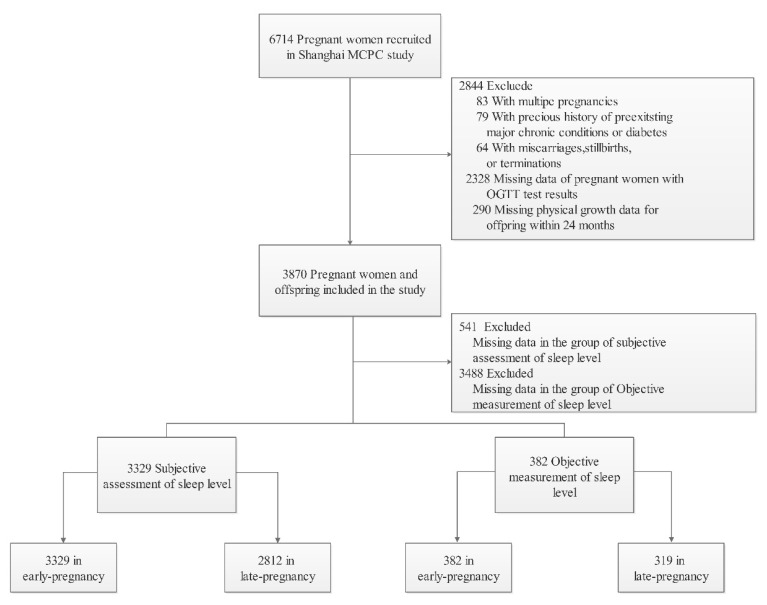
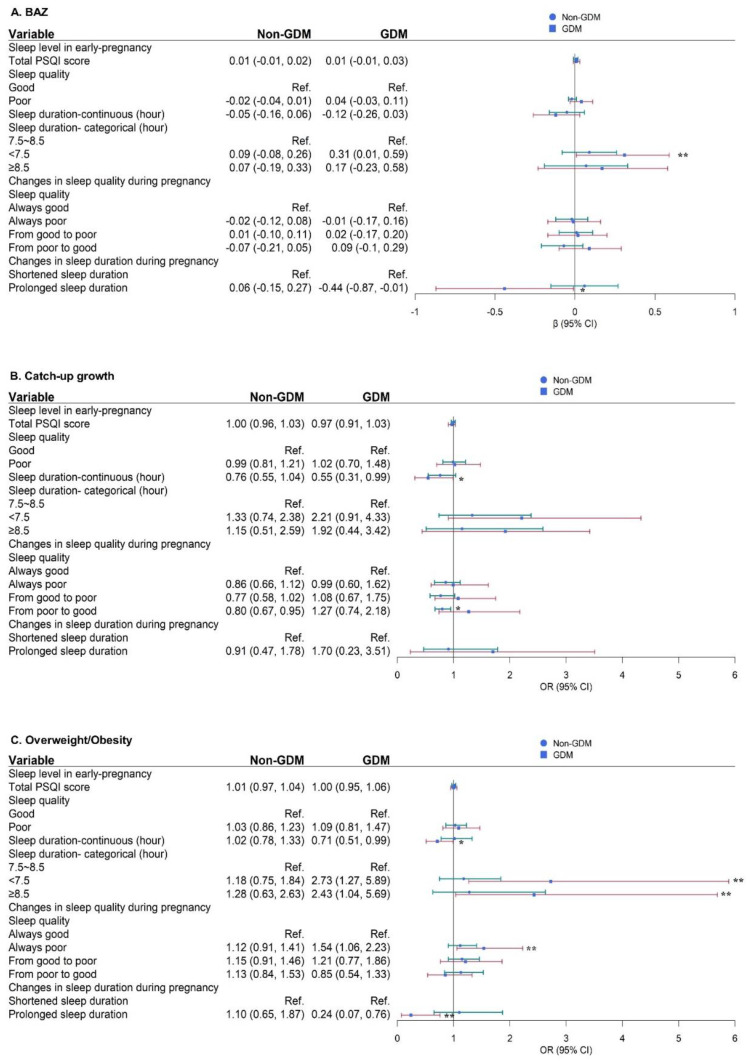
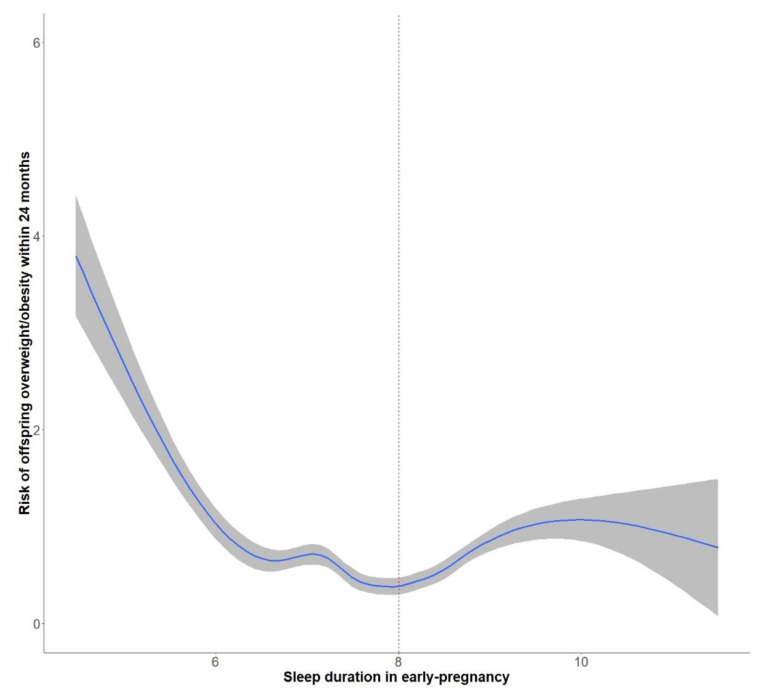
Maternal sleep patterns during pregnancy are drawing increased attention to examine its role in the regulation of maternal glycemia and physical growth of offspring within 24 months. Among 3329 eligible mother–child pairs included in the Shanghai Maternal–Child Pairs Cohort, sleep patterns of pregnant women were assessed by Pittsburgh Sleep Quality Index and objective measurement in early and late pregnancy. Offspring physical growth within 24 months was primarily indicated by the body mass index Z-score (BAZ), catch-up growth, and overweight/obesity. In total, 3329 and 382 pregnant women were included with subjectively assessed and objectively measured sleep pattern, respectively. The increased risk of GDM was associated with maternal night-time sleep duration ≥8.5 h in early pregnancy, or sleep quality change from poor to good during pregnancy (OR = 1.48; 95% CI, 1.06 to 2.07). In the GDM group, the effect of sleep duration in early pregnancy on overweight/obesity in offspring within 24 months showed a U-shaped curve, with a 1.73-fold and 1.43-fold increased risk of overweight/obesity of offspring in pregnant women with <7.5 or ≥8.5 h of sleep duration, respectively. A good gestational sleep pattern was required to reduce the risk of GDM and offspring overweight/obesity within 24 months.
Overview
The claims and statistics of this paper haven’t been checked yet.
Free: it reads the open-access text and checks the first 5 claims that cite a source we can check. Create a free account to check every claim.
Integrity signals
Registry
Cites
Statistics
Figures
Verification
Claims the paper makes
The claims and statistics of this paper haven’t been checked yet.
Free: it reads the open-access text and checks the first 5 claims that cite a source we can check. Create a free account to check every claim.
Claims other papers make about this one
Each is checked against this paper’s own text: does it say what the citing paper says it does?
The source backs part of the claim, not all of it — or backs it for a different population, condition or comparison.
In the citing paper
“Moreover, a cohort study involving 6714 pregnant women conducted in Shanghai demonstrated that poor sleep quality among women with GDM was associated with adverse health outcomes for their offspring, such as overweight or obesity and unhealthy lifestyles [39].”
From Neglected sleep quality problems in women with gestational diabetes mellitus: a multi-center cross-sectional study (2024) · cites this paper as [39]
Experimental — accuracy not yet measured
Self-check
Percentages, sums and reported differences re-computed from the paper’s own numbers.
The self-check needs the paper’s full text.
Citations
Cites
The Pittsburgh Sleep Quality Index: a new instrument for psychiatric practice and research
Buysse, D. J., Reynolds, C. F., Monk, T. H., Berman, S. R., & Kupfer, D. J. (1989) · Psychiatry Research · doi:10.1016/0165-1781(89)90047-4 · Cited by 35,234 · cited 1×
“Higher total PSQI scores indicated worse sleep quality, with greater than five being considered as poor sleep quality and lower scores as good sleep quality [19].”
BackgroundElective induction versus spontaneous labor after sonographic diagnosis of fetal macrosomia.
Combs, C. A., Singh, N. B., & Khoury, J. C. (1993) · PubMed · Cited by 2,505
Buchanan, T. A., & Xiang, A. H. (2005) · Journal of Clinical Investigation · doi:10.1172/jci200524531 · Cited by 2,123
Predicting adult obesity from childhood obesity: a systematic review and meta‐analysis
Simmonds, M., Llewellyn, A., Owen, C. G., & Woolacott, N. (2016) · Obesity Reviews · doi:10.1111/obr.12334 · Cited by 2,103 · cited 1×
“Hyperglycemia during pregnancy has adverse effects on offspring growth, such as an increased risk of overweight/obesity in early life [1].”
BackgroundAssociation between postnatal catch-up growth and obesity in childhood: prospective cohort study
Ong, K. K. L. (2000) · BMJ · doi:10.1136/bmj.320.7240.967 · Cited by 1,668 · cited 1×
“67, and overweight/obese was defined as BAZ > 1 [21,22].”
BackgroundSleep duration and risk of type 2 diabetes: a meta-analysis of prospective studies
Shan, Z., Ma, H., Xie, M., Yan, P., Guo, Y., Bao, W., Rong, Y., Jackson, C. L., Hu, F. B., & Liu, L. (2015) · Diabetes Care · doi:10.2337/dc14-2073 · Cited by 902 · cited 1×
“increasing the risk of type II diabetes [9,10].”
BackgroundAnothaisintawee, T., Reutrakul, S., Van Cauter, E., & Thakkinstian, A. (2016) · Sleep Medicine Reviews · doi:10.1016/j.smrv.2015.10.002 · Cited by 640 · cited 2×
“Compared to other countries, pregnant women in China slept significantly less than 7 h per night [6], so 7.”
BackgroundEffects of Sleep Fragmentation on Glucose Metabolism in Normal Subjects
Stamatakis, K. A., & Punjabi, N. M. (2010) · Chest · doi:10.1378/chest.09-0791 · Cited by 614 · cited 1×
“Offspring of pregnant women with a prolonged sleep duration have been shown to have a lower mean birth weight [36], and offspring of those who slept more than 8 h in early pregnancy had a 39% lower risk of being overweight at five years of age [37].”
BackgroundFetal Origins of Mental Health: The Developmental Origins of Health and Disease Hypothesis
O’Donnell, K. J., & Meaney, M. J. (2017) · American Journal of Psychiatry · doi:10.1176/appi.ajp.2016.16020138 · Cited by 608 · cited 1×
“As obesity persisted from birth to two years of age and even into adulthood [2,3], according to the Developmental Origins of Health and Disease (DOHaD) [4], early pregnancy planning should be incorporated as a preventable factor in child obesity interventions.”
BackgroundSleep quality during pregnancy: A meta-analysis
Sedov, I. D., Cameron, E. E., Madigan, S., & Tomfohr-Madsen, L. M. (2018) · Sleep Medicine Reviews · doi:10.1016/j.smrv.2017.06.005 · Cited by 564 · cited 2×
“which was consistent with the results of two existing studies [28,29] that observed a Ushaped association between sleep duration during pregnancy and the risk of GDM.”
Result
Research works printed but not linked: 1
- Huijing S.H.I. Strengthening researches in early-life course risk factors for childhood overweight and obesity Chin. J. Sch. Health 2022 43 801 804 10.16835/j.cnki.1000-9817.2022.06.001 · doi:10.16835/j.cnki.1000-9817.2022.06.001
Cited by
Cohort Profile: The Shanghai Maternal-Child Pairs Cohort (MCPC)
Gui, Y., Zhao, Y., Tao, X. G., Xu, W., Yang, Q., Wang, Y., Zhu, Q., Wang, P., Wei, Q., Shi, H., et al. (2023) · International Journal of Epidemiology · doi:10.1093/ije/dyad185 · Cited by 22
Self-citationSleep During Pregnancy and Offspring Outcomes From Infancy to Childhood: A Systematic Review
Nevarez-Brewster, M., Han, D., Todd, E. L., Keim, P., Doom, J. R., & Davis, E. P. (2024) · Psychosomatic Medicine · doi:10.1097/psy.0000000000001352 · Cited by 20
Chen, Y., Tong, E., Rao, Y., Yu, E. Y.-W., Zeegers, M. P., & Wesselius, A. (2025) · Journal of Global Health · doi:10.7189/jogh.15.04016 · Cited by 16
The impact of maternal sleep during pregnancy on childhood health: A systematic review
Zhang, Y., Chen, Y., Lu, R., Zhao, A., Ning, Z., Wang, D., Yuan, J., & Li, S. (2025) · Sleep Medicine Reviews · doi:10.1016/j.smrv.2025.102090 · Cited by 8
Self-citationYu, J., Chen, Z., Chen, Y., Wang, X., Luo, Z., Fan, J., Chen, L., Zhao, Q., & Tang, J. (2024) · BMC Pregnancy and Childbirth · doi:10.1186/s12884-024-06940-y · Cited by 4
Metadata
- Authors
- Zou, J., Wei, Q., Ye, P., Shi, Y., Zhang, Y., & Shi, H.
- Affiliations
- Fudan University (CN)
- Corresponding author
- Shi, Huijing
- Venue
- Nutrients
- Publisher
- MDPI AG
- Published
- 2022-08-18
- Volume
- 14
- Issue
- 16
- Pages
- 3390
- ISSN
- 2072-6643 (ISSN-L)
- PMC
- PMC9416776
- OpenAlex
- W4293780042
- Cited by
- 12
- References
- 40
- Citations by year
- 2026: 3 · 2025: 4 · 2024: 3 · 2023: 2
- FWCI
- 2.27
- Type
- journal article
- Language
- en
- Open access
- gold
- doi.org
- Licence
- Locations
- Nutrients (publishedVersion, cc-by)
- PubMed Central (publishedVersion, cc-by)
- PubMed (publishedVersion)
- DOAJ (DOAJ: Directory of Open Access Journals) (submittedVersion, cc-by-sa)
- Funders
- the Special Foundation of Basic Science and Technology Resources Survey from the Ministry of Science and Technology of China (2019FY101004)
- Topics
- Health Sciences › Medicine › Obstetrics and Gynecology › Gestational Diabetes Research and Management
- Health Sciences › Medicine › Pediatrics, Perinatology and Child Health › Birth, Development, and Health
- Social Sciences › Psychology › Experimental and Cognitive Psychology › Sleep and related disorders
- Keywords
- sleep quality, gestational diabetes mellitus, maternal glycemia, catch-up growth, childhood overweight and obesity, BMI z-score, pregnancy
- MeSH terms
- Blood Glucose, China, Female, Humans, Obesity, Pregnancy, Risk Factors, Sleep, Body Mass Index, Diabetes, Gestational, Overweight
About these checks
Registry, retraction, Cites and statistics results are computed, not judged, with one exception: a printed reference that no index lists is read once by a model before it counts as a citation error. Claims are extracted by a model and kept only when their quote appears verbatim in the text; each cited source is then checked, with a model’s help, for whether it says what the claim relies on. Those verdicts can be wrong — read the claim’s quote and the cited source before relying on one.
Statistics and arithmetic are recomputed, not judged.
Confidence bands are shown only for fields calibrated on our annotated test set. None is calibrated yet, so no band is shown.
What counts as a claim ›How we measure confidence ›How we check this ›
Are you an author, or do you see a problem with this page? Request a review
Data sources
Bibliographic data: Semantic Scholar, OpenAlex, Crossref.
Contains information from the Semantic Scholar Academic Graph Datasets, made available under the ODC Attribution License (ODC-BY 1.0).
Semantic Scholar’s data is described in: Kinney, R., et al. (2023). The Semantic Scholar Open Data Platform. arXiv:2301.10140.
