

Pro-Inflammatory Diet Is Correlated with High Veillonella rogosae, Gut Inflammation and Clinical Relapse of Inflammatory Bowel Disease
Open accessThe DOI matches its Crossref record; 60 of the 60 references it cites were found in a registry or an index.
Abstract
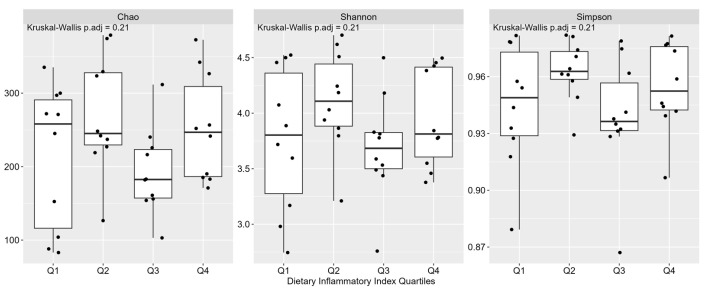
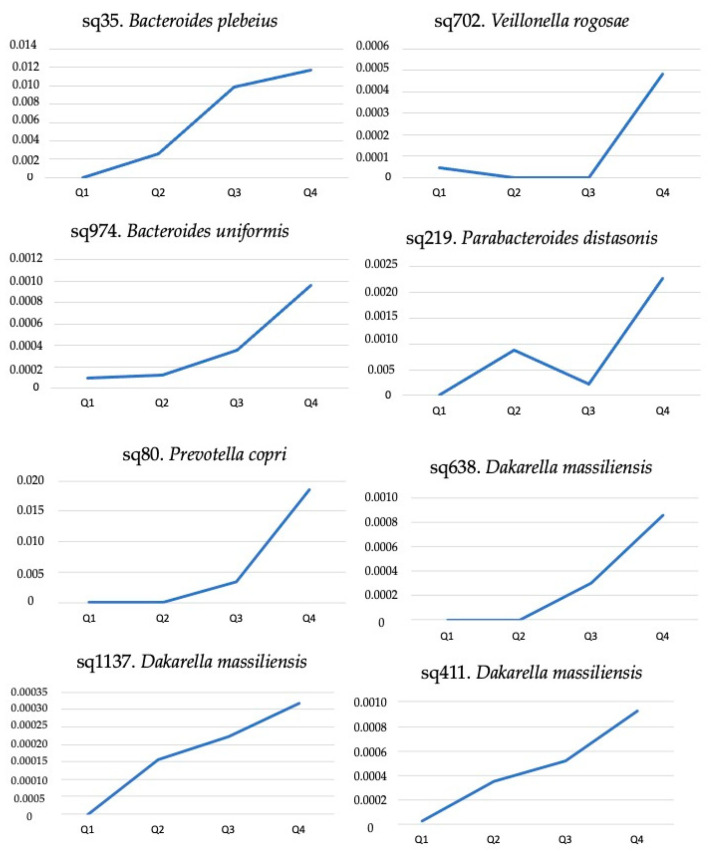
Inflammatory bowel diseases (IBD) are chronic conditions arising from an intricate interplay of genetics and environmental factors, and are associated with gut dysbiosis, inflammation, and gut permeability. In this study, we investigated whether the inflammatory potential of the diet is associated with the gut microbiota profile, inflammation, and permeability in forty patients with IBD in clinical remission. The dietary inflammatory index (DII) score was used to assess the inflammatory potential of the diet. The fecal microbiota profile was analyzed using 16SrRNA (V3–V4) gene sequencing, while fecal zonulin and calprotectin levels were measured with enzyme-linked immunosorbent assays. We found a positive correlation between the DII score and elevated calprotectin levels (Rho = 0.498; p = 0.001), but not with zonulin levels. Although α- and β-diversity did not significantly differ across DII quartiles, the most pro-inflammatory diet group exhibited a higher fecal abundance of Veillonella rogosae (p = 0.026). In addition, the abundance of some specific bacteria sequences showed an exponential behavior across DII quartiles and a correlation with calprotectin or zonulin levels (p ≤ 0.050). This included a positive correlation between sq702. Veillonella rogosae and fecal calprotectin levels (Rho = 0.419, p = 0.007). DII, calprotectin, and zonulin levels were identified as significant predictors of 6-month disease relapse (p ≤ 0.050). Our findings suggest a potential relationship of a pro-inflammatory diet intake with Veillonella rogosae and calprotectin levels in IBD patients in clinical remission, which may contribute to disease relapse.
Overview
The claims and statistics of this paper haven’t been checked yet.
Free: it reads the open-access text and checks the first 5 claims that cite a source we can check. Create a free account to check every claim.
Integrity signals
Registry
Cites
Statistics
Figures
Verification
Claims the paper makes
The claims and statistics of this paper haven’t been checked yet.
Free: it reads the open-access text and checks the first 5 claims that cite a source we can check. Create a free account to check every claim.
Claims other papers make about this one
Each is checked against this paper’s own text: does it say what the citing paper says it does?
In the citing paper
“Elevated fecal calprotectin has been correlated with dysbiotic alterations in microbiota composition among IBD patients,123”
From Gut dysbiosis in oncology: a risk factor for immunoresistance (2026) · doi:10.1038/s41422-025-01212-6 · cites this paper as [123]
Self-check
Percentages, sums and reported differences re-computed from the paper’s own numbers.
The self-check needs the paper’s full text.
Citations
Cites
DADA2: High–resolution sample inference from Illumina amplicon data
Callahan, B. J., McMurdie, P. J., Rosen, M. J., Han, A. W., Johnson, A. J. A., & Holmes, S. P. (2016) · Nature Methods · doi:10.1038/nmeth.3869 · Cited by 35,698 · cited 1×
“To assign species-level taxonomic IDs to each ASV, we employed DADA2, which identified exact matches (100% identity) between ASVs and reference sequences from the Silva database (version 132) [34,35].”
The SILVA ribosomal RNA gene database project: improved data processing and web-based tools
Quast, C., Pruesse, E., Yilmaz, P., Gerken, J., Schweer, T., Yarza, P., Peplies, J., & Glöckner, F. O. (2012) · Nucleic Acids Research · doi:10.1093/nar/gks1219 · Cited by 33,055 · cited 1×
“To assign species-level taxonomic IDs to each ASV, we employed DADA2, which identified exact matches (100% identity) between ASVs and reference sequences from the Silva database (version 132) [34,35].”
Ng, S. C., Shi, H. Y., Hamidi, N., Underwood, F. E., Tang, W., Benchimol, E. I., Panaccione, R., Ghosh, S., Wu, J. C. Y., Chan, F. K. L., et al. (2017) · The Lancet · doi:10.1016/s0140-6736(17)32448-0 · Cited by 6,087
The Treatment-Naive Microbiome in New-Onset Crohn’s Disease
Gevers, D., Kugathasan, S., Denson, L. A., Vázquez-Baeza, Y., Van Treuren, W., Ren, B., Schwager, E., Knights, D., Song, S. J., Yassour, M., et al. (2014) · Cell Host & Microbe · doi:10.1016/j.chom.2014.02.005 · Cited by 3,220
Designing and developing a literature-derived, population-based dietary inflammatory index
Shivappa, N., Steck, S. E., Hurley, T. G., Hussey, J. R., & Hébert, J. R. (2014) · Public Health Nutrition · doi:10.1017/s1368980013002115 · Cited by 2,731 · cited 3×
“However, the Dietary Inflammatory Index (DII) may address this issue by assessing the overall inflammatory potential of a diet [21].”
InfluentialPsychosomatic medicine in Germany: more timely than ever
Zipfel, S., Herzog, W., Kruse, J., & Henningsen, P. (2016) · Psychotherapy and Psychosomatics · doi:10.1159/000447701 · Cited by 2,323
Gomollón, F., Dignass, A., Annese, V., Tilg, H., Van Assche, G., Lindsay, J. O., Peyrin-Biroulet, L., Cullen, G. J., Daperno, M., Kucharzik, T., et al. (2017) · Journal of Crohn's and Colitis · doi:10.1093/ecco-jcc/jjw168 · Cited by 2,057 · cited 1×
“CD and UC diagnoses were established in accordance with the European Crohn’s and Colitis Organization criteria [24,25], while data concerning disease remission were derived from medical appointments, which were conducted by the attending physician based on the Harvey–Bradshaw index ( 5) for CD [26]…”
Magro, F., Gionchetti, P., Eliakim, R., Ardizzone, S., Armuzzi, A., Barreiro-de Acosta, M., Burisch, J., Gecse, K. B., Hart, A. L., Hindryckx, P., et al. (2017) · Journal of Crohn's and Colitis · doi:10.1093/ecco-jcc/jjx008 · Cited by 1,910
You are what you eat: Diet, health and the gut microbiota
Zmora, N., Suez, J., & Elinav, E. (2019) · Nature Reviews Gastroenterology & Hepatology · doi:10.1038/s41575-018-0061-2 · Cited by 1,792 · cited 1×
“This imbalance may disrupt the gut microbiota, compromise the epithelial barrier function, and disturb intestinal immune homeostasis, ultimately triggering or exacerbating intestinal inflammation [45].”
Sandborn, W. J., van Assche, G., Reinisch, W., Colombel, J., D’Haens, G., Wolf, D. C., Kron, M., Tighe, M. B., Lazar, A., & Thakkar, R. B. (2012) · Gastroenterology · doi:10.1053/j.gastro.2011.10.032 · Cited by 1,269 · cited 1×
“…with the European Crohn’s and Colitis Organization criteria [24,25], while data concerning disease remission were derived from medical appointments, which were conducted by the attending physician based on the Harvey–Bradshaw index ( 5) for CD [26] and the partial Mayo score ( 2) for UC [27].”
Research works printed but not linked: 2
- Khalil H. Sherwood P. PTH-034 Do fecal calprotectin levels influence colonoscopy rates? Gut 2018 67 A29
- Haubrock J. Hartigg U. Souverein O. Boeing H. An improved statistical tool for estimating usual intake distributions: The multiple source method (MSM) Arch. Public Health 2010 68 14 15
Cited by
Gut dysbiosis in oncology: a risk factor for immunoresistance
(2026) · doi:10.1038/s41422-025-01212-6 · Cited by 24
What is the link between the dietary inflammatory index and the gut microbiome? A systematic review
Mirhosseini, S. M., Mahdavi, A. A., Yarmohammadi, H., Razavi, A., Rezaei, M., Soltanipur, M., Nemch, M. K., Naeini, S. J., & Siadat, S. D. (2024) · European Journal of Nutrition · doi:10.1007/s00394-024-03470-3 · Cited by 29
Liu, C., Liu, L., Tian, Z., Zhan, S., Qiu, Y., Li, M., Li, T., Mao, R., Zhang, S., Chen, M., et al. (2024) · Journal of Advanced Research · doi:10.1016/j.jare.2024.11.025 · Cited by 31
Inflammation in Development and Aging: Insights from the Zebrafish Model
Mastrogiovanni, M., Martínez-Navarro, F. J., Bowman, T. V., & Cayuela, M. L. (2024) · International Journal of Molecular Sciences · doi:10.3390/ijms25042145 · Cited by 32
Fonseca, D. C., da Rocha, I. M. G., Balmant, B. D., Callado, L., Prudêncio, A. P. A., Alves, J. T. M., Torrinhas, R. S., Fernandes, G. D. R., & Waitzberg, D. L. (2024) · Gut Microbes · doi:10.1080/19490976.2023.2297815 · Cited by 26
“This outcome suggests that, for the specific profile of individuals in our cohort previously described by Rocha et al., 38 the gut microbiota may not be the most reliable marker for distinguishing healthy individuals from those with UC or the other diseases under consideration.”
BackgroundSelf-citation
Metadata
- Authors
- Rocha, I. M. G. D., Torrinhas, R., Fonseca, D., Lyra, C. D. O., de Sousa Alves Neri, J. L., Balmant, B. D., Callado, L., Charlton, K., Queiroz, N., & Waitzberg, D. L.
- Affiliations
- Universidade de São Paulo (BR)
- Department of Nutrition, Universidade Federal do Rio Grande do Norte, Natal 59078-900, RN, Brazil
- School of Medical, Indigenous and Health Sciences, Faculty of Science, Medicine and Health, University of Wollongong, Wollongong, NSW 2522, Australia
- University of Wollongong (AU)
- Department of Gastroenterology, Faculdade de Medicina, Hospital das Clinicas HCFMUSP, Universidade de São Paulo, São Paulo 05508-070, SP, Brazil
- Corresponding author
- Waitzberg, Dan L.
- ORCID
- Venue
- Nutrients
- Publisher
- MDPI AG
- Published
- 2023-09-26
- Volume
- 15
- Issue
- 19
- Pages
- 4148
- ISSN
- 2072-6643 (ISSN-L)
- PMC
- PMC10574102
- OpenAlex
- W4387054692
- Cited by
- 43
- References
- 60
- Citations by year
- 2026: 12 · 2025: 19 · 2024: 12
- FWCI
- 7.13
- Type
- journal article
- Language
- en
- Open access
- gold
- doi.org
- Licence
- Locations
- Nutrients (publishedVersion, cc-by)
- PubMed Central (publishedVersion, cc-by)
- PubMed (publishedVersion)
- Research Online (University of Wollongong) (submittedVersion)
- Figshare (submittedVersion, cc-by)
- LA Referencia (Red Federada de Repositorios Institucionales de Publicaciones Científicas) (submittedVersion, cc-by)
- Funders
- Coordenação de Aperfeiçoamento de Pessoal de Nível Superior
- Topics
- Health Sciences › Medicine › Gastroenterology › Inflammatory Bowel Disease
- Life Sciences › Biochemistry, Genetics and Molecular Biology › Molecular Biology › Gut microbiota and health
- Health Sciences › Medicine › Public Health, Environmental and Occupational Health › Nutritional Studies and Diet
- Keywords
- inflammatory bowel disease, pro-inflammatory diet, Dietary Inflammatory Index, gut microbiota, calprotectin, zonulin, intestinal permeability, recurrence, clinical remission, gut dysbiosis
- MeSH terms
- Chronic Disease, Diet, Feces, Humans, Inflammation, Recurrence, Veillonella, Inflammatory Bowel Diseases, Biomarkers, Leukocyte L1 Antigen Complex
About these checks
Registry, retraction, Cites and statistics results are computed, not judged, with one exception: a printed reference that no index lists is read once by a model before it counts as a citation error. Claims are extracted by a model and kept only when their quote appears verbatim in the text; each cited source is then checked, with a model’s help, for whether it says what the claim relies on. Those verdicts can be wrong — read the claim’s quote and the cited source before relying on one.
Statistics and arithmetic are recomputed, not judged.
Confidence bands are shown only for fields calibrated on our annotated test set. None is calibrated yet, so no band is shown.
What counts as a claim ›How we measure confidence ›How we check this ›
Are you an author, or do you see a problem with this page? Request a review
Data sources
Bibliographic data: Semantic Scholar, OpenAlex, Crossref.
Contains information from the Semantic Scholar Academic Graph Datasets, made available under the ODC Attribution License (ODC-BY 1.0).
Semantic Scholar’s data is described in: Kinney, R., et al. (2023). The Semantic Scholar Open Data Platform. arXiv:2301.10140.
