

The DOI matches its Crossref record; 32 of the 33 references it cites were found in a registry or an index, and 1 are not checked yet; none of the 175 sources its claims cite is checked for support yet.
Effects of Intermittent Fasting on Male and Female Reproductive Hormones, Fertility, and Sexual Function: A Comprehensive Review with Emphasis on the Existing Evidence Gap in Women
Open accessAbstract
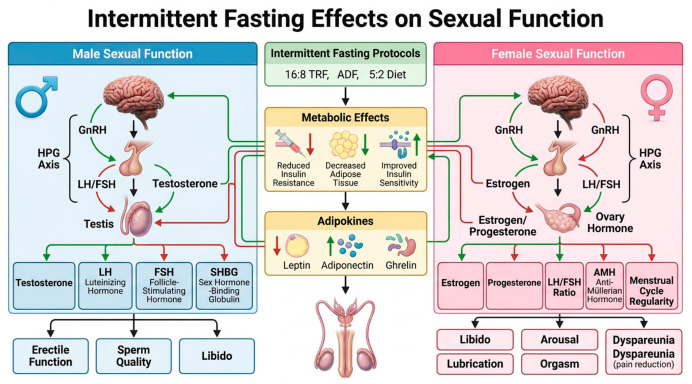
Intermittent fasting (IF) has emerged as a popular dietary intervention with potential metabolic and endocrine benefits. However, its effects on sexual function and reproductive health remain incompletely understood. This comprehensive review synthesizes current evidence from human clinical trials and animal studies examining the impact of various IF protocols—including time-restricted eating (TRE), alternate-day fasting (ADF), and Ramadan fasting—on male and female sexual function, reproductive hormones, and fertility outcomes. In males, limited human data suggest preserved erectile function but reduced sexual desire during Ramadan fasting, with neutral effects on testosterone in obese adults undergoing TRE. Animal studies demonstrate context-dependent effects, with IF protecting against high-fat diet-induced reproductive dysfunction while potentially impairing spermatogenesis under prolonged energy restriction. In females, IF shows promise for improving hyperandrogenism and menstrual regularity in polycystic ovary syndrome (PCOS), mediated by enhanced insulin sensitivity and reduced free androgen index. However, direct measurements of female sexual function domains (libido, arousal, lubrication, orgasm) are largely absent from the literature. Mechanistic pathways involve modulation of the hypothalamic–pituitary–gonadal (HPG) axis, insulin–adipokine signaling, sex hormone-binding globulin (SHBG), and oxidative stress pathways. Evidence quality is limited by small sample sizes, heterogeneous protocols, short follow-up periods, and predominance of animal data. While IF may offer reproductive benefits in metabolically compromised populations, particularly women with PCOS, caution is warranted in young, lean, or energy-deficient individuals. Future research should employ standardized IF protocols, validated sexual function instruments, and long-term fertility endpoints to establish evidence-based clinical recommendations.
Checked 2026-11-14 · 1 reference not checked yet
Overview
CoChat Summary
TL;DR
This comprehensive review finds that intermittent fasting (IF) has context-dependent effects on reproductive hormones, fertility, and sexual function, with the strongest evidence for metabolic and hormonal benefits in women with PCOS. However, direct validated data on female sexual function are entirely absent, and male libido findings derive almost exclusively from Ramadan fasting, limiting generalizability to TRE or ADF.
Key findings
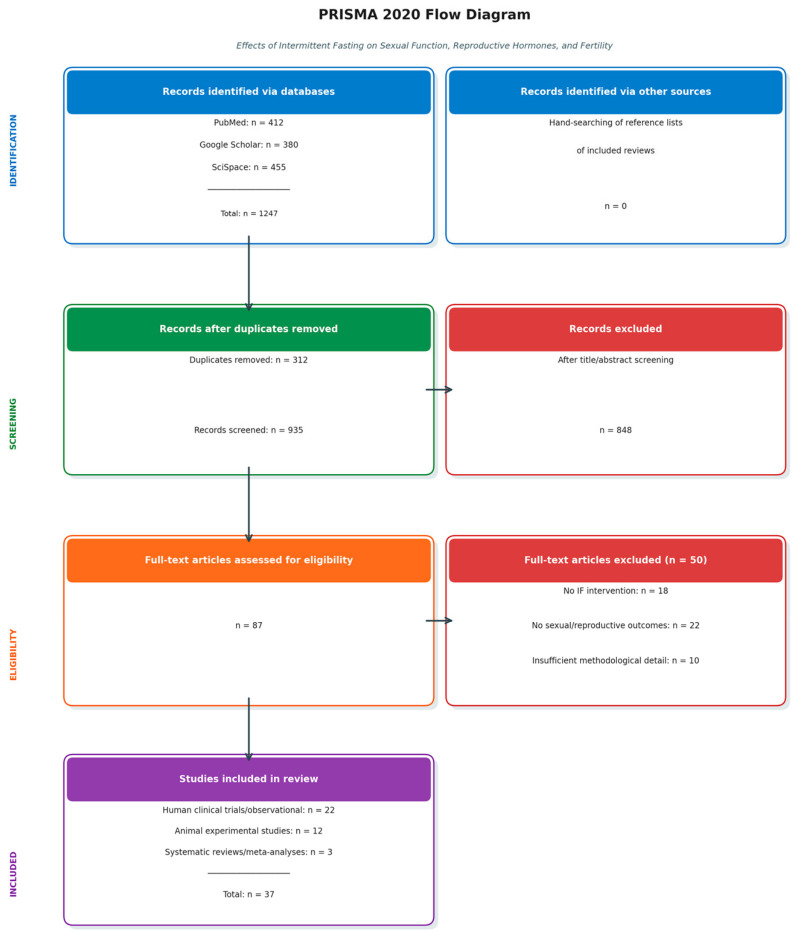
- From 1,247 records, 37 studies were included. In males, one Ramadan study of 45 healthy married men found significantly reduced sexual desire (p = 0.002) and intercourse frequency (p = 0.046), but no significant change in erectile function (p = 0.714); FSH decreased significantly (p = 0.016), while testosterone and LH were unchanged.
- A 12-month RCT in 90 adults with obesity found that 8 h time-restricted eating produced weight loss but no changes in total testosterone or SHBG in males, suggesting hormonal neutrality in obese men.
- In women with PCOS, a 6-week 8 h time-restricted feeding study of 30 women significantly reduced AMH, FSH, LH, estradiol, prolactin, total testosterone, and free testosterone (all p < 0.001, except FSH p = 0.002 and prolactin p = 0.038), decreased free androgen index (p < 0.001), increased SHBG (p < 0.001), reduced hyperandrogenism (p = 0.016), and normalized menstrual cycles in over 70%.
- No identified study assessed female sexual function domains (desire, arousal, lubrication, orgasm, satisfaction, dyspareunia) using validated instruments such as the FSFI under any IF protocol; all conclusions about female sexual function are inferential from hormonal and metabolic surrogates.
Methods
- Comprehensive literature search across PubMed, Google Scholar, SciSpace, and full-text repositories from database inception to March 2025, restricted to English-language studies, using keywords for IF protocols and sexual/reproductive outcomes.
- Two-stage screening identified 1,247 records; after removing 312 duplicates and screening 935 titles/abstracts, 87 full texts were assessed and 37 studies were included.
- Narrative synthesis organized by sex and outcome domain; study quality was characterized as strong, moderate, limited, or insufficient based on sample size, controls, randomization, follow-up, validated measures, and confounding. The review was not prospectively registered in PROSPERO.
Limitations
- The paper explicitly states limitations including small sample sizes, short follow-up, heterogeneous IF protocols, lack of validated sexual function measures, absence of direct fertility endpoints (pregnancy/live birth), predominance of animal data, potential publication bias, and inadequate control for weight loss, diet composition, exercise, sleep, and psychosocial factors.
- The authors emphasize two critical limitations: no published study directly assessed female sexual function under IF using validated instruments, and Ramadan fasting findings cannot be generalized to secular TRE or ADF because of mandatory sexual abstinence, fluid restriction, sleep disruption, and religious context.
- Evident from the text: the review is narrative rather than meta-analytic, quality assessment is not described as using a formal standardized tool, and most human evidence is in obese or PCOS populations, leaving lean, young, and non-PCOS women underrepresented.
Model-written summary. Check it against the paper before relying on it.
Integrity signals
Registry
Cites
Statistics
Figures
Verification
Claims the paper makes
0 Valid · 2 Not valid · 143 Not checked · 52 Own results and interpretations
In the paper
“In males, limited human data suggest preserved erectile function but reduced sexual desire during Ramadan fasting, with neutral effects on testosterone in obese adults undergoing TRE.”
§ Effects of Intermittent Fasting on Male and Female Reproductive Hormones, Fertility, and Sexual Function: A Comprehensive Review with Emphasis on the Existing Evidence Gap in Women > Abstract
What the sources say
- Not checked yetcites [10] Talib, 2015, The effect of fasting on erectile function and sexual desire on men in the month of Ramadan, Urol. J.
hedgedstates a possible cause- Asserted: passes — The authors put it forward as true.
- Checkable: passes — It can be checked against evidence.
- Load-bearing: unclear — It is unclear whether the paper’s conclusions depend on it.
- Based: passes — The paper gives a reason why it holds.
In the paper
“In the Ramadan fasting study, serum testosterone and LH levels remained unchanged, while FSH decreased significantly (p = 0.016) [10].”
§ Effects of Intermittent Fasting on Male and Female Reproductive Hormones, Fertility, and Sexual Function: A Comprehensive Review with Emphasis on the Existing Evidence Gap in Women > 3. Results > 3.1. Male Sexual Function
What the sources say
- Not checked yetcites [10] Talib, 2015, The effect of fasting on erectile function and sexual desire on men in the month of Ramadan, Urol. J.
plainn = 45- Asserted: passes — The authors put it forward as true.
- Checkable: passes — It can be checked against evidence.
- Load-bearing: unclear — It is unclear whether the paper’s conclusions depend on it.
- Based: passes — The paper gives a reason why it holds.
In the paper
“IF restored serum testosterone levels, preserved testicular histology, and maintained sperm parameters that were otherwise impaired by HFD [16].”
§ Effects of Intermittent Fasting on Male and Female Reproductive Hormones, Fertility, and Sexual Function: A Comprehensive Review with Emphasis on the Existing Evidence Gap in Women > 3. Results > 3.1. Male Sexual Function
What the sources say
- Not checked yetcites [16] Hemead, 2025, Intermittent fasting restores fertility dysfunction caused by a high-fat diet in male rats: Role of SIRT-1/NRF2/P38 MAPK/NLRP3, Reprod. Fertil. Dev. source
plainstates a cause- Asserted: passes — The authors put it forward as true.
- Checkable: passes — It can be checked against evidence.
- Load-bearing: unclear — It is unclear whether the paper’s conclusions depend on it.
- Based: passes — The paper gives a reason why it holds.
In the paper
“In males, limited human data suggest preserved erectile function but reduced sexual desire during Ramadan fasting, with neutral effects on testosterone in obese adults undergoing TRE.”
§ Effects of Intermittent Fasting on Male and Female Reproductive Hormones, Fertility, and Sexual Function: A Comprehensive Review with Emphasis on the Existing Evidence Gap in Women > Abstract
What the sources say
- Not matchedcites [12] Cienfuegos, S., Corapi, S., Gabel, K., Ezpeleta, M., Kalam, F., Lin, S., Pavlou, V., and Varady, K.A. (2024). Effect of time restricted eating versus daily calorie restriction on sex hormones in males and females with obesity. medRxiv.
Couldn’t be matched to a paper in Crossref, so it can’t be checked.
hedged- Asserted: passes — The authors put it forward as true.
- Checkable: passes — It can be checked against evidence.
- Load-bearing: unclear — It is unclear whether the paper’s conclusions depend on it.
- Based: passes — The paper gives a reason why it holds.
- Not matched
A result the paper states — it cites no source for it, so there is none to check. The quote shows it is in the paper.
In the paper
“However, direct measurements of female sexual function domains (libido, arousal, lubrication, orgasm) are largely absent from the literature.”
§ Effects of Intermittent Fasting on Male and Female Reproductive Hormones, Fertility, and Sexual Function: A Comprehensive Review with Emphasis on the Existing Evidence Gap in Women > Abstract
plain- Asserted: passes — The authors put it forward as true.
- Checkable: passes — It can be checked against evidence.
- Load-bearing: passes — The paper’s conclusions depend on it.
- Based: passes — The paper gives a reason why it holds.
133 more claims
Create a free account to see all 197 claims and to verify the 161 references still open.
- It may state two separate claims as one. 48
- Probably not a substantial claim. 16
Self-check
Percentages, sums and reported differences re-computed from the paper’s own numbers.
Each contradiction between two passages listed here was confirmed by an independent check.
Rated major: it would touch a result — a value a result rests on, reported and recomputed p-values on opposite sides of the significance level, two passages that conflict with no sign which is right, or a cited work retracted before this paper was published.
In the paper
§ Effects of Intermittent Fasting on Male and Female Reproductive Hormones, Fertility, and Sexual Function: A Comprehensive Review with Emphasis on the Existing Evidence Gap in Women > 3. Results > 3.2. Female Sexual Function
“supported by one RCT (Güven [8]) and two systematic reviews/meta-analyses”
§ Effects of Intermittent Fasting on Male and Female Reproductive Hormones, Fertility, and Sexual Function: A Comprehensive Review with Emphasis on the Existing Evidence Gap in Women > 3. Results > 3.2. Female Sexual Function
“supported by multiple RCTs, meta-analyses, and systematic reviews demonstrating consistent improvements”
Rated major: it would touch a result — a value a result rests on, reported and recomputed p-values on opposite sides of the significance level, two passages that conflict with no sign which is right, or a cited work retracted before this paper was published.
In the paper
§ Effects of Intermittent Fasting on Male and Female Reproductive Hormones, Fertility, and Sexual Function: A Comprehensive Review with Emphasis on the Existing Evidence Gap in Women > 3. Results > 3.2. Female Sexual Function
“Evidence quality assessment (Section 3.2.3—PCOS): MODERATE—supported by one RCT (Güven [8]) and two systematic reviews/meta-analyses”
§ Effects of Intermittent Fasting on Male and Female Reproductive Hormones, Fertility, and Sexual Function: A Comprehensive Review with Emphasis on the Existing Evidence Gap in Women > 3. Results > 3.2. Female Sexual Function
“Quality Assessment—Section 3.2.3 [STRONG]: The strongest evidence base in this review”
Rated minor: it would not touch a result — a value no result rests on, a p-value that stays on the same side of the significance level, or a conflict that is clerical, resolved elsewhere in the paper, or outside its own findings.
In the paper
§ Effects of Intermittent Fasting on Male and Female Reproductive Hormones, Fertility, and Sexual Function: A Comprehensive Review with Emphasis on the Existing Evidence Gap in Women > 3. Results > 3.1. Male Sexual Function
“examined 45 healthy married men (mean age 37 ± 7.2 years) before and after Ramadan fasting”
§ Effects of Intermittent Fasting on Male and Female Reproductive Hormones, Fertility, and Sexual Function: A Comprehensive Review with Emphasis on the Existing Evidence Gap in Women > 3. Results > 3.1. Male Sexual Function
“one cross-sectional study (Talib et al. [10], n = 45)”
Rated minor: it would not touch a result — a value no result rests on, a p-value that stays on the same side of the significance level, or a conflict that is clerical, resolved elsewhere in the paper, or outside its own findings.
In the paper
§ Effects of Intermittent Fasting on Male and Female Reproductive Hormones, Fertility, and Sexual Function: A Comprehensive Review with Emphasis on the Existing Evidence Gap in Women > 3. Results > 3.1. Male Sexual Function
“human data consist of a single conference abstract (Sayme et al. [22]) without full published results.”
§ Effects of Intermittent Fasting on Male and Female Reproductive Hormones, Fertility, and Sexual Function: A Comprehensive Review with Emphasis on the Existing Evidence Gap in Women > 3. Results > 3.1. Male Sexual Function
“Human data are scarce and predominantly from small observational studies”
Citations
Cites
Azziz, R., Carmina, E., Chen, Z., Dunaif, A., Laven, J. S. E., Legro, R. S., Lizneva, D., Natterson-Horowtiz, B., Teede, H. J., & Yildiz, B. O. (2016) · Nature Reviews Disease Primers · doi:10.1038/nrdp.2016.57 · Cited by 2,005
Diamanti-Kandarakis, E., & Dunaif, A. (2012) · Endocrine Reviews · doi:10.1210/er.2011-1034 · Cited by 1,947
The effects of oxidative stress on female reproduction: a review
Agarwal, A., Aponte-Mellado, A., Premkumar, B. J., Shaman, A., & Gupta, S. (2012) · Reproductive Biology and Endocrinology · doi:10.1186/1477-7827-10-49 · Cited by 1,637
Effect of Lifestyle Changes on Erectile Dysfunction in Obese Men: A Randomized Controlled Trial
Esposito, K., Giugliano, F., Di Palo, C., Giugliano, G., Marfella, R., D'Andrea, F., D'Armiento, M., & Giugliano, D. (2004) · JAMA · doi:10.1001/jama.291.24.2978 · Cited by 841
Sexual Well-Being, Happiness, and Satisfaction, in Women: The Case for a New Conceptual Paradigm
Rosen, R. C., & Bachmann, G. A. (2008) · Journal of Sex & Marital Therapy · doi:10.1080/00926230802096234 · Cited by 233
Ghrelin as a pleotrophic modulator of gonadal function and reproduction
Tena-Sempere, M. (2008) · Nature Clinical Practice Endocrinology & Metabolism · doi:10.1038/ncpendmet1003 · Cited by 85
Sexual Function in Women with Polycystic Ovary Syndrome
Stovall, D. W., Scriver, J., Clayton, A. H., Williams, C. D., & Pastore, L. M. (2011) · The Journal of Sexual Medicine · doi:10.1111/j.1743-6109.2011.02539.x · Cited by 83
Cienfuegos, S., Corapi, S., Gabel, K., Ezpeleta, M., Kalam, F., Lin, S., Pavlou, V., & Varady, K. A. (2022) · Nutrients · doi:10.3390/nu14112343 · Cited by 82
Schneider, J. E., Brozek, J. M., & Keen-Rhinehart, E. (2014) · Hormones and Behavior · doi:10.1016/j.yhbeh.2014.03.011 · Cited by 45
Kumar, S., & Kaur, G. (2013) · PLoS ONE · doi:10.1371/journal.pone.0052416 · Cited by 44
Research works printed but not linked: 3
- Plant, T.M., and Zeleznik, A.J. (2015). Knobil and Neill’s Physiology of Reproduction, Academic Press. [4th ed.].
- 2013, Effect of Ramadan Fasting on Sex Hormones in Infertile Male, Tikrit J. Pharm. Sci., 9, 277
- Omolaso, 2012, Evaluation of the Effects of Fasting on Fertility in Adult Male Wistar Rats, IOSR J. Pharm. Biol. Sci., 3, 12
Cited by
Birch, D., Wake, J., Paul, E., Usher, R., Mike, C., & Tunny, J. (2026) · Ibn Sina Journal of Medical Science Health & Pharmacy · doi:10.64440/ibnsina/sina0023
Vignera, S. L., & Condorelli, R. A. (2026) · Nutrients · doi:10.3390/nu18152417
Self-citationBryliński, Ł., Brylińska, K., Sado, J., Kraśnik, K., Smyk, M., Komar, O., Woliński, F., Flieger, M., Flieger, J., Teresiński, G., et al. (2026) · International Journal of Molecular Sciences · doi:10.3390/ijms27188306
Metadata
- Authors
- La Vignera, S., & Condorelli, R. A.
- Affiliations
- Department of Clinical and Experimental Medicine, University of Catania, 95123 Catania, Italy
- University of Catania (IT)
- Venue
- Nutrients
- Publisher
- MDPI AG
- Published
- 2026-06-04
- Volume
- 18
- Issue
- 11
- Pages
- 1817
- ISSN
- 2072-6643 (ISSN-L)
- PMC
- PMC13259202
- OpenAlex
- W7163544285
- Cited by
- 3
- References
- 32
- Citations by year
- 2026: 3
- FWCI
- 2.35
- Type
- journal article
- Language
- en
- Open access
- gold
- doi.org
- Licence
- Locations
- Nutrients (publishedVersion, cc-by)
- PubMed Central (publishedVersion, cc-by)
- PubMed (publishedVersion)
- Topics
- Health Sciences › Medicine › Physiology (medical) › Dietary Effects on Health
- Health Sciences › Medicine › Reproductive Medicine › Ovarian function and disorders
- Health Sciences › Medicine › Reproductive Medicine › Hypothalamic control of reproductive hormones
- Keywords
- intermittent fasting, reproductive hormones, fertility, sexual function, time-restricted eating, alternate-day fasting, Ramadan fasting, erectile function, testosterone, spermatogenesis, polycystic ovary syndrome, hyperandrogenism, menstrual cycle regularity, hypothalamic-pituitary-gonadal axis, sex hormone-binding globulin, insulin sensitivity, oxidative stress, caloric restriction, obesity, women's reproductive health
- MeSH terms
- Intermittent Fasting, Animals, Female, Fertility, Humans, Male, Sexual Behavior
About these checks
Registry, retraction, Cites and statistics results are computed, not judged, with one exception: a printed reference that no index lists is read once by a model before it counts as a citation error. Claims are extracted by a model and kept only when their quote appears verbatim in the text; each cited source is then checked, with a model’s help, for whether it says what the claim relies on. Those verdicts can be wrong — read the claim’s quote and the cited source before relying on one.
A language model drew the claims from the paper on 2026-11-14, under version 3 of the claim definition (model deepseek-v4.1-flash, prompt extract-v3).
A second model labelled each claim on 2026-11-14 (model jev-1.13-20260917, definition revision gold-guideline-v0.2).
Statistics and arithmetic are recomputed, not judged.
Confidence bands are shown only for fields calibrated on our annotated test set. None is calibrated yet, so no band is shown.
What counts as a claim ›How we measure confidence ›How we check this ›
Are you an author, or do you see a problem with this page? Request a review
How to cite
Cite CoChat for the checks on this page, and the paper for its own findings.
- This page
- CoChat. (2026). Citation check: Effects of Intermittent Fasting on Male and Female Reproductive Hormones, Fertility, and Sexual Function: A Comprehensive Review with Emphasis on the Existing Evidence Gap in Women. https://app.cochat.ai/papers/10.3390/nu18111817
- The paper
- La Vignera, S., & Condorelli, R. A. (2026). Effects of Intermittent Fasting on Male and Female Reproductive Hormones, Fertility, and Sexual Function: A Comprehensive Review with Emphasis on the Existing Evidence Gap in Women. Nutrients. https://doi.org/10.3390/nu18111817
Data sources
Bibliographic data: Semantic Scholar, OpenAlex, Crossref.
Contains information from the Semantic Scholar Academic Graph Datasets, made available under the ODC Attribution License (ODC-BY 1.0).
Semantic Scholar’s data is described in: Kinney, R., et al. (2023). The Semantic Scholar Open Data Platform. arXiv:2301.10140.
