

The DOI matches its Crossref record; 26 of the 26 references it cites were found in a registry or an index; 3 of the 12 sources its claims cite were checked for support.
High-Efficiency Polarization-Independent LCoS Utilizing a Silicon-Based Metasurface
Open accessAbstract
In this paper, we propose and demonstrate a liquid crystal on silicon (LCoS) device that achieves high-efficiency, broadband, polarization-independent phase modulation by integrating a metasurface between the liquid crystal layer and the backplane of a commercial LCoS device. The metasurface is composed of rectangular silicon pillars encapsulated in silicon dioxide. By precisely adjusting the orientation and dimensions of these silicon pillars, the metasurface effectively controls the polarization state of the incident light, enabling polarization-independent phase modulation across the C+L band. Experimental results show that the polarization conversion ratio remains approximately 95% throughout the entire C+L band under varying driving voltages. Due to the low absorption characteristics of silicon and silicon dioxide, the metasurface integration introduces minimal loss. Additionally, the experimental results indicate that the reflectance of the metasurface-integrated LCoS exceeds 96% of the original LCoS reflectance. Notably, the metasurface does not affect the phase modulation characteristics of the device or exacerbate the fringing field effect, which could otherwise degrade modulation efficiency. The fabrication process for incorporating the silicon metasurface into the LCoS is fully compatible with standard semiconductor manufacturing techniques, thus facilitating the potential for large-scale production. Theoretical analysis further confirms that the design is tolerant to fabrication errors.
Overview
CoChat Summary
TL;DR
The paper proposes and demonstrates a polarization-independent LCoS device that integrates a silicon-based metasurface between the liquid crystal layer and backplane of a commercial LCoS, enabling broadband phase modulation across the C+L band. It reports ~95% polarization conversion ratio and >96% relative reflectance, with no exacerbation of the fringing field effect.
Key findings
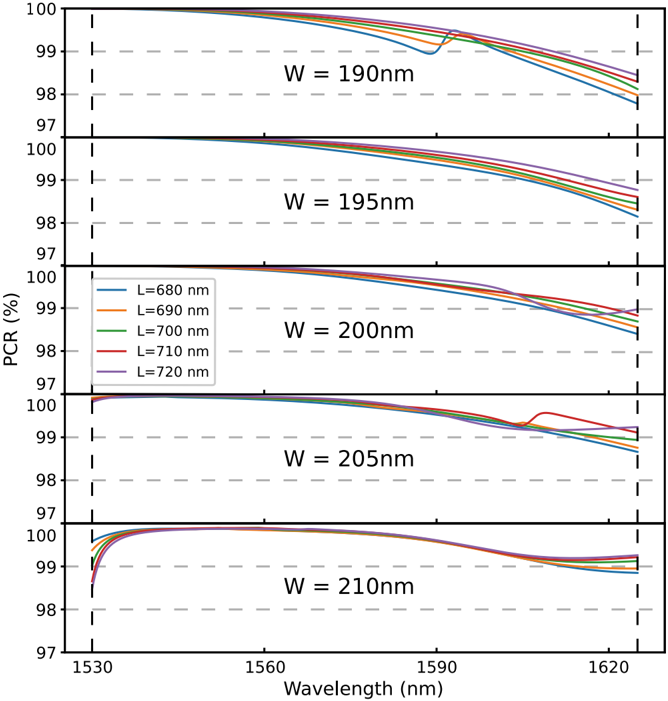
- The polarization conversion ratio (PCR) is approximately 95% across the entire C+L band under varying driving voltages; simulated PCR exceeds 96% in the majority of regions, and experimental PCR is ~95% for wavelengths from 1520 to 1630 nm at various LCoS driving voltages.
- The reflectance ratio of the metasurface-integrated LCoS to the original LCoS (R_m/R_c) remains above 96% at five different wavelengths covering the entire C+L band throughout the LC driving voltage range, with negligible light absorption from the metasurface.
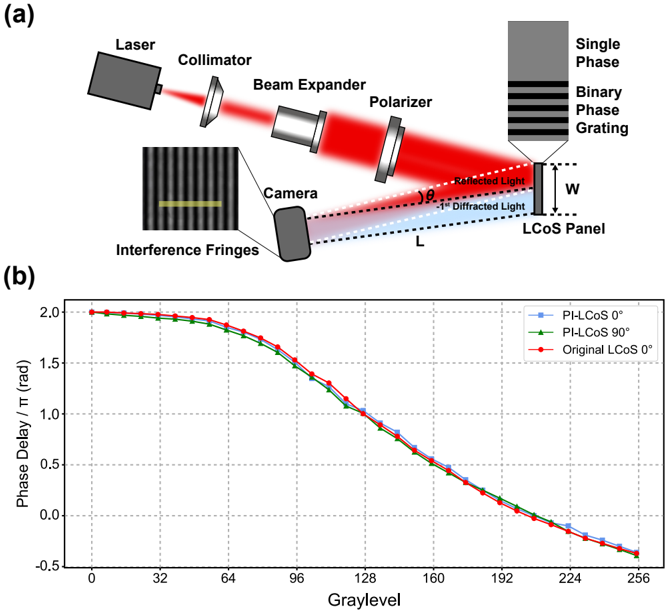
- The metasurface does not affect the device’s phase modulation characteristics or exacerbate the fringing field effect; the diffraction efficiency of the PI-LCoS is almost the same as that of the original LCoS.
- Simulated PCR remains greater than 97.5% throughout the C+L band when the silicon pillar width varies within ±10 nm and length within ±20 nm, indicating process tolerance.
Methods
- Design and fabrication: a metasurface of periodic square cells with rectangular silicon pillars (period P = 1000 nm, pillar length L = 700 nm, width W = 200 nm, height H = 460 nm) and SiO₂ cladding (height H_c = 500 nm) was integrated on a commercial LCoS (PLUTO-2-TELCO-013, operating wavelength 1400–1700 nm); fabrication used PECVD silicon deposition, electron beam lithography, Cr mask, ICP etching, SiO₂ cladding deposition, CMP, and LC packaging.
- Measurements and simulations: PCR was measured from 1520 to 1630 nm at various driving voltages; phase response was measured at 1550 nm; fringing field effects were simulated in COMSOL 6.0 for three adjacent pixels (1 µm pixel pitch, 8 µm LC thickness, 5 V on the middle pixel); beam steering used blazed gratings with periods from 6 to 12 pixels and white-light interferometry at λ_c = 580 nm; optical simulations used the frequency-domain solver in CST 2023.
Limitations
- Stated: experimental PCR values are somewhat lower than simulated values, primarily because process-related factors that affect PCR were omitted from the simulation.
- Stated: data underlying the results are not publicly available at this time but can be obtained from the authors upon reasonable request.
- Evident from the supplied text: the text is fragmented and reordered, with some section content omitted, so not all experimental details are verifiable from the provided text alone.
Model-written summary. Check it against the paper before relying on it.
Integrity signals
Registry
Cites
Statistics
Figures



Verification
Claims the paper makes
3 Valid · 3 Not valid · 8 Not checked · 56 Own results and interpretations
A result the paper reports from its own data — it cites no other source for it, so there is none to check. The quote shows it is in the paper.
In the paper
“Additionally, the experimental results indicate that the reflectance of the metasurface-integrated LCoS exceeds 96% of the original LCoS reflectance.”
- Also stated in: § Abstract · plain
“the reflectance of the metasurface-integrated LCoS exceeds 96% of the original LCoS reflectance.”
- Also stated in: § 3.1. Fabrication and Optical Property Measurement · plain
“The ratios, at five different wavelengths covering the entire C+L band, remain above 96% throughout the LC driving voltage range”
§ High-Efficiency Polarization-Independent LCoS Utilizing a Silicon-Based Metasurface > Abstract
plain- Asserted: passes — The authors put it forward as true.
- Checkable: passes — It can be checked against evidence.
- Load-bearing: passes — The paper’s conclusions depend on it.
- Based: passes — The paper gives a reason why it holds.
- Also stated in: § Abstract · plain
A result the paper reports from its own data — it cites no other source for it, so there is none to check. The quote shows it is in the paper.
In the paper
“Theoretical analysis further confirms that the design is tolerant to fabrication errors.”
- Also stated in: § 3.4. Processing Tolerence · hedged
“indicating that there is a process tolerance of ±10 nm for the width and ±20 nm for the length of the silicon pillars.”
§ High-Efficiency Polarization-Independent LCoS Utilizing a Silicon-Based Metasurface > Abstract
boosted- Asserted: passes — The authors put it forward as true.
- Checkable: passes — It can be checked against evidence.
- Load-bearing: passes — The paper’s conclusions depend on it.
- Based: passes — The paper gives a reason why it holds.
- Also stated in: § 3.4. Processing Tolerence · hedged
A result the paper reports from its own data — it cites no other source for it, so there is none to check. The quote shows it is in the paper.
In the paper
“the metasurface does not affect the phase modulation characteristics of the device”
- Also stated in: § 3.2. Phase Response Measurement · plain
“does not affect the original phase modulation characteristics.”
§ High-Efficiency Polarization-Independent LCoS Utilizing a Silicon-Based Metasurface > Abstract
plain- Asserted: passes — The authors put it forward as true.
- Checkable: passes — It can be checked against evidence.
- Load-bearing: passes — The paper’s conclusions depend on it.
- Based: passes — The paper gives a reason why it holds.
- Also stated in: § 3.2. Phase Response Measurement · plain
A result the paper reports from its own data — it cites no other source for it, so there is none to check. The quote shows it is in the paper.
In the paper
“the reflectivities r xx and r yy are nearly 100%”
§ High-Efficiency Polarization-Independent LCoS Utilizing a Silicon-Based Metasurface > 2. Design Principle
plain- Asserted: passes — The authors put it forward as true.
- Checkable: passes — It can be checked against evidence.
- Load-bearing: passes — The paper’s conclusions depend on it.
- Based: passes — The paper gives a reason why it holds.
A result the paper reports from its own data — it cites no other source for it, so there is none to check. The quote shows it is in the paper.
In the paper
“It can be seen that, in the majority of the regions, PCR exceeds 96%.”
§ High-Efficiency Polarization-Independent LCoS Utilizing a Silicon-Based Metasurface > 3.1. Fabrication and Optical Property Measurement
plain- Asserted: passes — The authors put it forward as true.
- Checkable: passes — It can be checked against evidence.
- Load-bearing: passes — The paper’s conclusions depend on it.
- Based: passes — The paper gives a reason why it holds.
28 more claims
Create a free account to see all 70 claims and every source verdict.
- Probably not a substantial claim. 10
- It may state two separate claims as one. 27
- Borderline: one of the tests for a substantial claim is unclear. 1
- The quote only partly states this claim. 1
Citations
Cites
Light Propagation with Phase Discontinuities: Generalized Laws of Reflection and Refraction
Yu, N., Genevet, P., Kats, M. A., Aieta, F., Tetienne, J.-P., Capasso, F., & Gaburro, Z. (2011) · Science · doi:10.1126/science.1210713 · Cited by 10,361 · cited 1×
“Recently, pixelated metasurfaces have emerged as a focal point of significant research and application interest [11,12].”
Fundamentals of phase-only liquid crystal on silicon (LCOS) devices
Zhang, Z., You, Z., & Chu, D. (2014) · Light: Science & Applications · doi:10.1038/lsa.2014.94 · Cited by 519 · cited 1×
“Compared to amplitude-modulating LCoS devices (mainly for video and image projections), phase-only modulating LCoS devices [2,3] have a wider range of applications, including correction of chromatic aberration in imaging systems [4], phase control in biological optical microscopy [5], wavefront…”
Lee, K. B., Cheon, S., & Kim, C. O. (2017) · IEEE Transactions on Semiconductor Manufacturing · doi:10.1109/tsm.2017.2676245 · Cited by 483 · cited 1×
“In the actual fabrication process, discrepancies between the actual and the design values may occur due to process errors [24].”
Lazarev, G., Chen, P.-J., Strauss, J., Fontaine, N., & Forbes, A. (2019) · Optics Express · doi:10.1364/oe.27.016206 · Cited by 175 · cited 1×
“Compared to amplitude-modulating LCoS devices (mainly for video and image projections), phase-only modulating LCoS devices [2,3] have a wider range of applications, including correction of chromatic aberration in imaging systems [4], phase control in biological optical microscopy [5], wavefront…”
Molecular theory of nematic liquid crystals
Gelbart, W. M. (1982) · The Journal of Physical Chemistry · doi:10.1021/j100219a007 · Cited by 132 · cited 1×
“In the PI-LCoS device, the LC layer is composed of nematic liquid crystal with positive uniaxiality [19].”
Ramachandran, G. N., & Ramaseshan, S. (1961) · Handbuch der Physik · doi:10.1007/978-3-642-45959-7_1 · Cited by 97
Lin, Y.-H., Ren, H., Wu, Y.-H., Zhao, Y., Fang, J., Ge, Z., & Wu, S.-T. (2005) · Optics Express · doi:10.1364/opex.13.008746 · Cited by 95 · cited 1×
“The first employs a dual-layer liquid crystal structure with orthogonal orientations to independently modulate two orthogonal polarization states, thereby achieving polarization independence [14].”
Zhang, C., Hu, J., Dong, Y., Zeng, A., Huang, H., & Wang, C. (2021) · Photonics Research · doi:10.1364/prj.415342 · Cited by 93 · cited 1×
“Recently, pixelated metasurfaces have emerged as a focal point of significant research and application interest [11,12].”
Vettese, D. (2010) · Nature Photonics · doi:10.1038/nphoton.2010.252 · Cited by 80 · cited 1×
“By varying the applied external electric field, the alignment of LC molecules is controlled, and the amplitude, phase, and polarization states of the incident light are manipulated [1].”
Nematic Liquid Crystal Optical Dispersion in the Visible-Near Infrared Range
Tkachenko, V., Abbate, G., Marino, A., et al. (2006) · Molecular Crystals and Liquid Crystals · doi:10.1080/15421400600655816 · Cited by 59 · cited 2×
“The phase modulation at a wavelength of 1550 nm could be obtained by ∆ ϕ 1550 = ( λ c /1550 )( ∆ n 1550 / ∆ n λ c ) ∆ ϕ λ c , where ∆ n 1550 = 0.23 and ∆ n λ c = 0.29 are the birefringence values of the LC at the two wavelengths respectively [22].”
Influential
Cited by
Kostikov, D. A., Krakhalev, M. N., Nabol, S. V., Pankin, P. S., Максимов, Д. Н., Abdullaev, A. S., Sutormin, V. S., Timofeev, I. V., & Zyryanov, V. Y. (2025) · Optics Express · doi:10.1364/oe.582556
Metadata
- Authors
- Deng, Y., Liu, B., & Yan, J.
- Affiliations
- Zhejiang University of Technology (CN)
- Corresponding author
- Yan, Jinhua
- Venue
- Photonics
- Publisher
- MDPI AG
- Published
- 2025-05-30
- Volume
- 12
- Issue
- 6
- Pages
- 552
- ISSN
- 2304-6732 (ISSN-L)
- OpenAlex
- W4410875435
- Cited by
- 1
- References
- 23
- Citations by year
- 2025: 1
- FWCI
- 0.16
- Type
- journal article
- Language
- en
- Open access
- gold
- doi.org
- Licence
- Locations
- Photonics (publishedVersion, cc-by)
- DOAJ (DOAJ: Directory of Open Access Journals) (submittedVersion, cc-by-sa)
- Funders
- Research Project at Zhejiang University of Technology (KYY-HX-20230664, KYY-HX-20230664-1)
- Topics
- Physical Sciences › Materials Science › Electronic, Optical and Magnetic Materials › Metamaterials and Metasurfaces Applications
- Physical Sciences › Materials Science › Electronic, Optical and Magnetic Materials › Liquid Crystal Research Advancements
- Physical Sciences › Engineering › Media Technology › Advanced Optical Imaging Technologies
- Keywords
- liquid crystal on silicon, metasurfaces, silicon pillars, polarization conversion, C+L band, fringe effect, reflectivity, manufacturing tolerances
About these checks
Registry, retraction, Cites and statistics results are computed, not judged, with one exception: a printed reference that no index lists is read once by a model before it counts as a citation error. Claims are extracted by a model and kept only when their quote appears verbatim in the text; each cited source is then checked, with a model’s help, for whether it says what the claim relies on. Those verdicts can be wrong — read the claim’s quote and the cited source before relying on one.
The claim verdicts this report counts are experimental: their accuracy is not yet measured.
A language model drew the claims from the paper on 2026-10-10, under version 3 of the claim definition (model deepseek-v4.1-flash, prompt extract-v3).
A second model labelled each claim on 2026-10-10 (model jev-1.13-20260917, definition revision gold-guideline-v0.2).
Statistics and arithmetic are recomputed, not judged.
Confidence bands are shown only for fields calibrated on our annotated test set. None is calibrated yet, so no band is shown.
What counts as a claim ›How we measure confidence ›How we check this ›
Are you an author, or do you see a problem with this page? Request a review
How to cite
Cite CoChat for the checks on this page, and the paper for its own findings.
- This page
- CoChat. (2026). Citation check: High-Efficiency Polarization-Independent LCoS Utilizing a Silicon-Based Metasurface. https://app.cochat.ai/papers/10.3390/photonics12060552
- The paper
- Deng, Y., Liu, B., & Yan, J. (2025). High-Efficiency Polarization-Independent LCoS Utilizing a Silicon-Based Metasurface. Photonics. https://doi.org/10.3390/photonics12060552
Data sources
Bibliographic data: Semantic Scholar, OpenAlex, Crossref.
Contains information from the Semantic Scholar Academic Graph Datasets, made available under the ODC Attribution License (ODC-BY 1.0).
Semantic Scholar’s data is described in: Kinney, R., et al. (2023). The Semantic Scholar Open Data Platform. arXiv:2301.10140.
