

The DOI matches its Crossref record; 33 of the 35 references it cites were found in a registry or an index.
Scission, Cross-Linking, and Physical Relaxation during Thermal Degradation of Elastomers
Open accessAbstract
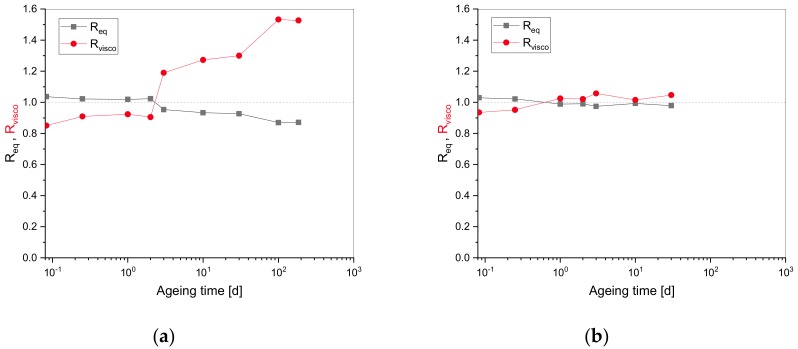
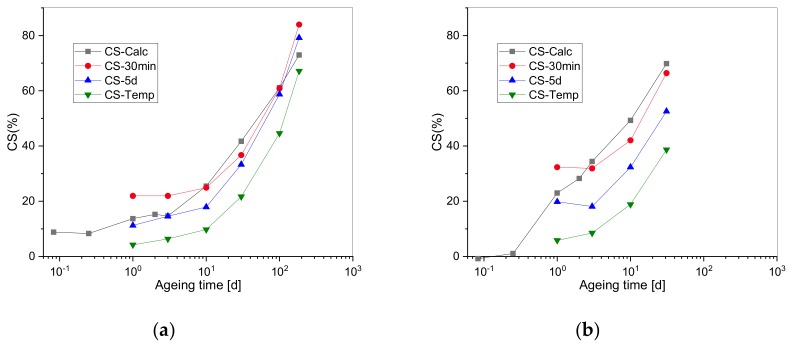
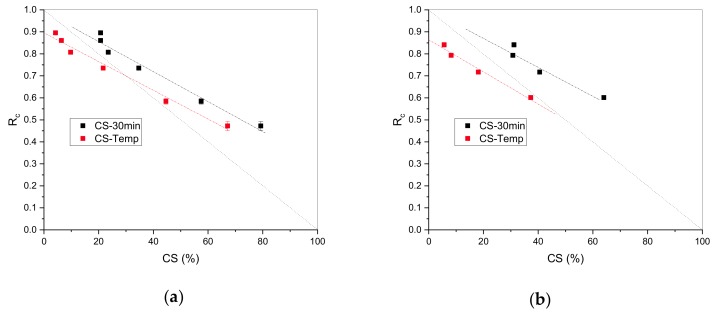
Elastomers are susceptible to chemical ageing, i.e., scission and cross-linking, at high temperatures. This thermally driven ageing process affects their mechanical properties and leads to limited operating time. Continuous and intermittent stress relaxation measurements were conducted on ethylene propylene diene rubber (EPDM) and hydrogenated nitrile butadiene rubber (HNBR) samples for different ageing times and an ageing temperature of 125 °C. The contributions of chain scission and cross-linking were analysed for both materials at different ageing states, elucidating the respective ageing mechanisms. Furthermore, compression set experiments were performed under various test conditions. Adopting the two-network model, compression set values were calculated and compared to the measured data. The additional effect of physical processes to scission and cross-linking during a long-term thermal exposure is quantified through the compression set analysis. The characteristic times relative to the degradation processes are also determined.
Overview
The claims and statistics of this paper haven’t been checked yet.
Run the check — free, no account needed. It reads the open-access text and checks the sources it cites.
Integrity signals
Registry
Cites
Statistics
Figures
Verification
Claims the paper makes
The claims and statistics of this paper haven’t been checked yet.
Run the check — free, no account needed. It reads the open-access text and checks the sources it cites.
Claims other papers make about this one
Each is checked against this paper’s own text: does it say what the citing paper says it does?
The source backs part of the claim, not all of it — or backs it for a different population, condition or comparison.
In the citing paper
“As indicated in the literature [234], whenever a material undergoes a process involving melting, it can adversely affect its properties, including tensile Young's modulus, strength, and impact strength.”
From A comprehensive review of lunar-based manufacturing and construction (2024) · cites this paper as [235]
Experimental — accuracy not yet measured
Self-check
Percentages, sums and reported differences re-computed from the paper’s own numbers.
The self-check needs the paper’s full text.
Citations
Cites
Über die Reaktionsgeschwindigkeit bei der Inversion von Rohrzucker durch Säuren
Arrhenius, S. A. (1889) · Zeitschrift für Physikalische Chemie · doi:10.1515/zpch-1889-0116 · Cited by 2,372
Softening of Rubber by Deformation
Mullins, L. (1969) · Rubber Chemistry and Technology · doi:10.5254/1.3539210 · Cited by 1,293
Hutchinson, J. M. (1995) · Progress in Polymer Science · doi:10.1016/0079-6700(94)00001-i · Cited by 1,050
Physical aging in polymers and polymer nanocomposites: recent results and open questions
Cangialosi, D., Boucher, V. M., Alegría, Á., & Colmenero, J. (2013) · Soft Matter · doi:10.1039/c3sm51077h · Cited by 259
Wise, J., GILLEN, K. T., & Clough, R. L. (1995) · Polymer Degradation and Stability · doi:10.1016/0141-3910(95)00137-b · Cited by 228
The Theory of Permanent Set at Elevated Temperatures in Natural and Synthetic Rubber Vulcanizates
Andrews, R. D., Tobolsky, A. V., & Hanson, E. E. (1946) · Journal of Applied Physics · doi:10.1063/1.1707724 · Cited by 199
VISCOELASTIC PROPERTIES OF DILUTE POLYMER SOLUTIONS
Ferry, J. D. (1979) · Macromolecular Chemistry · doi:10.1016/b978-0-08-022039-0.50009-6 · Cited by 198
Quantitative model for the time development of diffusion-limited oxidation profiles
Wise, J., GILLEN, K. T., & Clough, R. L. (1997) · Polymer · doi:10.1016/s0032-3861(96)00716-1 · Cited by 169
A theoretical basis for viscoelastic relaxation of elastomers in the long-time limit
Curro, J. G., & Pincus, P. A. (1983) · Macromolecules · doi:10.1021/ma00238a014 · Cited by 162
Rigorous experimental confirmation of a theoretical model for diffusion-limited oxidation
GILLEN, K. T., & Clough, R. L. (1992) · Polymer · doi:10.1016/0032-3861(92)90280-a · Cited by 149
Research works printed but not linked: 2
- Bender, 2001, Improving the heat resistance of hydrogenated nitrile rubber compounds, KGK, 54, 14
- Reincke, 2014, Alterung und Beständigkeitsuntersuchungen von Elastomerwerkstoffen, KGK, 67, 60
Cited by
Sorted by citations
COVID-19 discarded disposable gloves as a source and a vector of pollutants in the environment
Jędruchniewicz, K., Ok, Y. S., & Oleszczuk, P. (2021) · Journal of Hazardous Materials · doi:10.1016/j.jhazmat.2021.125938 · Cited by 92
Insights for lifetime predictions of O-ring seals from five-year long-term aging tests
Kömmling, A., Jaunich, M., Goral, M., & Wolff, D. (2020) · Polymer Degradation and Stability · doi:10.1016/j.polymdegradstab.2020.109278 · Cited by 68
Self-citationA comprehensive review of lunar-based manufacturing and construction
Azami, M., Kazemi, Z., Moazen, S., Dubé, M., Potvin, M.-J., & Skonieczny, K. (2024) · Progress in Aerospace Sciences · doi:10.1016/j.paerosci.2024.101045 · Cited by 57
Ahuja, V., Singh, P. K., Mahata, C., Jeon, J.-M., Kumar, G., Yang, Y.-H., & Bhatia, S. K. (2024) · Microbial Cell Factories · doi:10.1186/s12934-024-02430-0 · Cited by 57
Review of hydraulic seal failures due to effect of medium to high temperature
Mahankar, P. S., & Dhoble, A. S. (2021) · Engineering Failure Analysis · doi:10.1016/j.engfailanal.2021.105552 · Cited by 50
Metadata
- Authors
- Zaghdoudi, M., Kömmling, A., Jaunich, M., & Wolff, D.
- Affiliations
- Federal Institute For Materials Research and Testing (DE)
- Corresponding author
- Zaghdoudi, Maha
- Venue
- Polymers
- Publisher
- MDPI AG
- Published
- 2019-07-31
- Volume
- 11
- Issue
- 8
- Pages
- 1280
- ISSN
- 2073-4360 (ISSN-L)
- PMC
- PMC6723081
- OpenAlex
- W2965859879
- Cited by
- 89
- References
- 35
- Citations by year
- 2026: 15 · 2025: 23 · 2024: 17 · 2023: 10 · 2022: 8 · 2021: 7 · 2020: 9
- FWCI
- 2.12
- Type
- journal article
- Language
- en
- Open access
- gold
- dx.doi.org
- Licence
- Locations
- Polymers (publishedVersion, cc-by)
- Europe PMC (PubMed Central) (publishedVersion, cc-by)
- PubMed Central (publishedVersion, cc-by)
- PubMed (publishedVersion)
- DOAJ (DOAJ: Directory of Open Access Journals) (submittedVersion, cc-by-sa)
- Funders
- BMWi (project no. 1501509)
- Topics
- Physical Sciences › Engineering › Biomedical Engineering › Elasticity and Material Modeling
- Physical Sciences › Materials Science › Polymers and Plastics › Polymer Science and PVC
- Physical Sciences › Chemical Engineering › Fluid Flow and Transfer Processes › Rheology and Fluid Dynamics Studies
- Keywords
- chain scission, crosslinking, physical relaxation, chemical aging, ethylene-propylene-diene rubber, hydrogenated nitrile rubber, stress relaxation, compression set, aging mechanisms, characteristic time
About these checks
Registry, retraction, Cites and statistics results are computed, not judged, with one exception: a printed reference that no index lists is read once by a model before it counts as a citation error. Claims are extracted by a model and kept only when their quote appears verbatim in the text; each cited source is then checked, with a model’s help, for whether it says what the claim relies on. Those verdicts can be wrong — read the claim’s quote and the cited source before relying on one.
Statistics and arithmetic are recomputed, not judged.
Confidence bands are shown only for fields calibrated on our annotated test set. None is calibrated yet, so no band is shown.
What counts as a claim ›How we measure confidence ›How we check this ›
Are you an author, or do you see a problem with this page? Request a review
