

The DOI matches its Crossref record; 36 of the 36 references it cites were found in a registry or an index; 1 of the 9 sources its claims cite were checked for support.
A Novel Polytetrahydrofuran-Based Shape Memory Polyurethane Enhanced by Polyglycolide-Block-Polytetrahydrofuran-Block-Polyglycolide Copolymer
Open accessAbstract
Compared with material lacking the block polymer, the polyurethane systems containing the PGA-PTHF-PGA block polymer showed excellent mechanical properties and temperature-responsive shape memory, with conceptual experiments indicating potential medical applications in vascular and wound repair.
Overview
CoChat Summary
TL;DR
A series of crosslinked polyurethanes (PU-GT) were prepared from PGA-PTHF-PGA triblock copolymer, PTHF homopolymer, glycerol, and HDI, giving temperature-responsive shape memory behavior based on PTHF crystallization/melting. PU-GT-50 showed the best combination of mechanical and shape memory performance and was tested in conceptual vascular and wound-repair experiments.
Key findings
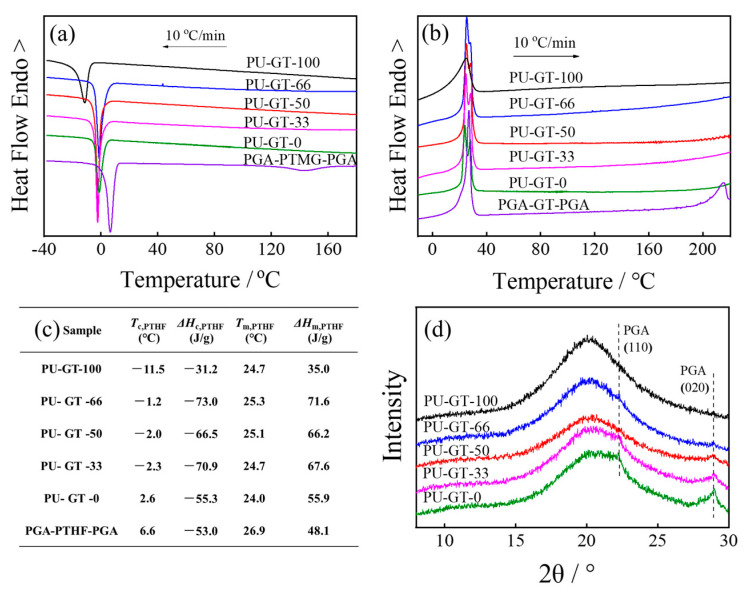
- PTHF in PU-GT crystallized during cooling at −11.5~2.6 °C, and PTHF crystallite melting temperatures were 24.0~26.9 °C; WAXD indicated a small amount of PGA crystallized in PU-GT films.
- Mechanical properties improved with PGA-PTHF-PGA: PU-GT-100 tensile strength was 2.0 ± 0.5 MPa, while PU-GT-50 reached 35.6 ± 3.4 MPa; maximum elongation at break was 1043 ± 18% for PU-GT-33, and PU-GT-100 had approximately 917 ± 33%.
- Shape memory: PU-GT-100 had the highest shape fixity at 99.8 ± 0.3% and shape recovery at 92.9 ± 4.6%; PU-GT-0 had much lower fixity at 22.8 ± 6.5%. PU-GT-50 temporary shape was fixed at −20 °C and recovered at 37 °C within 30 s.
- L929 cell viability remained well above 70%, meeting ISO 10993-5 requirements; PU-GT-50/SA bilayer adhesion on pig skin was 19.4 ± 0.4 kPa, and conceptual experiments suggested potential for vascular and wound repair.
Methods
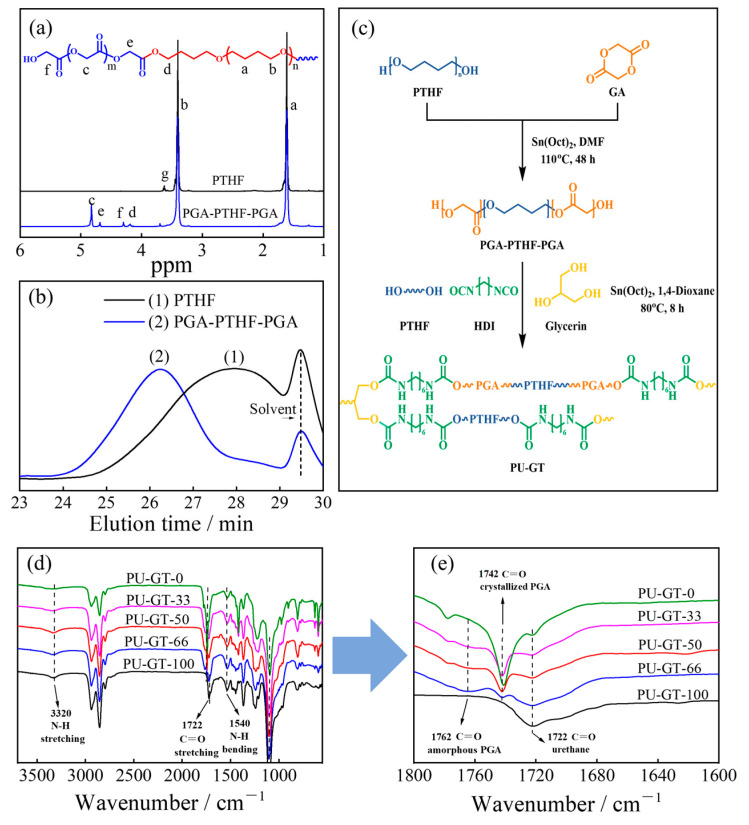
- PGA-PTHF-PGA triblock copolymer was synthesized by ring-opening polymerization using PTHF as macro-initiator; PU-GT polyurethanes were prepared by one-pot synthesis with PGA-PTHF-PGA, PTHF, glycerol, and HDI. Samples were named PU-GT-x, where x was the molar ratio of PTHF homopolymer in the polymer diols.
- Characterization included 1H NMR, GPC, FTIR, non-isothermal DSC, WAXD, tensile testing per ASTM D1708, U-bend shape memory tests, pig-skin adhesion tests, and L929 cytotoxicity by CCK8.
- Tensile tests were repeated five times and averaged; adhesion values were averaged from at least three samples; shape fixity and recovery were calculated from measured angles using the paper’s equations.
Limitations
- The paper does not include a dedicated limitations section. It describes the biomedical demonstrations as “conceptual experiments” and uses in vitro simulated models, including a latex tube to simulate damaged blood vessel and pig skin for wound repair.
- Evident from the text: no in vivo biocompatibility, degradation, or long-term implantation data are reported; cytotoxicity is limited to L929 cells, and wound/vascular repair is only simulated in vitro.
- Evident from the text: PGA melting was difficult to observe in PU-GT by DSC because of low PGA content, and PTHF diffraction was not observed at room temperature, so some crystalline features were inferred from limited WAXD/DSC evidence.
Model-written summary. Check it against the paper before relying on it.
Integrity signals
Registry
Cites
Statistics
Figures


Verification
Claims the paper makes
1 Valid · 0 Not valid · 6 Not checked · 69 Own results and interpretations
The cited sources support only part of this claim — read each source’s verdict below.
In the paper
“which was due to the crystallization of PTHF chains in PU-GT [33].”
§ A Novel Polytetrahydrofuran-Based Shape Memory Polyurethane Enhanced by Polyglycolide-Block-Polytetrahydrofuran-Block-Polyglycolide Copolymer > 3. Results and Discussions
What the sources say
- Partly supportedcites [33] Sandraa, 2024, Influence of flexible segment length on the phase structure and properties of poly(hexamethylene 2,5-furandicarboxylate)-block-biopolytetrahydrofuran copolymers, J. Appl. Polym. Sci. sourceExperimental — accuracy not yet measured
Section 3.1 and Table 2 identify crystallization peaks from a pTHF-rich phase at −27 °C to −13 °C in the PHF-b-F-pTHF2000 copolymers, within the claimed range. The paper does not identify those peaks in PU-GT or establish that they occur in each PU-GT sample. (LLM, conf=0.84)
plainstates a cause- Asserted: passes — The authors put it forward as true.
- Checkable: passes — It can be checked against evidence.
- Load-bearing: passes — The paper’s conclusions depend on it.
- Based: passes — The paper gives a reason why it holds.
- Partly supported
A result the paper reports from its own data — it cites no other source for it, so there is none to check. The quote shows it is in the paper.
In the paper
“The maximum elongation at break of 1043 ± 18% was observed for the PU-GT-33 film.”
§ A Novel Polytetrahydrofuran-Based Shape Memory Polyurethane Enhanced by Polyglycolide-Block-Polytetrahydrofuran-Block-Polyglycolide Copolymer > 3. Results and Discussions
plain- Asserted: passes — The authors put it forward as true.
- Checkable: passes — It can be checked against evidence.
- Load-bearing: passes — The paper’s conclusions depend on it.
- Based: passes — The paper gives a reason why it holds.
A result the paper reports from its own data — it cites no other source for it, so there is none to check. The quote shows it is in the paper.
In the paper
“PGA-PTHF-PGA triblock copolymers were synthesized by ring-opening polymerization (ROP), in which the PTHF was used as the macro-initiator.”
- Also stated in: § 3. Results and Discussions · boosted
“The elution time of PGA-PTHF-PGA was significantly shorter than that of the PTHF homopolymer, further confirming the successful synthesis of the block copolymer.”
§ A Novel Polytetrahydrofuran-Based Shape Memory Polyurethane Enhanced by Polyglycolide-Block-Polytetrahydrofuran-Block-Polyglycolide Copolymer > 2. Experimental Section
boostedstates a cause- Asserted: passes — The authors put it forward as true.
- Checkable: passes — It can be checked against evidence.
- Load-bearing: passes — The paper’s conclusions depend on it.
- Based: passes — The paper gives a reason why it holds.
- Also stated in: § 3. Results and Discussions · boosted
A result the paper reports from its own data — it cites no other source for it, so there is none to check. The quote shows it is in the paper.
In the paper
“The viability of L929 cells co-cultured with PU-GT polyurethanes was also close to that of the control group”
§ A Novel Polytetrahydrofuran-Based Shape Memory Polyurethane Enhanced by Polyglycolide-Block-Polytetrahydrofuran-Block-Polyglycolide Copolymer > 3. Results and Discussions
plain- Asserted: passes — The authors put it forward as true.
- Checkable: passes — It can be checked against evidence.
- Load-bearing: passes — The paper’s conclusions depend on it.
- Based: passes — The paper gives a reason why it holds.
A result the paper states — it cites no source for it, so there is none to check. The quote shows it is in the paper.
In the paper
“And compared with PU-GT-100, which did not contain the PGA-PTHF-PGA block polymer, other PU-GT polyurethanes showed excellent mechanical properties because of the existence of the PGA component.”
§ A Novel Polytetrahydrofuran-Based Shape Memory Polyurethane Enhanced by Polyglycolide-Block-Polytetrahydrofuran-Block-Polyglycolide Copolymer > Abstract
plainstates a cause- Asserted: passes — The authors put it forward as true.
- Checkable: passes — It can be checked against evidence.
- Load-bearing: passes — The paper’s conclusions depend on it.
- Based: passes — The paper gives a reason why it holds.
45 more claims
Create a free account to see all 76 claims and to verify the 1 reference still open.
- It may state two separate claims as one. 22
- Probably not a substantial claim. 5
Self-check
Percentages, sums and reported differences re-computed from the paper’s own numbers.
Each contradiction between two passages listed here was confirmed by an independent check.
Rated minor: it would not touch a result — a value no result rests on, a p-value that stays on the same side of the significance level, or a conflict that is clerical, resolved elsewhere in the paper, or outside its own findings.
In the paper
§ A Novel Polytetrahydrofuran-Based Shape Memory Polyurethane Enhanced by Polyglycolide-Block-Polytetrahydrofuran-Block-Polyglycolide Copolymer > 3. Results and Discussions
“When the weight ratio of PTHF homopolymer decreased to 50% (PU-GT-50), the ultimate strength increased to 35.6 ± 3.4 MPa”
§ A Novel Polytetrahydrofuran-Based Shape Memory Polyurethane Enhanced by Polyglycolide-Block-Polytetrahydrofuran-Block-Polyglycolide Copolymer > 3. Results and Discussions
“The polyurethane samples were named PU-GT-x, where x represented the molar ratio of PTHF homopolymer in the two kinds of polymer diols used for the synthesis of polyurethane.”
Citations
Cites
Hearst, M. A., Dumais, S. T., Osuna, E., Platt, J., & Scholkopf, B. (1998) · IEEE Intelligent Systems and their Applications · doi:10.1109/5254.708428 · Cited by 7,243 · cited 1×
“We conducted tensile testing according to the ASTM D1708 standard [24], which specifies the preparation and testing methods for miniature dog-bone-shaped specimens.”
Samantaray, P. K., Little, A., Haddleton, D. M., McNally, T., Tan, B., Sun, Z., Huang, W., Ji, Y., & Wan, C. (2020) · Green Chemistry · doi:10.1039/d0gc01394c · Cited by 450
Thermally-induced two-way shape memory polymers: Mechanisms, structures, and applications
Zare, M., Prabhakaran, M. P., Parvin, N., & Ramakrishna, S. (2019) · Chemical Engineering Journal · doi:10.1016/j.cej.2019.05.167 · Cited by 330
Shape Memory Polymers as Smart Materials: A Review
Dayyoub, T., Maksimkin, A. V., Filippova, O. V., Tcherdyntsev, V. V., & Telyshev, D. V. (2022) · Polymers · doi:10.3390/polym14173511 · Cited by 253
A review on synthesis and biomedical applications of polyglycolic acid
Budak, K., Sogut, O., & Aydemir Sezer, U. (2020) · Journal of Polymer Research · doi:10.1007/s10965-020-02187-1 · Cited by 251 · cited 1×
“In addition, using block copolymers to synthesize polyurethane is a common method to improve the flexibility of materials [20,21].”
Guan, J., Sacks, M. S., Beckman, E. J., & Wagner, W. R. (2004) · Biomaterials · doi:10.1016/s0142-9612(03)00476-9 · Cited by 250 · cited 1×
“In addition, using block copolymers to synthesize polyurethane is a common method to improve the flexibility of materials [20,21].”
Mechanical behaviors and applications of shape memory polymer and its composites
Zhao, W. D., Li, N., Liu, L., Leng, J., & Liu, Y. (2023) · Applied Physics Reviews · doi:10.1063/5.0126892 · Cited by 128 · cited 1×
“Shape memory polymers (SMPs) can change their shapes in a pre-designed manner in response to specific external stimuli [1–4]; when heated above a transition temperature ( T trans ), an SMP can be programmed via a mechanical stimulus and set into a secondary shape during cooling [5].”
Self-citationDai, S., Yue, S., Ning, Z., Jiang, N., & Gan, Z. (2022) · ACS Applied Materials & Interfaces · doi:10.1021/acsami.2c03172 · Cited by 112 · cited 1×
“…polyesters such as polylactic acid (PLA) and poly( ε -caprolactone) (PCL) are widely used as soft segments in PU and have attracted increasing interest because of their good biocompatibility and biodegradability, which means that they have great potential for biomedical applications [14,15].”
Self-citationAn overview of polyurethane biomaterials and their use in drug delivery
Wienen, D., Gries, T., Cooper, S. L., & Heath, D. E. (2023) · Journal of Controlled Release · doi:10.1016/j.jconrel.2023.09.036 · Cited by 112 · cited 1×
“Among them, polyurethane (PU) stands out for its unique advantages, as its chemical structure can be modified extensively to achieve a wide range of properties [11].”
4D printing: processability and measurement of recovery force in shape memory polymers
Monzón, M., Paz, R., Pei, E., Ortega, Z., Suárez, L., Ortega, Z., Alemán‐Domínguez, M. E., Plucinski, T., & Clow, N. (2016) · The International Journal of Advanced Manufacturing Technology · doi:10.1007/s00170-016-9233-9 · Cited by 110
Cited by
Wang, X., Tang, F., Dou, T., et al. (2026) · Surfaces and Interfaces · doi:10.1016/j.surfin.2026.108805 · Cited by 3
Metadata
- Authors
- Li, X., Mao, L., Li, W., Wu, H., Dai, S., Xiao, R., Huang, J., Liu, G., Yang, K., Bu, W., Jiang, N., Gan, Z., & Ning, Z.
- Affiliations
- State Key Laboratory of Organic-Inorganic Composite Materials (CN)
- State Key Laboratory of Organic-Inorganic Composites, Beijing Laboratory of Biomedical Materials, College of Life Science and Technology, Beijing University of Chemical Technology, Beijing 100029, China
- Zhejiang Shuren University (CN)
- Chinese Academy of Sciences (CN)
- Corresponding author
- Yang, Keda
- Ning, Zhenbo
- Venue
- Polymers
- Publisher
- MDPI AG
- Published
- 2024-12-23
- Volume
- 16
- Issue
- 24
- Pages
- 3610
- ISSN
- 2073-4360 (ISSN-L)
- PMC
- PMC11679042
- OpenAlex
- W4405722647
- Cited by
- 1
- References
- 36
- Citations by year
- 2026: 1
- FWCI
- 0.11
- Type
- journal article
- Language
- en
- Open access
- gold
- doi.org
- Licence
- Locations
- Polymers (publishedVersion, cc-by)
- PubMed Central (publishedVersion, cc-by)
- PubMed (publishedVersion)
- Funders
- the National Natural Science Foundation of China (51973010, 52033001, 51603005)
- Topics
- Physical Sciences › Materials Science › Polymers and Plastics › Polymer composites and self-healing
- Physical Sciences › Materials Science › Biomaterials › biodegradable polymer synthesis and properties
- Physical Sciences › Materials Science › Polymers and Plastics › Polymer crystallization and properties
- Keywords
- shape memory polyurethane, polytetrahydrofuran, block copolymers, temperature-responsive materials, hexamethylene diisocyanate, mechanical properties, vascular repair, wound healing, medical applications
About these checks
Registry, retraction, Cites and statistics results are computed, not judged, with one exception: a printed reference that no index lists is read once by a model before it counts as a citation error. Claims are extracted by a model and kept only when their quote appears verbatim in the text; each cited source is then checked, with a model’s help, for whether it says what the claim relies on. Those verdicts can be wrong — read the claim’s quote and the cited source before relying on one.
The claim verdicts this report counts are experimental: their accuracy is not yet measured.
A language model drew the claims from the paper on 2026-10-10, under version 3 of the claim definition (model deepseek-v4.1-flash, prompt extract-v3).
A second model labelled each claim on 2026-10-10 (model jev-1.13-20260917, definition revision gold-guideline-v0.2).
Cited sources are checked with a language model’s help (gpt-6-sol).
Statistics and arithmetic are recomputed, not judged.
Confidence bands are shown only for fields calibrated on our annotated test set. None is calibrated yet, so no band is shown.
What counts as a claim ›How we measure confidence ›How we check this ›
Are you an author, or do you see a problem with this page? Request a review
Data sources
Bibliographic data: Semantic Scholar, OpenAlex, Crossref.
Contains information from the Semantic Scholar Academic Graph Datasets, made available under the ODC Attribution License (ODC-BY 1.0).
Semantic Scholar’s data is described in: Kinney, R., et al. (2023). The Semantic Scholar Open Data Platform. arXiv:2301.10140.
