

Why the Many-Worlds Interpretation?
Open accessPublished version of a preprint
The DOI matches its Crossref record; 37 of the 37 references it cites were found in a registry or an index; 10 of the 15 sources its claims cite were checked for support.
Abstract
A brief (subjective) description of the state of the art of the many-worlds interpretation of quantum mechanics (MWI) is presented. It is argued that the MWI is the only interpretation which removes action at a distance and randomness from quantum theory. Limitations of the MWI regarding questions of probability which can be legitimately asked are specified. The ontological picture of the MWI as a theory of the universal wave function decomposed into a superposition of world wave functions, the important parts of which are defined in three-dimensional space, is presented from the point of view of our particular branch. Some speculations about misconceptions, which apparently prevent the MWI from being in the consensus, are mentioned.
Overview
CoChat Summary
TL;DR
Vaidman argues that the many-worlds interpretation (MWI) is the only interpretation that removes action at a distance and randomness from quantum theory, presenting his version of MWI as a universal wave function decomposed into world wave functions. He specifies limitations concerning probability and self-location, and speculates about why MWI is not in consensus.
Key findings
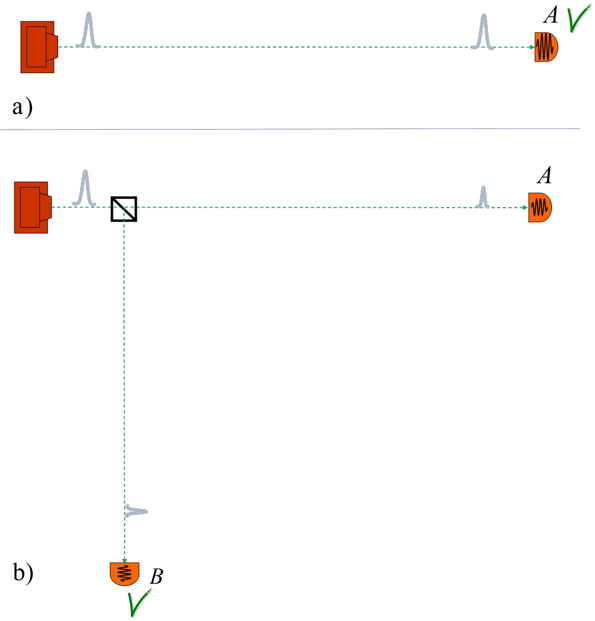
- MWI avoids action at a distance: in a single-world framework, placing a detector before location A changes the probability at spacelike-separated B from p = 0.5 to p = 0 or p = 1; in MWI this change occurs only in the observer’s world, not in the physical universe including all worlds.
- MWI is the most economical quantum theory regarding laws: only the wave function and Hamiltonian are fundamental, with no collapse mechanisms, Bohmian positions, consistent/decoherent histories, algebras of observables, or relational properties; it adds a self-location probability postulate proportional to the “measure of existence,” a counterpart to the Born rule, restoring determinism.
- MWI resolves quantum paradoxes including Schrödinger’s Cat, Bell-type experiments, Lorentz-frame collapse paradoxes, interaction-free bomb testing, teleportation information transfer, the 3-box paradox, Hardy paradox, quantum pigeon holes conundrum, and discontinuous traces in nested interferometers.
- A “world” is defined as the totality of macroscopic objects in a definite classically described state; the world wave function is part of the universal wave function superposition, and there is no preferred basis problem because our world defines the basis.
Methods
- Conceptual/philosophical preface to the Quantum Reports special issue and workshop “The Many-Worlds Interpretation of Quantum Mechanics: Current Status and Relation to Other Interpretations,” Tel Aviv, 18–24 October 2022.
- No empirical data or sample; the paper uses thought experiments (single-photon source, beam splitter, detectors, betting, “sleeping pill” trick) and references to prior work.
- Main analysis is argumentative and conceptual, not statistical or experimental.
Limitations
- The paper states MWI limitations regarding questions of probability that can be legitimately asked: only self-location probability is legitimate, outcome probability is an illusion, and an additional postulate beyond unitary evolution is necessary.
- The paper states that “world” is vaguely defined (“macroscopic” and “classically definite” are not rigorous terms), that there is no diachronic identity toward the future, and that one cannot ask what is the probability for a result of a quantum measurement to be performed.
- Evident from the text: this is a subjective preface without empirical tests or a formal derivation presented; the paper also notes that brain theory is not developed enough and that we have very little information about the universal wave function.
Model-written summary. Check it against the paper before relying on it.
Integrity signals
Registry
Cites
Statistics
Figures


Verification
Claims the paper makes
8 Valid · 1 Not valid · 5 Not checked · 34 Own results and interpretations
At least one cited source doesn’t support this claim or points to a different paper, and none confirmed it — see the verdicts below.
In the paper
“The only way to introduce ignorance is to apply a 'sleeping pill' trick [3] which leads to a situation in which an observer splits according to the outcome of the measurement without being aware of the outcome.”
What the sources say
- Disputedcites [3] Vaidman, 1998, On schizophrenic experiences of the neutron or why we should believe in the many-worlds interpretation of quantum theory, Int. Stud. Philos. Sci. sourceExperimental — accuracy not yet measured
Section 7 uses the sleeping-pill story to explain how ignorance-type probability can arise when an observer does not yet know an outcome. But it explicitly says the pill is “hardly necessary”: in typical experiments, distinct states arise before observers become aware of the result. That contradicts the claim that the trick is the only way to introduce ignorance. (LLM, conf=0.90)
Checked by a reasoning model — may be wrong.
plainstates a cause- Asserted: passes — The authors put it forward as true.
- Checkable: passes — It can be checked against evidence.
- Load-bearing: passes — The paper’s conclusions depend on it.
- Based: passes — The paper gives a reason why it holds.
- Disputed
Every source the paper cites for this claim was checked and supports it.
In the paper
“The paradox of interaction-free bomb testing [19] in which we get information about a region without a probe being there, is resolved by interaction of the probe in a parallel world.”
What the sources say
- Supportedcites [19] Elitzur, 1993, Quantum mechanical interaction-free measurements, Found. Phys. source
Section 2 (p. 6) says the apparent paradox of gaining information without interaction can be avoided in the Many-Worlds Interpretation: the photon does not touch the object in one world but interacts with it in another. The References note on bomb testing (p. 13) also applies that interpretation to a world in which the photon hits the bomb. (LLM, conf=0.90)
plainstates a cause- Asserted: passes — The authors put it forward as true.
- Checkable: passes — It can be checked against evidence.
- Load-bearing: passes — The paper’s conclusions depend on it.
- Based: passes — The paper gives a reason why it holds.
- Supported
Every source the paper cites for this claim was checked and supports it.
In the paper
“The paradox of the amount of information transferred in teleportation is resolved by the nonlocality of worlds and an observation that the only information remaining to be transferred after the local Bell measurement is the identity of the world we are in [2].”
What the sources say
- Supportedcites [2] Hull, D.M.F., and Burian, R. (1994). On the paradoxical aspects of new quantum experiments. PSA 1994, Philosophy of Science Association. source
Vaidman (p. 3) explains that after the local measurement, the information needed for teleportation is which world resulted, indicating the transformation to apply. He also describes the components corresponding to worlds as nonlocal (p. 4). (LLM, conf=0.93)
plainstates a cause- Asserted: passes — The authors put it forward as true.
- Checkable: passes — It can be checked against evidence.
- Load-bearing: passes — The paper’s conclusions depend on it.
- Based: passes — The paper gives a reason why it holds.
- Supported
The cited sources support only part of this claim — read each source’s verdict below.
In the paper
“We must add a postulate about the probability of self-location in a world which is a counterpart of the Born rule of the standard interpretation [13].”
What the sources say
- Partly supportedcites [13] Hemmo, M., and Shenker, O. (2020). Derivations of the Born rule. Quantum, Probability, Logic: The Work and Influence of Itamar Pitowsky, Springer Nature. sourceExperimental — accuracy not yet measured
In §5 (p. 27), the paper quotes Hemmo and Pitowsky's argument that resolving the probability problem in many-worlds theory requires adding a stochastic element. That supports the general idea of an addition to the theory, but the passage does not specify a postulate about the probability of self-location in a world or present that particular requirement as the paper's conclusion. (LLM, conf=0.78)
plain- Asserted: passes — The authors put it forward as true.
- Checkable: passes — It can be checked against evidence.
- Load-bearing: passes — The paper’s conclusions depend on it.
- Based: passes — The paper gives a reason why it holds.
- Partly supported
The cited sources support only part of this claim — read each source’s verdict below.
In the paper
“Finally, recent paradoxes appearing in the description of pre and postselected quantum systems: the 3-box paradox [20], Hardy paradox [21], the quantum pigeon holes conundrum [22], and discontinuous traces in nested interferometers [23] are all resolved by the fact that there are parallel worlds with different postselections [14].”
What the sources say
- Partly supportedcites [14] McQueen, K.J., and Vaidman, L. (2020). How the Many Worlds Interpretation brings Common Sense to Paradoxical Quantum Experiments. Scientific Challenges to Common Sense Philosophy, Routledge. sourceExperimental — accuracy not yet measured
Section 6 explains the nested-interferometer trace using parallel worlds with different detector outcomes; Section 3 explains that different postselections yield different traces. The copy does not extend that resolution to the three-box, Hardy, or quantum-pigeonhole paradoxes, so it supports only the nested-interferometer part of the claim. No page numbers are available in the indexed passages. (LLM, conf=0.88)
plainstates a cause- Asserted: passes — The authors put it forward as true.
- Checkable: passes — It can be checked against evidence.
- Load-bearing: passes — The paper’s conclusions depend on it.
- Based: passes — The paper gives a reason why it holds.
- Partly supported
18 more claims
Create a free account to see all 48 claims and every source verdict.
- Probably not a substantial claim. 12
- The quote only partly states this claim. 2
- It may state two separate claims as one. 15
Citations
Cites
"Relative State" Formulation of Quantum Mechanics
Everett, H. (1957) · Reviews of Modern Physics · doi:10.1103/revmodphys.29.454 · Cited by 3,379
Rapid solution of problems by quantum computation
Deutsch, D., & Jozsa, R. (1992) · Proceedings of the Royal Society of London. Series A: Mathematical and Physical Sciences · doi:10.1098/rspa.1992.0167 · Cited by 2,700
Stanford Encyclopedia of Philosophy 2009: Building an Endowment with Community Support
Loy, M. (2015) · doi:10.18665/sr.22353 · Cited by 2,465
Quantum mechanics, local realistic theories, and Lorentz-invariant realistic theories
Hardy, L. (1992) · Physical Review Letters · doi:10.1103/physrevlett.68.2981 · Cited by 739
Quantum mechanical interaction-free measurements
Elitzur, A. C., & Vaidman, L. (1993) · Foundations of Physics · doi:10.1007/bf00736012 · Cited by 673
Many Worlds Interpretation of Quantum Mechanics
Barrett, J. A. (2009) · Compendium of Quantum Physics · doi:10.1007/978-3-540-70626-7_113 · Cited by 630
Quantum theory of probability and decisions
Deutsch, D. (1999) · Proceedings of the Royal Society of London. Series A: Mathematical, Physical and Engineering Sciences · doi:10.1098/rspa.1999.0443 · Cited by 566
The Emergent Multiverse: Quantum Theory according to the Everett Interpretation
Wallace, D. (2012) · doi:10.1093/acprof:oso/9780199546961.001.0001 · Cited by 528
The emergent multiverse: quantum theory according to the Everett interpretation
(2013) · Choice Reviews Online · doi:10.5860/choice.50-3911 · Cited by 414
Complete description of a quantum system at a given time
Aharonov, Y., & Vaidman, L. (1991) · Journal of Physics A: Mathematical and General · doi:10.1088/0305-4470/24/10/018 · Cited by 400
Research works printed but not linked: 3
- DeWitt, B.S., and Graham, N. (1973). The Theory of the Universal Wave Function. The Many-Worlds Interpretation of Quantum Mechanics, Princeton University Press.
- Saunders, S., Barrett, J., Kent, A., and Wallace, D. (2010). Many Worlds? Everett, Quantum Theory, & Reality, OUP Oxford. · DOI · Paper page
- Saunders, S., Barrett, J., Kent, A., and Wallace, D. (2010). Can the world be only wavefunction?. Many Worlds? Everett, Quantum Theory, & Reality, Oxford University Press. · DOI · Paper page
Cited by
Everett’s Interpretation and Convivial Solipsism
Hervé Zwirn, C. (2023) · Quantum Reports · doi:10.3390/quantum5010018 · Cited by 20
A Holographic Principle for Non-Relativistic Quantum Mechanics
Thompson, R. B. (2023) · International Journal of Theoretical Physics · doi:10.1007/s10773-022-05274-9 · Cited by 5
Many-Worlds: Why Is It Not the Consensus?
Allori, V. (2023) · Quantum Reports · doi:10.3390/quantum5010007 · Cited by 8
Lev Vaidman, A. (2024) · Quantum Reports · doi:10.3390/quantum6020011 · Cited by 5
Self-citationStoica, O. C. (2023) · Quantum Reports · doi:10.3390/quantum5010008 · Cited by 11
Some Classical Models of Particles and Quantum Gauge Theories
Akhmeteli, A. (2022) · Quantum Reports · doi:10.3390/quantum4040035 · Cited by 2
Consistent Histories and Many Worlds
Bigaj, T. (2023) · Quantum Reports · doi:10.3390/quantum5010012 · Cited by 2
Visualizing Quantum Entanglement in Bose-Einstein Condensates Without State Vectors
Thompson, R. B. (2025) · International Journal of Theoretical Physics · doi:10.1007/s10773-024-05880-9 · Cited by 2
Everett’s Interpretation and Convivial Solipsism
(2023) · doi:10.20944/preprints202301.0289.v1 · Cited by 1
Many retrocausal worlds: A foundation for quantum probability
Ridley, M. (2025) · European Journal for Philosophy of Science · doi:10.1007/s13194-025-00696-8 · Cited by 4
Alatas, H., Muhammad, F. L., Hardhienata, H., & Ahmad, F. (2026) · Physica Scripta · doi:10.1088/1402-4896/ae8e53
Does science undermine the theistic multiverse?
Donahue, M. K. (2025) · Erkenntnis · doi:10.1007/s10670-025-00972-2
Introdução à cosmologia quântica
Delgado, P. C. M. (2023) · Cadernos de Astronomia · doi:10.47456/cad.astro.v4n2.41563 · Cited by 3
Fixing the Measure: Deriving |Ψ|² From Symmetry in Deterministic GeometryPreprint
Blore, Z. (2025) · Qeios · doi:10.32388/4en2oa
A Possible Connection Between Quantum Mechanics and Spacetime
Wang, H., & Wang, J. (2026) · Quantum Reports · doi:10.3390/quantum8010021
Fixing the Measure: Deriving |Ψ|² From Symmetry in Deterministic GeometryPreprint
Blore, Z. (2026) · Qeios · doi:10.32388/4en2oa.2
Ennadifi, S. E. (2026) · International Journal of Theoretical Physics · doi:10.1007/s10773-025-06247-4
Filho, O. L. D. S. (2026) · Mathematics · doi:10.3390/math14111961
Letertre, L. (2026) · Sciences & philosophie · doi:10.3917/edmat.papal.2026.01.0213
Metadata
- Authors
- Vaidman, L.
- Affiliations
- Raymond and Beverly Sackler School of Physics and Astronomy, Tel-Aviv University, Tel-Aviv 69978, Israel
- ORCID
- Vaidman, Lev
- Venue
- Quantum Reports
- Publisher
- MDPI AG
- Published
- 2022-08-04
- Volume
- 4
- Issue
- 3
- Pages
- 264-271
- ISSN
- 2624-960X (ISSN-L)
- OpenAlex
- W4289860605
- Semantic Scholar
- 8a577e78d725848e039bac2ebddc1f63ddb19bc6
- Cited by
- 22
- References
- 36
- Citations by year
- 2026: 7 · 2025: 5 · 2024: 2 · 2023: 6 · 2022: 2
- FWCI
- 1.53
- Type
- journal article
- Language
- en
- Open access
- gold
- doi.org
- Licence
- Locations
- Quantum Reports (publishedVersion, cc-by)
- Preprints.org (acceptedVersion, cc-by)
- arXiv (Cornell University) (submittedVersion)
- DOAJ (DOAJ: Directory of Open Access Journals) (submittedVersion, cc-by-sa)
- arXiv (Cornell University) (cc-by)
- Funders
- Israel Science Foundation (2064/19)
- Topics
- Physical Sciences › Physics and Astronomy › Atomic and Molecular Physics, and Optics › Quantum Mechanics and Applications
- Physical Sciences › Physics and Astronomy › Nuclear and High Energy Physics › Noncommutative and Quantum Gravity Theories
- Physical Sciences › Physics and Astronomy › Atomic and Molecular Physics, and Optics › Quantum Information and Cryptography
- Keywords
- many-worlds interpretation, interpretation of quantum mechanics, action at a distance, quantum randomness, quantum probability, wave function of the universe, superposition
About these checks
Registry, retraction, Cites and statistics results are computed, not judged, with one exception: a printed reference that no index lists is read once by a model before it counts as a citation error. Claims are extracted by a model and kept only when their quote appears verbatim in the text; each cited source is then checked, with a model’s help, for whether it says what the claim relies on. Those verdicts can be wrong — read the claim’s quote and the cited source before relying on one.
The claim verdicts this report counts are experimental: their accuracy is not yet measured.
A language model drew the claims from the paper on 2026-10-10, under version 3 of the claim definition (model deepseek-v4.1-flash, prompt extract-v3).
A second model labelled each claim on 2026-10-10 (model jev-1.13-20260917, definition revision gold-guideline-v0.2).
Cited sources are checked with a language model’s help (gpt-6-sol).
Statistics and arithmetic are recomputed, not judged.
Confidence bands are shown only for fields calibrated on our annotated test set. None is calibrated yet, so no band is shown.
What counts as a claim ›How we measure confidence ›How we check this ›
Are you an author, or do you see a problem with this page? Request a review
Data sources
Bibliographic data: Semantic Scholar, OpenAlex, Crossref.
Contains information from the Semantic Scholar Academic Graph Datasets, made available under the ODC Attribution License (ODC-BY 1.0).
Semantic Scholar’s data is described in: Kinney, R., et al. (2023). The Semantic Scholar Open Data Platform. arXiv:2301.10140.
