

Adaptive Backstepping Integral Sliding Mode Control of a MIMO Separately Excited DC Motor
Open accessThe DOI matches its Crossref record; 30 of the 30 references it cites were found in a registry or an index.
Abstract
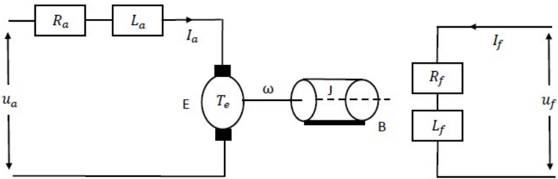
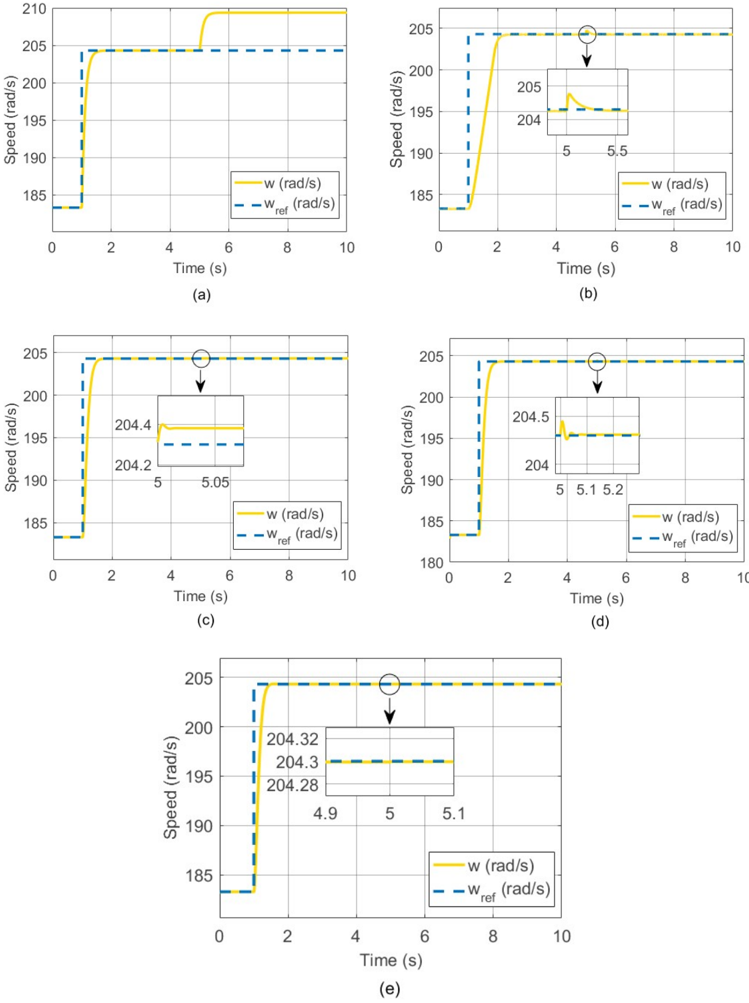
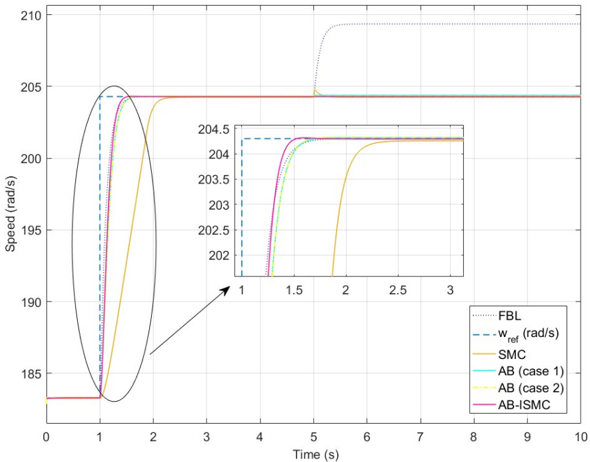
This research proposes a robust nonlinear hybrid control approach to the speed control of a multi-input-and-multi-output separately excited DC motor (SEDCM). The motor that was under consideration experienced parametric uncertainties and load disturbances in the weak field region. The proposed technique aims to merge the benefits of adaptive backstepping (AB) and integral sliding mode control (ISMC) to enhance the overall system’s robustness. The unknown parameters with load disturbances are estimated using an adaptation law. These estimated parameters are incorporated into the controller design, to achieve a highly robust controller. The theoretical stability of the system is proved using the Lyapunov stability criteria. The effectiveness of the proposed AB–ISMC was demonstrated by simulation, to track the reference speed under parametric uncertainties and load disturbances. The control performance of the proposed technique was compared to that of feedback linearization (FBL), conventional sliding mode control (SMC), and AB control laws without and with the adaptation law. Regression parameters, such as integral square error, integral absolute error, and integral time absolute error, were calculated to quantitatively analyze the tracking performance and robustness of the implemented nonlinear control techniques. The simulation results demonstrated that the proposed controller could accurately track the reference speed and exhibited robustness, with steady-state error accuracy. Moreover, AB–ISMC overperformed, compared to the FBL, SMC, AB controller without adaptation law and AB controller with adaptation law, in reducing the settling time by factors of 27%, 67%, 23%, and 21%, respectively, thus highlighting the superior performance of the proposed controller.
Overview
The claims and statistics of this paper haven’t been checked yet.
Free: it reads the open-access text and checks the first 5 claims that cite a source we can check. Create a free account to check every claim.
Integrity signals
Registry
Cites
Statistics
Figures
Verification
Claims the paper makes
The claims and statistics of this paper haven’t been checked yet.
Free: it reads the open-access text and checks the first 5 claims that cite a source we can check. Create a free account to check every claim.
Claims other papers make about this one
Each is checked against this paper’s own text: does it say what the citing paper says it does?
The source backs part of the claim, not all of it — or backs it for a different population, condition or comparison.
In the citing paper
“SMC is particularly well-suited for UAV applications, as it offers strong robustness, fast response, and consistent performance under rapidly changing flight conditions and external disturbances [118].”
From A Review of Modeling and Control Techniques for Unmanned Aerial Vehicles (2025) · cites this paper as [118]
Experimental — accuracy not yet measured
Self-check
Percentages, sums and reported differences re-computed from the paper’s own numbers.
The self-check needs the paper’s full text.
Citations
Cites
Robust Speed Control of PMSM Using Sliding Mode Control (SMC)—A Review
Mohd Zaihidee, F., Mekhilef, S., & Mubin, M. (2019) · Energies · doi:10.3390/en12091669 · Cited by 248
Saleem, O., Ali, S., & Iqbal, J. (2023) · Energies · doi:10.3390/en16135039 · Cited by 65
Self-citationAhmad, S., Uppal, A. A., Azam, M. R., & Iqbal, J. (2023) · Electronics · doi:10.3390/electronics12040876 · Cited by 61
Self-citationAnjum, M. B., Khan, Q., Ullah, S., Hafeez, G., Fida, A., Iqbal, J., & Albogamy, F. R. (2022) · Applied Sciences · doi:10.3390/app12062773 · Cited by 60 · cited 1×
“During the analysis of the system’s response in SMC, there are two distinct phases: (i) the sliding phase and (ii) the reaching phase [20,28,29].”
BackgroundSelf-citationAdaptive Backstepping Based Sensor and Actuator Fault Tolerant Control of a Manipulator
Awan, Z. S., Ali, K., Iqbal, J., & Mehmood, A. (2019) · Journal of Electrical Engineering and Technology · doi:10.1007/s42835-019-00277-9 · Cited by 58 · cited 3×
“The AB–ISMC is an effective control strategy that can achieve precise and robust con-trol of nonlinear systems [31].”
MethodSelf-citationSaleem, O., Abbas, F., & Iqbal, J. (2023) · Mathematics · doi:10.3390/math11040913 · Cited by 51 · cited 1×
“Conventional controllers struggle to maintain a constant speed for the motor, due to parametric variations associated with nonlinear loads, such as friction and magnetic saturation [13].”
BackgroundSelf-citationZhang, S., Wang, Q., Ge, Y., & Zhang, M. (2019) · ISA Transactions · doi:10.1016/j.isatra.2019.02.017 · Cited by 50 · cited 1×
“However, its ability to effectively reject disturbances caused by load torque is relatively less efficient than SMC [26].”
BackgroundGou, L., Wang, C., Zhou, M., & You, X. (2019) · IEEE Transactions on Power Electronics · doi:10.1109/tpel.2019.2933599 · Cited by 41 · cited 3×
“However, the main drawback of SMC is chattering, which is typically undesirable in practical drive systems [18–24].”
BackgroundMethodRiaz, S., Qi, R., Tutsoy, Ö., & Iqbal, J. (2023) · PLoS ONE · doi:10.1371/journal.pone.0279253 · Cited by 38
Self-citationBackstepping control of a separately excited DC motor
Harrouz, A., Becheri, H., Çolak, İ., & Kayışlı, K. (2017) · Electrical Engineering · doi:10.1007/s00202-017-0592-5 · Cited by 33 · cited 10×
“Nonlinear control techniques, such as feedback linearization (FBL), sliding mode control (SMC), and backstepping control (BSC), have been proposed and applied, to control the speed of a SEDCM above base speed [3,10,14].”
BackgroundMethodInfluential
Research works printed but not linked: 4
- 11. Sagar, J.D. DC Motor Control using PID Controller. Int. Res. J. Eng. Technol. 2020, 7, 1765-1769.
- 24. Khalil, H.K. Nonlinear Control; Pearson: New York, NY, USA, 2015.
- 33. Slotine, J.J.E.; Li, W. Applied Nonlinear Control; Prentice Hall: Englewood Cliffs, NJ, USA, 1991; p. 705.
- 34. Fradkov, A.L.; Miroshnik, I.V.; Nikiforov, V.O. Nonlinear and Adaptive Control of Complex Systems; Springer Science & Business Media: New York, NY, USA, 2013.
Cited by
Trajectory Tracking of Fixed-Wing UAV Using ANFIS-Based Sliding Mode Controller
Yareshe, F. T., Madebo, N. W., Abdissa, C. M., & Negash, L. (2025) · IEEE Access · doi:10.1109/access.2025.3557472 · Cited by 70
“SMC tracking dynamics [38]. system to distinguish between the reaching phase and the sliding phase of its state motion [35], [36], [37].”
A Review of Modeling and Control Techniques for Unmanned Aerial Vehicles
Gedefaw, E. A., Abera, N. B., & Abdissa, C. M. (2025) · Engineering Reports · doi:10.1002/eng2.70215 · Cited by 54
Review of DC Motor Modeling and Linear Control: Theory with Laboratory Tests
Kuczmann, M. (2024) · Electronics · doi:10.3390/electronics13112225 · Cited by 47
Efficient Speed Control for DC Motors Using Novel Gazelle Simplex Optimizer
Ekinci, S., İzci, D., & Yılmaz, M. (2023) · IEEE Access · doi:10.1109/access.2023.3319596 · Cited by 43
Li, W., Zhu, X., Wang, X., Hu, Z., & Wang, M. (2024) · International Journal of Hydrogen Energy · doi:10.1016/j.ijhydene.2024.04.361 · Cited by 26
Metadata
- Authors
- Afifa, R., Ali, S., Pervaiz, M., & Iqbal, J.
- Affiliations
- COMSATS University Islamabad (PK)
- International Islamic University, Islamabad (PK)
- University of Hull (GB)
- Corresponding author
- Iqbal, Jamshed
- Venue
- Robotics
- Publisher
- MDPI AG
- Published
- 2023-07-16
- Volume
- 12
- Issue
- 4
- Pages
- 105
- ISSN
- 2218-6581 (ISSN-L)
- OpenAlex
- W4384525335
- Cited by
- 72
- References
- 30
- Citations by year
- 2026: 9 · 2025: 34 · 2024: 17 · 2023: 12
- FWCI
- 7.73
- Type
- journal article
- Language
- en
- Open access
- gold
- doi.org
- Licence
- Locations
- Robotics (publishedVersion, cc-by)
- Repository@Hull (Worktribe) (University of Hull) (publishedVersion, other-oa)
- DOAJ (DOAJ: Directory of Open Access Journals) (submittedVersion, cc-by-sa)
- Topics
- Physical Sciences › Engineering › Control and Systems Engineering › Adaptive Control of Nonlinear Systems
- Physical Sciences › Engineering › Electrical and Electronic Engineering › Sensorless Control of Electric Motors
- Physical Sciences › Engineering › Control and Systems Engineering › Stability and Control of Uncertain Systems
- Keywords
- adaptive backstepping control, integral sliding mode control, separately excited DC motor, parameter uncertainty, load disturbance rejection, parameter estimation, Lyapunov stability, robust nonlinear control
About these checks
Registry, retraction, Cites and statistics results are computed, not judged, with one exception: a printed reference that no index lists is read once by a model before it counts as a citation error. Claims are extracted by a model and kept only when their quote appears verbatim in the text; each cited source is then checked, with a model’s help, for whether it says what the claim relies on. Those verdicts can be wrong — read the claim’s quote and the cited source before relying on one.
Statistics and arithmetic are recomputed, not judged.
Confidence bands are shown only for fields calibrated on our annotated test set. None is calibrated yet, so no band is shown.
What counts as a claim ›How we measure confidence ›How we check this ›
Are you an author, or do you see a problem with this page? Request a review
How to cite
Cite CoChat for the checks on this page, and the paper for its own findings.
- This page
- CoChat. (2026). Citation check: Adaptive Backstepping Integral Sliding Mode Control of a MIMO Separately Excited DC Motor. https://app.cochat.ai/papers/10.3390/robotics12040105
- The paper
- Afifa, R., Ali, S., Pervaiz, M., & Iqbal, J. (2023). Adaptive Backstepping Integral Sliding Mode Control of a MIMO Separately Excited DC Motor. Robotics. https://doi.org/10.3390/robotics12040105
Data sources
Bibliographic data: Semantic Scholar, OpenAlex, Crossref.
Contains information from the Semantic Scholar Academic Graph Datasets, made available under the ODC Attribution License (ODC-BY 1.0).
Semantic Scholar’s data is described in: Kinney, R., et al. (2023). The Semantic Scholar Open Data Platform. arXiv:2301.10140.
