

Modeling Artificial Light Exposure after Vegetation Trimming at a Marine Turtle Nesting Beach
Open accessThe DOI matches its Crossref record; 46 of the 47 references it cites were found in a registry or an index, and 1 are not checked yet; none of the 49 sources its claims cite is checked for support yet.
Abstract
Light pollution caused by poorly directed artificial lighting has increased globally in recent years. Artificial lights visible along marine turtle nesting beaches can disrupt natural brightness cues used by hatchling turtles to orient correctly to the ocean for their offshore migrations. Natural barriers, such as tall dunes and dense vegetation, that block coastal and inland lights from the beach may reduce this disruption. However, coastal areas are often managed toward human values, including the trimming of vegetation to improve ocean views. We used viewshed models to determine how reducing the dune vegetation height (specifically that of seagrape, Cocoloba uvifera) might increase the amount of artificial light from upland buildings that reaches a marine turtle nesting beach in Southeast Florida. We incorporated three data sets (LiDAR data, turtle nest locations, and field surveys of artificial lights) into a geographic information system to create viewsheds of lighting from buildings across 21 vegetation profiles. In 2018, when most seagrape patches had been trimmed to <1.1 m tall, female loggerhead turtles nested in areas with potential for high light exposure based on a cumulative viewshed model. Viewshed models using random (iterative simulations) and nonrandom selections of buildings revealed that untrimmed seagrape heights (mean = 3.1 m) and especially taller vegetation profiles effectively reduced potential lighting exposure from three building heights (upper story, midstory, and ground level). Even the tallest modeled vegetation, however, would fail to block lights from the upper stories of some tall buildings. Results from this study can support management decisions regarding the trimming of beach dune vegetation, any associated changes in the visibility of artificial lighting from the nesting areas, and modifications to existing lighting needed to mitigate light exposure.
Checked 2026-11-24 · 1 reference not checked yet
Overview
CoChat Summary
TL;DR
Viewshed models in Delray Beach, Florida, showed that trimming seagrape dune vegetation to ~1 m increased the potential artificial light exposure of loggerhead turtle nesting areas from upland buildings. Untrimmed and taller vegetation reduced exposure, but tall buildings still illuminated the beach regardless of vegetation height.
Key findings
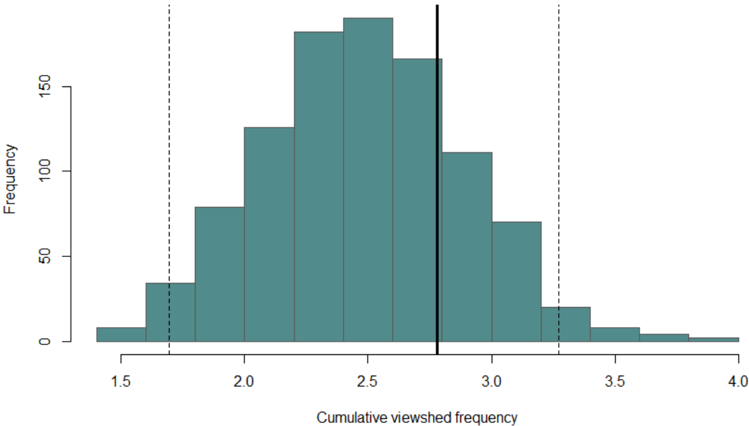
- Under the 2018 concurrent vegetation profile, loggerhead nests occurred in areas with relatively high potential light exposure: mean lights visible per nest was 2.8 versus 2.5 for random beach points (95% CI = 1.7–3.3). Hatchling disorientation in 2018 was 8.9% (5 of 56 nests with emergent hatchlings).
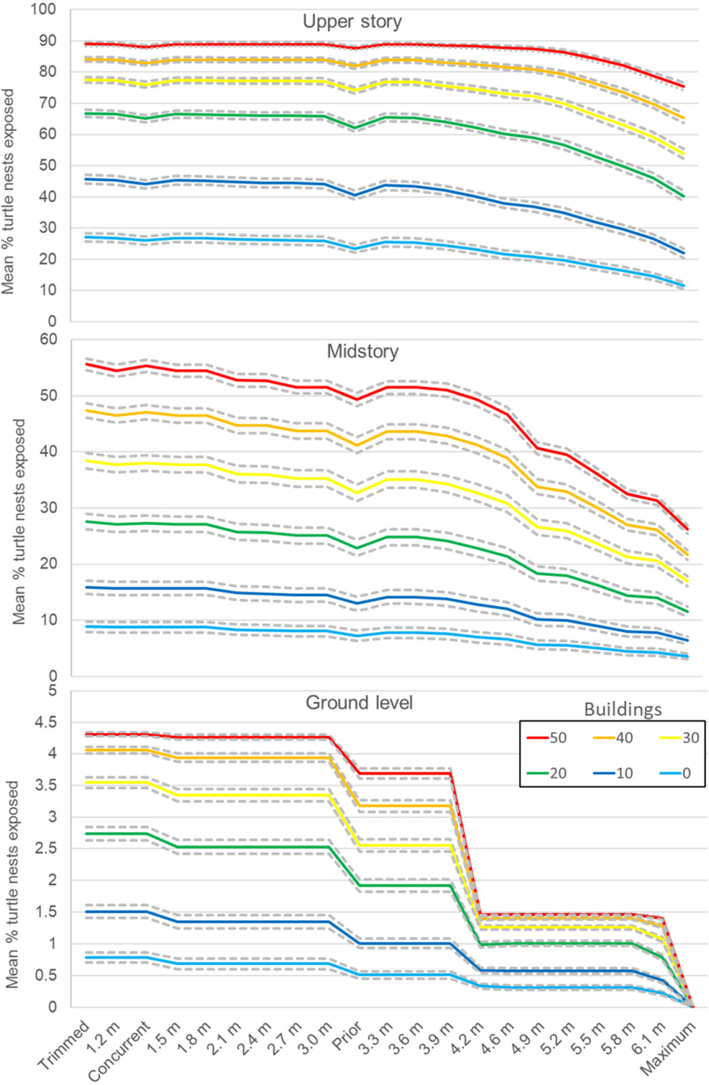
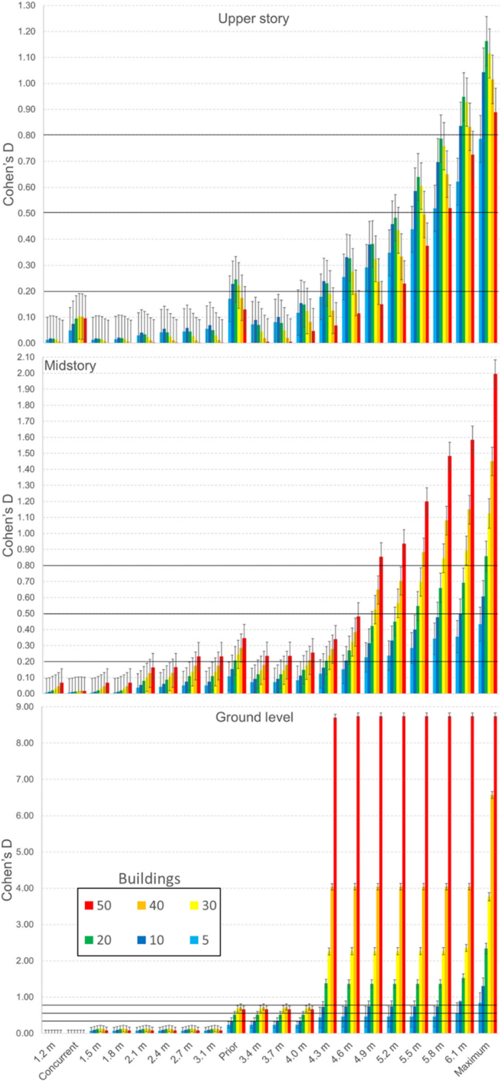
- Randomly iterated viewsheds showed that upper-story lights could expose 11.5–88.9% of nests, midstory lights 3.5–55.6%, and ground-level lights 0.2–4.3% across vegetation profiles. Medium-to-high effect sizes began around 5.2 m vegetation height for upper stories, 4.9 m for midstory, and the prior-to-trimming profile for ground level.
- Under trimmed vegetation, adding buildings from 5 to 50 increased the percentage of nests exposed by 61.8% for upper-story lights and 46.8% for midstory lights.
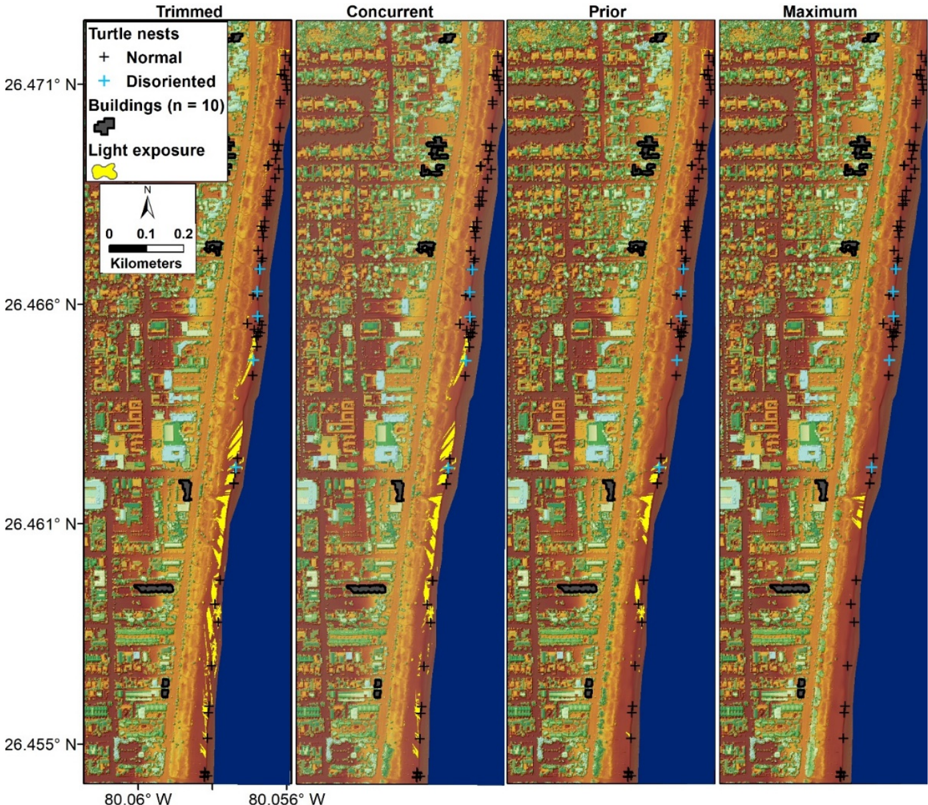
- Nonrandomly selected buildings with the greatest differences in light visibility produced cumulative light exposure on the beach that fell from 18,726 m² (17.0%) under trimmed vegetation to 3,855 m² (3.5%) under maximum vegetation. One tall building was visible to 33% of the beach area and could have exposed 81% of turtle nests.
Methods
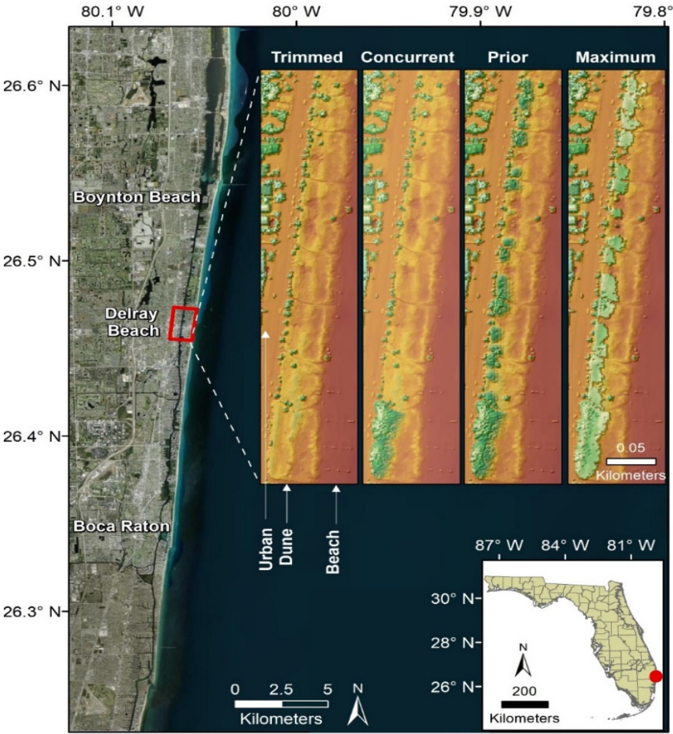
- Study site: 2.5 km² in Delray Beach, Florida, with 0.1 km² beach, 0.1 km² dune, and 2.2 km² urban cover. Loggerhead nesting data from 2018 included 74 nests; after removing 6 with >20 m distance discrepancies, 68 nests were retained and buffered by 3 m.
- LiDAR data from 2018 and 2004 were used to build 1 m resolution DEMs and 21 seagrape height profiles, including trimmed (~1 m), concurrent 2018, prior-to-trimming 2004, and generated heights from 1.2 to 6.1 m plus a maximum of 6.1–8.0 m.
- Viewshed models used 73 visible buildings at upper-story, midstory, and ground-level heights, producing 4,221 viewsheds. Random subsamples of 5–50 buildings were iterated 1,000 times per vegetation profile; effect sizes were calculated with Cohen’s D. Nonrandom models compared the 10 buildings with greatest and smallest individual differences in light exposure across four vegetation profiles.
Limitations
- Stated by the authors: the study lacked actual artificial lighting data for 2018 and instead used 2020 lighting surveys, so models represented potential lighting scenarios from buildings rather than measured 2018 light exposure.
- Stated by the authors: the models did not investigate all direct artificial light sources (e.g., streetlights), all lighting factors (e.g., intensity, attenuation), lighting durations, or reflected light such as skyglow. They also modeled lights from entire buildings rather than individual lights; a per-light approach would require 1,206 viewsheds per model run.
- Stated by the authors: rates of hatchling disorientation before and after vegetation trimming were lacking at the study site, and it is unlikely that all seagrape patches would reach the modeled maximum height. Evident from the text: the analysis is a geospatial modeling study of potential exposure, not an experimental test of whether trimming directly caused changes in hatchling orientation.
Model-written summary. Check it against the paper before relying on it.
Integrity signals
Registry
Cites
Statistics
Figures
Verification
Claims the paper makes
0 Valid · 0 Not valid · 26 Not checked · 47 Own results and interpretations
A result the paper reports from its own data — it cites no other source for it, so there is none to check. The quote shows it is in the paper.
In the paper
“Taller vegetation (>4.6 m) was most effective in our randomly iterated models”
§ Modeling Artificial Light Exposure after Vegetation Trimming at a Marine Turtle Nesting Beach > 4. Discussion
plainstates a cause- Asserted: passes — The authors put it forward as true.
- Checkable: passes — It can be checked against evidence.
- Load-bearing: unclear — It is unclear whether the paper’s conclusions depend on it.
- Based: passes — The paper gives a reason why it holds.
A result the paper reports from its own data — it cites no other source for it, so there is none to check. The quote shows it is in the paper.
In the paper
“Lower effect sizes resulted from random iterations”
§ Modeling Artificial Light Exposure after Vegetation Trimming at a Marine Turtle Nesting Beach > 4. Discussion
plainstates a cause- Asserted: passes — The authors put it forward as true.
- Checkable: passes — It can be checked against evidence.
- Load-bearing: unclear — It is unclear whether the paper’s conclusions depend on it.
- Based: passes — The paper gives a reason why it holds.
A result the paper reports from its own data — it cites no other source for it, so there is none to check. The quote shows it is in the paper.
In the paper
“In the 2018 DSM, we identified 56 relatively large patches of seagrape, which ranged in area from 21 m 2 to 1786 m 2 (mean area = 265.9± 300.2 m 2 ).”
§ Modeling Artificial Light Exposure after Vegetation Trimming at a Marine Turtle Nesting Beach > 3.1. Surface Model Summaries
plain- Asserted: passes — The authors put it forward as true.
- Checkable: passes — It can be checked against evidence.
- Load-bearing: unclear — It is unclear whether the paper’s conclusions depend on it.
- Based: passes — The paper gives a reason why it holds.
A result the paper reports from its own data — it cites no other source for it, so there is none to check. The quote shows it is in the paper.
In the paper
“For the prior-to-trimming vegetation profile, nonrandomly selected building lights were noticeably blocked across the beach (Figure 5)”
§ Modeling Artificial Light Exposure after Vegetation Trimming at a Marine Turtle Nesting Beach > 4. Discussion
plainstates a cause- Asserted: passes — The authors put it forward as true.
- Checkable: passes — It can be checked against evidence.
- Load-bearing: unclear — It is unclear whether the paper’s conclusions depend on it.
- Based: passes — The paper gives a reason why it holds.
A result the paper reports from its own data — it cites no other source for it, so there is none to check. The quote shows it is in the paper.
In the paper
“Much of the beach in our study area, however, had a high potential for lighting exposure limiting nest site selection in unlit areas (Figure 2).”
§ Modeling Artificial Light Exposure after Vegetation Trimming at a Marine Turtle Nesting Beach > 4. Discussion
plainstates a cause- Asserted: passes — The authors put it forward as true.
- Checkable: passes — It can be checked against evidence.
- Load-bearing: passes — The paper’s conclusions depend on it.
- Based: passes — The paper gives a reason why it holds.
24 more claims
Create a free account to see all 73 claims and to verify the 48 references still open.
- It may state two separate claims as one. 30
- The quote only partly states this claim. 1
- Probably not a substantial claim. 18
Claims other papers make about this one
Each is checked against this paper’s own text: does it say what the citing paper says it does?
In the citing paper
“building up dunes may attract predators to the vegetation and face opposition from residents concerned about obstructed ocean views [52,54]”
From Disorientation patterns of loggerhead sea turtle (Caretta caretta) hatchlings in Pinellas County, Florida, USA (2026) · cites this paper as [54]
In the citing paper
“disorientation rates in Pinellas County (36%) far exceed the 2018 statewide mean of 3% reported for Florida [54]”
From Disorientation patterns of loggerhead sea turtle (Caretta caretta) hatchlings in Pinellas County, Florida, USA (2026) · cites this paper as [54]
In the citing paper
“the 2018 statewide mean of 3% reported for Florida [54]”
From Disorientation patterns of loggerhead sea turtle (Caretta caretta) hatchlings in Pinellas County, Florida, USA (2026) · cites this paper as [54]
In the citing paper
“Various field experiments provide corroborating evidence, showing that turtle hatchlings orient away from elevated tall dunes and dense vegetation on nesting beaches faced with artificial lighting (Barrett and Sella, 2022;Hirama et al., 2021;Karnad et al., 2009;Limpus and Kamrowski, 2013;Pendoley and Kamrowski, 2015).”
From The effect of artificial light at night on sea turtle hatchling early dispersal: A systematic review of methods, impacts and findings (2025) · cites this paper as Barrett and Sella, 2022
Self-check
Percentages, sums and reported differences re-computed from the paper’s own numbers.
Each contradiction between two passages listed here was confirmed by an independent check.
Rated minor: it would not touch a result — a value no result rests on, a p-value that stays on the same side of the significance level, or a conflict that is clerical, resolved elsewhere in the paper, or outside its own findings.
In the paper
“The mean number of observer points (i.e., lights) per building was 15.6 ± 16.1, ranging from 1 to 86; the total number of observer points was 1233”
§ Modeling Artificial Light Exposure after Vegetation Trimming at a Marine Turtle Nesting Beach > 3.1. Surface Model Summaries
Reported 15.6 · recomputed 16.890411
Rated minor: it would not touch a result — a value no result rests on, a p-value that stays on the same side of the significance level, or a conflict that is clerical, resolved elsewhere in the paper, or outside its own findings.
In the paper
§ Modeling Artificial Light Exposure after Vegetation Trimming at a Marine Turtle Nesting Beach > 2.4.2. Randomly Iterated Viewsheds
“We randomly selected buildings at each of five levels”
§ Modeling Artificial Light Exposure after Vegetation Trimming at a Marine Turtle Nesting Beach > 2.4.2. Randomly Iterated Viewsheds
“(5, 10, 20, 30, 40, 50)”
Rated minor: it would not touch a result — a value no result rests on, a p-value that stays on the same side of the significance level, or a conflict that is clerical, resolved elsewhere in the paper, or outside its own findings.
In the paper
§ Modeling Artificial Light Exposure after Vegetation Trimming at a Marine Turtle Nesting Beach > 3.4. Nonrandomly Selected Viewsheds
“15,854 (13.1%) for maximum”
§ Modeling Artificial Light Exposure after Vegetation Trimming at a Marine Turtle Nesting Beach > 3.4. Nonrandomly Selected Viewsheds
“20,212 m 2 (18.3%)”
Rated minor: it would not touch a result — a value no result rests on, a p-value that stays on the same side of the significance level, or a conflict that is clerical, resolved elsewhere in the paper, or outside its own findings.
In the paper
§ Modeling Artificial Light Exposure after Vegetation Trimming at a Marine Turtle Nesting Beach > 3.1. Surface Model Summaries
“76.0% were within 200 m, and 8.9% were >500 m from the shoreline.”
§ Modeling Artificial Light Exposure after Vegetation Trimming at a Marine Turtle Nesting Beach > 2.4. Viewshed Models
“resulting in 73 visible buildings.”
Rated minor: it would not touch a result — a value no result rests on, a p-value that stays on the same side of the significance level, or a conflict that is clerical, resolved elsewhere in the paper, or outside its own findings.
In the paper
§ Modeling Artificial Light Exposure after Vegetation Trimming at a Marine Turtle Nesting Beach > 4. Discussion
“for the priorto-trimming profile, the mean vegetation height was smaller than those of other profiles”
§ Modeling Artificial Light Exposure after Vegetation Trimming at a Marine Turtle Nesting Beach > 5. Conclusions
“| Trimmed | 1.53 | 1.61 | Height limited to 0.9 m or 1.1 m |”
Citations
Cites
Cohen, J. (1992) · Psychological Bulletin · doi:10.1037//0033-2909.112.1.155 · Cited by 8,771
Lidar Remote Sensing for Ecosystem Studies
LEFSKY, M. A., COHEN, W. B., PARKER, G. G., & HARDING, D. J. (2002) · BioScience · doi:10.1641/0006-3568(2002)052[0019:lrsfes]2.0.co;2 · Cited by 1,824
A global analysis of human settlement in coastal zones
Small, C., & Nicholls, R. J. (2003) · ePrints Soton (University of Southampton) · Cited by 1,527
Longcore, T., & Rich, C. (2004) · Frontiers in Ecology and the Environment · doi:10.1890/1540-9295(2004)002[0191:elp]2.0.co;2 · Cited by 1,423
The ecological impacts of nighttime light pollution: a mechanistic appraisal
Gaston, K. J., Bennie, J., Davies, T. W., & Hopkins, J. (2013) · Biological Reviews · doi:10.1111/brv.12036 · Cited by 1,110
The dark side of light: a transdisciplinary research agenda for light pollution policy
Hölker, F., Moss, T., Griefahn, B., Kloas, W., Voigt, C. C., Henckel, D., Hänel, A., Kappeler, P. M., Völker, S., Schwope, A., et al. (2010) · Ecology and Society · doi:10.5751/es-03685-150413 · Cited by 623 · cited 1×
“Light pollution created by errant artificial lighting has increased rapidly and globally in recent years [1,2].”
BackgroundREVIEW: Reducing the ecological consequences of night‐time light pollution: options and developments
Gaston, K. J., Davies, T. W., Bennie, J., & Hopkins, J. (2012) · Journal of Applied Ecology · doi:10.1111/j.1365-2664.2012.02212.x · Cited by 523
Environmental Warming and Feminization of One of the Largest Sea Turtle Populations in the World
Jensen, M. P., Allen, C. D., Eguchi, T., Bell, I. P., LaCasella, E. L., Hilton, W. A., Hof, C. A. M., & Dutton, P. H. (2018) · Current Biology · doi:10.1016/j.cub.2017.11.057 · Cited by 407
Davies, T. W., Bennie, J., Inger, R., de Ibarra, N. H., & Gaston, K. J. (2013) · Global Change Biology · doi:10.1111/gcb.12166 · Cited by 244
Global Trends in Exposure to Light Pollution in Natural Terrestrial Ecosystems
Bennie, J., Duffy, J., Davies, T., Correa-Cano, M., & Gaston, K. (2015) · Remote Sensing · doi:10.3390/rs70302715 · Cited by 208
Research works printed but not linked: 2
- Witherington, B.E.; Martin, R.E. Understanding, Assessing, and Resolving Light-Pollution Problems on Sea Turtle Nesting Beaches, 3rd ed.; Technical Report TR-2; Florida Marine Research Institute: St. Petersburg, FL, USA, 2000; pp. 1-73.
- Meylan, A.B.; Schroeder, B.A.; Mosier, A. Sea Turtle Nesting Activity in the State of Florida 1979-1992; Florida Marine Research Institute: St. Petersburg, FL, USA; Florida Department of Environmental Protection: Tallahassee, FL, USA, 1995; pp. 1-51.
Cited by
Key issues in assessing threats to sea turtles: knowledge gaps and future directions
Fuentes, M., McMichael, E., Kot, C. Y., Silver‐Gorges, I., Wallace, B., Godley, B. J., Brooks, A., Ceriani, S. A., Cortés-Gómez, A. A., Dawson, T., et al. (2023) · Endangered Species Research · doi:10.3354/esr01278 · Cited by 112
Gomez Isaza, D. F., Jones, R., Wilson, P., Pendoley, K., Fossette, S., & Thums, M. (2025) · Biological Conservation · doi:10.1016/j.biocon.2025.111327 · Cited by 8
Fadli, S. N., Idris, N. H., Osman, M. J., Othman, N., & Ishak, M. H. I. (2023) · IOP Conference Series Earth and Environmental Science · doi:10.1088/1755-1315/1240/1/012012 · Cited by 5
Long, T. M., Anderson, R., Ceriani, S. A., Frederick, C., Koperski, M., Shea, C. P., Wideroff, M., & Trindell, R. N. (2025) · Journal for Nature Conservation · doi:10.1016/j.jnc.2025.126843 · Cited by 2
McNally, K. L., Oakley, C., Davila, M., & Farinelli, S. (2026) · PLOS One · doi:10.1371/journal.pone.0347104 · Cited by 1
Metadata
- Authors
- Barrett, M. A., & Nelson Sella, K.
- Affiliations
- Florida Fish and Wildlife Conservation Commission (US)
- Florida Fish and Wildlife Conservation Commission, Fish and Wildlife Research Institute, Information Science & Management, Center for Spatial Analysis, 620 South Meridian Street, Tallahassee, FL 32399, USA
- Corresponding author
- Barrett, Mark A.
- Venue
- Remote Sensing
- Publisher
- MDPI AG
- Published
- 2022-06-04
- Volume
- 14
- Issue
- 11
- Pages
- 2702
- ISSN
- 2072-4292 (ISSN-L)
- OpenAlex
- W4281720735
- Semantic Scholar
- d29b1614dd0c6b4d8603e666cb71fb4d1ec61e10
- Cited by
- 8
- References
- 46
- Citations by year
- 2026: 4 · 2025: 2 · 2023: 2
- FWCI
- 0.28
- Type
- journal article
- Language
- en
- Open access
- gold
- doi.org
- Licence
- Locations
- Remote Sensing (publishedVersion, cc-by)
- DOAJ (DOAJ: Directory of Open Access Journals) (submittedVersion)
- Funders
- Florida Fish and Wildlife Conservation Commission
- Topics
- Physical Sciences › Environmental Science › Global and Planetary Change › Impact of Light on Environment and Health
- Physical Sciences › Environmental Science › Nature and Landscape Conservation › Turtle Biology and Conservation
- Physical Sciences › Environmental Science › Pollution › Microplastics and Plastic Pollution
- Keywords
- light pollution, Caretta caretta, hatchling orientation, building lighting, LiDAR, Southeast Florida
About these checks
Registry, retraction, Cites and statistics results are computed, not judged, with one exception: a printed reference that no index lists is read once by a model before it counts as a citation error. Claims are extracted by a model and kept only when their quote appears verbatim in the text; each cited source is then checked, with a model’s help, for whether it says what the claim relies on. Those verdicts can be wrong — read the claim’s quote and the cited source before relying on one.
A language model drew the claims from the paper on 2026-11-24, under version 3 of the claim definition (model deepseek-v4.1-flash, prompt extract-v3).
A second model labelled each claim on 2026-11-24 (model jev-1.13-20260917, definition revision gold-guideline-v0.2).
Statistics and arithmetic are recomputed, not judged.
Confidence bands are shown only for fields calibrated on our annotated test set. None is calibrated yet, so no band is shown.
What counts as a claim ›How we measure confidence ›How we check this ›
Are you an author, or do you see a problem with this page? Request a review
Data sources
Bibliographic data: Semantic Scholar, OpenAlex, Crossref.
Contains information from the Semantic Scholar Academic Graph Datasets, made available under the ODC Attribution License (ODC-BY 1.0).
Semantic Scholar’s data is described in: Kinney, R., et al. (2023). The Semantic Scholar Open Data Platform. arXiv:2301.10140.
