

A Comprehensive Review of Sensors and Instrumentation Methods in Devices for Musical Expression
Open accessThe DOI matches its Crossref record; 93 of the 97 references it cites were found in a registry or an index.
Abstract
Digital Musical Instruments (DMIs) are musical instruments typically composed of a control surface where user interaction is measured by sensors whose values are mapped to sound synthesis algorithms. These instruments have gained interest among skilled musicians and performers in the last decades leading to artistic practices including musical performance, interactive installations and dance. The creation of DMIs typically involves several areas, among them: arts, design and engineering. The balance between these areas is an essential task in DMI design so that the resulting instruments are aesthetically appealing, robust, and allow responsive, accurate and repeatable sensing. In this paper, we review the use of sensors in the DMI community as manifested in the proceedings of the International Conference on New Interfaces for Musical Expression (NIME 2009–2013). Focusing on the sensor technologies and signal conditioning techniques used by the NIME community. Although it has been claimed that specifications for artistic tools are harder than those for military applications, this study raises a paradox showing that in most of the cases, DMIs are based on a few basic sensors types and unsophisticated engineering solutions, not taking advantage of more advanced sensing, instrumentation and signal processing techniques that could dramatically improve their response. We aim to raise awareness of limitations of any engineering solution and to assert the benefits of advanced electronics instrumentation design in DMIs. For this, we propose the use of specialized sensors such as strain gages, advanced conditioning circuits and signal processing tools such as sensor fusion. We believe that careful electronic instrumentation design may lead to more responsive instruments.
Overview
The claims and statistics of this paper haven’t been checked yet.
Free: it reads the open-access text and checks the first 5 claims that cite a source we can check. Create a free account to check every claim.
Integrity signals
Registry
Cites
Statistics
Figures
Verification
Claims the paper makes
The claims and statistics of this paper haven’t been checked yet.
Free: it reads the open-access text and checks the first 5 claims that cite a source we can check. Create a free account to check every claim.
Claims other papers make about this one
Each is checked against this paper’s own text: does it say what the citing paper says it does?
The cited source says what the claim attributes to it.
In the citing paper
“Moreover, the work presented in the current paper resonates with previous findings by Medeiros and Wanderley [97], suggesting that DMIs often are based on a few basic sensory types and that more advanced sensing methods are rare for these instruments.”
From Accessible Digital Musical Instruments—A Review of Musical Interfaces in Inclusive Music Practice (2019) · cites this paper as [97]
Self-check
Percentages, sums and reported differences re-computed from the paper’s own numbers.
The self-check needs the paper’s full text.
Citations
Cites
An Introduction to the Kalman Filter
Welch, G., & Bishop, G. (1995) · CiteSeer X (The Pennsylvania State University) · Cited by 7,039
Introduction to Social Network Methods
Hanneman, R. A. (2001) · Cited by 3,966
introduction to random signals and applied kalman filtering
Brown, R. G., & Hwang, P. Y. (1992) · Virtual Defense Library (Ministerio de Defensa) · Cited by 3,365
Stochastic models, estimation, and control
(1982) · Mathematics in Science and Engineering · doi:10.1016/s0076-5392(08)x6186-7 · Cited by 3,229
An algorithm for drawing general undirected graphs
Kamada, T., & Kawai, S. (1989) · Information Processing Letters · doi:10.1016/0020-0190(89)90102-6 · Cited by 2,698 · cited 1×
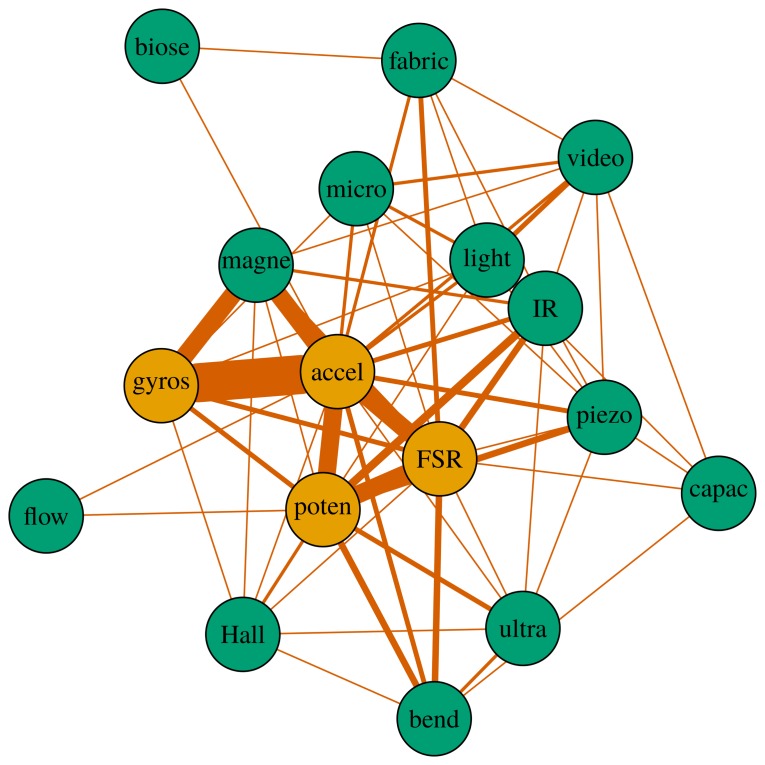
“This algorithm defines the ideal distance between the elements in order to provide a total balance of the graph and a small amount of edge crossings [63].”
Kalman Filtering and Neural Networks
(2001) · Wiley eBooks · doi:10.1002/0471221546 · Cited by 2,386
Kalman Filtering: Theory and Practice Using Matlab®
S. Grewal, M., & P. Andrews, A. (2014) · doi:10.1002/9781118984987 · Cited by 2,117
Estimation of IMU and MARG orientation using a gradient descent algorithm
Madgwick, S. O. H., Harrison, A. J. L., & Vaidyanathan, R. (2011) · 2011 IEEE International Conference on Rehabilitation Robotics · doi:10.1109/icorr.2011.5975346 · Cited by 2,068 · cited 1×
“Interesting examples of sensor fusion for human application using MARG sensing range from complementary filters to Kalman filter [33,46,120].”
MethodA Tutorial on Particle Filtering and Smoothing: Fifteen years later
Arnaud Doucet, B., & Johansen, A. M. (2008) · Cited by 1,449
Mathematical Techniques in Multisensor Data Fusion
Hall, D. L. (1992) · Cited by 1,356
Research works printed but not linked: 16
- 18. Page, A.F.; Rosario, H.D.; Mata, V.; Besa, A. Rules of propagation of artifact to kinematic variables in human movement analysis: Effect of the angular displacement representation. J. Biomech. Eng. 2013, 36, 034502.
- 23. Fraden, J. Handbook of Modern Sensors: Physics, Design and Applications, 3rd ed.; Springer: New York, NY, USA, 2004.
- 25. Omega. Transactions in Measurement and Control-Volume 2: Data Acquisition. Available online: http://www.omega.com/literature/transactions/volume2/trantocvol2.html (accessed on 22 July 2014).
- 43. Farrell, J. Aided Navigation: GPS with High Rate Sensors; McGraw-Hill: New York, NY, USA,2008.
- 46. Lapinski, M. A Platform for High-Speed Biomechanical Data Analysis using Wearable Wireless Sensors. Ph.D. Thesis, MIT: Boston, MA, USA, 2013.
- 67. Schacher, J.C.; Stoecklin, A. Traces-Body, Montion and Sound. In Proceedings of the International Conference on New Interfaces for Musical Expression (NIME 2011), Oslo, Norway, 30 May-1 June 2011.
- 74. Heaston, R.J. Why did Einstein put so Much Emphasis on the Equivalence Principal. In Proceeding of the 15th Annual Conference of the Natural Philosophy Alliance, Albuquerque, NW, USA, 21-25 May 2008.
- 83. Baba, T.; Hashida, M.; Katayose, H. "VirtualPhilharmony": A Conducting SySystem with Heuristics of Conducting an Orchestra. In Proceedings of the International Conference on New Interfaces for Musical Expression (NIME 2010), Sydney, Australia, 15-18 June 2010.
- 85. Yaremchuk, V.; Wanderley, M.M. Artificial Neural Networks for Movement Analysis of Musical Performance. In Proceedings of the International Workshop on Movement and Computing (MOCO 2014), Paris, France, 16-17 June 2014.
- 88. Medeiros, C.B.; Wanderley, M.M. Conditioning Circuits and Data Fusion for Low Performance Sensors. In forthcoming conference paper.
- 90. Strain Gauge Technology, 2nd ed.; Window, A., Ed.; Elsevier Applied Science: Newnes, Australia, 1993.
- 92. Sharpe, W.N., Jr., Ed.; Springer: New York, NY, USA, 2008.
- 93. Medeiros, C.B.; Wanderley, M.M. Evaluation of Sensor Technologies for The Rulers: A Kalimba-like Digital Musical Instrument. In Proceedings of the Sound and Music Computing Conference (SMC 2011), Padova, Italy, 6-9 July 2011.
- 99. Buschert, J.R. Musician Marker: Play Expressive Music WitWith Practice. In Proceedings of the Conference on New Interfaces for Musical Expression (NIME 2012), Ann Arbor, MI, USA, 21-23 May 2012.
- Hollinger, A. (2014). Optical Sensing, Embedded Systems Musical Interfaces for Functional Neuroimaging. [Ph.D. Thesis, McGill University].
- Crisan, D., and Rozovsky, B. (2011). Handbook of Nonlinear Filtering, Oxford University Press.
Cited by
Accessible Digital Musical Instruments—A Review of Musical Interfaces in Inclusive Music Practice
Frid, E. (2019) · Multimodal Technologies and Interaction · doi:10.3390/mti3030057 · Cited by 177
Digital instruments and their uses in music therapy
Partesotti, E., Peñalba, A., & Manzolli, J. (2018) · Nordic Journal of Music Therapy · doi:10.1080/08098131.2018.1490919 · Cited by 59
“One of the reasons for their use, in conjunction with several other motion analysis techniques, is their low-cost and easy utilization (Medeiros & Wanderley, 2014).”
BackgroundMethodSound Actions: Conceptualizing Musical Instruments
Jensenius, A. R. (2022) · The MIT Press eBooks · doi:10.7551/mitpress/14220.001.0001 · Cited by 71
Action-sound Latency and the Perceived Quality of Digital Musical Instruments
Jack, R. H., Mehrabi, A., Stockman, T., & McPherson, A. (2018) · Music Perception An Interdisciplinary Journal · doi:10.1525/mp.2018.36.1.109 · Cited by 48
Dyer, J., Stapleton, P., & Rodger, M. W. M. (2015) · The Open Psychology Journal · doi:10.2174/1874350101508010192 · Cited by 46
Metadata
- Authors
- Medeiros, C., & Wanderley, M.
- Affiliations
- Centre for Interdisciplinary Research in Music Media and Technology (CA)
- Corresponding author
- Medeiros, Carolina
- ORCID
- Wanderley, Marcelo
- Venue
- Sensors
- Publisher
- MDPI AG
- Published
- 2014-07-25
- Volume
- 14
- Issue
- 8
- Pages
- 13556-13591
- ISSN
- 1424-8220 (ISSN-L)
- PMC
- PMC4179008
- OpenAlex
- W1978615060
- Cited by
- 60
- References
- 97
- Citations by year
- 2026: 1 · 2025: 5 · 2024: 4 · 2023: 2 · 2022: 5 · 2021: 9 · 2020: 8 · 2019: 5 · 2018: 7 · 2017: 6 · 2016: 2 · 2015: 6
- FWCI
- 1.31
- Type
- journal article
- Language
- en
- Open access
- gold
- doi.org
- Licence
- Locations
- Sensors (publishedVersion, cc-by)
- Europe PMC (PubMed Central) (publishedVersion, cc-by)
- PubMed Central (publishedVersion, cc-by)
- PubMed (publishedVersion)
- eScholarship@McGill (McGill) (submittedVersion, cc-by)
- DOAJ (DOAJ: Directory of Open Access Journals) (submittedVersion, cc-by-sa)
- Funders
- Coordenação de Aperfeiçoamento de Pessoal de Nível Superior
- Natural Sciences and Engineering Research Council of Canada
- Topics
- Social Sciences › Arts and Humanities › Music › Music Technology and Sound Studies
- Physical Sciences › Physics and Astronomy › Instrumentation › Sensor Technology and Measurement Systems
- Social Sciences › Arts and Humanities › Visual Arts and Performing Arts › Art, Technology, and Culture
- Keywords
- digital musical instruments, musical expression, signal conditioning, sensor fusion, strain gauges, sound synthesis
- MeSH terms
- Engineering, Humans, Music, Electrical Equipment and Supplies
About these checks
Registry, retraction, Cites and statistics results are computed, not judged, with one exception: a printed reference that no index lists is read once by a model before it counts as a citation error. Claims are extracted by a model and kept only when their quote appears verbatim in the text; each cited source is then checked, with a model’s help, for whether it says what the claim relies on. Those verdicts can be wrong — read the claim’s quote and the cited source before relying on one.
Statistics and arithmetic are recomputed, not judged.
Confidence bands are shown only for fields calibrated on our annotated test set. None is calibrated yet, so no band is shown.
What counts as a claim ›How we measure confidence ›How we check this ›
Are you an author, or do you see a problem with this page? Request a review
Data sources
Bibliographic data: Semantic Scholar, OpenAlex, Crossref.
Contains information from the Semantic Scholar Academic Graph Datasets, made available under the ODC Attribution License (ODC-BY 1.0).
Semantic Scholar’s data is described in: Kinney, R., et al. (2023). The Semantic Scholar Open Data Platform. arXiv:2301.10140.
