

NFC Internal: An Indoor Navigation System
Open accessThe DOI matches its Crossref record; 23 of the 23 references it cites were found in a registry or an index.
Abstract
Indoor navigation systems have recently become a popular research field due to the lack of GPS signals indoors. Several indoors navigation systems have already been proposed in order to eliminate deficiencies; however each of them has several technical and usability limitations. In this study, we propose NFC Internal, a Near Field Communication (NFC)-based indoor navigation system, which enables users to navigate through a building or a complex by enabling a simple location update, simply by touching NFC tags those are spread around and orient users to the destination. In this paper, we initially present the system requirements, give the design details and study the viability of NFC Internal with a prototype application and a case study. Moreover, we evaluate the performance of the system and compare it with existing indoor navigation systems. It is seen that NFC Internal has considerable advantages and significant contributions to existing indoor navigation systems in terms of security and privacy, cost, performance, robustness, complexity, user preference and commercial availability.
Overview
The claims and statistics of this paper haven’t been checked yet.
Free: it reads the open-access text and checks the first 5 claims that cite a source we can check. Create a free account to check every claim.
Integrity signals
Registry
Cites
Statistics
Figures







Verification
Claims the paper makes
The claims and statistics of this paper haven’t been checked yet.
Free: it reads the open-access text and checks the first 5 claims that cite a source we can check. Create a free account to check every claim.
Claims other papers make about this one
Each is checked against this paper’s own text: does it say what the citing paper says it does?
The cited source doesn’t support the claim as written.
In the citing paper
“NFC is not as effective and efficient as Bluetooth or Wi-Fi Direct”
From Making Shopping Easy for People with Visual Impairment Using Mobile Assistive Technologies (2019) · cites this paper as [72]
Checked by a reasoning model — may be wrong.
Experimental — accuracy not yet measuredThe source backs part of the claim, not all of it — or backs it for a different population, condition or comparison.
In the citing paper
“PVI do not need to be in a direct line of sight between the reader and tags”
From Making Shopping Easy for People with Visual Impairment Using Mobile Assistive Technologies (2019) · cites this paper as [72]
Experimental — accuracy not yet measuredThe source backs part of the claim, not all of it — or backs it for a different population, condition or comparison.
In the citing paper
“| NFC | Low | NFC reader | 1 | No | Up to 10 cm | Maximum 1.6MB |”
From Making Shopping Easy for People with Visual Impairment Using Mobile Assistive Technologies (2019) · cites this paper as [72]
Experimental — accuracy not yet measuredThe cited source says what the claim attributes to it.
In the citing paper
“NFC minimizes response time and provides accurate position information”
From Making Shopping Easy for People with Visual Impairment Using Mobile Assistive Technologies (2019) · cites this paper as [72]
The cited source says what the claim attributes to it.
In the citing paper
“PVI should be inside the reading area in order to identify NFC tags”
From Making Shopping Easy for People with Visual Impairment Using Mobile Assistive Technologies (2019) · cites this paper as [72]
2 more claims about this paper
Create a free account to see every claim other papers make about this one.
Self-check
Percentages, sums and reported differences re-computed from the paper’s own numbers.
The self-check needs the paper’s full text.
Citations
Cites
Survey of Wireless Indoor Positioning Techniques and Systems
Liu, H., Darabi, H., Banerjee, P., & Liu, J. (2007) · IEEE Transactions on Systems, Man and Cybernetics, Part C (Applications and Reviews) · doi:10.1109/tsmcc.2007.905750 · Cited by 4,098 · cited 6×
“According to [9,10], four different system topologies are defined for wireless positioning systems: (a) remote positioning; (b) self-positioning; (c) indirect remote positioning and (d) indirect self-positioning.”
BackgroundResultInfluentialLANDMARC: indoor location sensing using active RFID
Ni, L. M., Liu, Y., Lau, Y. C., & Patil, A. P. (2004) · Proceedings of the First IEEE International Conference on Pervasive Computing and Communications, 2003. (PerCom 2003). · doi:10.1109/percom.2003.1192765 · Cited by 2,323
A survey of indoor positioning systems for wireless personal networks
Gu, Y., Lo, A., & Niemegeers, I. (2009) · IEEE Communications Surveys & Tutorials · doi:10.1109/surv.2009.090103 · Cited by 1,534 · cited 10×
“According to [5], the evaluation is to be performed according to the following criteria:”
BackgroundMethodResultInfluentialDrane, C., Macnaughtan, M., & Scott, C. (1998) · IEEE Communications Magazine · doi:10.1109/35.667413 · Cited by 417 · cited 1×
“According to [9,10], four different system topologies are defined for wireless positioning systems: (a) remote positioning; (b) self-positioning; (c) indirect remote positioning and (d) indirect self-positioning.”
BackgroundA Survey on Near Field Communication (NFC) Technology
Coskun, V., Ozdenizci, B., & Ok, K. (2013) · Wireless Personal Communications · doi:10.1007/s11277-012-0935-5 · Cited by 390 · cited 2×
“NFC technology operates in: (a) reader/writer; (b) peer-to-peer; and (c) card emulation operating modes, where communication occurs between a mobile phone on the one side, and a passive NFC tag, a mobile phone or an NFC reader, on the other side, respectively [8,17].”
BackgroundSelf-citationAn introduction to geographical information systems
(1999) · Choice Reviews Online · doi:10.5860/choice.36-3920 · Cited by 361
A Survey of Indoor Positioning and Object Locating Systems
Koyuncu, H., & Yang, S. H. (2010) · Cited by 251
An indoor localization mechanism using active RFID tag
Jin, G.-Y., Lu, X.-Y., & Park, M.-S. (2006) · Sensor Networks, Ubiquitous, and Trustworthy Computing · doi:10.1109/sutc.2006.36 · Cited by 229
Overview of current indoor positioning systems
Mautz, R. (2009) · Geodesy and Cartography · doi:10.3846/1392-1541.2009.35.18-22 · Cited by 204 · cited 9×
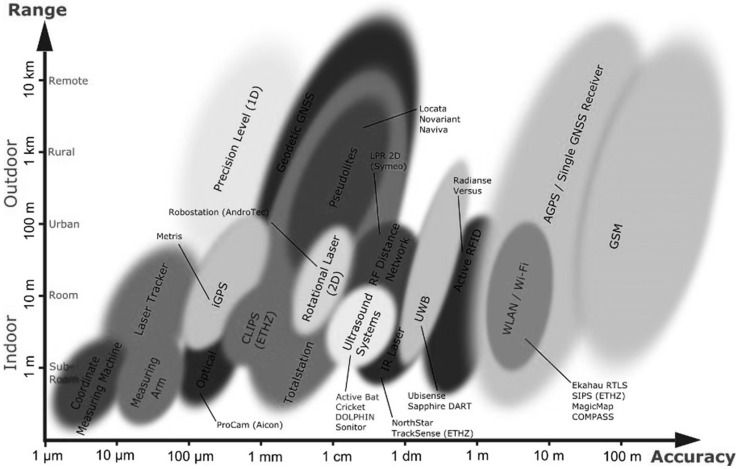
“Current positioning systems according to their accuracy and coverage area (with permission from [6]).”
BackgroundInfluentialIndoor Navigation of Emergency Agents
Renaudin, V., Yalak, O., Tomé, P., & Merminod, B. (2007) · Infoscience (Ecole Polytechnique Fédérale de Lausanne) · Cited by 95
Research works printed but not linked: 1
- IHS Technology NFC-Enabled Cellphone Shipments to Soar Fourfold in Next Five Years 27 2 2014 Available online: http://press.ihs.com/press-release/design-supply-chain/nfc-enabled-cellphone-shipments-soar-fourfold-next-five-years (accessed on 22 January 2015)
Cited by
Location based services: ongoing evolution and research agenda
Huang, H., Gartner, G., Krisp, J. M., Raubal, M., & Van de Weghe, N. (2018) · Journal of Location Based Services · doi:10.1080/17489725.2018.1508763 · Cited by 316
Indoor Localization Improved by Spatial Context—A Survey
Gu, F., Hu, X., Ramezani, M., Acharya, D., Khoshelham, K., Valaee, S., & Shang, J. (2020) · ACM Computing Surveys · doi:10.1145/3322241 · Cited by 172
“In the research works [40, 120], NFC tags deployed at specific locations were used as NFC landmarks for indoor navigation.”
MethodGao, Y., Liu, S., Atia, M., & Noureldin, A. (2015) · Sensors · doi:10.3390/s150923286 · Cited by 167
“), passive beacons (like passive RFID, Near Field Communication (NFC) [1,2]), and manmade or natural landmarks, etc.”
BackgroundRobust Pedestrian Dead Reckoning Based on MEMS-IMU for Smartphones
Kuang, J., Niu, X., & Chen, X. (2018) · Sensors · doi:10.3390/s18051391 · Cited by 149
“Therefore, indoor localization technology is flourishing, and many different techniques have been designed and developed for tracking pedestrians’ positions when in indoor environments, such as Wi-Fi [2,3], Bluetooth/iBeacon [4,5], radio frequency identification (RFID) [6,7], near-field communication (NFC) [8], ultra-…”
BackgroundA Survey of NFC Sensors Based on Energy Harvesting for IoT Applications
Lazaro, A., Villarino, R., & Girbau, D. (2018) · Sensors · doi:10.3390/s18113746 · Cited by 144
“NFC systems are, therefore, gaining importance in the Internet of Things (IoT) scenario [3,4].”
BackgroundThe Survey on Near Field Communication
Coskun, V., Ozdenizci, B., & Ok, K. (2015) · Sensors · doi:10.3390/s150613348 · Cited by 122
“The accuracy of using NFC technology for localization in indoor environments is guaranteed due to the fixed positions of the NFC tags [145,147].”
BackgroundSelf-citationA Survey of Smartphone-Based Indoor Positioning System Using RF-Based Wireless Technologies
Subedi, S., & Pyun, J.-Y. (2020) · Sensors · doi:10.3390/s20247230 · Cited by 146
“Localization can be realized with NFC by deploying several tags at places of interest, where a location is estimated simply by touching the tag with the NFC equipped device [39,40].”
BackgroundPDR/INS/WiFi Integration Based on Handheld Devices for Indoor Pedestrian Navigation
Zhuang, Y., Lan, H., Li, Y., & El‐Sheimy, N. (2015) · Micromachines · doi:10.3390/mi6060793 · Cited by 108
“Several different techniques have been developed for indoor navigation, such as WiFi [7,8], Bluetooth [9], near field communication (NFC) [10,11], radio-frequency identification (RFID) [12], and micro-electro-mechanical systems (MEMS) sensors [13,14].”
Near-Field Communication Sensors
Cao, Z., Chen, P., Ma, Z., Li, S., Gao, X., Wu, R.-X., Pan, L., & Shi, Y. (2019) · Sensors · doi:10.3390/s19183947 · Cited by 100
“It has achieved successful applications in commercial consumption field by providing convenient payment methods, which gradually replaced the traditional way of paying with banknotes [6].”
BackgroundSmart Pipe System for a Shipyard 4.0
Fraga-Lamas, P., Noceda-Davila, D., Fernández-Caramés, T., Díaz-Bouza, M., & Vilar-Montesinos, M. (2016) · Sensors · doi:10.3390/s16122186 · Cited by 73
“A good example is described in [28], where it is proposed a navigation system for identifying and tracking tags indoors, where there are no GPS signals available.”
BackgroundRSSI and Machine Learning-Based Indoor Localization Systems for Smart Cities
Rathnayake, R. M. M. R., Maduranga, M. W. P., Tilwari, V., & Dissanayake, M. B. (2023) · Eng—Advances in Engineering · doi:10.3390/eng4020085 · Cited by 77
BLE RSS Measurements Dataset for Research on Accurate Indoor Positioning
Mendoza-Silva, G. M., Matey-Sanz, M., Torres-Sospedra, J., & Huerta, J. (2019) · Data · doi:10.3390/data4010012 · Cited by 69
“Among those alternatives are magnetic signals [4,5], RFID [6], LED light [7,8], vision-based techniques [9], and Wi-Fi [10] and Bluetooth Low Energy (BLE) [11] signals, all of them often combined with Pedestrian Dead Reckoning (PDR) and Map-Matching [3,12].”
BackgroundBluetooth-based indoor navigation mobile system
Sátán, Á. (2018) · International Carpathian Control Conference · doi:10.1109/carpathiancc.2018.8399651 · Cited by 61
“NFC Internal [5] is an Near Field Communication (NFC) based indoor navigation system.”
BackgroundIndoor Navigation Using Augmented Reality
Verma, P., Agrawal, K., & Sarasvathi, V. (2020) · International Conference Virtual and Augmented Reality Simulations · doi:10.1145/3385378.3385387 · Cited by 49
“The implementation of Indoor positioning system with NFC[8] is done with the touch-based interaction using the NFC Tags and NFC sensor, where the NFC Tags are placed at a fixed position in the indoor area.”
MethodInfluentialMaking Shopping Easy for People with Visual Impairment Using Mobile Assistive Technologies
Elgendy, M., Sik-Lanyi, C., & Kelemen, A. (2019) · Applied Sciences · doi:10.3390/app9061061 · Cited by 48
“After identifying the items, PVI get details about them [33,72].”
BackgroundMethodStudy on the Reading of Energy-Harvested Implanted NFC Tags Using Mobile Phones
Lázaro, A., Boada, M., Villarino, R., & Girbau, D. (2019) · IEEE Access · doi:10.1109/access.2019.2962570 · Cited by 53
“As smartphones are designed to read a variety of NFC protocols, the quality factor is limited to 35 [24], [26].”
BackgroundFellner, I., Huang, H., & Gärtner, G. (2017) · ISPRS International Journal of Geo-Information · doi:10.3390/ijgi6060183 · Cited by 39
Rubio-Sandoval, J. I., Martinez-Rodriguez, J. L., López-Arévalo, I., Rios-Alvarado, A. B., Rodríguez-Rodríguez, A. J., & Vargas-Requena, D. T. (2021) · Sensors · doi:10.3390/s21165435 · Cited by 49
“…focus on the development of positioning meth-ods, based on wireless networks (IR, sensors, ultrasound, WLANs, UWB, Bluetooth, RFID) [2,4,6–8]; Augmented Reality (AR), but not providing contextual information [3,9–11]; or the development of methods providing contextual information…”
BackgroundConfidence-Interval-Fuzzy-Model-Based Indoor Localization
Tomažič, S., Dovžan, D., & Škrjanc, I. (2018) · IEEE Transactions on Industrial Electronics · doi:10.1109/tie.2018.2840525 · Cited by 34
“…devices can receive various radio signals, different approaches to localization using cellular networks (global system for mobiles and long-term evolution) [1], Wi-Fi networks [2], Bluetooth [3], frequency-modulated signals [4], near-field communication connections [5], etc., have been established.”
BackgroundIvanov, R. (2017) · Journal of Ambient Intelligence and Smart Environments · doi:10.3233/ais-170441 · Cited by 33
“Five of the spatial models [3,9,18,22,24] do not take into account the presence of landmarks, obstacles, and hazards in the building.”
Sensors for Indoor Mapping and Navigation
Khoshelham, K., & Sisi Zlatanova, B. (2016) · Sensors · doi:10.3390/s16050655 · Cited by 31
“Other sensors used for positioning in indoor environments include Ultrasonic [33], Pseudolites [34–36], RFID (including near field communication—NFC) [37–39], Ultra Wide Band (UWB) [40–42], microphone and light sensor [19].”
BackgroundSecure Utilization of Beacons and UAVs in Emergency Response Systems for Building Fire Hazard
Seo, S.-H., Choi, J.-I., & Song, J. (2017) · Sensors · doi:10.3390/s17102200 · Cited by 27
立川, 雅., Maekawa, T., & Matsushita, Y. (2016) · ACM International Joint Conference on Pervasive and Ubiquitous Computing (UbiComp) · doi:10.1145/2971648.2971684 · Cited by 23
“In addition to the above sensors, a light sensor, camera, and NFC reader have been used to locate a user and understand a user’s location context [32, 51, 54].”
MethodRecent Developments in Near Field Communication: A Study
Chandrasekar, P., & Dutta, A. (2020) · Wireless Personal Communications · doi:10.1007/s11277-020-07827-9 · Cited by 23
Chen, Z., Xu, A., Sui, X., Hao, Y., Zhang, C., & Shi, Z. (2022) · Remote Sensing · doi:10.3390/rs14174258 · Cited by 24
Hu, J., Chen, Z., Zheng, T., Schober, R., & Luo, J. (2023) · IEEE Journal on Selected Areas in Communications · doi:10.1109/jsac.2023.3322788 · Cited by 31
“4.”
Indoor Navigation for People with Visual Impairment using Augmented Reality Markers
Elgendy, M. A., Herperger, M., Guzsvinecz, T., & Sik‐Lányi, C. (2019) · IEEE International Conference on Cognitive Infocommunications · doi:10.1109/coginfocom47531.2019.9089960 · Cited by 24
“These tags can be detected and tracked by using smartphones or tags reader [8], [9].”
BackgroundMulti-Sensor Fusion Approach for Improving Map-Based Indoor Pedestrian Localization
Huang, H.-Y., Hsieh, C.-Y., Liu, K.-C., Cheng, H.-C., Hsu, S. J.-P., & Chan, C.-T. (2019) · Sensors · doi:10.3390/s19173786 · Cited by 20
“Based on the studies mentioned above, the issue of initial location can be tackled by using QR code, NFC or image markers.”
BackgroundElgendy, M. A., Guzsvinecz, T., & Sik‐Lányi, C. (2019) · Applied Sciences · doi:10.3390/app9235110 · Cited by 23
“These solutions fall into three categories: Tag Based Systems: Such as radio-frequency identification (RFID) and near field communication (NFC), which use wireless components to transfer data from a tag attached to an object for the purpose of automatic identification and tracking [20,21].”
BackgroundMobile Phone Sensing: A New Application Paradigm
Ali, S., & Khusro, S. (2016) · Indian Journal of Science and Technology · doi:10.17485/ijst/2016/v9i19/53088 · Cited by 17
Image-Based Camera Localization Algorithm for Smartphone Cameras Based on Reference Objects
Jabborov, F., & Cho, J. (2020) · Wireless Personal Communications · doi:10.1007/s11277-020-07487-9 · Cited by 16
Efficient End-to-End Secure Key Management Protocol for Internet of Things
Benslimane, Y., & Benahmed, K. (2017) · International Journal of Electrical and Computer Engineering (IJECE) · doi:10.11591/ijece.v7i6.pp3622-3631 · Cited by 15
Morag, I., & Pintelon, L. M. (2020) · Applied Ergonomics · doi:10.1016/j.apergo.2020.103260 · Cited by 17
State-of-art-in-indoor navigation and positioning of visually impaired and blind
Silva, C. S., & Wimalaratne, P. (2017) · International Conference on Advances in ICT for Emerging Regions · doi:10.1109/icter.2017.8257826 · Cited by 17
A Tokenization-Based Communication Architecture for HCE-Enabled NFC Services
Özdenizci, B., Ok, K., & Coşkun, V. (2016) · Mobile Information Systems · doi:10.1155/2016/5046284 · Cited by 13
“In order to engage in an NFC communication, the user needs to touch her NFC Smartphone to either an NFC tag, another NFC Smartphone, or an NFC reader [3].”
BackgroundMethodSelf-citationUWB-MAC: MAC protocol for UWB localization using ultra-low power anchor nodes
Bauwens, J., Macoir, N., Giannoulis, S., Moerman, I., & Poorter, E. D. (2021) · Ad Hoc Networks · doi:10.1016/j.adhoc.2021.102637 · Cited by 13
SIMSec: A Key Exchange Protocol Between SIM Card and Service Provider
Ok, K., Coşkun, V., Yarman, B. S., Cevikbas, C., & Özdenizci, B. (2016) · Wireless Personal Communications · doi:10.1007/s11277-016-3326-5 · Cited by 13
“years especially with the introduction of emerging technologies such as NFC technology [9, 10, 11], Internet”
BackgroundSelf-citationBibbò, L., Bramanti, A., Sharma, J., & Cotroneo, F. (2024) · BioMedInformatics · doi:10.3390/biomedinformatics4030087 · Cited by 12
“Ozdenizci et al. [39] have designed an indoor navigation system based on Near Field Communication (NFC), which allows users to navigate a building using location updates through NFC tags distributed inside the building, and orient users to the desired destination.”
BackgroundMobile Positioning Techniques and Systems: A Comprehensive Review
Ramtohul, A., & Khedo, K. K. (2020) · Mobile Information Systems · doi:10.1155/2020/3708521 · Cited by 11
“Many existing solutions have used GPS for localisation and tracking purposes, but they present several limitations to work under different environments due to the loss of signals [4].”
BackgroundDesign of a key exchange protocol between SIM card and service provider
Ok, K., Coşkun, V., Cevikbas, C., & Özdenizci, B. (2015) · Telecommunications Forum (TELFOR) · doi:10.1109/telfor.2015.7377465 · Cited by 10
Self-citationCreation of AI-driven smart spaces for enhanced indoor environments – A survey
Varol, A., Motlagh, N. H., Leino, M., Tarkoma, S., & Virkki, J. (2026) · Internet of Things · doi:10.1016/j.iot.2026.101876 · Cited by 16
“NFC can enhance indoor navigation systems by allowing users to update their location by simply tapping NFC tags placed throughout an environment, effectively addressing the limitations of GPS in indoor settings [105].”
Fine-tuning the usability of a crowdsourced indoor navigation system
Ooms, K., Duytschaever, A., Stroeken, K., Verdoolaege, A., Viaene, P., & de Weghe, N. V. (2018) · Cartography and Geographic Information Science · doi:10.1080/15230406.2018.1535331 · Cited by 9
“Therefore, a number of alternative solutions have been proposed, which can be categorized as (1) dead reck-oning, (2) direct-sensing, (3) triangulation, and (4) pattern recognition (Fallah, Apostolopoulos, Bekris, & Folmer, 2013; Ozdenizci, Coskun, & Ok, 2015).”
BackgroundYang, P., Liu, Z., Qi, H., Fu, X., & Peng, Z. (2024) · Journal of Advanced Ceramics · doi:10.26599/jac.2024.9220853 · Cited by 7
Graichen, T., Richter, J., Schmidt, R., & Heinkel, U. (2021) · ISPRS International Journal of Geo-Information · doi:10.3390/ijgi10040216 · Cited by 7
“Near-field communication (NFC) high accuracy, very short range (20 cm), user interaction with NFC tags required [23]”
BackgroundHARIN: HoloLens Augmented Reality Indoor Navigation
Lynam, H., Folmer, E., & Dascalu, S. M. (2022) · doi:10.1145/3543895.3543938 · Cited by 6
“The work done by Ozdenizci et al [7] used NFC tags in a shopping mall environment and saw good results in a user study.”
iBaby: A low cost BLE pseudolite based indoor baby care system
Cao, Z., Chen, R., Guo, G., & Pan, Y. (2018) · Ubiquitous Positioning, Indoor Navigation, and Location Based Service · doi:10.1109/upinlbs.2018.8559887 · Cited by 6
LED Smart Illumination with RFID Indoor Positioning
Floarea, D., & Sgârciu, V. (2017) · International Conference on Control Systems and Computer Science · doi:10.1109/cscs.2017.79 · Cited by 5
“The authors of [10] propose a navigation system called "NFC Internal" for indoor environment that is based on NFC to allow users to browse through a smart building, allowing a simple action like tapping NFC tags that are spread around the building to get location updates.”
Background3D Mapping and Indoor Navigation for an Indoor Environment of the University Campus
Show, S.-E., Pu, C.-H., & Kadim, Z. (2023) · IEEE Symposium on Wireless Technology & Applications (ISWTA) · doi:10.1109/iswta58588.2023.10249749 · Cited by 5
“The use of NFC to locate users in an indoor environment was proposed in [3] where NFC tags serving as a signage that could be scanned by users with their NFC-enabled mobile devices to achieve positioning purposes.”
Indoor Navigation Systems for Reduced Mobility Users: The w4all Case Study
Cardoso, P. B., Domingos, D., & Cláudio, A. P. (2016) · Procedia Computer Science · doi:10.1016/j.procs.2016.09.143 · Cited by 4
Indoor RSSI-based Localization using Fuzzy Path Loss Models
Tomažič, S., & Škrjanc, I. (2018) · IEEE International Conference on Fuzzy Systems (FUZZ-IEEE) · doi:10.1109/fuzz-ieee.2018.8491546 · Cited by 4
“Since modern smartphones enable the receiving and transmitting of different radio signals, many approaches to localization using Wi-Fi networks [2], Bluetooth [3], FM signals [4], NFC connections [5], cellular networks (GSM, LTE) [6] etc.”
BackgroundICAD - An Economical Indoor & Outdoor Delivery Vehicle Capable of Autonomous Navigation
Darya, A. M., Rehman, J., Aldawoud, O., & Soudan, B. (2019) · Advances in Science and Engineering Technology International Conferences (ASET) · doi:10.1109/icaset.2019.8714225 · Cited by 3
“In the NFC Internal project completed in 2015, Near Field Communication (NFC) tags were used to send information to a user device for guidance in a semi-structured environment [8].”
MethodReal-time indoor tracking for augmented reality using computer vision technique
Shewail, A. S., Zayed, H. H., & ElSayed, N. (2024) · IAES International Journal of Artificial Intelligence · doi:10.11591/ijai.v13.i2.pp1845-1857 · Cited by 3
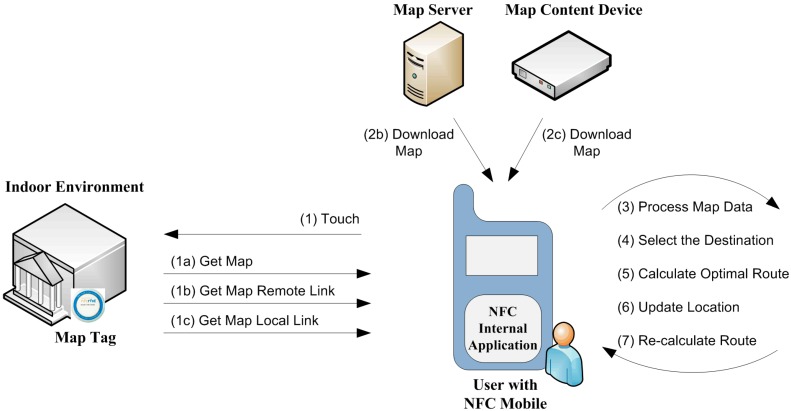
“In these systems, a smartphone with an integrated NFC component is used to connect to a uniform resource locator (URL) tag, which sends map information to the device [14].”
Methoddesigning and implementing a 3D indoor navigation web application
Sadidi, J., Judaki, Z., & Rezayan, H. (2020) · Journal of Spatial Analysis Environmental Hazarts · doi:10.29252/jsaeh.7.2.67 · Cited by 3
BLE Beacon Interaction Module and Mobile Application in the Indoor-Navigation System
Karabtcev, S. N., Khorosheva, T. A., & Kapkov, N. R. (2019) · 2019 International Science and Technology Conference "EastConf" · doi:10.1109/eastconf.2019.8725420 · Cited by 4
Mobile Based Indoor Hospital Navigation System for Tertiary Care Setup: A Scoping ReviewPreprint
Gupta, P., Sharma, V., Gairolla, J., Thakur, U., Pandey, N., Khurana, D., & Ramavat, A. S. (2024) · Research Square · doi:10.21203/rs.3.rs-3890861/v1 · Cited by 3
Gudauskis, M., Žvironas, A., & Plikynas, D. (2026) · Signals and communication technology · doi:10.1007/978-3-031-91550-5_18 · Cited by 3
Smart wearable navigation device for visually impaired person
Kumar, N., & Jain, A. (2023) · AIP conference proceedings · doi:10.1063/5.0163446 · Cited by 2
Visitor Experience Map and NFC-Based Scoring for Data-Driven Exhibition Enhancement
Razak, A., Hee, J. P. S., Ahmad, R., Yogarayan, S., Kamis, N. H., & Sayeed, M. S. (2024) · Emerging Science Journal · doi:10.28991/esj-2024-08-01-015 · Cited by 3
“Following the touching activity, the NFC mobile may use the obtained data further, or alternatively, accessible mobile services such as downloading a web page, initiating a web service connection, and so on [43].”
MethodSmart Location-based Services (Smart-LBS): Platform for Smart Space-Independent LBS
Khaled, A. E. (2024) · IEEE International Conference on Electro Information Technology · doi:10.1109/eit60633.2024.10609850 · Cited by 2
“Different types of NFC tags have different capacities, data transfer speeds, and read/write capabilities [9][11].”
Background3D-based location positioning using the Dew Computing approach for indoor navigation
Podbojec, D., Herynek, B., Jazbec, D., Cvetko, M., Debevc, M., & Kožuh, I. (2017) · International Convention on Information and Communication Technology, Electronics and Microelectronics · doi:10.23919/mipro.2017.7973455 · Cited by 2
“NFC technology is simple and convenient to use, but is complicated for the end user [1].”
BackgroundResultInfluentialLocation-Based Content Delivery Using iBeacon Technology
Albraheem, L., Al-Yahya, J., Al-Rowais, N., Al-Shathri, S., Alsuhaibani, L., & Alabdulkarim, A. (2017) · Lecture notes in networks and systems · doi:10.1007/978-3-319-56994-9_65 · Cited by 2
Yang, W., Xiu, C., Ye, J., Lin, Z., Wei, H., Yan, D., & Yang, D. (2018) · Micromachines · doi:10.3390/mi9090458 · Cited by 3
“Unlike infrastructure-free IPSs, infrastructure-based ones need preinstalled transmitters such as WiFi [9,21,22], Bluetooth [23,24], near-field communication [25], RFID [26], ultrawide band (UWB) [27,28], LED [29,30], or ultrasound [31].”
BackgroundWang, X., Zhou, Z., Li, Y., & Jin, Z. (2020) · International Conference on Intelligent Transportation, Big Data & Smart City (ICITBS) · doi:10.1109/icitbs49701.2020.00186 · Cited by 2
Dumedah, G., Fuseini, A. W., Marfo, I., Agbadi, G., Osei‐Tutu, A., Kwadwo, G. F., & Asori, M. (2022) · Transactions in GIS · doi:10.1111/tgis.12998 · Cited by 3
“The need for indoor navigation tools has recently increased given the widespread usage of wireless mobile devices and the evolution of complex urban environments and smart structural designs (Amat et al., 2014; Hub et al., 2003; Ozdenizci et al., 2015; Pereira et al., 2015).”
BackgroundŠtefanička, T., Ďuračiová, R., & Seres, C. (2017) · Slovak Journal of Civil Engineering · doi:10.1515/sjce-2017-0022 · Cited by 2
Asante, B. K. A., & Imamura, H. (2024) · Joint International Conference on Soft Computing and Intelligent Systems and International Symposium on Advanced Intelligent Systems (SCIS&ISIS) · doi:10.1109/scisisis61014.2024.10760133 · Cited by 1
“Recent advancements in sensory devices such as WI-FIs [11] [12], Bluetooth [8], NFC tags [13], and cameras [1] have led to an increasing interest in indoor navigation research.”
Setyoko, A. T., Nurcahyo, R., Suryanegara, M., Sumaedi, S., & Prabuwono, A. S. (2026) · Journal of Open Innovation Technology Market and Complexity · doi:10.1016/j.joitmc.2026.100749 · Cited by 2
Location-aware system for content delivery using Bluetooth low energy technology
Albraheem, L., Al-Yahya, J., Al-Rowais, N., Al-Shathri, S., Alsuhaibani, L., & Alabdulkarim, A. (2016) · International Conference on Information Integration and Web-based Applications & Services (iiWAS) · doi:10.1145/3011141.3011187 · Cited by 1
Monitoring weather condition based on Near-Field Communication (NFC) system
Keyanfar, A., Roeintan, M., & Gheibi, K. (2022) · International Conference on Mathematics, Actuarial Science, Computer Science and Statistics (MACS) · doi:10.1109/macs56771.2022.10022999 · Cited by 2
“This helps to have more memory and the ability to read/write from a long distance [39].”
BackgroundAccess Control System Integrated with RFID and NFC-Enabled Smartphone Technologies
Bispo, B. C., Cavalcante, É. L., & Rodrigues, M. A. B. (2024) · World Congress on Medical Physics and Biomedical Engineering, September 7 - 12, 2009, Munich, Germany · doi:10.1007/978-3-031-49407-9_65 · Cited by 2
Xu, F., Moats, J., Gabbard, J. L., & Du, J. (2024) · ASCE International Conference on Computing in Civil Engineering (i3CE) · doi:10.1061/9780784485224.049 · Cited by 1
A Specification Based Ids for Detecting Selective-Forwarding Attack in 6lowpan Network for IoT
Benslimane, Y., & Benslimane, A. (2024) · Lecture notes in networks and systems · doi:10.1007/978-3-031-60632-8_3 · Cited by 1
Idris, S. A., Rahman, S. B. A., Farid, F. N. A. B. M., Rahman, S. B. A., Yazid, R. B., & Lazam, N. A. M. (2025) · IEEE International Symposium in Robotics and Manufacturing Automation (ROMA) · doi:10.1109/roma66616.2025.11155852 · Cited by 1
“Kang et al. [18] explored biomedical applications, while Ozdenizci et al. [19] developed NFC-based indoor navigation systems demonstrating location-aware application potential.”
A novel approach to mobile indoor navigation systems
Zhanbyrtayev, M., & Bekzhan, K. (2016) · IEEE/ACM International Conference on Mobile Software Engineering and Systems (MOBILESoft) · doi:10.1145/2897073.2897131 · Cited by 1
“Many different techniques have been proposed for indoor positioning, including reference points, such as NFC tags or Bluetooth beacons, radio signal triangulation, and pattern or image recognition [3, 6].”
BackgroundLi, W., Chen, Y., Zhou, C., & Wang, B. (2019) · IEEE International Conference on High Performance Computing and Communications; IEEE International Conference on Smart City; IEEE International Conference on Data Science and Systems (HPCC/SmartCity/DSS) · doi:10.1109/hpcc/smartcity/dss.2019.00355 · Cited by 1
“Beside the ”Leader Follower” mode, some researchers have proposed to exploit the landmarks or beacons to assist indoor navigation [14]– [17].”
BackgroundMulti Target Detection of UAV Video Based on Deep Convolution Neural Network
Wang, X., Zhou, Z., & Li, Y. (2019) · International Conference on Information Technologies and Electrical Engineering (ICITEE) · doi:10.1145/3386415.3386972 · Cited by 1
“This method can be called convolution neural network target detection based on regression[9].”
MethodAn Efficient Sports Navigation Method Based on NFC Technology
Wang, X., Zhou, Z., Li, Y., & Jin, Z. (2020) · International Conference on Intelligent Transportation, Big Data & Smart City (ICITBS) · doi:10.1109/icitbs49701.2020.00187 · Cited by 1
“The system with NFC reads and write technology is used for indoor navigation, showing the shortest route [5] from one point to another.”
MethodSurvey of indoor navigation solutions
Boros, T. (2020) · Multidiszciplináris Tudományok · doi:10.35925/j.multi.2020.2.11 · Cited by 1
A Sensor-fusion Framework for Queue-less Check-out in RetailPreprint
Gayen, T., & Shukla, A. (2019) · OSF Preprints (OSF Preprints) · doi:10.31219/osf.io/d9xg6 · Cited by 1
Lázaro, A., Boada, M., Villarino, R., & Girbau, D. (2024) · Wiley eBooks · doi:10.1002/9781394169108.ch12 · Cited by 2
Opu, M. M. R., & Ruqnuzzaman, M. (2026) · Research Square · doi:10.21203/rs.3.rs-8464801/v1 · Cited by 1
A ubiquitous navigation service on smartphones
Hassen, W. F. (2020) · theses.fr (ABES) · doi:10.70675/7ff2de8fzf347z4225zb5f3z1d5bf3c216d8 · Cited by 1
Dalton, B., Yu, C.-H., & Yun, M. (2017) · ACM Symposium on User Interface Software and Technology (UIST) · doi:10.1145/3131785.3131826
An Indoor Position System Based on Dynamic Digital Signage and Mobile Devices
Gan, C.-C., Lee, Y.-J., & Lien, K.-W. (2018) · International Cognitive Cities Conference (IC3) · doi:10.1109/ic3.2018.00-31
“Indoor position can be approached by using wireless communication technologies, such as Wi-Fi, NFC, and Bluetooth for cost reduction and implementation convenience [1,2,3].”
BackgroundAN OVERVIEW OF THE NFC-BASED SYSTEM FOR THE TOURIST GUIDANCE IN SMART CITY
Hodoň, M., Koman, G., & Ševčík, P. (2018) · Recent Advances in IT, Tourism, Economics, Management and Agriculture · doi:10.31410/itema.2018.59
Expanding Navigation Systems by Integrating It with Advanced Technologies
Domb, M. (2020) · IntechOpen eBooks · doi:10.5772/intechopen.91203
Jiménez, M. P. (2019) · UPM Digital Archive (Technical University of Madrid) · doi:10.20868/upm.thesis.57558
Falconer, M. (2019) · Carleton University's Institutional Repository (MacOdrum Library, Carleton University) · doi:10.22215/etd/2019-13664 · Cited by 3
A Brief Comparative of Indoor Positioning System
Safwan, M. A., Ng, G. W., & Hasnah, S. (2022) · Lecture notes in electrical engineering · doi:10.1007/978-981-16-8515-6_6
Sistemas de Navegação Indoor Não Adaptativos: Conceitos e Desafios para sua Implementação
Antunes, A. P., Delazari, L. S., Lima, M. D. C., & de Araújo, N. S. (2022) · Revista Brasileira de Cartografia · doi:10.14393/rbcv74n4-60875
A New Indoor Unmanned Vehicle Navigation System Based on The Combination of Lidar and IMU
Zhu, R., & Yu, B. (2023) · IEEE International Conference on Mechatronics and Automation (ICMA) · doi:10.1109/icma57826.2023.10215723
“External wireless positioning method are widely studied to achieve absolute positioning, including pseudolite [2], Radio Frequency Identification (RFID) [3], Near Field Communication (NFC) [4], Wi-Fi [5], Bluetooth [6], UltraWideband (UWB) [7], etc.”
MethodArtificial Intelligence Enabled Indoor Localization and Navigation: A Review
Bekteshi, E., Pascarelli, C., Catalano, C., Pennetta, R., & Conte, J. (2025) · Lecture notes in computer science · doi:10.1007/978-3-031-97781-7_1
NFC-Based Map Switching for Efficient Robot Operation in Indoor Environments
Yun, H., & Yoo, S. (2025) · International Conference on Ubiquitous and Future Networks · doi:10.1109/icufn65838.2025.11170015
“These features allow the robot to detect the NFC tag as soon as it enters the switching point, and by using the switching point for initial position estimation, computationally expensive position estimation algorithms [10] such as SLAM position estimation are not required.”
Eguchi, R., & Yonetani, R. (2026) · IEEE/SICE International Symposium on System Integration (SII) · doi:10.1109/sii64115.2026.11404554
“Mobile navigation systems that efficiently take you to the shelves with those items would be helpful in such situations, as previously demonstrated in various similar settings at public buildings [1], offices [2], museums [3], or retail stores [4], [5].”
LoRa-Based Data Mule Technology for Fuel Station Monitoring in Underground Mining
Theissen, M., Wang, Q., Kianfar, A. E., & Clausen, E. (2026) · Sensors · doi:10.3390/s26082369
“NFC offers only extremely short ranges [35], which could reduce manual logging but would still extend the personnel Jeep routes.”
Metadata
- Authors
- Ozdenizci, B., Coskun, V., & Ok, K.
- Affiliations
- NFC Lab-Istanbul, Department of Information Technologies, ISIK University, Istanbul 34980, Turkey
- Işık University (TR)
- ORCID
- Ok, Kerem
- Venue
- Sensors
- Publisher
- MDPI AG
- Published
- 2015-03-27
- Volume
- 15
- Issue
- 4
- Pages
- 7571-7595
- ISSN
- 1424-8220 (ISSN-L)
- PMC
- PMC4431189
- OpenAlex
- W2074542010
- Cited by
- 96
- References
- 23
- Citations by year
- 2026: 6 · 2025: 3 · 2024: 11 · 2023: 5 · 2022: 6 · 2021: 3 · 2020: 12 · 2019: 16 · 2018: 11 · 2017: 10 · 2016: 9 · 2015: 4
- FWCI
- 5.46
- Type
- journal article
- Language
- en
- Open access
- gold
- dx.doi.org
- Licence
- Locations
- Sensors (publishedVersion, cc-by)
- PubMed Central (publishedVersion, cc-by)
- PubMed (publishedVersion)
- Akademik Açık Erişim (Işık Üniversitesi) (submittedVersion, cc-by-nc-nd)
- DOAJ (DOAJ: Directory of Open Access Journals) (submittedVersion, cc-by-sa)
- Topics
- Physical Sciences › Engineering › Electrical and Electronic Engineering › Indoor and Outdoor Localization Technologies
- Physical Sciences › Computer Science › Computer Networks and Communications › RFID technology advancements
- Social Sciences › Transportation › Human Mobility and Location-Based Analysis
- Keywords
- indoor navigation, near field communication, NFC tags, location update, GPS-denied environments, mobile navigation application, privacy and security, user preferences, prototype testing
About these checks
Registry, retraction, Cites and statistics results are computed, not judged, with one exception: a printed reference that no index lists is read once by a model before it counts as a citation error. Claims are extracted by a model and kept only when their quote appears verbatim in the text; each cited source is then checked, with a model’s help, for whether it says what the claim relies on. Those verdicts can be wrong — read the claim’s quote and the cited source before relying on one.
Statistics and arithmetic are recomputed, not judged.
Confidence bands are shown only for fields calibrated on our annotated test set. None is calibrated yet, so no band is shown.
What counts as a claim ›How we measure confidence ›How we check this ›
Are you an author, or do you see a problem with this page? Request a review
Data sources
Bibliographic data: Semantic Scholar, OpenAlex, Crossref.
Contains information from the Semantic Scholar Academic Graph Datasets, made available under the ODC Attribution License (ODC-BY 1.0).
Semantic Scholar’s data is described in: Kinney, R., et al. (2023). The Semantic Scholar Open Data Platform. arXiv:2301.10140.
