

Deep Learning-Based Real-Time Multiple-Object Detection and Tracking from Aerial Imagery via a Flying Robot with GPU-Based Embedded Devices
Open accessThe DOI matches its Crossref record; 33 of the 33 references it cites were found in a registry or an index.
Abstract
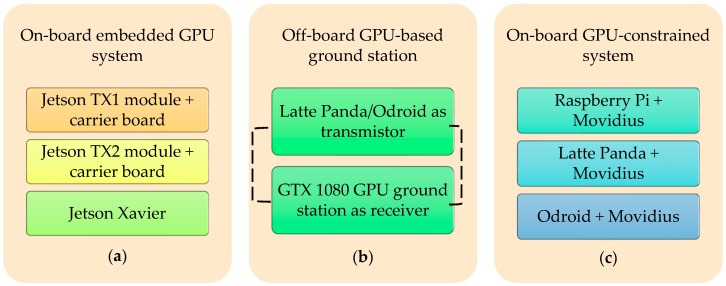
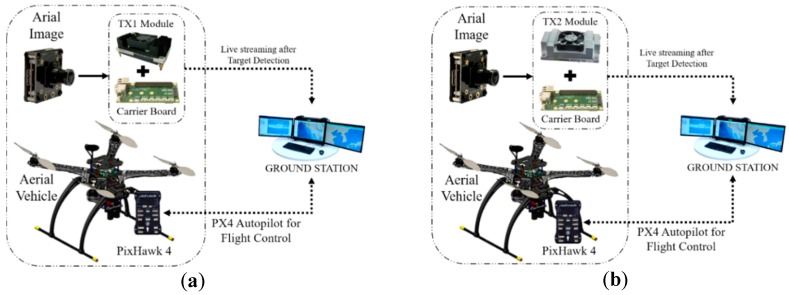
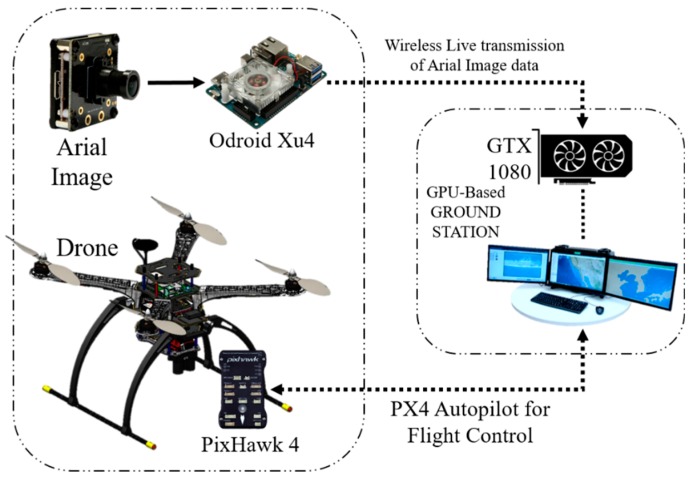
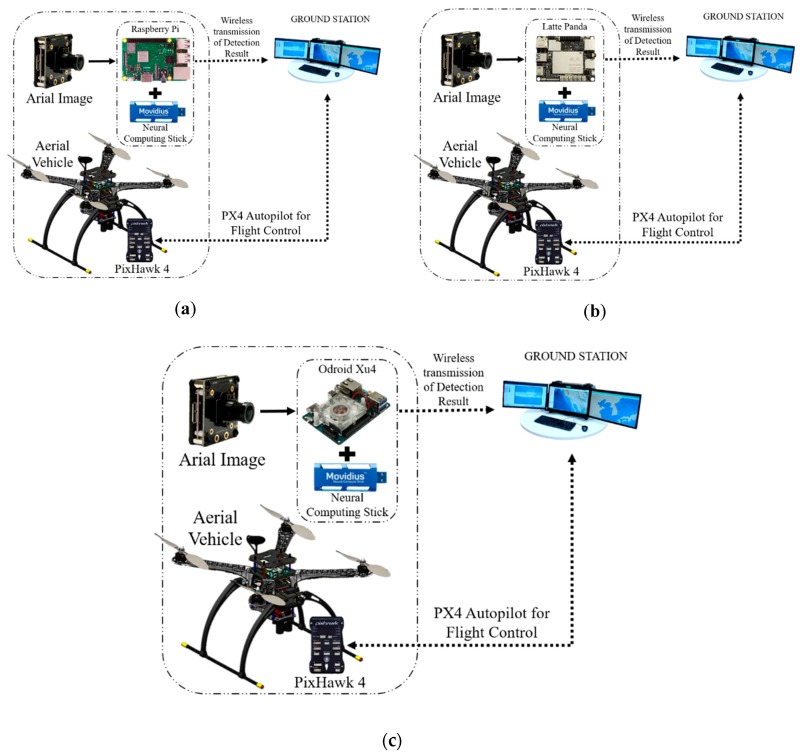
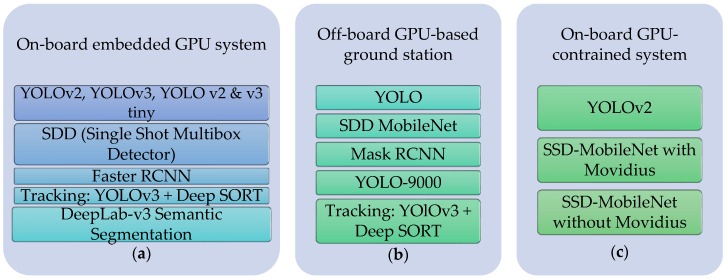
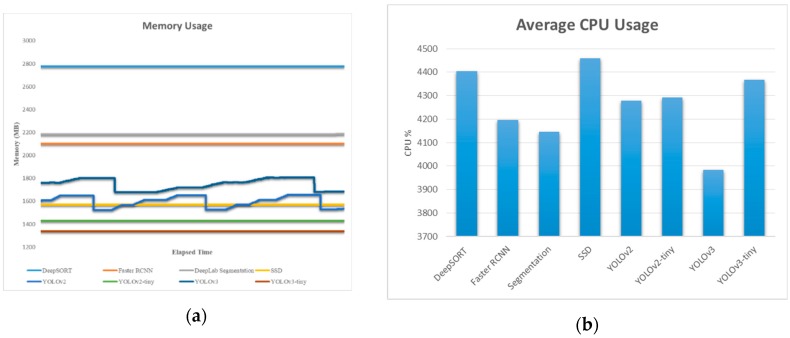
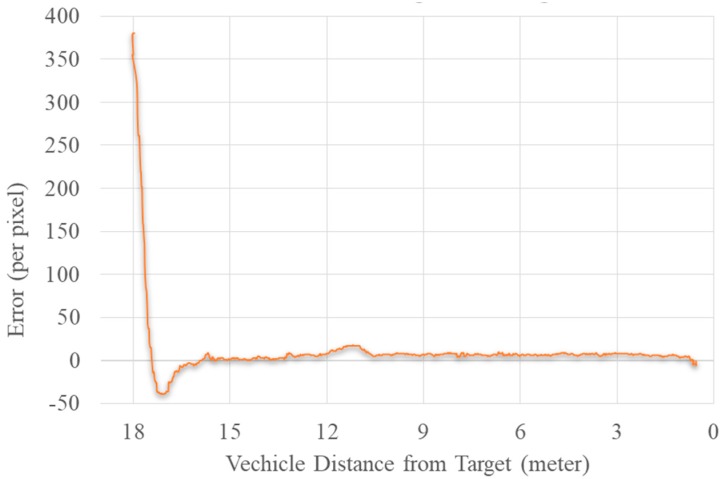
In recent years, demand has been increasing for target detection and tracking from aerial imagery via drones using onboard powered sensors and devices. We propose a very effective method for this application based on a deep learning framework. A state-of-the-art embedded hardware system empowers small flying robots to carry out the real-time onboard computation necessary for object tracking. Two types of embedded modules were developed: one was designed using a Jetson TX or AGX Xavier, and the other was based on an Intel Neural Compute Stick. These are suitable for real-time onboard computing power on small flying drones with limited space. A comparative analysis of current state-of-the-art deep learning-based multi-object detection algorithms was carried out utilizing the designated GPU-based embedded computing modules to obtain detailed metric data about frame rates, as well as the computation power. We also introduce an effective target tracking approach for moving objects. The algorithm for tracking moving objects is based on the extension of simple online and real-time tracking. It was developed by integrating a deep learning-based association metric approach with simple online and real-time tracking (Deep SORT), which uses a hypothesis tracking methodology with Kalman filtering and a deep learning-based association metric. In addition, a guidance system that tracks the target position using a GPU-based algorithm is introduced. Finally, we demonstrate the effectiveness of the proposed algorithms by real-time experiments with a small multi-rotor drone.
Overview
The claims and statistics of this paper haven’t been checked yet.
Free: it reads the open-access text and checks the first 5 claims that cite a source we can check. Create a free account to check every claim.
Integrity signals
Registry
Cites
Statistics
Figures

Verification
Claims the paper makes
The claims and statistics of this paper haven’t been checked yet.
Free: it reads the open-access text and checks the first 5 claims that cite a source we can check. Create a free account to check every claim.
Claims other papers make about this one
Each is checked against this paper’s own text: does it say what the citing paper says it does?
The source backs part of the claim, not all of it — or backs it for a different population, condition or comparison.
In the citing paper
“Real time object detection and tracking is implemented and benchmarking results are obtained using embedded hardware such as Jetson TX/AGX Xavier and Intel Neural Compute Stick wherein RCNN is employed on the embedded hardware for object detection [26].”
From Object detection using YOLO: challenges, architectural successors, datasets and applications (2023) · cites this paper as [26]
Experimental — accuracy not yet measured
Self-check
Percentages, sums and reported differences re-computed from the paper’s own numbers.
The self-check needs the paper’s full text.
Citations
Cites
LeCun, Y., Bengio, Y., & Hinton, G. (2015) · Nature · doi:10.1038/nature14539 · Cited by 84,126
Faster R-CNN: Towards Real-Time Object Detection with Region Proposal Networks
Ren, S., He, K., Girshick, R., & Sun, J. (2017) · IEEE Transactions on Pattern Analysis and Machine Intelligence · doi:10.1109/tpami.2016.2577031 · Cited by 73,472
You Only Look Once: Unified, Real-Time Object Detection
Redmon, J., Divvala, S., Girshick, R., & Farhadi, A. (2016) · 2016 IEEE Conference on Computer Vision and Pattern Recognition (CVPR) · doi:10.1109/cvpr.2016.91 · Cited by 53,803
Rich Feature Hierarchies for Accurate Object Detection and Semantic Segmentation
Girshick, R., Donahue, J., Darrell, T., & Malik, J. (2014) · 2014 IEEE Conference on Computer Vision and Pattern Recognition · doi:10.1109/cvpr.2014.81 · Cited by 32,684
(2016) · Cited by 31,590
He, K., Gkioxari, G., Dollar, P., & Girshick, R. (2017) · 2017 IEEE International Conference on Computer Vision (ICCV) · doi:10.1109/iccv.2017.322 · Cited by 29,137
Chen, L.-C., Papandreou, G., Kokkinos, I., Murphy, K., & Yuille, A. L. (2018) · IEEE Transactions on Pattern Analysis and Machine Intelligence · doi:10.1109/tpami.2017.2699184 · Cited by 22,392
Chen, L.-C., Papandreou, G., Kokkinos, I., Murphy, K., & Yuille, A. L. (2016) · arXiv · doi:10.48550/arxiv.1606.00915 · Cited by 22,392
SSD: Single Shot MultiBox Detector
Liu, W., Anguelov, D., Erhan, D., Szegedy, C., Reed, S., Fu, C.-Y., & Berg, A. C. (2016) · Lecture Notes in Computer Science · doi:10.1007/978-3-319-46448-0_2 · Cited by 22,128
Xception: Deep Learning with Depthwise Separable Convolutions
Chollet, F. (2017) · 2017 IEEE Conference on Computer Vision and Pattern Recognition (CVPR) · doi:10.1109/cvpr.2017.195 · Cited by 20,380
Research works printed but not linked: 3
- Tsang, S.-H. (2019, February 24). Review: YOLOv2 & YOLO9000—You Only Look Once (Object Detection). Available online: towardsdatascience.com/review-YOLOv2-YOLO9000-you-only-look-once-object-detection-7883d2b02a65.
- Szegedy, C., Reed, S., Erhan, D., Anguelov, D., and Ioffe, S. (2014). Scalable, high-quality object detection. arXiv.
- Qi, H., Zhang, Z., Xiao, B., Hu, H., Cheng, B., Wei, Y., and Dai, J. (2017, January 28). Deformable convolutional networks–coco detection and segmentation challenge 2017 entry. Proceedings of the ICCV COCO Challenge Workshop, Venice, Italy.
Cited by
Review of deep learning: concepts, CNN architectures, challenges, applications, future directions
Alzubaidi, L., Zhang, J., Humaidi, A. J., Al-Dujaili, A., Duan, Y., Al-Shamma, O., Santamaría, J., Fadhel, M. A., Al-Amidie, M., & Farhan, L. (2021) · Journal of Big Data · doi:10.1186/s40537-021-00444-8 · Cited by 7,906
Object detection using YOLO: challenges, architectural successors, datasets and applications
Diwan, T., Anirudh, G., & Tembhurne, J. V. (2023) · Multimedia Tools and Applications · doi:10.1007/s11042-022-13644-y · Cited by 1,549
“Real time object detection and tracking is implemented and benchmarking results are obtained using embedded hardware such as Jetson TX/AGX Xavier and Intel Neural Compute Stick wherein RCNN is employed on the embedded hardware for object detection [26].”
MethodLiterature review: efficient deep neural networks techniques for medical image analysis
Abdou, M. A. (2022) · Neural Computing and Applications · doi:10.1007/s00521-022-06960-9 · Cited by 312
UAV in the advent of the twenties: Where we stand and what is next
Nex, F., Armenakis, C., Cramer, M., Cucci, D. A., Gerke, M., Honkavaara, E., Kukko, A., Persello, C., & Skaloud, J. (2022) · ISPRS Journal of Photogrammetry and Remote Sensing · doi:10.1016/j.isprsjprs.2021.12.006 · Cited by 309
A Survey of Object Detection for UAVs Based on Deep Learning
Tang, G., Ni, J., Zhao, Y., Gu, Y., & Cao, W. (2023) · Remote Sensing · doi:10.3390/rs16010149 · Cited by 244
Real-time video fire/smoke detection based on CNN in antifire surveillance systems
Saponara, S., Elhanashi, A., & Gagliardi, A. (2021) · Journal of Real-Time Image Processing · doi:10.1007/s11554-020-01044-0 · Cited by 234
Applications of deep learning in precision weed management: A review
Rai, N., Zhang, Y., Ram, B. G., Schumacher, L., Yellavajjala, R. K., Bajwa, S., & Sun, X. (2023) · Computers and Electronics in Agriculture · doi:10.1016/j.compag.2023.107698 · Cited by 218
Murthy, C. B., Hashmi, M. F., Bokde, N. D., & Geem, Z. W. (2020) · Applied Sciences · doi:10.3390/app10093280 · Cited by 171
Ullah, A., Muhammad, K., Ding, W., Palade, V., Haq, I. U., & Baik, S. W. (2021) · Applied Soft Computing · doi:10.1016/j.asoc.2021.107102 · Cited by 166
A review on object detection in unmanned aerial vehicle surveillance
Ramachandran, A., & Sangaiah, A. K. (2021) · International Journal of Cognitive Computing in Engineering · doi:10.1016/j.ijcce.2021.11.005 · Cited by 165
Real-Time Object Detection Based on UAV Remote Sensing: A Systematic Literature Review
Cao, Z. Z., Kooistra, L., Wang, W., Guo, L., & Valente, J. R. P. (2023) · Drones · doi:10.3390/drones7100620 · Cited by 148
Mixed YOLOv3-LITE: A Lightweight Real-Time Object Detection Method
Zhao, H., Zhou, Y., Zhang, L., Peng, Y., Hu, X., Peng, H., & Cai, X. (2020) · Sensors · doi:10.3390/s20071861 · Cited by 119
Real-Time Human Detection and Gesture Recognition for On-Board UAV Rescue
Liu, C., & Szirányi, T. (2021) · Sensors · doi:10.3390/s21062180 · Cited by 120
Gąsienica-Józkowy, J., Knapik, M., & Cyganek, B. (2021) · Integrated Computer-Aided Engineering · doi:10.3233/ica-210649 · Cited by 107
Flying Free: A Research Overview of Deep Learning in Drone Navigation Autonomy
Lee, T., McKeever, S., & Courtney, J. (2021) · Drones · doi:10.3390/drones5020052 · Cited by 92
Detection in adverse weather conditions for autonomous vehicles via deep learning
Al-Haija, Q. A., Gharaibeh, M., & Odeh, A. (2022) · AI · doi:10.3390/ai3020019 · Cited by 81
Meng, L., Peng, Z., Zhou, J. P., Zhang, J., Lu, Z., Baumann‐Ouyang, A., & Du, Y. R. (2020) · Remote Sensing · doi:10.3390/rs12010182 · Cited by 77
Kusetoğulları, H., Yavariabdi, A., Hall, J., & Lavesson, N. (2020) · Big Data Research · doi:10.1016/j.bdr.2020.100182 · Cited by 91
AERO: AI-Enabled Remote Sensing Observation with Onboard Edge Computing in UAVs
Koubâa, A., Ammar, A., Abdelkader, M., Alhabashi, Y., & Ghouti, L. (2023) · Remote Sensing · doi:10.3390/rs15071873 · Cited by 98
Bakırcı, M. (2023) · Traitement du signal · doi:10.18280/ts.400524 · Cited by 101
Multiple Object Tracking in Deep Learning Approaches: A Survey
Park, Y., Dang, L. M., Lee, S., Han, D., & Moon, H. (2021) · Electronics · doi:10.3390/electronics10192406 · Cited by 69
Deep Learning-Based Mask Identification System Using ResNet Transfer Learning Architecture
Jain, A., Moparthi, N. R., Swathi, A., Sharma, Y. K., Mittal, N., Alhussen, A., Alzamil, Z. S., & Haq, M. (2024) · Computer Systems Science and Engineering · doi:10.32604/csse.2023.036973 · Cited by 54
Evaluation Method of Deep Learning-Based Embedded Systems for Traffic Sign Detection
Lopez-Montiel, M. A., Orozco-Rosas, U., Sánchez-Adame, M., Picos, K., & Montiel, O. (2021) · IEEE Access · doi:10.1109/access.2021.3097969 · Cited by 61
Li, H., Dong, Y., Liu, Y., & Ai, J. (2022) · Drones · doi:10.3390/drones6090252 · Cited by 59
OSDDY: embedded system-based object surveillance detection system with small drone using deep YOLO
Madasamy, K., Shanmuganathan, V., Kandasamy, V., Lee, M. Y., & Thangadurai, M. (2021) · EURASIP Journal on Image and Video Processing · doi:10.1186/s13640-021-00559-1 · Cited by 59
A Systematic Assessment of Embedded Neural Networks for Object Detection
Verucchi, M., Brilli, G., Sapienza, D., Verasani, M., Arena, M., Gatti, F., Capotondi, A., Cavicchioli, R., Bertogna, M., & Solieri, M. (2020) · IEEE International Conference on Emerging Technologies and Factory Automation (ETFA) · doi:10.1109/etfa46521.2020.9212130 · Cited by 67
Lightweight Semantic Segmentation Network for Real-Time Weed Mapping Using Unmanned Aerial Vehicles
Deng, J., Zhong, Z., Huang, H., Lan, Y., Han, Y., & Zhang, Y. (2020) · Applied Sciences · doi:10.3390/app10207132 · Cited by 60
Research on Mask-Wearing Detection Algorithm Based on Improved YOLOv5
Guo, S., Li, L., Guo, T., Cao, Y., & Li, Y. (2022) · Sensors · doi:10.3390/s22134933 · Cited by 49
On-Board Small-Scale Object Detection for Unmanned Aerial Vehicles (UAVs)
Saeed, Z., Yousaf, M. H., Ahmed, R., Velastín, S. A., & Viriri, S. (2023) · Drones · doi:10.3390/drones7050310 · Cited by 54
Jain, D. K., Zhao, X., Gan, C., Shukla, P. K., Jain, A., & Sharma, S. (2024) · Information Fusion · doi:10.1016/j.inffus.2024.102429 · Cited by 50
Intelligent Traffic Light Control System Based On Traffic Environment Using Deep Learning
Sharma, M., Bansal, A., Kashyap, V., Goyal, P., & Sheikh, T. H. (2021) · IOP Conference Series Materials Science and Engineering · doi:10.1088/1757-899x/1022/1/012122 · Cited by 39
Multiple Drone Navigation and Formation Using Selective Target Tracking-Based Computer Vision
Upadhyay, J., Rawat, A., & Deb, D. (2021) · Electronics · doi:10.3390/electronics10172125 · Cited by 38
Tekli, J. (2022) · Knowledge and Information Systems · doi:10.1007/s10115-021-01650-9 · Cited by 36
Low-power deep learning edge computing platform for resource constrained lightweight compact UAVs
Albanese, A., Nardello, M., & Brunelli, D. (2022) · Sustainable Computing Informatics and Systems · doi:10.1016/j.suscom.2022.100725 · Cited by 60
Video surveillance in smart cities: current status, challenges & future directions
Sharma, H., & Kanwal, N. (2024) · Multimedia Tools and Applications · doi:10.1007/s11042-024-19696-6 · Cited by 50
Kim, D. H., Lee, S., Jeon, J., & Song, B. C. (2019) · Expert Systems with Applications · doi:10.1016/j.eswa.2019.113063 · Cited by 38
Douklias, A., Karagiannidis, L., Misichroni, F. D., & Amditis, A. (2022) · Sensors · doi:10.3390/s22052049 · Cited by 38
Sneharika, P., Anvitha, B. C. S. S., Kumar, A. M., Pradeep, T., Devi, M. M. Y., & Kumar, S. (2024) · International Conference on Communication, Computer Sciences and Engineering (IC3SE) · doi:10.1109/ic3se62002.2024.10593056 · Cited by 33
Multi-Camera Vehicle Tracking Using Edge Computing and Low-Power Communication
Nikodem, M., Słabicki, M., Surmacz, T., Mrówka, P., & Dołęga, C. (2020) · Sensors · doi:10.3390/s20113334 · Cited by 37
Benchmarking Object Detection Deep Learning Models in Embedded Devices
Cantero, D., Esnaola-Gonzalez, I., Miguel-Alonso, J., & Jauregi, E. (2022) · Sensors · doi:10.3390/s22114205 · Cited by 42
Hussain, M. (2023) · IEEE Access · doi:10.1109/access.2023.3332468 · Cited by 57
Real-Time Multiple Object Visual Tracking for Embedded GPU Systems
Fernández-Sanjurjo, M., Mucientes, M., & Brea, V. M. (2021) · IEEE Internet of Things Journal · doi:10.1109/jiot.2021.3056239 · Cited by 41
Kolosov, D., Kelefouras, V. I., Kourtessis, P., & Mporas, I. (2022) · IEEE Access · doi:10.1109/access.2022.3214214 · Cited by 37
Advanced deep learning and large language models: Comprehensive insights for cancer detection
Habchi, Y., Kheddar, H., Himeur, Y., Belouchrani, A., Serpedin, E., Khelifi, F., & Chowdhury, M. E. H. (2025) · Image and Vision Computing · doi:10.1016/j.imavis.2025.105495 · Cited by 40
Small Low-Contrast Target Detection: Data-Driven Spatiotemporal Feature Fusion and Implementation
Xie, J., Gao, C., Wu, J., Shi, Z., & Chen, J. (2021) · IEEE Transactions on Cybernetics · doi:10.1109/tcyb.2021.3072311 · Cited by 28
Alasmari, N., Alohali, M. A., Khalid, M., Almalki, N. S., Motwakel, A., Alsaid, M. I., Osman, A. E., & Alneil, A. A. (2023) · Computers & Electrical Engineering · doi:10.1016/j.compeleceng.2023.108718 · Cited by 28
Tilon, S., Nex, F., George Vosselman, A., Llave, I. S. D. L., & Kerle, N. (2022) · Remote Sensing · doi:10.3390/rs14164008 · Cited by 27
Distributed Real-Time Image Processing of Formation Flying SAR Based on Embedded GPUs
Yang, T., Xu, Q., Meng, F., & Zhang, S. (2022) · IEEE Journal of Selected Topics in Applied Earth Observations and Remote Sensing · doi:10.1109/jstars.2022.3197199 · Cited by 24
A Novel Technique to Detect and Track Multiple Objects in Dynamic Video Surveillance Systems.
Adimoolam, M., Mohan, S., John, A., & Srivastava, G. (2022) · International Journal of Interactive Multimedia and Artificial Intelligence · doi:10.9781/ijimai.2022.01.002 · Cited by 23
Road Condition Detection and Emergency Rescue Recognition Using On-Board UAV in the Wildness
Liu, C., & Szirányi, T. (2022) · Remote Sensing · doi:10.3390/rs14174355 · Cited by 25
TASM: A Tile-Based Storage Manager for Video Analytics
Daum, M., Haynes, B. M., He, D., Mazumdar, A., & Bałazińska, M. (2021) · IEEE International Conference on Data Engineering (ICDE) · doi:10.1109/icde51399.2021.00156 · Cited by 40
Yu, F., Zhang, G., Zhao, F., Wang, X., Liu, H., Lin, P., & Chen, Y. (2023) · Internet of Things · doi:10.1016/j.iot.2023.100881 · Cited by 26
Yang, L., Liu, Z., Wang, X., Yu, X., Wang, G., & Shen, L. (2021) · Journal of Intelligent & Robotic Systems · doi:10.1007/s10846-021-01425-y · Cited by 21
Progress in multi-object detection models: a comprehensive survey
Balakrishna, S., & Mustapha, A. A. (2022) · Multimedia Tools and Applications · doi:10.1007/s11042-022-14131-0 · Cited by 25
Barodi, A., Bajit, A., Harrouti, T. E., Tamtaoui, A., & Benbrahim, M. (2021) · Advances in Science Technology and Engineering Systems Journal · doi:10.25046/aj060173 · Cited by 19
Kumar, K., Kumar, P., Deshpande, V. K., Bhalerao, R. H., Shah, K., Vaidhya, P. K., & Panda, S. K. (2023) · IEEE Sensors Journal · doi:10.1109/jsen.2023.3267101 · Cited by 22
Habash, N. M., Alqumsan, A. A., & Zhou, T. (2025) · Sensors · doi:10.3390/s25247563 · Cited by 35
Chen, X. (2022) · Security and Communication Networks · doi:10.1155/2022/3418466 · Cited by 18
RetractedTarget Detection, Tracking and Avoidance System for Low-cost UAVs using AI-Based Approaches
Varatharasan, V., Rao, A. S. S., Toutounji, E., Hong, J.-H., & Shin, H. (2019) · Workshop on Research, Education and Development of Unmanned Aerial Systems (RED-UAS) · doi:10.1109/reduas47371.2019.8999683 · Cited by 18
CNN-SVM based vehicle detection for UAV platform
Valappil, N. K., & Memon, Q. A. (2021) · International Journal of Hybrid Intelligent Systems · doi:10.3233/his-210003 · Cited by 18
Few-shot Adaptive Object Detection with Cross-Domain CutMix
Nakamura, Y., Ishii, Y., Maruyama, Y., & Yamashita, T. (2023) · Lecture notes in computer science · doi:10.1007/978-3-031-26351-4_45 · Cited by 20
Adaptive Subsampling for ROI-Based Visual Tracking: Algorithms and FPGA Implementation
Iqbal, O., Muro, V. I. T., Katoch, S., Spanias, A., & Jayasuriya, S. (2022) · IEEE Access · doi:10.1109/access.2022.3200755 · Cited by 20
Wei, C., & Huang, T.-H. (2021) · Sensors · doi:10.3390/s21124200 · Cited by 16
Lin, C.-T., Chen, S., Santoso, P. S., Lin, H.-J., & Lai, S. (2019) · IEEE Transactions on Vehicular Technology · doi:10.1109/tvt.2019.2961625 · Cited by 17
Alzanin, S. M. (2025) · Scientific Reports · doi:10.1038/s41598-025-05136-4 · Cited by 18
Evaluation of Deep Learning Accelerators for Object Detection at the Edge
Puchtler, P., & Peinl, R. (2020) · Lecture notes in computer science · doi:10.1007/978-3-030-58285-2_29 · Cited by 23
Sengan, S., Kotecha, K. V., Indragandhi, V., Velayutham, P., Varadarajan, V., Ravi, L., & Subramaniyaswamy, V. (2021) · Electronics · doi:10.3390/electronics10243079 · Cited by 20
Hong-quan, Y., Sharma, A., & Sharma, P. (2021) · International Journal of Systems Assurance Engineering and Management · doi:10.1007/s13198-021-01128-5 · Cited by 15
The Detection System of Helipad for Unmanned Aerial Vehicle Landing Using YOLO Algorithm
Suprapto, B. Y., Wahyudin, A., Hikmarika, H., & Dwijayanti, S. (2021) · Jurnal Ilmiah Teknik Elektro Komputer dan Informatika · doi:10.26555/jiteki.v7i2.20684 · Cited by 14
Real-Time Object Detection from UAV Inspection Videos by Combining YOLOv5s and DeepStream
Xie, S., Deng, G., Lin, B., Jing, W., Li, Y., & Zhao, X. (2024) · Sensors · doi:10.3390/s24123862 · Cited by 19
Maltezos, E., Douklias, A., Dadoukis, A., Misichroni, F. D., Karagiannidis, L., Αντωνόπουλος, Μ., Voulgary, K., Ouzounoglou, E., & Amditis, A. (2021) · Computation · doi:10.3390/computation9020012 · Cited by 15
Optimized Deep Learning Object Recognition for Drones using Embedded GPU
Rad, P. A., Hofmann, D., Pertuz, S. A., & Göhringer, D. (2021) · IEEE International Conference on Emerging Technologies and Factory Automation (ETFA) · doi:10.1109/etfa45728.2021.9613590 · Cited by 13
VLC localization: deep learning models by Kalman filter algorithm combined with RSS
Salama, W. M., Aly, M. H., & Amer, E. S. (2022) · Optical and Quantum Electronics · doi:10.1007/s11082-022-03985-1 · Cited by 15
Deep Learning Based Apples Counting for Yield Forecast Using Proposed Flying Robotic System
Yıldırım, Ş., & Ulu, B. (2023) · Sensors · doi:10.3390/s23136171 · Cited by 42
To Compute or Not to Compute? Adaptive Smart Sensing in Resource-Constrained Edge Computing
Ballotta, L., Peserico, G., Zanini, F., & Dini, P. (2023) · IEEE Transactions on Network Science and Engineering · doi:10.1109/tnse.2023.3306202 · Cited by 13
Ntousis, O., Makris, E., Tsanakas, P. D., & Pavlatos, C. (2025) · Technologies · doi:10.3390/technologies13010035 · Cited by 16
Real-time unsupervised video object detection on the edge
Ruiz-Barroso, P., Castro, F. M., & Guil, N. (2025) · Future Generation Computer Systems · doi:10.1016/j.future.2025.107737 · Cited by 18
[Retracted] Sensor‐Based Environmental Perception Technology for Intelligent Vehicles
Wang, B., Han, Y., Tian, D., & Guan, T. M. (2021) · Journal of Sensors · doi:10.1155/2021/8199361 · Cited by 13
RetractedDetection and Analysis of Sow Targets Based on Image Vision
Lei, K., Zong, C., Yang, T., Peng, S., Zhu, P., Wang, H., Teng, G., & Du, X. (2022) · Agriculture · doi:10.3390/agriculture12010073 · Cited by 13
Gesture Recognition for UAV-based Rescue Operation based on Deep Learning
Liu, C., & Szirányi, T. (2021) · International Conference on Image Processing and Vision Engineering (IMPROVE) · doi:10.5220/0010522001800187 · Cited by 12
Deep Learning-based Trajectory Estimation of Vehicles in Crowded and Crossroad Scenarios
Siddique, A., & Afanasyev, I. M. (2021) · Conference of Open Innovations Association (FRUCT) · doi:10.23919/fruct50888.2021.9347580 · Cited by 11
Chun, D., Choi, J.-W., Lee, H., & Kim, H. (2023) · IEEE Access · doi:10.1109/access.2023.3280552 · Cited by 18
A PCB Alignment System Using RST Template Matching with CUDA on Embedded GPU Board
Le, M.-T., Tu, C., Guo, S., & Lien, J.-J. J. (2020) · Sensors · doi:10.3390/s20092736 · Cited by 10
DeepSpatial: Intelligent Spatial Sensor to Perception of Things
Teixeira, M. A. S., Neves, F., Koubâa, A., de Arruda, L. V. R., & de Oliveira, A. S. (2020) · IEEE Sensors Journal · doi:10.1109/jsen.2020.3035355 · Cited by 10
Speeding up an Adaptive Filter based ECG Signal Pre-processing on Embedded Architectures
Mejhoudi, S., Latif, R., Saddik, A., Jenkal, W., & Elouardi, A. (2021) · International Journal of Advanced Computer Science and Applications · doi:10.14569/ijacsa.2021.0120544 · Cited by 11
Exploring the Performance of Deep Neural Networks on Embedded Many-Core Processors
Yabe, T., & Azumi, T. (2022) · ACM/IEEE International Conference on Cyber-Physical Systems (ICCPS) · doi:10.1109/iccps54341.2022.00024 · Cited by 10
Gona, S. N. R., & Harish, C. H. (2023) · Evolutionary Intelligence · doi:10.1007/s12065-023-00817-3 · Cited by 9
Iaboni, C., Kelly, T., & Abichandani, P. (2025) · International Journal of Computer Vision · doi:10.1007/s11263-025-02418-2 · Cited by 12
Makrigiorgis, R., Kyrkou, C., & Kolios, P. (2023) · International Conference on Unmanned Aircraft Systems (ICUAS) · doi:10.1109/icuas57906.2023.10156376 · Cited by 10
SP-YOLO-Lite: A Lightweight Violation Detection Algorithm Based on SP Attention Mechanism
Huang, Z., Wu, J., Su, L., Xie, Y., Li, T., & Huang, X. (2023) · Electronics · doi:10.3390/electronics12143176 · Cited by 9
Fast Pedestrian Detection for Real-World Crowded Scenarios on Embedded GPU
Cormier, M., Wolf, S., Sommer, L. W., Schumann, A., & Beyerer, J. (2021) · IEEE EUROCON - International Conference on Computer as a Tool (EUROCON) · doi:10.1109/eurocon52738.2021.9535550 · Cited by 9
Bi, H., Dai, R., Han, F., & Zhang, C. (2025) · Image and Vision Computing · doi:10.1016/j.imavis.2025.105894 · Cited by 14
Laser-based drone vision disruption with a real-time tracking system for privacy preservation
Kuantama, E., Zhang, Y., Rahman, F., Han, R. Y., Dawes, J. M., Mildren, R. P., Abir, T. A., & Nguyen, P. (2024) · Expert Systems with Applications · doi:10.1016/j.eswa.2024.124626 · Cited by 9
AB9: A neural processor for inference acceleration
Cho, Y. C. P., Chung, J., Yang, J., Lyuh, C., Kim, H.-M., Kim, C., Ham, J.-S., Choi, M., Shin, K.-S., Han, J., et al. (2020) · ETRI Journal · doi:10.4218/etrij.2020-0134 · Cited by 8
Load Classification: A Case Study for Applying Neural Networks in Hyper-Constrained Embedded Devices
Agiollo, A., & Omicini, A. (2021) · Applied Sciences · doi:10.3390/app112411957 · Cited by 13
Adaptive Aerial Localization Using Lissajous Search Patterns
Steckenrider, J. J. (2021) · IEEE Transactions on Robotics · doi:10.1109/tro.2021.3126225 · Cited by 8
Drone Swarm for Distributed Video Surveillance of Roads and Car Tracking
Pedroche, D. S., Amigo, D., García, J., Molina, J. M., & Zubasti, P. (2024) · Drones · doi:10.3390/drones8110695 · Cited by 10
Real-Time Target Tracking System With Spiking Neural Networks Implemented on Neuromorphic Chips
Liu, K., Cui, X., Ji, X. L., Kuang, Y., Zou, C., Zhong, Y., Xiao, K., & Wang, Y. (2022) · IEEE Transactions on Circuits & Systems II Express Briefs · doi:10.1109/tcsii.2022.3227121 · Cited by 7
Development of an Autonomous UAS for on Air Surveillance and Object Detection: A Real Execution
Singh, A., Prakash, K., Manda, P. A., Sona, D. R., & Das, R. R. (2023) · Journal of Electrical Engineering and Technology · doi:10.1007/s42835-023-01573-1 · Cited by 6
Low-cost real-time aerial object detection and GPS location tracking pipeline
Lago, A., Patel, S., & SINGH, A. K. (2024) · ISPRS Open Journal of Photogrammetry and Remote Sensing · doi:10.1016/j.ophoto.2024.100069 · Cited by 9
Metadata
- Authors
- Hossain, S., & Lee, D.-J.
- Affiliations
- Kunsan National University (KR)
- Corresponding author
- Lee, Deok-jin
- Venue
- Sensors
- Publisher
- MDPI AG
- Published
- 2019-07-31
- Volume
- 19
- Issue
- 15
- Pages
- 3371
- ISSN
- 1424-8220 (ISSN-L)
- PMC
- PMC6695703
- OpenAlex
- W2957927798
- Cited by
- 184
- References
- 28
- Citations by year
- 2026: 4 · 2025: 18 · 2024: 26 · 2023: 35 · 2022: 38 · 2021: 39 · 2020: 21 · 2019: 3
- FWCI
- 11.29
- Type
- journal article
- Language
- en
- Open access
- gold
- doi.org
- Licence
- Locations
- Sensors (publishedVersion, cc-by)
- PubMed Central (publishedVersion, cc-by)
- PubMed (publishedVersion)
- DOAJ (DOAJ: Directory of Open Access Journals) (submittedVersion, cc-by-sa)
- Topics
- Physical Sciences › Computer Science › Computer Vision and Pattern Recognition › Video Surveillance and Tracking Methods
- Physical Sciences › Computer Science › Computer Vision and Pattern Recognition › Advanced Neural Network Applications
- Physical Sciences › Engineering › Automotive Engineering › Autonomous Vehicle Technology and Safety
- Keywords
- multi-target detection, object tracking, aerial imagery, unmanned aerial vehicles, multi-rotor drones, embedded computing, Jetson, DeepSORT, Kalman filter
About these checks
Registry, retraction, Cites and statistics results are computed, not judged, with one exception: a printed reference that no index lists is read once by a model before it counts as a citation error. Claims are extracted by a model and kept only when their quote appears verbatim in the text; each cited source is then checked, with a model’s help, for whether it says what the claim relies on. Those verdicts can be wrong — read the claim’s quote and the cited source before relying on one.
Statistics and arithmetic are recomputed, not judged.
Confidence bands are shown only for fields calibrated on our annotated test set. None is calibrated yet, so no band is shown.
What counts as a claim ›How we measure confidence ›How we check this ›
Are you an author, or do you see a problem with this page? Request a review
Data sources
Bibliographic data: Semantic Scholar, OpenAlex, Crossref.
Contains information from the Semantic Scholar Academic Graph Datasets, made available under the ODC Attribution License (ODC-BY 1.0).
Semantic Scholar’s data is described in: Kinney, R., et al. (2023). The Semantic Scholar Open Data Platform. arXiv:2301.10140.
