

The DOI matches its Crossref record.
ppb-Level Selective Hydrogen Gas Detection of Pd-Functionalized In2O3-Loaded ZnO Nanofiber Gas Sensors
Open accessAbstract
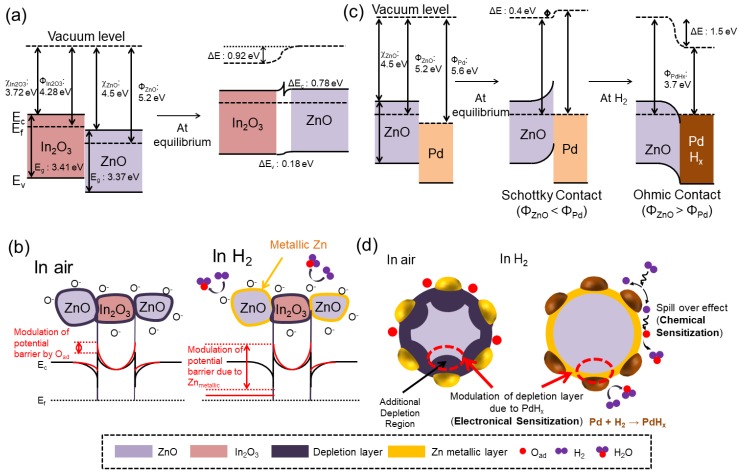
Pd nanoparticle-functionalized, xIn2O3 (x = 0.05, 0.1, and 0.15)-loaded ZnO nanofibers were synthesized by an electrospinning and ultraviolet (UV) irradiation method and assessed for their hydrogen gas sensing properties. Morphological and chemical analyses revealed the desired morphology and chemical composition of the synthesized nanofibers. The optimal gas sensor namely Pd-functionalized, 0.1In2O3-loaded ZnO nanofibers showed a very strong response to 172–50 ppb hydrogen gas at 350 °C, which is regarded as the optimal sensing temperature. Furthermore, the gas sensors showed excellent selectivity to hydrogen gas due to the much lower response to CO and NO2 gases. The enhanced gas response was attributed to the excellent catalytic activity of Pd to hydrogen gas, and the formation of Pd/ZnO and In2O3/ZnO heterojunctions, ZnO–ZnO homojunction, as well as the formation of PdHx. Overall, highly sensitive and selective hydrogen gas sensors can be produced based on a simple methodology using a synergistic effect from Pd functionalization and In2O3 loading in ZnO nanofibers.
Overview
The claims and statistics of this paper haven’t been checked yet.
Run the check — free, no account needed. It reads the open-access text and checks the sources it cites.
Integrity signals
Registry
Cites
Statistics
Figures
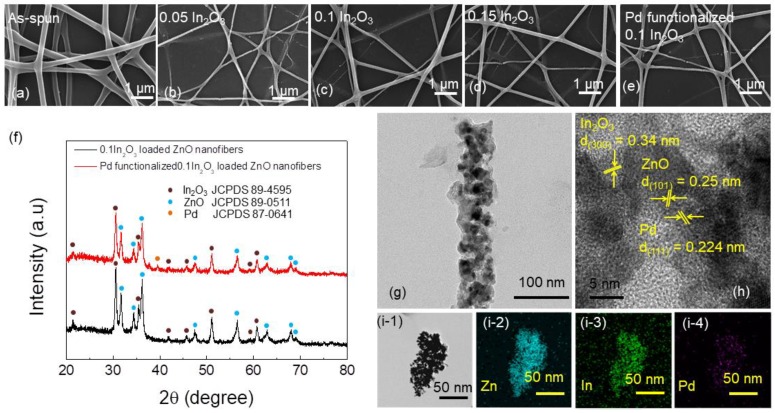
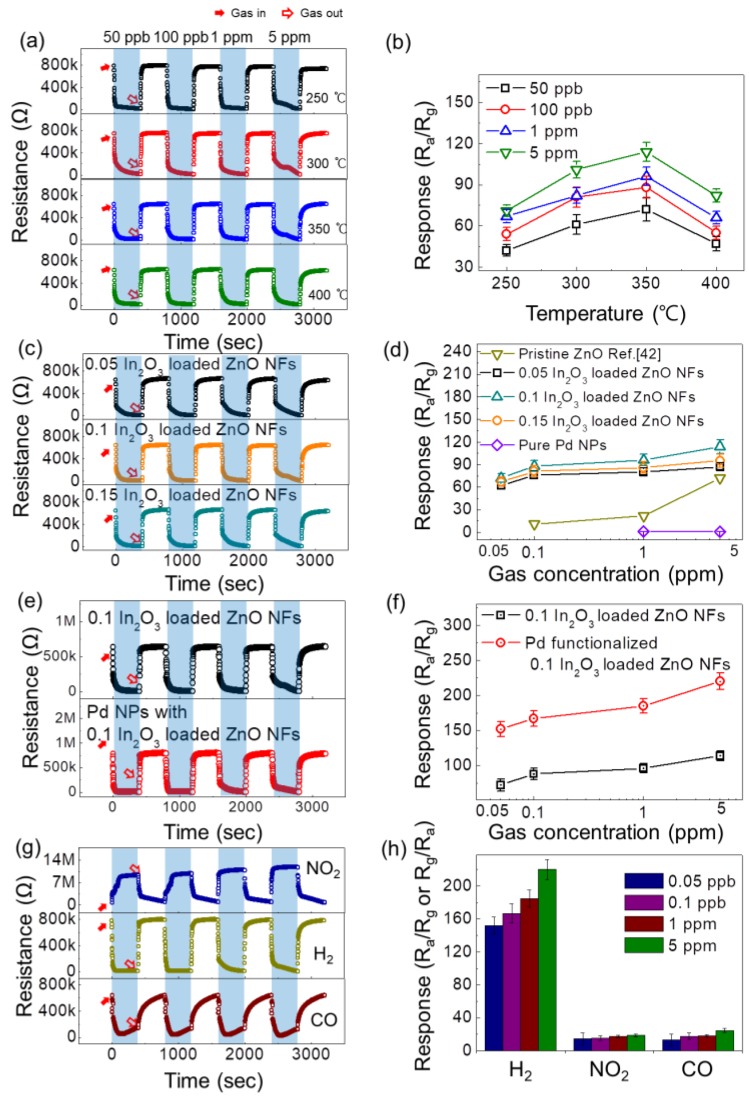
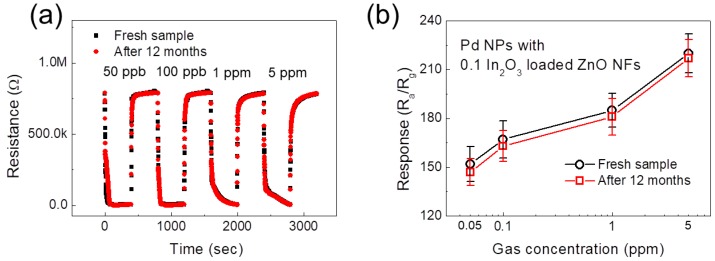
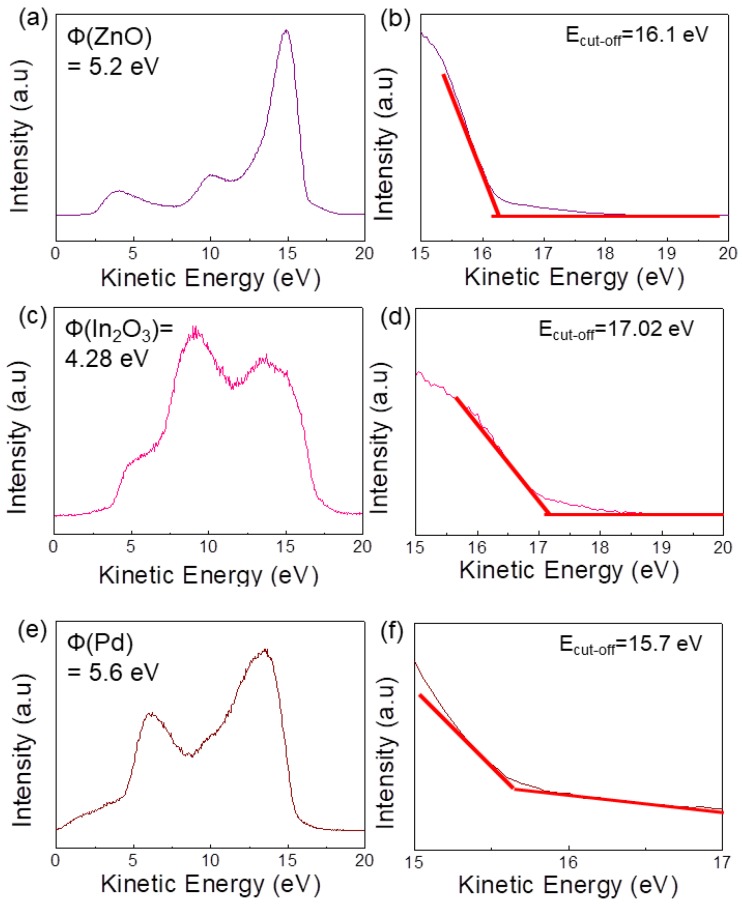
Verification
Claims the paper makes
The claims and statistics of this paper haven’t been checked yet.
Run the check — free, no account needed. It reads the open-access text and checks the sources it cites.
Claims other papers make about this one
Each is checked against this paper’s own text: does it say what the citing paper says it does?
The source backs part of the claim, not all of it — or backs it for a different population, condition or comparison.
In the citing paper
“flammable and explosive gases, such as H2 and CH4, pose a direct threat to the safety of human life and property”
From Functionalized Hydrogel-Based Wearable Gas and Humidity Sensors. (2023) · cites this paper as [16]
Experimental — accuracy not yet measured
Self-check
Percentages, sums and reported differences re-computed from the paper’s own numbers.
The self-check needs the paper’s full text.
Citations
Cites
No references could be resolved yet.
Research works printed but not linked: 53
- Dincer, 2018, Smart energy solutions with hydrogen options, Int. J. Hydrogen Energy, 43, 8579, 10.1016/j.ijhydene.2018.03.120 · DOI
- Kamal, 2017, High performance NiO decorated graphene as a potential H2 gas sensor, J. Alloy. Compd., 729, 1058, 10.1016/j.jallcom.2017.09.124 · DOI
- Kim, 2019, Design of supersensitive and selective ZnO nanofiber based sensors for H2 gas sensing by electron beam irradiation, Sens. Actuators B Chem., 293, 210, 10.1016/j.snb.2019.04.113 · DOI
- Mirzaei, A., Kim, J.-H., Kim, H.W., and Kim, S.S. (2019). Gasochromic WO3 nanostructures for the detection of hydrogen gas: An overview. Appl. Sci., 9. · DOI
- Palmisano, 2014, Developments in gas sensor technology for hydrogen safety, Int. J. Hydrogen Energy, 39, 20474, 10.1016/j.ijhydene.2014.05.042 · DOI
- Black, 2011, Hydrogen sensors: A review, Sens. Actuators B Chem., 157, 329, 10.1016/j.snb.2011.04.070 · DOI
- Kumar, 2019, Nano lily-buds garden like ZnO nanostructures based gas sensor for H2 detection, Mater. Lett., 240, 13, 10.1016/j.matlet.2018.12.113 · DOI
- Kim, 2018, Amorphous Pd-assisted H2 detection of ZnO nanorod gas sensor with enhanced sensitivity and stability, Sens. Actuators B Chem., 262, 460, 10.1016/j.snb.2018.02.025 · DOI
- Drmosh, 2019, UV-activated gold decorated rGO/ZnO heterostructured nanocomposite sensor for efficient room temperature H2 detection, Sens. Actuators B Chem., 290, 666, 10.1016/j.snb.2019.03.077 · DOI
- Zhu, 2017, Room-temperature gas sensing of ZnO-based gas sensor: A review, Sens. Actuators A Phys., 267, 242, 10.1016/j.sna.2017.10.021 · DOI · Paper page
- Mondal, 2014, ZnO–SnO2 based composite type gas sensor for selective hydrogen sensing, Sens. Actuators B Chem., 194, 389, 10.1016/j.snb.2013.12.093 · DOI
- Katoch, 2015, Importance of the nanograin size on the H2S-sensing properties of ZnO–CuO composite nanofibers, Sens. Actuators B Chem., 214, 111, 10.1016/j.snb.2015.03.012 · DOI
- Lupan, 2018, Ultra-sensitive and selective hydrogen nanosensor with fast response at room temperature based on a single Pd/ZnO nanowire, Sens. Actuators B Chem., 254, 1259, 10.1016/j.snb.2017.07.200 · DOI
- Fan, 2017, Hydrogen sensing properties of Pt-Au bimetallic nanoparticles loaded on ZnO nanorods, Sens. Actuators B Chem., 241, 895, 10.1016/j.snb.2016.11.025 · DOI
- Galstyan, 2015, Nanostructured ZnO chemical gas sensors, Ceram. Int., 41, 14239, 10.1016/j.ceramint.2015.07.052 · DOI
- Liu, 2019, Rational design of sensitivity enhanced and stability improved tea gas sensor assembled with Pd nanoparticles-functionalized In2O3 composites, Sens. Actuators B Chem., 285, 1, 10.1016/j.snb.2019.01.029 · DOI
- Chava, 2019, Fabrication of aggregated In2O3 nanospheres for highly sensitive acetaldehyde gas sensors, J. Alloy. Compd., 772, 834, 10.1016/j.jallcom.2018.09.183 · DOI
- Haiduk, 2019, Study of WO3–In2O3 nanocomposites for highly sensitive CO and NO2 gas sensors, J. Solid State Chem., 273, 25, 10.1016/j.jssc.2019.02.023 · DOI
- Liu, 2018, Synthesis of Ce-doped In2O3 nanostructure for gas sensor applications, Appl. Surf. Sci., 428, 478, 10.1016/j.apsusc.2017.09.177 · DOI
- An, 2019, ZnO-enhanced In2O3 based sensors for n-butanol gas, Ceram. Int., 45, 6869, 10.1016/j.ceramint.2018.12.182 · DOI
- Liu, 2018, High response and selectivity of single crystalline ZnO nanorods modified by In2O3 nanoparticles for n-butanol gas sensing, Sens. Actuators B Chem., 277, 144, 10.1016/j.snb.2018.08.144 · DOI
- Lee, 2013, Selective and sensitive detection of trimethylamine using ZnO–In2O3 composite nanofibers, Sens. Actuators B Chem., 181, 463, 10.1016/j.snb.2013.02.008 · DOI
- Rambu, 2011, Polycrystalline ZnO–In2O3 thin films as gas sensors, Thin Solid Films, 520, 1303, 10.1016/j.tsf.2011.04.158 · DOI
- Chi, 2014, Synthesis of pristine In2O3/ZnO–In2O3 composited nanotubes and investigate the enhancement of their acetone sensing properties, Mat. Sci. Semicon. Process., 27, 494, 10.1016/j.mssp.2014.07.032 · DOI
- Huang, 2018, Enhanced gas-sensing performance of ZnO@In2O3 core@shell nanofibers prepared by coaxial electrospinning, Sens. Actuators B Chem., 255, 2248, 10.1016/j.snb.2017.09.022 · DOI
- Espid, 2017, Development of highly sensitive ZnO/In2O3 composite gas sensor activated by UV-LED, Sens. Actuators B Chem., 241, 828, 10.1016/j.snb.2016.10.129 · DOI
- Li, 2016, Hierarchical morphology-dependent gas-sensing performances of three-dimensional SnO2 nanostructures, ACS Sens., 2, 102, 10.1021/acssensors.6b00597 · DOI
- Alenezi, 2014, From 1D and 2D ZnO nanostructures to 3D hierarchical structures with enhanced gas sensing properties, Nanoscale, 6, 235, 10.1039/C3NR04519F · DOI
- Zhang, 2016, Fabrication and characterization of an ultrasensitive humidity sensor based on metal oxide/graphene hybrid nanocomposite, Sens. Actuators B Chem., 225, 233, 10.1016/j.snb.2015.11.024 · DOI
- Abideen, 2017, Electrospun metal oxide composite nanofibers gas sensors: A review, J. Korean Ceram. Soc., 54, 366, 10.4191/kcers.2017.54.5.12 · DOI
- Libardi, 2018, Characterization and Electrical Response to Humidity of Sintered Polymeric Electrospun fibers of vanadium oxide (TiO2-WO3), J. Electron. Mater., 47, 2710, 10.1007/s11664-018-6112-1 · DOI
- 2019, TiO2/WO3 heterogeneous structures prepared by electrospinning and sintering steps: Characterization and analysis of the impedance variation to humidity, J. Adv. Ceram., 8, 1
- Kim, 2019, Pd functionalization on ZnO nanowires for enhanced sensitivity and selectivity to hydrogen gas, Sens. Actuators B Chem., 297, 126693, 10.1016/j.snb.2019.126693 · DOI
- Phan, 2015, A large detectable-range, high-response and fast-response resistivity hydrogen sensor based on Pt/Pd core–shell hybrid with graphene, Sens. Actuators B Chem., 220, 962, 10.1016/j.snb.2015.06.029 · DOI
- Kim, 2018, SnO2 (n)-NiO (p) composite nanowebs: Gas sensing properties and sensing mechanisms, Sens. Actuators B Chem., 258, 204, 10.1016/j.snb.2017.11.063 · DOI
- Lee, J.-H., Kim, J.-Y., Mirzaei, A., Kim, H.W., and Kim, S.S. (2018). Significant enhancement of hydrogen-sensing properties of ZnO nanofibers through NiO loading. Nanomaterials, 8. · DOI
- Kim, 2019, Variation of shell thickness in ZnO-SnO2 core-shell nanowires for optimizing sensing behaviors to CO, C6H6, and C7H8 gases, Sens. Actuators B Chem., 302, 127150, 10.1016/j.snb.2019.127150 · DOI
- Xiao, 2017, Fabrication of mesoporous In2O3 nanospheres and their ultrasensitive NO2 sensing properties, Sens. Actuators B Chem., 248, 519, 10.1016/j.snb.2017.04.022 · DOI
- Lu, 2017, Abnormal room temperature ferromagnetism in CuO/ZnO nanocomposites via hydrothermal method, Appl. Surf. Sci., 399, 396, 10.1016/j.apsusc.2016.12.113 · DOI
- Tong, 2013, In-situ decoration of Pd nanocrystals on crystalline mesoporous NiO nanosheets for effective hydrogen gas sensors, Int. J. Hydrogen Energ., 38, 12090, 10.1016/j.ijhydene.2013.06.120 · DOI
- Hou, 2018, Packaging BiVO4 nanoparticles in ZnO microbelts for efficient photoelectrochemical hydrogen production, Electrochim. Acta, 283, 497, 10.1016/j.electacta.2018.06.148 · DOI
- Katoch, 2016, Grain size tuned highly H2 selective chemiresistive sensors based on ZnO−SnO2 composite nanofibers, ACS Appl. Mater. Interfaces, 8, 2486, 10.1021/acsami.5b08416 · DOI
- Kim, 2019, Improving the hydrogen sensing properties of SnO2 nanowire-based conductometric sensors by Pd-decoration, Sens. Actuators B Chem., 285, 358, 10.1016/j.snb.2019.01.008 · DOI
- Kim, 2018, Low power-consumption CO gas sensors based on Au-functionalized SnO2-ZnO core-shell nanowires, Sens. Actuators B Chem., 267, 597, 10.1016/j.snb.2018.04.079 · DOI
- Katoch, 2015, Bifunctional sensing mechanism of SnO2−ZnO composite nanofibers for drastically enhancing the sensing behavior in H2 Gas, ACS Appl. Mater. Interfaces, 7, 11351, 10.1021/acsami.5b01817 · DOI
- Mirzaei, 2019, An overview on how Pd on resistive-based nanomaterial gas sensors can enhance response toward hydrogen gas, Int. J. Hydrogen Energy, 44, 20552, 10.1016/j.ijhydene.2019.05.180 · DOI
- Mao, 2018, High performance hydrogen sensor based on Pd/TiO2 composite film, Int. J. Hydrogen Energy, 43, 22727, 10.1016/j.ijhydene.2018.10.094 · DOI
- Park, J., Attia, N.F., Jung, M., Lee, K., and Oh, H. (2019). Biobased derived nanoporous carbon for hydrogen isotope separation. Micropor. Mesopor. Mater. · DOI
- Kim, 2019, Realization of Au-decorated WS2 nanosheets as low power-consumption and selective gas sensors, Sens. Actuators B Chem., 296, 126659, 10.1016/j.snb.2019.126659 · DOI
- Kim, 2017, Extremely sensitive and selective sub-ppm CO detection by the synergistic effect of Au nanoparticles and core–shell nanowires, Sens. Actuators B Chem., 249, 177, 10.1016/j.snb.2017.04.090 · DOI
- Xing, 2011, High gas sensing performance of one-step-synthesized Pd–ZnO nanoflowers due to surface reactions and modifications, Nanotechnology, 22, 215501, 10.1088/0957-4484/22/21/215501 · DOI
- Park, 2019, Enhancement of hydrogen sensing response of ZnO nanowires for the decoration of WO3 nanoparticles, Mater. Lett., 234, 315, 10.1016/j.matlet.2018.09.129 · DOI
- Hassan, 2016, Platinum/Palladium bimetallic ultra-thin film decorated on a one-dimensional ZnO nanorods array for use as fast response flexible hydrogen sensor, Mater. Lett., 176, 232, 10.1016/j.matlet.2016.04.138 · DOI
Cited by
Sorted by citations
Functionalized Hydrogel-Based Wearable Gas and Humidity Sensors.
Luo, Y., Li, J., Ding, Q., Wang, H., Liu, C., & Wu, J. (2023) · Nano-Micro Letters · doi:10.1007/s40820-023-01109-2 · Cited by 236
Metadata
- Authors
- Lee, J.-H., Kim, J.-H., Kim, J.-Y., Mirzaei, A., Kim, H. W., & Kim, S. S.
- Affiliations
- Inha University (KR)
- Shiraz University of Technology (IR)
- Hanyang University (KR)
- Corresponding author
- Kim, Sang Sub
- Venue
- Sensors
- Publisher
- MDPI AG
- Published
- 2019-10-02
- Volume
- 19
- Issue
- 19
- Pages
- 4276
- ISSN
- 1424-8220 (ISSN-L)
- PMC
- PMC6806323
- OpenAlex
- W2977594736
- Cited by
- 73
- References
- 0
- Citations by year
- 2026: 5 · 2025: 12 · 2024: 15 · 2023: 10 · 2022: 18 · 2021: 7 · 2020: 6
- FWCI
- 2.79
- Type
- journal article
- Language
- en
- Open access
- gold
- dx.doi.org
- Licence
- Locations
- Sensors (publishedVersion, cc-by)
- PubMed Central (publishedVersion, cc-by)
- PubMed (publishedVersion)
- DOAJ (DOAJ: Directory of Open Access Journals) (submittedVersion, cc-by-sa)
- Topics
- Physical Sciences › Engineering › Electrical and Electronic Engineering › Gas Sensing Nanomaterials and Sensors
- Physical Sciences › Materials Science › Materials Chemistry › ZnO doping and properties
- Physical Sciences › Materials Science › Materials Chemistry › Catalytic Processes in Materials Science
- Keywords
- hydrogen detection, ZnO nanofibers, palladium nanoparticles, electrospun nanofibers, UV irradiation, PdHx, gas selectivity, gas sensors
About these checks
Registry, retraction, Cites and statistics results are computed, not judged, with one exception: a printed reference that no index lists is read once by a model before it counts as a citation error. Claims are extracted by a model and kept only when their quote appears verbatim in the text; each cited source is then checked, with a model’s help, for whether it says what the claim relies on. Those verdicts can be wrong — read the claim’s quote and the cited source before relying on one.
Statistics and arithmetic are recomputed, not judged.
Confidence bands are shown only for fields calibrated on our annotated test set. None is calibrated yet, so no band is shown.
What counts as a claim ›How we measure confidence ›How we check this ›
Are you an author, or do you see a problem with this page? Request a review
