

The DOI matches its Crossref record; 74 of the 75 references it cites were found in a registry or an index.
Innovations in Electrodermal Activity Data Collection and Signal Processing: A Systematic Review
Open accessAbstract
The electrodermal activity (EDA) signal is an electrical manifestation of the sympathetic innervation of the sweat glands. EDA has a history in psychophysiological (including emotional or cognitive stress) research since 1879, but it was not until recent years that researchers began using EDA for pathophysiological applications like the assessment of fatigue, pain, sleepiness, exercise recovery, diagnosis of epilepsy, neuropathies, depression, and so forth. The advent of new devices and applications for EDA has increased the development of novel signal processing techniques, creating a growing pool of measures derived mathematically from the EDA. For many years, simply computing the mean of EDA values over a period was used to assess arousal. Much later, researchers found that EDA contains information not only in the slow changes (tonic component) that the mean value represents, but also in the rapid or phasic changes of the signal. The techniques that have ensued have intended to provide a more sophisticated analysis of EDA, beyond the traditional tonic/phasic decomposition of the signal. With many researchers from the social sciences, engineering, medicine, and other areas recently working with EDA, it is timely to summarize and review the recent developments and provide an updated and synthesized framework for all researchers interested in incorporating EDA into their research.
Overview
The claims and statistics of this paper haven’t been checked yet.
Run the check — free, no account needed. It reads the open-access text and checks the sources it cites.
Integrity signals
Registry
Cites
Statistics
Figures
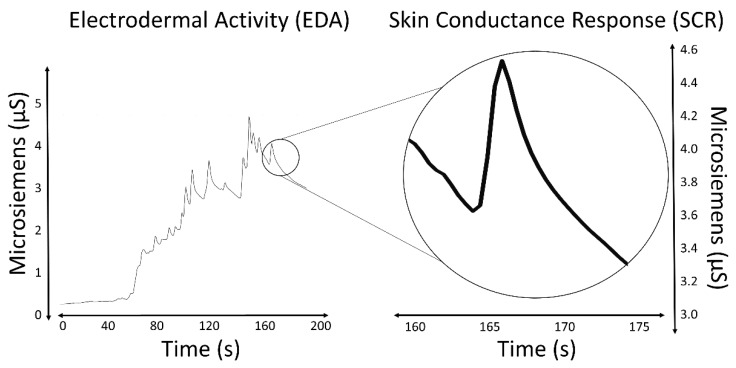
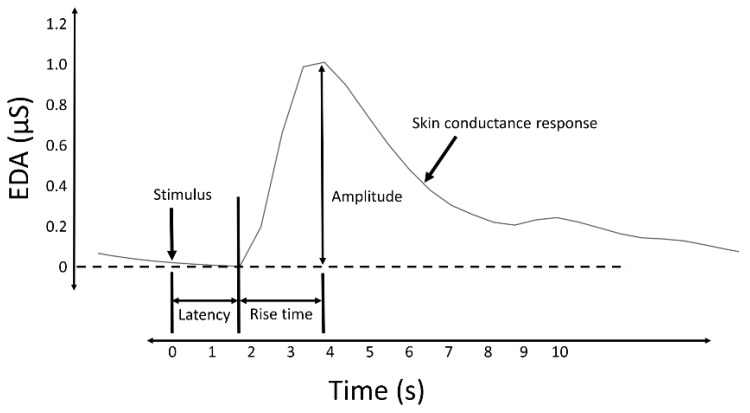
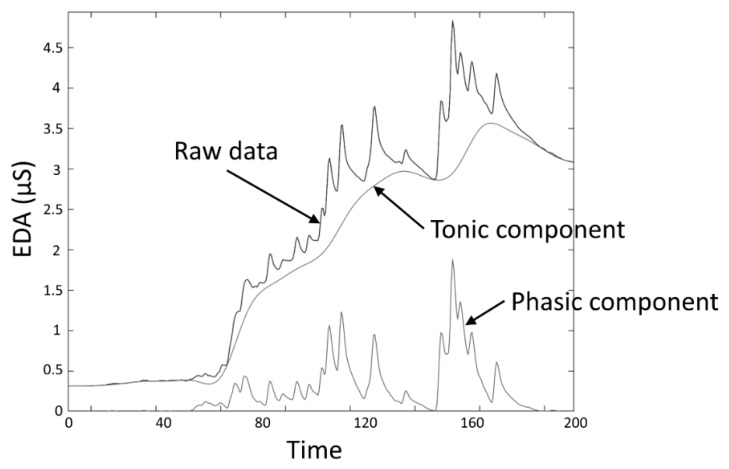
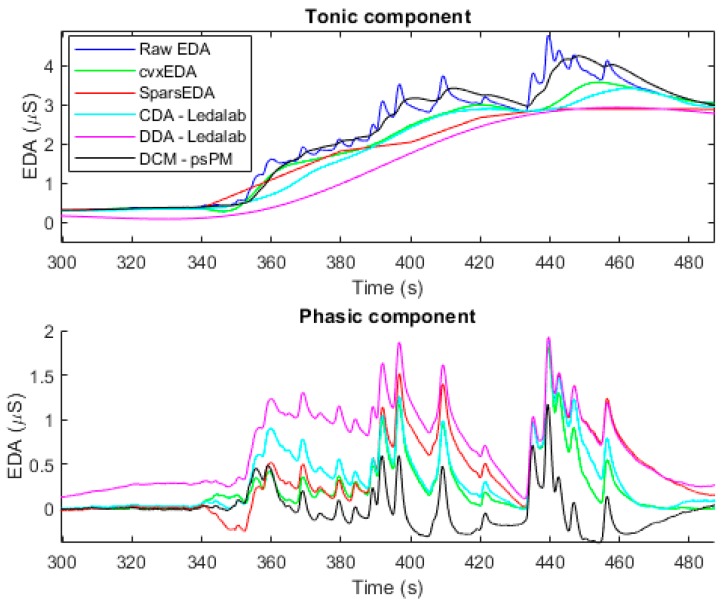
Verification
Claims the paper makes
The claims and statistics of this paper haven’t been checked yet.
Run the check — free, no account needed. It reads the open-access text and checks the sources it cites.
Claims other papers make about this one
Each is checked against this paper’s own text: does it say what the citing paper says it does?
In the citing paper
“Two components that contribute to measurable changes in EDA have been described. The fast galvanic skin responses, also referred to as phasic responses, act in the order of 0.5 to 5 s, whereas the tonic component, which expresses in level changes, acts in the order of minutes26,27”
From Data quality evaluation in wearable monitoring (2022) · cites this paper as [26]
In the citing paper
“Motion artifacts are a primary cause of bad signal quality, and research has suggested various methods for mitigating these26,39,40.”
From Data quality evaluation in wearable monitoring (2022) · cites this paper as [26]
Self-check
Percentages, sums and reported differences re-computed from the paper’s own numbers.
The self-check needs the paper’s full text.
Citations
Cites
Boucsein, W. (2012) · doi:10.1007/978-1-4614-1126-0 · Cited by 2,526
Detecting Stress During Real-World Driving Tasks Using Physiological Sensors
Healey, J. A., & Picard, R. W. (2005) · IEEE Transactions on Intelligent Transportation Systems · doi:10.1109/tits.2005.848368 · Cited by 2,207
Dawson, M. E., Schell, A. M., Filion, D. L., & Berntson, G. G. (2009) · Cambridge University Press eBooks · doi:10.1017/cbo9780511546396.007 · Cited by 1,776
Publication Recommendations for Electrodermal Measurements
Fowles, D. C., Christie, M. J., Edelberg, R., Grings, W. W., Lykken, D. T., & Venables, P. H. (1981) · Psychophysiology · doi:10.1111/j.1469-8986.1981.tb03024.x · Cited by 1,700
A continuous measure of phasic electrodermal activity
Benedek, M., & Kaernbach, C. (2010) · Journal of Neuroscience Methods · doi:10.1016/j.jneumeth.2010.04.028 · Cited by 1,689
Publication recommendations for electrodermal measurements
Society for Psychophysiological Research Ad Hoc Committee on Electrodermal Measures (2012) · Psychophysiology · doi:10.1111/j.1469-8986.2012.01384.x · Cited by 1,288
Discriminating Stress From Cognitive Load Using a Wearable EDA Device
Setz, C., Arnrich, B., Schumm, J., La Marca, R., Troster, G., & Ehlert, U. (2010) · IEEE Transactions on Information Technology in Biomedicine · doi:10.1109/titb.2009.2036164 · Cited by 742
A Wearable Sensor for Unobtrusive, Long-Term Assessment of Electrodermal Activity
Poh, M.-Z., Swenson, N. C., & Picard, R. W. (2010) · IEEE Transactions on Biomedical Engineering · doi:10.1109/tbme.2009.2038487 · Cited by 693
cvxEDA: a Convex Optimization Approach to Electrodermal Activity Processing
Greco, A., Valenza, G., Lanatà, A., Scilingo, E. P., & Citi, L. (2015) · IEEE Transactions on Biomedical Engineering · doi:10.1109/tbme.2015.2474131 · Cited by 646
Decomposition of skin conductance data by means of nonnegative deconvolution
Benedek, M., & Kaernbach, C. (2010) · Psychophysiology · doi:10.1111/j.1469-8986.2009.00972.x · Cited by 594
Research works printed but not linked: 5
- Cacioppo, J.T., Tassinary, L.G., and Berntson, G. (2007). Handbook of Psychophysiology, Cambridge University Press. [3rd ed.].
- Martin, I., and Venables, P.H. (1980). Techniques in Psychophysiology, John Wiley & Sons. Psychological Medicine.
- Hugdahl, K. (1995). Psychophysiology: The Mind–Body Perspective, Harvard University Press.
- Grings, 1974, Recording of electrodermal phenomena, Methods Physiol. Psychol., 1, 273
- Boucsein, W. (2012). Electrodermal Activity, Springer Science & Business Media. · DOI · Paper page
Cited by
Sorted by citations
The Validity of Physiological Measures to Identify Differences in Intrinsic Cognitive Load
Ayres, P., Lee, J. Y., PAAS, F. G. W. C., & van Merriënboer, J. J. G. (2021) · Frontiers in Psychology · doi:10.3389/fpsyg.2021.702538 · Cited by 232
Pain and Stress Detection Using Wearable Sensors and Devices—A Review
Chen, J., Abbod, M., & Shieh, J.-S. (2021) · Sensors · doi:10.3390/s21041030 · Cited by 234
Detecting Emotions through Electrodermal Activity in Learning Contexts: A Systematic Review
Horvers, A., Tombeng, N., Bosse, T., Lazonder, A., & Molenaar, I. (2021) · Italian National Conference on Sensors · doi:10.3390/s21237869 · Cited by 160
Biophilic office design: Exploring the impact of a multisensory approach on human well-being
Aristizabal, S., Byun, K., Porter, P., Clements, N. S., Campanella, C., Li, L., Mullan, A. F., Ly, S., Senerat, A. M., Nenadic, I., et al. (2021) · Journal of Environmental Psychology · doi:10.1016/j.jenvp.2021.101682 · Cited by 171
Jang, H., Sel, K., Kim, E., Kim, S., Yang, X., Kang, S., Ha, K.-H., Wang, R., Rao, Y., Jafari, R., et al. (2022) · Nature Communications · doi:10.1038/s41467-022-34406-2 · Cited by 127
Metadata
- Authors
- Posada-Quintero, H. F., & Chon, K. H.
- Affiliations
- University of Connecticut (US)
- Corresponding author
- Chon, Ki H.
- Venue
- Sensors
- Publisher
- MDPI AG
- Published
- 2020-01-15
- Volume
- 20
- Issue
- 2
- Pages
- 479
- ISSN
- 1424-8220 (ISSN-L)
- PMC
- PMC7014446
- OpenAlex
- W3000402017
- Cited by
- 525
- References
- 75
- Citations by year
- 2026: 103 · 2025: 92 · 2024: 109 · 2023: 85 · 2022: 57 · 2021: 57 · 2020: 22
- FWCI
- 9.90
- Type
- journal article
- Language
- en
- Open access
- gold
- dx.doi.org
- Licence
- Locations
- Sensors (publishedVersion, cc-by)
- Europe PMC (PubMed Central) (publishedVersion, cc-by)
- PubMed Central (publishedVersion, cc-by)
- PubMed (publishedVersion)
- DOAJ (DOAJ: Directory of Open Access Journals) (submittedVersion, cc-by-sa)
- Funders
- Office of Naval Research (N00014-19-1-2209)
- Topics
- Health Sciences › Medicine › Cardiology and Cardiovascular Medicine › Heart Rate Variability and Autonomic Control
- Physical Sciences › Computer Science › Artificial Intelligence › Emotion and Mood Recognition
- Physical Sciences › Engineering › Biomedical Engineering › Non-Invasive Vital Sign Monitoring
- Keywords
- electrodermal activity, sympathetic nervous system, sweat glands, psychophysiology, fatigue analysis, pain assessment, sleepiness, post-exercise recovery, epilepsy diagnosis, neuropathy, depression
About these checks
Registry, retraction, Cites and statistics results are computed, not judged, with one exception: a printed reference that no index lists is read once by a model before it counts as a citation error. Claims are extracted by a model and kept only when their quote appears verbatim in the text; each cited source is then checked, with a model’s help, for whether it says what the claim relies on. Those verdicts can be wrong — read the claim’s quote and the cited source before relying on one.
Statistics and arithmetic are recomputed, not judged.
Confidence bands are shown only for fields calibrated on our annotated test set. None is calibrated yet, so no band is shown.
What counts as a claim ›How we measure confidence ›How we check this ›
Are you an author, or do you see a problem with this page? Request a review
