

Machine Learning on Mainstream Microcontrollers
Open accessThe DOI matches its Crossref record; 27 of the 28 references it cites were found in a registry or an index.
Abstract
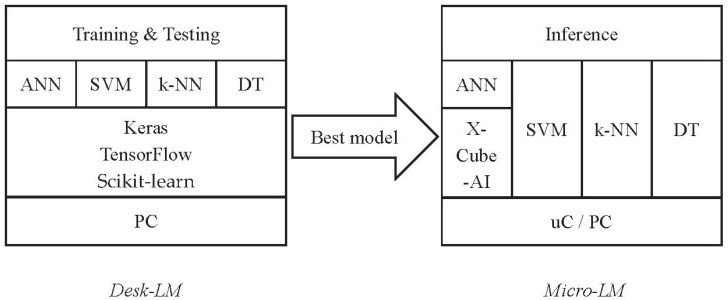
This paper presents the Edge Learning Machine (ELM), a machine learning framework for edge devices, which manages the training phase on a desktop computer and performs inferences on microcontrollers. The framework implements, in a platform-independent C language, three supervised machine learning algorithms (Support Vector Machine (SVM) with a linear kernel, k-Nearest Neighbors (K-NN), and Decision Tree (DT)), and exploits STM X-Cube-AI to implement Artificial Neural Networks (ANNs) on STM32 Nucleo boards. We investigated the performance of these algorithms on six embedded boards and six datasets (four classifications and two regression). Our analysis—which aims to plug a gap in the literature—shows that the target platforms allow us to achieve the same performance score as a desktop machine, with a similar time latency. ANN performs better than the other algorithms in most cases, with no difference among the target devices. We observed that increasing the depth of an NN improves performance, up to a saturation level. k-NN performs similarly to ANN and, in one case, even better, but requires all the training sets to be kept in the inference phase, posing a significant memory demand, which can be afforded only by high-end edge devices. DT performance has a larger variance across datasets. In general, several factors impact performance in different ways across datasets. This highlights the importance of a framework like ELM, which is able to train and compare different algorithms. To support the developer community, ELM is released on an open-source basis.
Overview
The claims and statistics of this paper haven’t been checked yet.
Free: it reads the open-access text and checks the first 5 claims that cite a source we can check. Create a free account to check every claim.
Integrity signals
Registry
Cites
Statistics
Figures
Verification
Claims the paper makes
The claims and statistics of this paper haven’t been checked yet.
Free: it reads the open-access text and checks the first 5 claims that cite a source we can check. Create a free account to check every claim.
Claims other papers make about this one
Each is checked against this paper’s own text: does it say what the citing paper says it does?
The source backs part of the claim, not all of it — or backs it for a different population, condition or comparison.
In the citing paper
“As a rough summary result, the best performance was that of ANN in all datasets except Sonar dataset. In contrast the SVM achieved the best results on the Heart and EnviroCar dataset. The performance of DT was on Virus and Peugeot 14. However, KNN achieved the best result in the Sonar dataset only.”
From TinyML: Enabling of Inference Deep Learning Models on Ultra-Low-Power IoT Edge Devices for AI Applications (2022) · cites this paper as [5]
Experimental — accuracy not yet measuredThe cited source says what the claim attributes to it.
In the citing paper
“Four algorithms were implemented on six devices from ARM Cortex-M microcontrollers released by STM-32, namely (F091RC, F303RE, F401RE, F746ZG, H743ZI2, and L452RE).”
From TinyML: Enabling of Inference Deep Learning Models on Ultra-Low-Power IoT Edge Devices for AI Applications (2022) · cites this paper as [5]
The cited source says what the claim attributes to it.
In the citing paper
“The authors [5] developed an Edge Learning Machine (ELM) framework to execute ML inference in edge devices such as Microcontroller.”
From TinyML: Enabling of Inference Deep Learning Models on Ultra-Low-Power IoT Edge Devices for AI Applications (2022) · cites this paper as [5]
Self-check
Percentages, sums and reported differences re-computed from the paper’s own numbers.
The self-check needs the paper’s full text.
Citations
Cites
Adam: A Method for Stochastic Optimization
Kingma, D. P., & Ba, J. (2014) · arXiv · doi:10.48550/arxiv.1412.6980 · Cited by 98,946
Batch Normalization: Accelerating Deep Network Training by Reducing Internal Covariate Shift
Ioffe, S., & Szegedy, C. (2015) · arXiv · doi:10.48550/arxiv.1502.03167 · Cited by 27,818
Batch Normalization: Accelerating Deep Network Training by Reducing Internal Covariate Shift
Ioffe, S. (2024) · arXiv (Cornell University) · doi:10.57702/o9raffed · Cited by 14,214
Internet of Things (IoT): A vision, architectural elements, and future directions
Gubbi, J., Buyya, R., Marusic, S., & Palaniswami, M. (2013) · Future Generation Computer Systems · doi:10.1016/j.future.2013.01.010 · Cited by 12,293 · cited 1×
“, [2]) to the edge has advantages in terms of response latency, bandwidth occupancy, energy consumption, security and expected privacy (e.”
BackgroundEdge computing: Vision and challenges
Shi, W., Cao, J., Zhang, Q., Li, Y., & Xu, L. (2016) · IEEE Internet of Things Journal · doi:10.1109/jiot.2016.2579198 · Cited by 8,733
Understanding Machine Learning: From Theory to Algorithms
Shalev-Shwartz, S., & Ben-David, S. (2014) · doi:10.1017/cbo9781107298019 · Cited by 3,115
(2007) · The MIT Press eBooks · doi:10.7551/mitpress/7496.001.0001 · Cited by 536
Computation Offloading Toward Edge Computing
Lin, L., Liao, X., Jin, H., & Li, P. (2019) · Proceedings of the IEEE · doi:10.1109/jproc.2019.2922285 · Cited by 456 · cited 1×
“The trend of moving computation towards the edge is becoming ever more relevant, leading to performance improvements and the development of new field data processing applications [1].”
BackgroundNearest-Neighbor Methods in Learning and Vision: Theory and Practice
(2006) · The MIT Press eBooks · doi:10.7551/mitpress/4908.001.0001 · Cited by 440
Generative Adversarial Networks for face generation: A survey
Kammoun, A., Slama, R., Tabia, H., Ouni, T., & Abid, M. (2022) · ACM Computing Surveys · doi:10.1145/1122445.1122456 · Cited by 311
Research works printed but not linked: 3
- Suda N. Loh D. Machine Learning on ARM Cortex-M Microcontrollers Arm Ltd. Cambridge, UK 2019
- Goodfellow I. Bengio Y. Courville A. Deep Learning The MIT Press Cambridge, UK 2016
- Vapnik V.N. Lerner A.Y. Recognition of Patterns with help of Generalized Portraits Avtomat. Telemekh. 1963 24 774 780
Cited by
TinyML for Ultra-Low Power AI and Large Scale IoT Deployments: A Systematic Review
Schizas, N., Karras, A., Karras, C., & Sioutas, S. (2022) · Future Internet · doi:10.3390/fi14120363 · Cited by 215
Alajlan, N. N., & Ibrahim, D. M. (2022) · Micromachines · doi:10.3390/mi13060851 · Cited by 224
Quantization and Deployment of Deep Neural Networks on Microcontrollers
Novac, P.-E., Boukli Hacene, G., Pegatoquet, A., Miramond, B., & Gripon, V. (2021) · Sensors · doi:10.3390/s21092984 · Cited by 210
Artificial Intelligence in the IoT Era: A Review of Edge AI Hardware and Software
Sipola, T., Alatalo, J., Kokkonen, T., & Rantonen, M. (2022) · 2022 31st Conference of Open Innovations Association (FRUCT) · doi:10.23919/fruct54823.2022.9770931 · Cited by 100
“The weka-porter project supports only WEKA [177] decision tree conversions, and the Micro-LM project supports only models trained with the Desk-LM module [174], although the Desk-LM module in turn depends on and uses scikit-learn library.”
BackgroundMethodOn-Device Training of Machine Learning Models on Microcontrollers with Federated Learning
Giménez, N. L., Grau, M. M., Centelles, R. P., & Freitag, F. (2022) · Electronics · doi:10.3390/electronics11040573 · Cited by 77
Robustifying the Deployment of tinyML Models for Autonomous mini-vehicles
de Prado, M., Rusci, M., Capotondi, A., Donze, R., Benini, L., & Pazos, N. (2021) · Sensors · doi:10.3390/s21041339 · Cited by 57
“For the evaluation, we employed an open-source framework [56] that offers implementations of the ML algorithms (KNN, DT and, SVM) in python (scikit-learn library) and C-code, which we used for training and deployment, respectively.”
MethodOn TinyML and Cybersecurity: Electric Vehicle Charging Infrastructure Use Case
Dehrouyeh, F., Yang, L., Ajaei, F. B., & Shami, A. A. (2024) · IEEE Access · doi:10.1109/access.2024.3437192 · Cited by 87
“This approach draws from multiple methodologies, including but not limited to the Edge Learning Machine (ELM) framework, as one example, where models are trained on a desktop environment and subsequently utilized for predictions on STM microcontrollers [24].”
BackgroundMethodPhiNets: A Scalable Backbone for Low-power AI at the Edge
Paissan, F., Ancilotto, A., & Farella, E. (2022) · ACM Transactions on Embedded Computing Systems · doi:10.1145/3510832 · Cited by 54
Mazzi, Y., Ben Sassi, H., Gaga, A., & Errahimi, F. (2022) · International Journal of Energy Research · doi:10.1002/er.7713 · Cited by 53
“Other model-based, such as thermal models using the ANN approach were also proposed for EV SOC estimation in Reference 19.”
MethodInfluentialShipboard Microgrid Frequency Control Based on Machine Learning Under Hybrid Cyberattacks
Heidary, J., Oshnoei, S., Gheisarnejad, M., Khalghani, M. R., & Khooban, M. H. (2023) · IEEE Transactions on Industrial Electronics · doi:10.1109/tie.2023.3303627 · Cited by 55
Implementation of a LoRa Mesh Library
Solé, J. M., Centelles, R. P., Freitag, F., & Meseguer, R. (2022) · IEEE Access · doi:10.1109/access.2022.3217215 · Cited by 47
“Indeed, the current trend in performing machine learning on low capacity devices only increases this need [5].”
BackgroundDDD TinyML: A TinyML-Based Driver Drowsiness Detection Model Using Deep Learning
Alajlan, N. N., & Ibrahim, D. M. (2023) · Sensors · doi:10.3390/s23125696 · Cited by 64
Voice-Activated Smart Home Controller Using Machine Learning
Filipe, L., Peres, R. S., & Santos‐Tavares, R. (2021) · IEEE Access · doi:10.1109/access.2021.3076750 · Cited by 48
“…no need to consume time in communication, however, architectures of this type are still not very common (at least in ML applications) due to the reduced computational capacity of micro-controllers and lack of quantitative analyses about the performance of common ML algorithms on such devices [22].”
BackgroundDNN is not all you need: Parallelizing Non-Neural ML Algorithms on Ultra-Low-Power IoT Processors
Tabanelli, E., Tagliavini, G., & Benini, L. (2021) · arXiv · doi:10.48550/arxiv.2107.09448 · Cited by 36
DNN Is Not All You Need: Parallelizing Non-neural ML Algorithms on Ultra-low-power IoT Processors
Tabanelli, E., Tagliavini, G., & Benini, L. (2023) · ACM Transactions on Embedded Computing Systems · doi:10.1145/3571133 · Cited by 56
A Generalization Performance Study Using Deep Learning Networks in Embedded Systems
Gorospe, J., Mulero, R., Arbelaitz, O., Muguerza, J., & Antón, M. Á. (2021) · Sensors · doi:10.3390/s21041031 · Cited by 32
Embedded federated learning over a LoRa mesh network
Giménez, N. L., Solé, J. M., & Freitag, F. (2023) · Pervasive and Mobile Computing · doi:10.1016/j.pmcj.2023.101819 · Cited by 37
Embedded real-time objects’ hardness classification for robotic grippers
Amin, Y., Gianoglio, C., & Valle, M. (2023) · Future Generation Computer Systems · doi:10.1016/j.future.2023.06.002 · Cited by 36
On-Device Training of Machine Learning Models on Microcontrollers With a Look at Federated Learning
Grau, M. M., Centelles, R. P., & Freitag, F. (2021) · Proceedings of the Conference on Information Technology for Social Good · doi:10.1145/3462203.3475896 · Cited by 28
“Inference with trained machine learning models is now possible on tiny computing devices, while a few years ago this was only run in the cloud [6].”
BackgroundEmbedded Intelligence: State-of-the-Art and Research Challenges
Seng, K. P., & Ang, L.-M. (2022) · IEEE Access · doi:10.1109/access.2022.3175574 · Cited by 36
“There are some authors which focused on EI and ML implementations for different hardware platforms, such as custom microcontrollers [19], [102], GPUs [20], FPGAs [21], wearables [103], [104], [105], [106] and IoT devices [107], [108].”
BackgroundVenuto, D. D., & Mezzina, G. (2021) · Sensors · doi:10.3390/s21123961 · Cited by 29
“For this aim, the Nucleo board L476RG was instantiated by using the STM32CubeMX peripheral initializer [41].”
MethodCBin-NN: An Inference Engine for Binarized Neural Networks
Sakr, F., Berta, R., Doyle, J. C., Capello, A., Dabbous, A., Lazzaroni, L., & Bellotti, F. (2024) · Electronics · doi:10.3390/electronics13091624 · Cited by 27
“CBin-NN is an open-source project within the ELM framework [56], available GitHub at Experimental analysis on the STM32F746 MCU using the CIFAR-10 dataset shows that our library, employing some speci fi c optimizations (e.g., channel-wise max pooling, Bop optimizer, PReLU additional activations, di…”
MethodSelf-citationContext-Aware Edge-Based AI Models for Wireless Sensor Networks—An Overview
Al-Saedi, A. A., Boeva, V., Casalicchio, E., & Exner, P. (2022) · Sensors · doi:10.3390/s22155544 · Cited by 33
“In addition, more than ever before, microcontrollers are powerful enough to make intelligent decisions without any external help based on data collected from various sensors [5].”
BackgroundLEDPOS: Indoor Visible Light Positioning Based on LED as Sensor and Machine Learning
Fragner, C., Krutzler, C., Weiss, A. P., & Leitgeb, E. (2024) · IEEE Access · doi:10.1109/access.2024.3382757 · Cited by 25
“Thus, the implementation of complex machine learning algorithms on microcontrollers can be challenging due to resource constraints [44].”
BackgroundMiniature Mobile Robot Detection Using an Ultralow-Resolution Time-of-Flight Sensor
Pleterski, J., Škulj, G., Esnault, C., Puc, J., Vrabič, R., & Podržaj, P. (2023) · IEEE Transactions on Instrumentation and Measurement · doi:10.1109/tim.2023.3318710 · Cited by 22
Developing a TinyML Image Classifier in an Hour
Berta, R., Dabbous, A., Lazzaroni, L., Pau, D. P., & Bellotti, F. (2024) · IEEE Open Journal of the Industrial Electronics Society · doi:10.1109/ojies.2024.3451959 · Cited by 21
“Other significant examples, particularly for tiny devices, include FANN-on-MCU [14], edge learning machine [15], MicroAI [16], IoTSim-Edge [8], embedded learning library [17], edge impulse [18], and uTensor [19].”
BackgroundSelf-citationAssessing Versatility of a Generic End-to-End Platform for IoT Ecosystem Applications
Berta, R., Bellotti, F., Gloria, A. D., & Lazzaroni, L. (2022) · Sensors · doi:10.3390/s22030713 · Cited by 20
Self-citationDistHD: A Learner-Aware Dynamic Encoding Method for Hyperdimensional Classification
Wang, J., Huang, S., & Imani, M. (2023) · ACM/IEEE Design Automation Conference (DAC) · doi:10.1109/dac56929.2023.10247876 · Cited by 39
Design and Evaluation of a New Machine Learning Framework for IoT and Embedded Devices
Cornetta, G., & Touhafi, A. (2021) · Electronics · doi:10.3390/electronics10050600 · Cited by 20
Rodić, L. D., Stančić, I., Čoko, D., Perković, T., & Granić, A. (2023) · Electronics · doi:10.3390/electronics12081951 · Cited by 19
Su, W., Xu, G., He, Z., Machica, I. K. D., Quimno, V., Du, Y. P., & Kong, Y. (2023) · Journal of Circuits Systems and Computers · doi:10.1142/s0218126623501682 · Cited by 17
Marques, M. J. M., Qiu, Y., Sato, H., & Umezu, S. (2024) · npj Robotics · doi:10.1038/s44182-024-00009-w · Cited by 15
Smart Cognitive IoT Devices Using Multi-Layer Perception Neural Network on Limited Microcontroller
Hussein, M., Mohammed, Y. S., Galal, A. I. A., Abd-Elrahman, E., & Zorkany, M. (2022) · Sensors · doi:10.3390/s22145106 · Cited by 20
“The second method, the learning and training process will be handled on the device, as this device will be a microcontroller [10,11].”
Żyliński, M., Nassibi, A., & Mandic, D. P. (2023) · Sensors · doi:10.3390/s23177521 · Cited by 18
MLoF: Machine Learning Accelerators for the Low-Cost FPGA Platforms
Chen, R., Wu, T., Zheng, Y., & Ling, M. (2021) · Applied Sciences · doi:10.3390/app12010089 · Cited by 17
“Compared to the traditional cloud-based approaches, they can compute in real-time and reduce the communication overhead [2].”
BackgroundTime-series forecasting of microbial fuel cell energy generation using deep learning
Hess-Dunlop, A., Kakani, H., Taylor, S., Louie, D., Eshraghian, J. K., & Josephson, C. (2025) · Frontiers in Computer Science · doi:10.3389/fcomp.2024.1447745 · Cited by 13
Artificial Neural Networks for Sensor Data Classification on Small Embedded SystemsPreprint
Venzke, M., Klisch, D., Kubik, P., Ali, A., Missier, J. D., & Turau, V. (2020) · arXiv (Cornell University) · doi:10.48550/arxiv.2012.08403 · Cited by 25
“One can also consider using other ML methods, such as decision trees [26], Bayesian networks [15], k-nearest neighbors [20, 26, 28], or support vector machines [26].”
MethodMemory-Efficient CMSIS-NN with Replacement Strategy
Sakr, F., Bellotti, F., Berta, R., Gloria, A. D., & Doyle, J. C. (2021) · International Conference on Future Internet of Things and Cloud (FiCloud) · doi:10.1109/ficloud49777.2021.00050 · Cited by 13
Self-citationMohsin, M. A., Shahrouzi, S. N., & Perera, D. G. (2024) · IEEE Access · doi:10.1109/access.2024.3365652 · Cited by 26
“A machine learning framework was proposed for edge devices in [47], where several machine learning (ML) algorithms were investigated, including linear SVM, k-nearest neighbor (kNN), decision tree (DT), and artificial neural networks (ANN).”
MethodAmin, Y., Cecere, P., Pomili, T., & Pompa, P. P. (2024) · Electromagnetic waves · doi:10.2528/pier24120505 · Cited by 10
Memory Efficient Binary Convolutional Neural Networks on Microcontrollers
Sakr, F., Berta, R., Doyle, J. C., Younes, H., Gloria, A. D., & Bellotti, F. (2022) · IEEE International Conference on Edge Computing and Communications (EDGE) · doi:10.1109/edge55608.2022.00032 · Cited by 11
“Edge Learning Machine (ELM) is a framework for training shallow ML models on desktops and deploying them on microcontrollers [10].”
Self-citationBePOCH: Improving Federated Learning Performance in Resource-Constrained Computing Devices
Ibraimi, L., Selimi, M., & Freitag, F. (2021) · Globecom · doi:10.1109/globecom46510.2021.9685095 · Cited by 15
“Inference with trained machine learning models is now possible on the smallest computing devices while only a few years ago it was mostly run in the cloud only [1].”
BackgroundSmart Lighting Systems: State-of-the-Art in the Adoption of the EdgeML Computing Paradigm
Paolone, G., Paesani, R., Pilotti, F., Camplone, J., Piazza, A., & Felice, P. D. (2025) · Future Internet · doi:10.3390/fi17020090 · Cited by 14
An enhanced binary classifier for Edge devices
Hurbungs, V., Bassoo, V., & Fowdur, T. P. (2022) · Microprocessors and Microsystems · doi:10.1016/j.micpro.2022.104596 · Cited by 8
Stančić, I., Musić, J., Grujić, T., Vasić, M. K., & Bonković, M. (2022) · Computation · doi:10.3390/computation10090159 · Cited by 9
Neural Architecture for Tennis Shot Classification on Embedded System
Dabbous, A., Fresta, M., Bellotti, F., & Berta, R. (2024) · Lecture notes in electrical engineering · doi:10.1007/978-3-031-48121-5_14 · Cited by 7
Self-citationSelf-Learning Pipeline for Low-Energy Resource-Constrained Devices
Sakr, F., Berta, R., Doyle, J. C., Gloria, A. D., & Bellotti, F. (2021) · Energies · doi:10.3390/en14206636 · Cited by 9
“To support the research activity in the field, the AEP is made available open source in the context of the ELM platform [33] ( https://github.”
MethodSelf-citationTag Estimation Method for ALOHA RFID System Based on Machine Learning Classifiers
Rodić, L. D., Stančić, I., Zovko, K., Perković, T., & Šolić, P. (2022) · Electronics · doi:10.3390/electronics11162605 · Cited by 7
On-Device Federated Learning for Energy-Efficient Smart Irrigation
Dakhia, Z., Lazzaro, A., Sebti, M. R., Russo, M., & Merenda, M. (2025) · Electronics · doi:10.3390/electronics14214311 · Cited by 9
Arduino Nano-Based System for Tennis Shot Classification
Dabbous, A., Fresta, M., Bellotti, F., & Berta, R. (2023) · Lecture notes in electrical engineering · doi:10.1007/978-3-031-48711-8_43 · Cited by 6
Self-citationTowards Invisible Eye Tracking with Lens-Coupled Lateral Photodetectors
Crafa, D. M., Giacomo, S. D., Natali, D., Fiorini, C. E., & Carminati, M. (2024) · ACM Symposium on Eye Tracking Research and Applications (ETRA) · doi:10.1145/3649902.3656354 · Cited by 6
“As activation functions for the hidden layers, simple rectified linear units (ReLU) were chosen, which are easily compatible with embedded implementations, for instance in low-power microcontrollers running tiny machine learning [Crafa et al. 2023; Sakr et al. 2020].”
MethodConstrained Tiny Machine Learning for Predicting Gas Concentration with I4.0 Low-cost Sensors
Adoui, M. E., Herpoel, T., & Frénay, B. (2024) · ACM Transactions on Embedded Computing Systems · doi:10.1145/3590956 · Cited by 7
Fayyad, A. A., Abdel-Gawad, A. F., Alenany, A., & Saleh, S. M. (2021) · Electric Power Components and Systems · doi:10.1080/15325008.2022.2050446 · Cited by 5
A Fault Diagnosis Platform of Actuators on Embedded IoT Microcontrollers
Chen, S., Huang, Y., Wen, P., Gu, C., & Zhao, S. (2022) · Prognostics and Health Management Conference (PHM) · doi:10.1109/phm2022-london52454.2022.00044 · Cited by 5
“Fouad Sakr et al. [6] listed the current articles about implementing AI algorithms on embedded devices, most of which use powerful MPU devices (e.g., Cortex-A9, Raspberry PI) to implement the algorithms, and the research about deploying AI algorithms on MCU is still in its infancy.”
MethodPoster: Testbed in Wireless City Mesh Network with Application to Federated Learning Experiments
Freitag, F., Vílchez, P., Wei, L., Liu, C.-H., & Selimi, M. (2021) · International Conference on the Internet of Things (IoT) · doi:10.1145/3494322.3494353 · Cited by 4
Designing a Double LoRa Connectivity for the Arduino Portenta H7
Pino, D. L., Freitag, F., & Selimi, M. (2022) · IEEE International Symposium on Local and Metropolitan Area Networks (LANMAN) · doi:10.1109/lanman54755.2022.9820092 · Cited by 4
“Machine learning (ML) is nowadays deployed in ever smaller computing devices including microcontrollers found in Internet of Things (IoT) nodes [1].”
BackgroundPietrzak, P., Wolkiewicz, M., & Kotarski, J. (2024) · Electronics · doi:10.3390/electronics13152975 · Cited by 3
Position Paper: LoRa Mesh Networks for Enabling Distributed Intelligence on Tiny IoT Nodes
Freitag, F., Solé, J. M., & Meseguer, R. (2023) · Ambient intelligence and smart environments · doi:10.3233/aise230026 · Cited by 6
Increasing the Model Classification Accuracy of Thermal Images
Stančić, I., & Saric, E. (2024) · International Conference on Smart and Sustainable Technologies (SpliTech) · doi:10.23919/splitech61897.2024.10612393 · Cited by 3
“There are many researches available where machine learning models are successfully ported into a microcontroller, assuming they have adequate processing power and memory to store optimized models [13], [15].”
BackgroundANOMALY DETECTION IN THE TEMPERATURE OF AN AC MOTOR USING EMBEDDED MACHINE LEARNING
Ismail, E. A. I., & Ahmad, M. R. (2023) · Jurnal Teknologi · doi:10.11113/jurnalteknologi.v85.19416 · Cited by 3
“This is because computation at the edge has a better response time, less energy consumption, and is more secure in transferring data [8, 9].”
BackgroundFederatedMesh: Collaborative Federated Learning for Medical Data Sharing in Mesh Networks
Shkurti, L., Selimi, M., & Besimi, A. (2024) · Lecture notes of the Institute for Computer Sciences, Social Informatics and Telecommunications Engineering · doi:10.1007/978-3-031-54531-3_9 · Cited by 4
Yoo, S., Jung, J. H., Lee, J.-K., Shin, S. W., & Jang, D. S. (2024) · International Journal of Precision Engineering and Manufacturing · doi:10.1007/s12541-024-01108-2 · Cited by 3
“Sakr et al. introduced the edge learning machine (ELM), a machine-learning framework designed for edge devices [12, 13].”
Edge AI Algorithm for FBG-Based E-Skin Touch Localization on Embedded Electronics
Leogrande, E., Dell’Olio, F., Mazzoleni, S., Oddo, C. M., & Filosa, M. (2024) · Proceedings of IEEE Sensors/Proceedings of IEEE Sensors ... · doi:10.1109/sensors60989.2024.10784928 · Cited by 3
Machine Learning and Genetic Algorithms to Improve Strategic Retail Management
Bruzzone, A. G., Sinelshchikov, K., Massei, M., & Schmidt, W. (2021) · The ...International conference on modeling and applied simulation · doi:10.46354/i3m.2021.mas.023 · Cited by 3
Exploring Unsupervised Learning on STM32 F4 Microcontroller
Bellotti, F., Berta, R., Gloria, A. D., Doyle, J. C., & Sakr, F. (2021) · Lecture notes in electrical engineering · doi:10.1007/978-3-030-66729-0_5 · Cited by 3
Self-citationJiang, W., Ma, Y., & Chen, R. (2021) · PeerJ Computer Science · doi:10.7717/peerj-cs.774 · Cited by 3
An Algorithmic Approach to Adapting Edge-based Devices for Autonomous Robotic Navigation
Benyeogor, M. S., Nnoli, K. P., Olakanmi, O. O., Lawal, O. I., Gratton, E., Kumar, S., Akpado, K. A., & Saha, P. (2018) · EAI Endorsed Transactions on Context-aware Systems and Applications · doi:10.4108/eai.5-8-2021.170559 · Cited by 3
Zubair, S., Abdulazeez, H., Salihu, B. A., Umar, M., & Ojo-Arome, P. I. (2026) · Journal of Future Artificial Intelligence and Technologies · doi:10.62411/faith.3048-3719-363 · Cited by 2
Edgine, A Runtime System for IoT Edge Applications
Berta, R., Mazzara, A., Bellotti, F., Gloria, A. D., & Lazzaroni, L. (2021) · Lecture notes in electrical engineering · doi:10.1007/978-3-030-66729-0_31 · Cited by 2
Self-citationSoy, H. (2023) · International Journal of Automotive Science And Technology · doi:10.30939/ijastech..1335390 · Cited by 3
“3390/s20092533 [24] Sakr F, Bellotti F, Berta R, De Gloria A.”
BackgroundZeinaty, C. E., Herrou, G., Hamidouche, W., & Ménard, D. (2024) · IEEE International Conference on Acoustics Speech and Signal Processing · doi:10.1109/icassp48485.2024.10447958 · Cited by 2
On Board Analysis and Evaluation of Battery EIS Data for Second Life Application
Khurana, A., Dattaterya, S., & Chatterjee, G. (2024) · IEEE India Council International Subsections Conference (INDISCON) · doi:10.1109/indiscon62179.2024.10744314 · Cited by 2
“We selected the STMH7 series microcontroller for our prototype deployment with dual-core capabilities and moderate power consumption [14].”
BackgroundMethodPolara-Keras2c: Supporting Vectorized AI Models on RISC-V Edge Devices
Zarif, N. E., AskariHemmat, M., Dupuis, T., David, J., & Savaria, Y. (2024) · IEEE Access · doi:10.1109/access.2024.3498462 · Cited by 4
“Notable research leveraging X-Cube-AI includes [30], which assessed the tool’s efficiency, and [31], which employed it for edge learning on STM32 Nucleo boards.”
On-Chip Memory Optimization for Deep Learning Inference on Resource-Deficient Devices
Kumar, D., & Satija, U. (2024) · IEEE transactions on circuits and systems for artificial intelligence. · doi:10.1109/tcasai.2024.3523858 · Cited by 2
“The application and performance on a frontline microcontroller is shown by [29], where authors developed an edge learning machine (ELM) framework and implemented it in various ARM Cortex-M series microcontrollers manufactured by STMicroelectronics.”
Modulating Users’ Involvement in Interactive Machine Learning Solutions: A Model Cascade Strategy
Gómez–Carmona, O., Casado–Mansilla, D., López–de–Ipiña, D., & García-Zubía, J. (2022) · Lecture notes in networks and systems · doi:10.1007/978-3-031-21333-5_35 · Cited by 2
Niaze, A. A., Sharma, A., Ghosh, R., & Upadhyayula, S. (2025) · Biochemical Engineering Journal · doi:10.1016/j.bej.2025.109828 · Cited by 1
AI-Enhanced Embedded IoT System for Real-Time Industrial Sensor Calibration
Sánchez, A. C., Iza, J., Proaño, P., & Valenzuela, J. (2025) · Conference on Electrical and Electronic Engineering · doi:10.3390/engproc2025115013 · Cited by 3
“Advances in edge AI now permit on-device inference, reducing latency and mitigating dependence on persistent connectivity [19].”
Hybrid machine learning and EKF based pipeline for lithium ion battery SoH estimation
Khurana, A., Dattatreya, S., & Chatterjee, G. (2026) · Proceedings of the Institution of Mechanical Engineers Part A Journal of Power and Energy · doi:10.1177/09576509261420384 · Cited by 2
“42 To maximize predictive performance and generalization, the model was systematically tuned using grid search with 5-fold cross-validation.”
Benchmarking Microcontrollers with Ultra-Low Resolution Images Classification
Dabbous, A., Berta, R., Lazzaroni, L., Pighetti, A., & Bellotti, F. (2025) · Lecture notes in electrical engineering · doi:10.1007/978-3-031-84100-2_28 · Cited by 1
Self-citationLiu, Q., Kong, F., & Li, K. (2025) · Earth Science Informatics · doi:10.1007/s12145-025-01936-4 · Cited by 1
“Embedded devices must be robust enough to withstand harsh environmental conditions while possessing sufficient computational power to run complex ML algorithms (Saha et al. 2022; Sakr et al. 2020).”
Machine Learning as Tag Estimation Method for ALOHA-based RFID system
Rodić, L. D., Stansic, I., Zovko, K., & Šolić, P. (2021) · International Conference on Smart and Sustainable Technologies (SpliTech) · doi:10.23919/splitech52315.2021.9566455 · Cited by 1
PhiNets: a scalable backbone for low-power AI at the edge
Paissan, F., Ancilotto, A., & Farella, E. (2021) · arXiv · doi:10.48550/arxiv.2110.00337 · Cited by 1
Recent Trends on Applications of Electronics Pervading the Industry, Environment and Society
Saponara, S., Gloria, A. D., & Bellotti, F. (2020) · Sensors · doi:10.3390/s20247295
Self-citationĐokić, K., Mandušić, D., & Blašković, L. (2021) · Lecture notes in computer science · doi:10.1007/978-3-030-84340-3_25
Souza, K. C. A., de Oliveira, L. G. D. S., & Torres, M. B. R. (2021) · LA Referencia (Red Federada de Repositorios Institucionales de Publicaciones Científicas) · doi:10.21057/10.21057/repamv15n1.2021.38280
Đokić, K., Mandušić, D., & Blašković, L. (2022) · doi:10.1109/csase51777.2022.9759761
Design of Stopwatch based on STC89C52 Single Chip Microcomputer
Wang, W., & Sun, Y. (2022) · Journal of Current Scientific Research · doi:10.14302/issn.2766-8681.jcsr-22-4126
Hardware-aware design, search, and optimization of deep neural networks
Chitty-Venkata, S. S. (2023) · doi:10.31274/td-20240329-380 · Cited by 1
Intelligent Health Surveillance: Cognitive IoT Enhanced by Rapid Machine Learning
Souza, M. D. (2024) · International Journal for Research in Applied Science and Engineering Technology · doi:10.22214/ijraset.2024.63492
Izzulhaq, M. A., Widodo, R. T., & Oktavianto, H. (2024) · International Electronics Symposium (IES) · doi:10.1109/ies63037.2024.10665796
Tiny-Ml Model for Pugilism Sport Gesture Classification and Its Potential over Computer Vision
Sahasra, K., Jain, A., Savaridassan, P., & Likhitha, P. (2024) · Communications in computer and information science · doi:10.1007/978-3-031-68905-5_41
MICROCONTROLLERS SUITABLE FOR ARTIFICIAL INTELLIGENCE
Pernes, P., Jaroš, M., Podivín, J., & Trenz, O. (2024) · International Conference Economic Competitiveness and Sustainability · doi:10.11118/978-80-7509-990-7-0120
Implementation of Artificial Intelligence Internet of Things (AIoT) Device for Activity Recognition
Triwahyuni, N., Wardihani, E. D., & Rizal, A. (2024) · Proceeding of the Electrical Engineering Computer Science and Informatics · doi:10.1109/eecsi63442.2024.10776152
“So extra analysis and optimization are needed to apply this ML method internally to a processor with low computing capabilities such as a microcontroller [16].”
Benchmarking of Microcontroller-based Platforms for EdgeAI Applications
Li, W. C., Godinez, J. C., Salazar-García, C., & Cabrera-Quirós, L. (2024) · IEEE Central America and Panama Convention (CONCAPAN) · doi:10.1109/concapan63470.2024.10933904 · Cited by 1
“While previous work has introduced initial comparisons for machine learning algorithms running in microcontrollers [2], [3], it tend to focus on classic machine learning algorithms such as K-Nearest Neighbor or Support Vector Machines, which are less computationally demanding than the current…”
TinyML Applications in Micronutrient Sensing: A Review of Microcontroller DeploymentsPreprint
Moeketsi, D., Mkhantshwa, A., Modise, C., & Mlangeni, N. (2025) · Research Square · doi:10.21203/rs.3.rs-6844555/v1 · Cited by 2
Djawad, Y. A., Rifqie, D. M., Ridwansyah, Supriadi, Sokku, S. R., Kaswar, A. B., & Idris, M. (2025) · Ingenieria y Universidad · doi:10.11144/javeriana.iued29.pacn
Nithish kumar, P., Prabha, K. L., & Abishek, S. (2025) · International Conference on Sustainable Computing and Data Communication Systems (ICSCDS) · doi:10.1109/icscds65426.2025.11167868
Tenesaca, M., Báez-Sánchez, D. J., Serpa-Andrade, L. J., & García-Vélez, R. A. (2025) · Lecture notes in networks and systems · doi:10.1007/978-3-032-07992-3_8
ML Based Predictive Maintenance of Electric Power Distribution Transformer
Kerure, Y. C., Bharadwaj, V. S., Myageri, N. P., Gajare, K., & Kantanavar, P. (2025) · International Conference on Intelligent Computing and Systems at the Edge (ICEdge) · doi:10.1109/icedge67252.2025.11412456
“Microcontrollers now have sufficient processing power [8][9] to execute well-optimized machine learning models directly on-device, removing the dependency on cloud infrastructure [7][8] and enabling faster, more autonomous responses.”
Metadata
- Authors
- Sakr, F., Bellotti, F., Berta, R., & De Gloria, A.
- Affiliations
- University of Genoa (IT)
- Department of Electrical, Electronic and Telecommunication Engineering (DITEN)-University of Genoa, Via Opera Pia 11a, 16145 Genova, Italy
- Corresponding author
- Bellotti, Francesco
- Venue
- Sensors
- Publisher
- MDPI AG
- Published
- 2020-05-05
- Volume
- 20
- Issue
- 9
- Pages
- 2638
- ISSN
- 1424-8220 (ISSN-L)
- PMC
- PMC7249132
- OpenAlex
- W3021575660
- Cited by
- 109
- References
- 27
- Citations by year
- 2026: 10 · 2025: 14 · 2024: 25 · 2023: 16 · 2022: 21 · 2021: 20 · 2020: 2
- FWCI
- 6.93
- Type
- journal article
- Language
- en
- Open access
- gold
- dx.doi.org
- Licence
- Locations
- Sensors (publishedVersion, cc-by)
- PubMed Central (publishedVersion, cc-by)
- PubMed (publishedVersion)
- DOAJ (DOAJ: Directory of Open Access Journals) (submittedVersion, cc-by-sa)
- CINECA IRIS Institutial Research Information System (University of Genoa) (submittedVersion, other-oa)
- Topics
- Physical Sciences › Computer Science › Computer Networks and Communications › IoT and Edge/Fog Computing
- Physical Sciences › Engineering › Control and Systems Engineering › Embedded Systems and FPGA Design
- Physical Sciences › Computer Science › Computer Vision and Pattern Recognition › Advanced Neural Network Applications
- Keywords
- edge machine learning, microcontroller, embedded machine learning, artificial neural networks, support vector machine, k-nearest neighbors, decision tree, supervised classification, regression analysis, inference latency, open source software framework
About these checks
Registry, retraction, Cites and statistics results are computed, not judged, with one exception: a printed reference that no index lists is read once by a model before it counts as a citation error. Claims are extracted by a model and kept only when their quote appears verbatim in the text; each cited source is then checked, with a model’s help, for whether it says what the claim relies on. Those verdicts can be wrong — read the claim’s quote and the cited source before relying on one.
Statistics and arithmetic are recomputed, not judged.
Confidence bands are shown only for fields calibrated on our annotated test set. None is calibrated yet, so no band is shown.
What counts as a claim ›How we measure confidence ›How we check this ›
Are you an author, or do you see a problem with this page? Request a review
Data sources
Bibliographic data: Semantic Scholar, OpenAlex, Crossref.
Contains information from the Semantic Scholar Academic Graph Datasets, made available under the ODC Attribution License (ODC-BY 1.0).
Semantic Scholar’s data is described in: Kinney, R., et al. (2023). The Semantic Scholar Open Data Platform. arXiv:2301.10140.
