

Machine Learning on Mainstream Microcontrollers
Open accessThe DOI matches its Crossref record; 27 of the 28 references it cites were found in a registry or an index.
Abstract
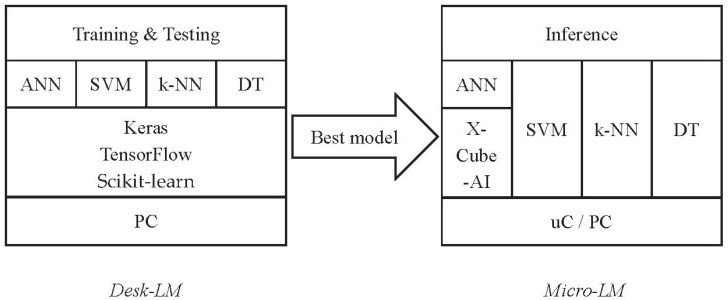
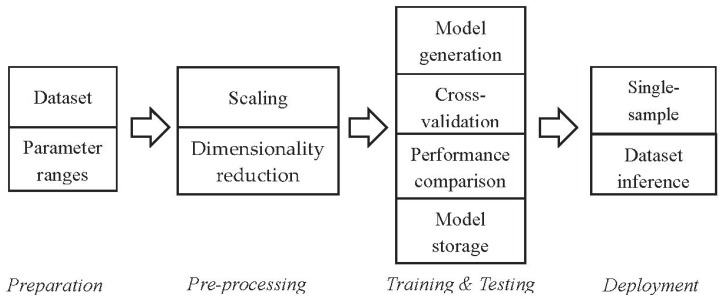
This paper presents the Edge Learning Machine (ELM), a machine learning framework for edge devices, which manages the training phase on a desktop computer and performs inferences on microcontrollers. The framework implements, in a platform-independent C language, three supervised machine learning algorithms (Support Vector Machine (SVM) with a linear kernel, k-Nearest Neighbors (K-NN), and Decision Tree (DT)), and exploits STM X-Cube-AI to implement Artificial Neural Networks (ANNs) on STM32 Nucleo boards. We investigated the performance of these algorithms on six embedded boards and six datasets (four classifications and two regression). Our analysis—which aims to plug a gap in the literature—shows that the target platforms allow us to achieve the same performance score as a desktop machine, with a similar time latency. ANN performs better than the other algorithms in most cases, with no difference among the target devices. We observed that increasing the depth of an NN improves performance, up to a saturation level. k-NN performs similarly to ANN and, in one case, even better, but requires all the training sets to be kept in the inference phase, posing a significant memory demand, which can be afforded only by high-end edge devices. DT performance has a larger variance across datasets. In general, several factors impact performance in different ways across datasets. This highlights the importance of a framework like ELM, which is able to train and compare different algorithms. To support the developer community, ELM is released on an open-source basis.
Overview
The claims and statistics of this paper haven’t been checked yet.
Free: it reads the open-access text and checks the first 5 claims that cite a source we can check. Create a free account to check every claim.
Integrity signals
Registry
Cites
Statistics
Figures
Verification
Claims the paper makes
The claims and statistics of this paper haven’t been checked yet.
Free: it reads the open-access text and checks the first 5 claims that cite a source we can check. Create a free account to check every claim.
Claims other papers make about this one
Each is checked against this paper’s own text: does it say what the citing paper says it does?
The source backs part of the claim, not all of it — or backs it for a different population, condition or comparison.
In the citing paper
“As a rough summary result, the best performance was that of ANN in all datasets except Sonar dataset. In contrast the SVM achieved the best results on the Heart and EnviroCar dataset. The performance of DT was on Virus and Peugeot 14. However, KNN achieved the best result in the Sonar dataset only.”
From TinyML: Enabling of Inference Deep Learning Models on Ultra-Low-Power IoT Edge Devices for AI Applications (2022) · cites this paper as [5]
Experimental — accuracy not yet measuredThe cited source says what the claim attributes to it.
In the citing paper
“Four algorithms were implemented on six devices from ARM Cortex-M microcontrollers released by STM-32, namely (F091RC, F303RE, F401RE, F746ZG, H743ZI2, and L452RE).”
From TinyML: Enabling of Inference Deep Learning Models on Ultra-Low-Power IoT Edge Devices for AI Applications (2022) · cites this paper as [5]
The cited source says what the claim attributes to it.
In the citing paper
“The authors [5] developed an Edge Learning Machine (ELM) framework to execute ML inference in edge devices such as Microcontroller.”
From TinyML: Enabling of Inference Deep Learning Models on Ultra-Low-Power IoT Edge Devices for AI Applications (2022) · cites this paper as [5]
Self-check
Percentages, sums and reported differences re-computed from the paper’s own numbers.
The self-check needs the paper’s full text.
Citations
Cites
Adam: A Method for Stochastic Optimization
Kingma, D. P., & Ba, J. (2014) · arXiv · doi:10.48550/arxiv.1412.6980 · Cited by 98,946
Batch Normalization: Accelerating Deep Network Training by Reducing Internal Covariate Shift
Ioffe, S., & Szegedy, C. (2015) · arXiv · doi:10.48550/arxiv.1502.03167 · Cited by 27,818
Batch Normalization: Accelerating Deep Network Training by Reducing Internal Covariate Shift
Ioffe, S. (2024) · arXiv (Cornell University) · doi:10.57702/o9raffed · Cited by 14,214
Internet of Things (IoT): A vision, architectural elements, and future directions
Gubbi, J., Buyya, R., Marusic, S., & Palaniswami, M. (2013) · Future Generation Computer Systems · doi:10.1016/j.future.2013.01.010 · Cited by 12,293 · cited 1×
“, [2]) to the edge has advantages in terms of response latency, bandwidth occupancy, energy consumption, security and expected privacy (e.”
BackgroundEdge computing: Vision and challenges
Shi, W., Cao, J., Zhang, Q., Li, Y., & Xu, L. (2016) · IEEE Internet of Things Journal · doi:10.1109/jiot.2016.2579198 · Cited by 8,733
Understanding Machine Learning: From Theory to Algorithms
Shalev-Shwartz, S., & Ben-David, S. (2014) · doi:10.1017/cbo9781107298019 · Cited by 3,115
(2007) · The MIT Press eBooks · doi:10.7551/mitpress/7496.001.0001 · Cited by 536
Computation Offloading Toward Edge Computing
Lin, L., Liao, X., Jin, H., & Li, P. (2019) · Proceedings of the IEEE · doi:10.1109/jproc.2019.2922285 · Cited by 456 · cited 1×
“The trend of moving computation towards the edge is becoming ever more relevant, leading to performance improvements and the development of new field data processing applications [1].”
BackgroundNearest-Neighbor Methods in Learning and Vision: Theory and Practice
(2006) · The MIT Press eBooks · doi:10.7551/mitpress/4908.001.0001 · Cited by 440
Generative Adversarial Networks for face generation: A survey
Kammoun, A., Slama, R., Tabia, H., Ouni, T., & Abid, M. (2022) · ACM Computing Surveys · doi:10.1145/1122445.1122456 · Cited by 311
Research works printed but not linked: 3
- Suda N. Loh D. Machine Learning on ARM Cortex-M Microcontrollers Arm Ltd. Cambridge, UK 2019
- Goodfellow I. Bengio Y. Courville A. Deep Learning The MIT Press Cambridge, UK 2016
- Vapnik V.N. Lerner A.Y. Recognition of Patterns with help of Generalized Portraits Avtomat. Telemekh. 1963 24 774 780
Cited by
Items 101–111 of 111
Cascaded Fault Diagnosis Model Based on Evidential Deep Learning
Yao, Y., Kang, J., Chen, S. W., Hu, S., Long, Y., & Wang, S. (2025) · Global Reliability and Prognostics and Health Management Conference (PHM) · doi:10.1109/phm-xian66756.2025.11427790
“Sakr et al. [6] pointed out in their research that current edge machine learning deployment schemes mainly rely on embedded microprocessor unit (MPU) platforms, including devices such as Cortex-A9 and Raspberry Pi.”
Notarianni, L., Bagnato, R., Sabatini, A., Tomaso, G. D., & Vollero, L. (2026) · Electronics · doi:10.3390/electronics15071490
MicroAI : embedded artificial intelligence for human activity recognition on smart glasses
Novac, P.-E. (2022) · theses.fr (ABES) · doi:10.70675/77c14a3ez0f87z4c4dza876z9064b1b107ec · Cited by 3
Dynamic Weighing Using MLP Neural Network Implemented on ARM Board Equipped with NPU
Passold, F., & da Silva, D. S. (2025) · IEEE CHILEAN Conference on Electrical, Electronics Engineering, Information and Communication Technologies (CHILECON) · doi:10.1109/chilecon66915.2025.11476510
“Studies benchmarking the implementation of ANNs in low-power MCUs have shown adequate inference time and accuracy in binary, classification and regression problems when using ANN architectures with up to four layers and up to a total of 650 neurons [7], [8].”
Muttaqin, A., Sakti, S. P., Butarbutar, V. D., Naba, A., Mudjirahardjo, P., & Sulistiyanto, N. (2026) · International Conference on Current Research in Artificial Intelligence and Data Science (ICCRAIDS) · doi:10.1109/iccraids67816.2026.11519746
Rajkumar, D., Praveen, B. M., Pichandi, S., Bakkiyalakshmi., B., & Mohan, D. (2026) · IEEE International Conference on Emerging Synergy Science and Technology (ICESST) · doi:10.1109/icesst69086.2026.11582902
“There are currently billions of smart monitors across the world that are linked to the Internet of Things (IoT) [1].”
Integración de IoT con inteligencia artificial mediante esp32 para aplicaciones inteligentes
soto, F. F. P., Rodríguez, Á. J. F., & Quezada, J. J. P. (2026) · ITFIPVIRTUAL · doi:10.54198/g7n5x712 · Cited by 1
Survey on Edge MLLM Architectures
Zhu, Y., Yang, F., Liao, P., & Wu, D. (2026) · Youth Academic Annual Conference of Chinese Association of Automation (YAC) · doi:10.1109/yac71005.2026.11616466
Tarhouni, M., Aicha, F. B., Khediri, S. E., & Moulahi, T. (2026) · Computing · doi:10.1007/s00607-026-01729-7
On-device ECG stress detection deployed on a resource-constrained ARM Cortex-M4 microcontroller
Cong, K. X., & Nugroho, H. (2026) · Discover Electronics · doi:10.1007/s44291-026-00279-8
“Frame-works such as TensorFlow Lite for Microcontrollers [38], STM32Cube X-CUBE-AI [39], and CMSIS-NN [40] provide tools for model conversion, optimization, and deployment.”
Fragner, C., Krutzler, C., Weiss, A. P., & Leitgeb, E. (2026) · International Conference on Transparent Optical Networks · doi:10.1109/icton71309.2026.11705213
“Machine learning techniques, particularly lightweight algorithms such as k-nearest neighbors (k-NN) or decision trees, are deployed directly on the luminaire's microcontroller [16].”
Metadata
- Authors
- Sakr, F., Bellotti, F., Berta, R., & De Gloria, A.
- Affiliations
- University of Genoa (IT)
- Department of Electrical, Electronic and Telecommunication Engineering (DITEN)-University of Genoa, Via Opera Pia 11a, 16145 Genova, Italy
- Corresponding author
- Bellotti, Francesco
- Venue
- Sensors
- Publisher
- MDPI AG
- Published
- 2020-05-05
- Volume
- 20
- Issue
- 9
- Pages
- 2638
- ISSN
- 1424-8220 (ISSN-L)
- PMC
- PMC7249132
- OpenAlex
- W3021575660
- Cited by
- 109
- References
- 27
- Citations by year
- 2026: 10 · 2025: 14 · 2024: 25 · 2023: 16 · 2022: 21 · 2021: 20 · 2020: 2
- FWCI
- 6.93
- Type
- journal article
- Language
- en
- Open access
- gold
- dx.doi.org
- Licence
- Locations
- Sensors (publishedVersion, cc-by)
- PubMed Central (publishedVersion, cc-by)
- PubMed (publishedVersion)
- DOAJ (DOAJ: Directory of Open Access Journals) (submittedVersion, cc-by-sa)
- CINECA IRIS Institutial Research Information System (University of Genoa) (submittedVersion, other-oa)
- Topics
- Physical Sciences › Computer Science › Computer Networks and Communications › IoT and Edge/Fog Computing
- Physical Sciences › Engineering › Control and Systems Engineering › Embedded Systems and FPGA Design
- Physical Sciences › Computer Science › Computer Vision and Pattern Recognition › Advanced Neural Network Applications
- Keywords
- edge machine learning, microcontroller, embedded machine learning, artificial neural networks, support vector machine, k-nearest neighbors, decision tree, supervised classification, regression analysis, inference latency, open source software framework
About these checks
Registry, retraction, Cites and statistics results are computed, not judged, with one exception: a printed reference that no index lists is read once by a model before it counts as a citation error. Claims are extracted by a model and kept only when their quote appears verbatim in the text; each cited source is then checked, with a model’s help, for whether it says what the claim relies on. Those verdicts can be wrong — read the claim’s quote and the cited source before relying on one.
Statistics and arithmetic are recomputed, not judged.
Confidence bands are shown only for fields calibrated on our annotated test set. None is calibrated yet, so no band is shown.
What counts as a claim ›How we measure confidence ›How we check this ›
Are you an author, or do you see a problem with this page? Request a review
Data sources
Bibliographic data: Semantic Scholar, OpenAlex, Crossref.
Contains information from the Semantic Scholar Academic Graph Datasets, made available under the ODC Attribution License (ODC-BY 1.0).
Semantic Scholar’s data is described in: Kinney, R., et al. (2023). The Semantic Scholar Open Data Platform. arXiv:2301.10140.
