

The DOI matches its Crossref record; 39 of the 39 references it cites were found in a registry or an index; none of the 5 sources its claims cite is checked for support yet.
Parking Time Violation Tracking Using YOLOv8 and Tracking Algorithms
Open accessAbstract
The major problem in Thailand related to parking is time violation. Vehicles are not allowed to park for more than a specified amount of time. Implementation of closed-circuit television (CCTV) surveillance cameras along with human labor is the present remedy. However, this paper presents an approach that can introduce a low-cost time violation tracking system using CCTV, Deep Learning models, and object tracking algorithms. This approach is fairly new because of its appliance of the SOTA detection technique, object tracking approach, and time boundary implementations. YOLOv8, along with the DeepSORT/OC-SORT algorithm, is utilized for the detection and tracking that allows us to set a timer and track the time violation. Using the same apparatus along with Deep Learning models and algorithms has produced a better system with better performance. The performance of both tracking algorithms was well depicted in the results, obtaining MOTA scores of (1.0, 1.0, 0.96, 0.90) and (1, 0.76, 0.90, 0.83) in four different surveillance data for DeepSORT and OC-SORT, respectively.
Overview
CoChat Summary
## TL;DR
This paper proposes a low-cost CCTV-based system for parking time violation tracking in Thailand using YOLOv8 for vehicle detection and DeepSORT or OC-SORT for tracking. On four surveillance datasets, DeepSORT achieved MOTA scores of 1.0, 1.0, 0.96, and 0.90, while OC-SORT achieved 1.0, 0.76, 0.90, and 0.83.
## Key findings
- The system detects vehicles with YOLOv8x, which the paper reports achieved a mAP of 53.9 and was selected over other YOLO versions.
- On four surveillance datasets, DeepSORT achieved MOTA scores of (1.0, 1.0, 0.96, 0.90).
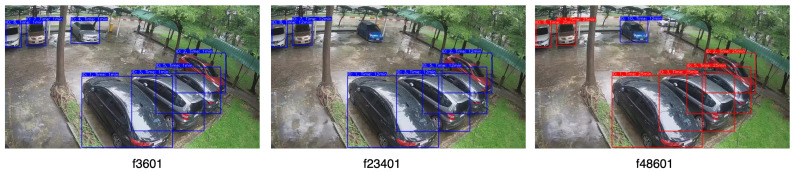
- On the same four datasets, OC-SORT achieved MOTA scores of (1.0, 0.76, 0.90, 0.83), with weaker performance in the second dataset due to frequent ID switching.
- The paper states that the method can reduce the need for manual monitoring and labor costs, and that a top-view camera placement can improve tracking accuracy by reducing overlap.
## Methods
- The study uses a CCTV-based real-time parking time violation tracking algorithm combining YOLOv8 vehicle detection with DeepSORT and OC-SORT tracking.
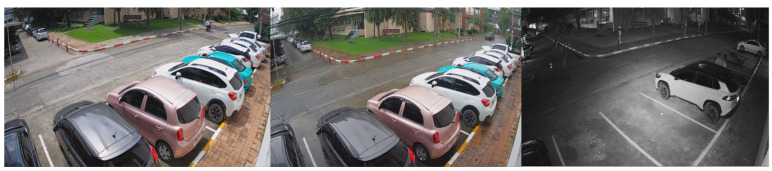
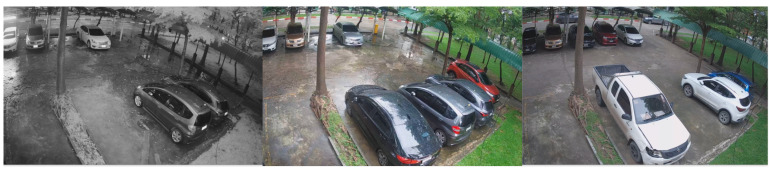
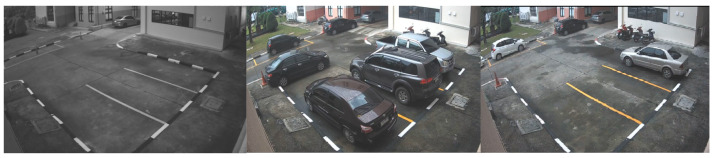
- The dataset came from 4 CCTV cameras at King Mongkut’s Institute of Technology, Ladkrabang (KMITL), with 1080P resolution and 15 FPS video, collected across different locations and daylight/weather settings.
- Evaluation used MOTA for tracking performance; the time-violation rule marked a vehicle as violating if its ID was present in 15 consecutive frames, while IDs were discarded if absent in the next 10 consecutive frames.
## Limitations
- The paper states that mini-mart data could not be acquired due to limitations and privacy concerns, so the dataset was taken from a university campus instead.
- The results show sensitivity to weather, camera position, reflections, and similar nearby vehicles; the text specifically notes OC-SORT struggled in rainy conditions and that reflections caused false negatives. This limitation is evident from the reported experiments.
- The paper notes that performance might be increased by customized training of the detection model with vehicles, which it says was not necessary but could improve robustness.
Model-written summary. Check it against the paper before relying on it.
Integrity signals
Registry
Cites
Statistics
Figures




Verification
Claims the paper makes
0 Valid · 0 Not valid · 5 Not checked · 30 Own results and interpretations
A result the paper reports from its own data — it cites no other source for it, so there is none to check. The quote shows it is in the paper.
In the paper
“The performance of both tracking algorithms was well depicted in the results, obtaining MOTA scores of (1.0, 1.0, 0.96, 0.90) and (1, 0.76, 0.90, 0.83) in four different surveillance data for DeepSORT and OC-SORT, respectively.”
- Also stated in: § 5. Conclusions · plain
“On the other hand, the OC-SORT algorithm achieved MOTA scores of (1.0, 0.76, 0.90, 0.83) across the same datasets.”
§ Parking Time Violation Tracking Using YOLOv8 and Tracking Algorithms > Abstract
plain- Asserted: passes — The authors put it forward as true.
- Checkable: passes — It can be checked against evidence.
- Load-bearing: passes — The paper’s conclusions depend on it.
- Based: passes — The paper gives a reason why it holds.
- Also stated in: § 5. Conclusions · plain
A result the paper states — it cites no source for it, so there is none to check. The quote shows it is in the paper.
In the paper
“The algorithm frequently switched vehicle IDs, leading to inaccuracies in tracking which impacted the overall performance.”
§ Parking Time Violation Tracking Using YOLOv8 and Tracking Algorithms > 4. Results and Discussion
plainstates a cause- Asserted: passes — The authors put it forward as true.
- Checkable: passes — It can be checked against evidence.
- Load-bearing: passes — The paper’s conclusions depend on it.
- Based: passes — The paper gives a reason why it holds.
A result the paper reports from its own data — it cites no other source for it, so there is none to check. The quote shows it is in the paper.
In the paper
“(1) The proposed algorithm demonstrates effective vehicle detection and tracking across various natural conditions, exploring the SOTA object detection and tracking models;”
§ Parking Time Violation Tracking Using YOLOv8 and Tracking Algorithms > 1. Introduction
boosted- Asserted: passes — The authors put it forward as true.
- Checkable: passes — It can be checked against evidence.
- Load-bearing: passes — The paper’s conclusions depend on it.
- Based: passes — The paper gives a reason why it holds.
- Rests on an assumption not shown here.
A result the paper reports from its own data — it cites no other source for it, so there is none to check. The quote shows it is in the paper.
In the paper
“The performance of YOLOv8 with DeepSORT proved to be superior for the dataset in contrast to the recently introduced OC-SORT algorithm, which had exhibited notable advancements across numerous MOT datasets.”
§ Parking Time Violation Tracking Using YOLOv8 and Tracking Algorithms > 4. Results and Discussion
plainstates a cause- Asserted: passes — The authors put it forward as true.
- Checkable: passes — It can be checked against evidence.
- Load-bearing: passes — The paper’s conclusions depend on it.
- Based: passes — The paper gives a reason why it holds.
A result the paper reports from its own data — it cites no other source for it, so there is none to check. The quote shows it is in the paper.
In the paper
“The OC-SORT algorithm did not exhibit satisfactory results on this specific dataset.”
§ Parking Time Violation Tracking Using YOLOv8 and Tracking Algorithms > 4. Results and Discussion
plain- Asserted: passes — The authors put it forward as true.
- Checkable: passes — It can be checked against evidence.
- Load-bearing: passes — The paper’s conclusions depend on it.
- Based: passes — The paper gives a reason why it holds.
11 more claims
Create a free account to see all 35 claims and every source verdict.
- It may state two separate claims as one. 10
- Probably not a substantial claim. 11
Citations
Cites
(2016) · Cited by 31,590
SSD: Single Shot MultiBox Detector
Liu, W., Anguelov, D., Erhan, D., Szegedy, C., Reed, S., Fu, C.-Y., & Berg, A. C. (2016) · Lecture Notes in Computer Science · doi:10.1007/978-3-319-46448-0_2 · Cited by 22,128
YOLO9000: Better, Faster, Stronger
Redmon, J., & Farhadi, A. (2017) · 2017 IEEE Conference on Computer Vision and Pattern Recognition (CVPR) · doi:10.1109/cvpr.2017.690 · Cited by 19,892
YOLOv3: An Incremental Improvement
Redmon, J., & Farhadi, A. (2018) · arXiv · doi:10.48550/arxiv.1804.02767 · Cited by 17,141
Object Detection With Deep Learning: A Review
Zhao, Z.-Q., Zheng, P., Xu, S.-T., & Wu, X. (2019) · IEEE Transactions on Neural Networks and Learning Systems · doi:10.1109/tnnls.2018.2876865 · Cited by 5,545
Simple online and realtime tracking with a deep association metric
Wojke, N., Bewley, A., & Paulus, D. (2017) · 2017 IEEE International Conference on Image Processing (ICIP) · doi:10.1109/icip.2017.8296962 · Cited by 5,286
Simple online and realtime tracking
Bewley, A., Ge, Z., Ott, L., Ramos, F., & Upcroft, B. (2016) · 2016 IEEE International Conference on Image Processing (ICIP) · doi:10.1109/icip.2016.7533003 · Cited by 4,433
ByteTrack: Multi-object Tracking by Associating Every Detection Box
Zhang, Y., Sun, P., Jiang, Y., Yu, D., Weng, F., Yuan, Z., Luo, P., Liu, W., & Wang, X. (2022) · Lecture Notes in Computer Science · doi:10.1007/978-3-031-20047-2_1 · Cited by 2,470
Observation-Centric SORT: Rethinking SORT for Robust Multi-Object Tracking
Cao, J., Pang, J., Weng, X., Khirodkar, R., & Kitani, K. (2023) · 2023 IEEE/CVF Conference on Computer Vision and Pattern Recognition (CVPR) · doi:10.1109/cvpr52729.2023.00934 · Cited by 1,115
Multiple object tracking: A literature review
Luo, W., Xing, J., Milan, A., Zhang, X., Liu, W., & Kim, T.-K. (2021) · Artificial Intelligence · doi:10.1016/j.artint.2020.103448 · Cited by 1,099
Research works printed but not linked: 2
- Janai, J., Güney, F., Behl, A., and Geiger, A. (2017). Computer Vision for Autonomous Vehicles: Problems, Datasets and State-of-the-Art. arXiv, Available online: http://xxx.lanl.gov/abs/1704.05519.
- Liu, W., Anguelov, D., Erhan, D., Szegedy, C., Reed, S., Fu, C.Y., and Berg, A.C. (2016). Computer Vision – ECCV 2016, Springer International Publishing.
Cited by
Hang, X., Zhu, X., Gao, X., Wang, Y., & Liu, L. (2024) · Renewable Energy · doi:10.1016/j.renene.2024.120152 · Cited by 63
Afonso, M. H. F., Teixeira, E. H., da Cruz, M. R., Aquino, G. P., & Boas, E. C. V. (2023) · IEEE International Conference on Computing (ICOCO) · doi:10.1109/icoco59262.2023.10397996 · Cited by 24
Lukovikov, D. A., Kolesnikova, T. O., Ikrin, A. N., Prokhorenko, N. O., Shevlyakov, A. D., Korotaev, A. A., Yang, L., Bley, V., de Abreu, M. S., & Kalueff, A. V. (2024) · Journal of Neuroscience Methods · doi:10.1016/j.jneumeth.2024.110256 · Cited by 21
Li, Y., Huang, Y., & Tao, Q. (2024) · Scientific Reports · doi:10.1038/s41598-024-68115-1 · Cited by 29
Çelik, M. T., Arslankaya, S., & Yıldız, A. (2024) · Measurement · doi:10.1016/j.measurement.2024.114975 · Cited by 22
Metadata
- Authors
- Sharma, N., Baral, S., Paing, M. P., & Chawuthai, R.
- Affiliations
- King Mongkut's Institute of Technology Ladkrabang (TH)
- Corresponding author
- Chawuthai, Rathachai
- Venue
- Sensors
- Publisher
- MDPI AG
- Published
- 2023-06-23
- Volume
- 23
- Issue
- 13
- Pages
- 5843
- ISSN
- 1424-8220 (ISSN-L)
- PMC
- PMC10346361
- OpenAlex
- W4382059840
- Cited by
- 78
- References
- 39
- Citations by year
- 2026: 13 · 2025: 13 · 2024: 44 · 2023: 8
- FWCI
- 7.05
- Type
- journal article
- Language
- en
- Open access
- gold
- doi.org
- Licence
- Locations
- Sensors (publishedVersion, cc-by)
- Preprints.org (acceptedVersion, cc-by)
- PubMed Central (publishedVersion, cc-by)
- PubMed (publishedVersion)
- DOAJ (DOAJ: Directory of Open Access Journals) (submittedVersion, cc-by-sa)
- Funders
- King Mongkut's Institute of Technology Ladkrabang
- Topics
- Physical Sciences › Computer Science › Computer Vision and Pattern Recognition › Video Surveillance and Tracking Methods
- Physical Sciences › Computer Science › Computer Vision and Pattern Recognition › Advanced Neural Network Applications
- Physical Sciences › Engineering › Automotive Engineering › Autonomous Vehicle Technology and Safety
- Keywords
- vehicle tracking, YOLOv8, DeepSORT, object tracking, CCTV surveillance, traffic law enforcement, low-cost monitoring system
About these checks
Registry, retraction, Cites and statistics results are computed, not judged, with one exception: a printed reference that no index lists is read once by a model before it counts as a citation error. Claims are extracted by a model and kept only when their quote appears verbatim in the text; each cited source is then checked, with a model’s help, for whether it says what the claim relies on. Those verdicts can be wrong — read the claim’s quote and the cited source before relying on one.
A language model drew the claims from the paper on 2026-10-10, under version 3 of the claim definition (model deepseek-v4.1-flash, prompt extract-v3).
A second model labelled each claim on 2026-10-10 (model jev-1.13-20260917, definition revision gold-guideline-v0.2).
Statistics and arithmetic are recomputed, not judged.
Confidence bands are shown only for fields calibrated on our annotated test set. None is calibrated yet, so no band is shown.
What counts as a claim ›How we measure confidence ›How we check this ›
Are you an author, or do you see a problem with this page? Request a review
How to cite
Cite CoChat for the checks on this page, and the paper for its own findings.
- This page
- CoChat. (2026). Citation check: Parking Time Violation Tracking Using YOLOv8 and Tracking Algorithms. https://app.cochat.ai/papers/10.3390/s23135843
- The paper
- Sharma, N., Baral, S., Paing, M. P., & Chawuthai, R. (2023). Parking Time Violation Tracking Using YOLOv8 and Tracking Algorithms. Sensors. https://doi.org/10.3390/s23135843
Data sources
Bibliographic data: Semantic Scholar, OpenAlex, Crossref.
Contains information from the Semantic Scholar Academic Graph Datasets, made available under the ODC Attribution License (ODC-BY 1.0).
Semantic Scholar’s data is described in: Kinney, R., et al. (2023). The Semantic Scholar Open Data Platform. arXiv:2301.10140.
