

Encrypted Network Traffic Analysis and Classification Utilizing Machine Learning
Open accessThe DOI matches its Crossref record; 99 of the 101 references it cites were found in a registry or an index, and 1 are not checked yet; 2 of the 47 sources its claims cite were checked for support.
Abstract
Encryption is a fundamental security measure to safeguard data during transmission to ensure confidentiality while at the same time posing a great challenge for traditional packet and traffic inspection. In response to the proliferation of diverse network traffic patterns from Internet-of-Things devices, websites, and mobile applications, understanding and classifying encrypted traffic are crucial for network administrators, cybersecurity professionals, and policy enforcement entities. This paper presents a comprehensive survey of recent advancements in machine-learning-driven encrypted traffic analysis and classification. The primary goals of our survey are two-fold: First, we present the overall procedure and provide a detailed explanation of utilizing machine learning in analyzing and classifying encrypted network traffic. Second, we review state-of-the-art techniques and methodologies in traffic analysis. Our aim is to provide insights into current practices and future directions in encrypted traffic analysis and classification, especially machine-learning-based analysis.
Verified 2026-11-22 · 1 reference not checked yet
Overview
CoChat Summary
## TL;DR
This paper is a survey of machine-learning-based encrypted network traffic analysis and classification, with emphasis on IoT devices, mobile devices/apps, and websites. It summarizes common workflows, strategies, and open problems, and argues that encrypted traffic can still be analyzed using features such as packet size, timing, direction, and statistical patterns.
## Key findings
- The survey focuses on three major encrypted-traffic application areas: the Internet of Things, mobile devices and applications, and web applications/website fingerprinting.
- It states that encrypted traffic can still be classified without decryption by using features such as packet size, inter-arrival times, packet direction, protocol headers, and statistical properties of encrypted payloads.
- For website fingerprinting, the paper notes that attacks can identify visited webpages from observed packet sequences, and that researchers use distance metrics such as unique packet-length frequencies and Levenshtein-distance variants.
- In its conclusions, the paper says classification methods support tasks such as IoT device fingerprinting and OS identification, web fingerprinting for privacy-leak/malicious-activity detection, and mobile-app traffic analysis for QoE measurement and anomaly detection.
## Methods
- The paper is a comprehensive survey of prior studies on encrypted traffic analysis and classification; it does not report a new experimental dataset or model of its own.
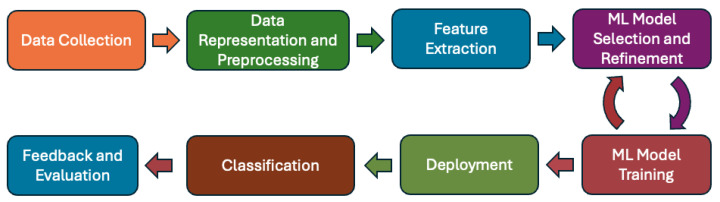
- It organizes the literature around a procedure for machine-learning-based traffic classification: data collection, preprocessing, feature extraction, model selection/refinement, model training, deployment, and feedback/evaluation.
- It synthesizes prior work on classical machine learning, deep learning, anomaly detection, feature extraction, dimensionality reduction, and deployment settings for encrypted traffic classifiers.
## Limitations
- The paper states that network dynamics such as asymmetric routing, NATing, and tunneling can affect classifier performance, and that features must be chosen to avoid being influenced by these functions.
- It states that the “curse of dimensionality,” computational overhead, memory limits, and processing time are major constraints, especially for real-time applications such as intrusion detection.
- It also notes limitations in the broader field: many public datasets lack reliable labels, real-world deployment is hindered by traffic velocity and large-scale data, and models often require continual retraining for new or unfamiliar traffic.
Model-written summary. Check it against the paper before relying on it.
Integrity signals
Registry
Cites
Statistics
Figures
Verification
Claims the paper makes
0 Valid · 2 Not valid · 30 Not checked · 22 Own results and interpretations
In the paper
“Consequently, when apps deviate from IANA rules by utilizing dynamic ports or encryption protocols like Peer to Peer (P2P) protocol, the methods used to identify traffic and applications based on ports become ineffective [19].”
§ Encrypted Network Traffic Analysis and Classification Utilizing Machine Learning > 2. Related Work
What the sources say
- Not checked — no full text of the sourcecites [19] Alrabaee S. Al-Kfairy M. Barka E. Efforts and suggestions for improving cybersecurity education Proceedings of the 2022 IEEE Global Engineering Education Conference (EDUCON) Tunis, Tunisia 28–31 March 2022 IEEE New York, NY, USA 2022 source
plainstates a cause- Asserted: passes — The authors put it forward as true.
- Checkable: passes — It can be checked against evidence.
- Load-bearing: passes — The paper’s conclusions depend on it.
- Based: passes — The paper gives a reason why it holds.
In the paper
“Machine learning has emerged as a potent solution, capable of extracting valuable insights from encrypted traffic analysis without accessing content [4].”
§ Encrypted Network Traffic Analysis and Classification Utilizing Machine Learning > 1. Introduction
What the sources say
- Not checked — no full text of the sourcecites [4] Atitallah S.B. Leveraging deep learning and IoT big data analytics to support the smart cities development: Review and future directions Comput. Sci. Rev. 2020 38 100303 10.1016/j.cosrev.2020.100303 source
plainstates a cause- Asserted: passes — The authors put it forward as true.
- Checkable: passes — It can be checked against evidence.
- Load-bearing: passes — The paper’s conclusions depend on it.
- Based: passes — The paper gives a reason why it holds.
A conclusion the paper draws from its own results — it cites no other source for it, so there is none to check. The quote shows it is in the paper.
In the paper
“The encrypted traffic exhibits diverse data distribution characteristics, even when employing the same encryption algorithm, owing to variations in the distribution and utilization of the original traffic.”
§ Encrypted Network Traffic Analysis and Classification Utilizing Machine Learning > 2. Related Work
plainstates a cause- Asserted: passes — The authors put it forward as true.
- Checkable: passes — It can be checked against evidence.
- Load-bearing: passes — The paper’s conclusions depend on it.
- Based: unclear — It is unclear why the paper says it holds.
In the paper
“Networking dynamics: network services such as asymmetric routing, NATing, and tunneling have an impact on the performance of traffic classifiers.”
§ Encrypted Network Traffic Analysis and Classification Utilizing Machine Learning > 7. Limitations
What the sources say
- Not checked — no full text of the sourcecites [92] Moustafa N. Slay J. UNSW-NB15: A comprehensive data set for network intrusion detection systems (UNSW-NB15 network data set) Proceedings of the 2015 Military Communications and Information Systems Conference (MilCIS) Canberra, Australia 10–12 November 2015 1 6 source
plainstates a cause- Asserted: passes — The authors put it forward as true.
- Checkable: passes — It can be checked against evidence.
- Load-bearing: unclear — It is unclear whether the paper’s conclusions depend on it.
- Based: passes — The paper gives a reason why it holds.
A claim is checked only against the cited paper’s full text, never its abstract, and none is available for its sources.
In the paper
“Therefore, the majority of research is centered on the binary categorization of encrypted traffic, namely the task of distinguishing harmful traffic from valid traffic [20,21].”
§ Encrypted Network Traffic Analysis and Classification Utilizing Machine Learning > 2. Related Work
What the sources say
- Not checked — no full text of the sourcecites [20] Azab A. Packing resistant solution to group malware binaries Int. J. Secur. Netw. 2020 15 123 132 10.1504/IJSN.2020.109686 source
- Not checked — no full text of the sourcecites [21] Alrabaee S. A stratified approach to function fingerprinting in program binaries using diverse features Expert Syst. Appl. 2022 193 116384 10.1016/j.eswa.2021.116384 source
plain- Asserted: passes — The authors put it forward as true.
- Checkable: passes — It can be checked against evidence.
- Load-bearing: unclear — It is unclear whether the paper’s conclusions depend on it.
- Based: passes — The paper gives a reason why it holds.
11 more claims
Create a free account to see all 54 claims and to verify the 11 references still open.
- It may state two separate claims as one. 17
- Probably not a substantial claim. 32
Citations
Cites
Deep Residual Learning for Image Recognition
He, K., Zhang, X., Ren, S., & Sun, J. (2016) · 2016 IEEE Conference on Computer Vision and Pattern Recognition (CVPR) · doi:10.1109/cvpr.2016.90 · Cited by 235,474 · cited 1×
“Different layers of the OSI architecture utilize deep packet inspection in various network components [81–84].”
BackgroundImageNet classification with deep convolutional neural networks
Krizhevsky, A., Sutskever, I., & Hinton, G. E. (2017) · Communications of the ACM · doi:10.1145/3065386 · Cited by 112,155
Xception: Deep Learning with Depthwise Separable Convolutions
Chollet, F. (2017) · 2017 IEEE Conference on Computer Vision and Pattern Recognition (CVPR) · doi:10.1109/cvpr.2017.195 · Cited by 20,380 · cited 1×
“During the step of selecting a classification approach, there are various ways available, including machine-learning technologies, statistical methods (such as heuristics), and graphical technique methods (such as motifs and graphlets) [37].”
MethodLabaca-Castro, R. (2023) · Machine Learning under Malware Attack · doi:10.1007/978-3-658-40442-0_9 · Cited by 19,272
Fast algorithms for mining association rules
Agrawal, R., & Srikant, R. (1998) · Cited by 11,307
Mining frequent patterns without candidate generation
Han, J., Pei, J., & Yin, Y. (2000) · ACM SIGMOD Record · doi:10.1145/335191.335372 · Cited by 6,402
Mining association rules between sets of items in large databases
Agrawal, R., Imieliński, T., & Swami, A. (1993) · ACM SIGMOD Record · doi:10.1145/170036.170072 · Cited by 4,551
Moustafa, N., & Slay, J. (2015) · 2015 Military Communications and Information Systems Conference (MilCIS) · doi:10.1109/milcis.2015.7348942 · Cited by 4,033 · cited 1×
“The features must be selected in a manner that ensures they are not influenced by any of these network functions [92].”
BackgroundA Survey of Data Mining and Machine Learning Methods for Cyber Security Intrusion Detection
Buczak, A. L., & Guven, E. (2016) · IEEE Communications Surveys & Tutorials · doi:10.1109/comst.2015.2494502 · Cited by 3,332
Estimating Continuous Distributions in Bayesian Classifiers
John, G. H., & Langley, P. (2013) · arXiv (Cornell University) · doi:10.48550/arxiv.1302.4964 · Cited by 2,885 · cited 1×
“Several studies have suggested several techniques for determining the application linked to a traffic flow [87–91].”
Background
Research works printed but not linked: 1
- Quinlan J.R. C4.5: Programs for machine learning Machine Learning Morgan Kaufmann San Francisco, CA, USA 1992
Cited by
El-Hajj, M. I. (2025) · Network · doi:10.3390/network5010001 · Cited by 124
“By using AI to analyze real-time network traffic patterns, encryption can be more intelligent, automatically adjusting to the nature of the communication being transmitted, whether it is video, voice, or data [107].”
Anomaly detection in encrypted network traffic using self-supervised learning
Sattar, S., Khan, S., Khan, M. I., Аkhmediyarova, A., Mamyrbayev, O. J., Kassymova, D., Оралбекова, Д., & Alimkulova, J. (2025) · Scientific Reports · doi:10.1038/s41598-025-08568-0 · Cited by 34
Fine-Grained Encrypted Traffic Classification Using Dual Embedding and Graph Neural Networks
Liu, Z., Wei, Q., Song, Q., & Duan, C. (2025) · Electronics · doi:10.3390/electronics14040778 · Cited by 20
Enhancing encrypted HTTPS traffic classification based on stacked deep ensembles models
Elshewey, A. M., & Osman, A. M. (2025) · Scientific Reports · doi:10.1038/s41598-025-21261-6 · Cited by 18
Zhang, X.-Y., Hu, M.-D., Maimaitijiang, D., Wang, T., & Wang, L. (2025) · World Journal of Gastroenterology · doi:10.3748/wjg.v31.i39.110971 · Cited by 10
Artificial intelligence abnormal driving behavior detection for mitigating traffic accidents
Takefuji, Y., Tano, M., Shigehara, M., & Sato, S. (2024) · Computers & Industrial Engineering · doi:10.1016/j.cie.2024.110667 · Cited by 7
“…al., 2024; Chen et al., 2023; Xu et al., 2022; Xu et al., 2022; Chengula et al., 2024; Yang et al., 2024; Verma et al., 2024; Prakash et al., 2024; Alwhbi et al., 2024; Podda et al., 2024; Ghoreishi et al., 2023), reveals that the maximum verification accuracy for abnormal driving behavior…”
Encrypted network traffic analysis using quantum machine learning
Sodar, G. S., Murthy, A., Jonnalagadda, A., & Cherukuri, A. K. (2026) · EPJ Quantum Technology · doi:10.1140/epjqt/s40507-025-00459-7 · Cited by 5
AI-Powered Data Encryption Techniques: Safeguarding Cloud Infrastructure
Patel, A., Ragothaman, H., Shah, M., Sheth, A., Upadhyay, C., Pandey, P., & Udayakumar, S. K. (2025) · IEEE Conference on Artificial Intelligence (CAI) · doi:10.1109/cai64502.2025.00153 · Cited by 8
“AI-based encryption ensures the network is monitored or analyzed, data traffic flow is predicted, and other resources are distributed effectively [24].”
Traffic Pattern Recognition Using IoT Sensors and Machine Learning: A Comprehensive Review
Ogunkan, S. K., & Ogunkan, D. V. (2025) · Int l Journal of Management Innovation Systems · doi:10.5296/ijmis.v9i1.22342 · Cited by 4
Real‐Time Encrypted Traffic Classification in Programmable Networks with P4 and Machine Learning
Akem, A. T., Fraysse, G., & Fiore, M. (2025) · International Journal of Network Management · doi:10.1002/nem.2320 · Cited by 11
Tang, S., Du, F., Diao, Z., & Fan, W. (2025) · Journal of Cybersecurity and Privacy · doi:10.3390/jcp5030047 · Cited by 5
Optimized Quantum-Resistant Cryptosystem: Integrating Kyber-KEM with Hardware TRNG on Zynq Platform
Zhang, K., Yang, M., Yuan, Z., Zhang, Y., & Liu, W. (2025) · Electronics · doi:10.3390/electronics14132591 · Cited by 6
MFF: A Multimodal Feature Fusion Approach for Encrypted Traffic Classification
Huang, H., Zhou, Y., Jiang, F., Zhou, X., & Jiang, Q. (2025) · Electronics · doi:10.3390/electronics14132584 · Cited by 5
Machine Learning-Powered Malware Detection in Encrypted IoT Traffic
Farhad, A., Khan, M. I., Sodhro, A. H., Ehsan, M. K., & Djebbar, F. (2025) · IEEE Vehicular Technology Conference · doi:10.1109/vtc2025-spring65109.2025.11174383 · Cited by 4
“…work addresses these gaps through machine learning (ML) and deep learning (DL) framework that combines: advanced feature mining techniques for encrypted traffic [4], lightweight model architectures suitable for IoT deployment [1], and real-time classification of emerging threat patterns [5].”
CLASSIFICATION OF NETWORK TRAFFIC USING MACHINE LEARNING MODELS ON THE NETML DATASET
Mezati, M. (2025) · International journal of Computer Networks & Communications · doi:10.5121/ijcnc.2025.17307 · Cited by 9
“Machine learning (ML) has emerged as a powerful tool for network traffic classification, offering the ability to recognize complex patterns and adapt to new traffic behaviors without requiring deep packet inspection[6][7][8][9][10].”
A comprehensive survey on encrypted network traffic classification
Han, S., Zhang, H., Lu, M., Guo, S., Tian, B., & Wang, J. (2026) · Computer Networks · doi:10.1016/j.comnet.2026.112524 · Cited by 2
Enhancing Network Traffic Monitoring Through eXplainable Artificial Intelligence Methodologies
Bucur, C.-E., Crihan, G., Rădoi, A., Robe-Voinea, E.-G., & Moroșan, I.-N. (2026) · Telecom · doi:10.3390/telecom7020034 · Cited by 2
NetTTT: Online Self-Adaptation Inference via Test-Time Training for Encrypted Traffic Classification
Liu, L., Song, X., Hu, N., Gu, Z., Tian, Z., & Jia, Y. (2026) · IEEE Internet of Things Journal · doi:10.1109/jiot.2026.3652996 · Cited by 1
Taleb, N. R. M., Zahary, A. T., Althor, H. L., Homid, H. S., Alammari, S. M., Al-Watary, M. A. K., Rafeeq, M. A., & Zubeiri, T. H. A. (2025) · International Conference on Emerging Smart Technologies and Applications (eSmarTA) · doi:10.1109/esmarta66764.2025.11132116 · Cited by 3
“Resilience to data drift Generalization may be affected 2024 [15] Encrypted traffic classification using ML Enhanced anomaly detection Some algorithms may not work efficiently in all cases 2024 [16] This section describes the data processing and machine learning methods used to detect anomalies in…”
The Evolving Landscape of Network Threats: Classification, Defense Challenges, and Future Directions
Roy, N., Tiwari, R. G., Roy, S., Agarwal, A. K., Garg, A., & Gupta, N. (2025) · International Conference on Computing Methodologies and Communication (ICCMC) · doi:10.1109/iccmc65190.2025.11140963 · Cited by 2
“Networks belonging to numerous organizations worldwide fall victim to web vulnerabilities and malicious code downloads [1].”
Performance Evaluation of LSTM Autoencoder for Behavioral-Based Insider Threat Detection
Iseed, S., & Hamarsheh, M. M. N. (2025) · International Conference on Smart Applications, Communications and Networking (SmartNets) · doi:10.1109/smartnets65254.2025.11106886 · Cited by 1
“Organizational logs such as user activities, network traffic, and system events can all be evaluated using ML and DL in real-time [9], [10], [11].”
Machine Learning Based Network Traffic Analyser for Malicious and Benign Traffic Detection
Alex, S. I., Akshata, Shashank, J., et al. (2025) · doi:10.1109/icctdc64446.2025.11158933 · Cited by 1
Machine Learning in Network Traffic Analysis: Classification, Optimization, and Security
Gujarathi, Y., & Potekar, Y. (2025) · International Journal for Research in Applied Science and Engineering Technology · doi:10.22214/ijraset.2025.68216 · Cited by 3
Veerabhadrappa, R., & Poornima, A. S. (2025) · Computer Systems Science and Engineering · doi:10.32604/csse.2025.061285 · Cited by 1
“Machine learning [11,12] and deep learning models [13–15] are increasingly utilized for analyzing encrypted traffic, taking into account both the spatial and temporal characteristics of data patterns.”
Babaei, A., Arogbonlo, A., Khosravi, A., & Lim, C. P. (2025) · Lecture notes in networks and systems · doi:10.1007/978-3-031-92605-1_22 · Cited by 1
Subach, I., Sharadkin, D., & Yakoviv, I. (2024) · Cybersecurity Education Science Technique · doi:10.28925/2663-4023.2024.25.434448 · Cited by 1
Oliveira, R. S., Gomes, T. F. N., Pinho, D., & Almeida, F. L. (2026) · Journal of Cybersecurity and Privacy · doi:10.3390/jcp6050147
Asim, A., Umair, M., Mazhar, N., & Asghar, M. N. (2026) · Applied Sciences · doi:10.3390/app16168223
Khan, F. A., Kadir, A. F. A., Ibrahim, A. A., & Khan, M. S. (2026) · Physica Scripta · doi:10.1088/1402-4896/ae999c
The attention leak: Behavioral inference from temporal metadata in network traffic
Donaire, A., Borrego, C., & Juarez, M. (2026) · Journal of Network and Computer Applications · doi:10.1016/j.jnca.2026.104560
Liyanage, D., Anuradha, D., Dineth, T. H. V., Jayasinghe, S. Y., Abeywardena, K. Y., & Pandithage, D. (2026) · Moratuwa Engineering Research Conference (MERCon) · doi:10.1109/mercon71835.2026.11691470
“…analysis: Moore and Zuev demonstrated that statistical features such as packet size distributions, inter-arrival times, and traffic directionality can classify traffic accurately without payload access [2], and later work showed such features remain discriminative under full encryption [10][11].”
Hussein, H. M., Raad, S., & QASIM, A. (2026) · Al-Noor Journal of Engineering Management and Computer Science · doi:10.71229/0rxvc265
GBFF: A Graph‐Based Feature Fusion Framework for Malware Detection in Encrypted Network Flows
Pathak, I., Indu, S., & Walia, G. S. (2026) · Concurrency and Computation Practice and Experience · doi:10.1002/cpe.70853
Graph–Time IoT IDS : Requirement‐Aligned Impact Evaluation
Dubey, K., Batra, I., Bajpai, A., Malik, A., Alshara, M. A., Jan, T., Ahmad, N., & Khalil, R. A. (2026) · Engineering Reports · doi:10.1002/eng2.70975
Cascaded Machine Learning Pipeline for Encrypted HTTPS Flow Classification
Kunz, T., Dötterl, J., & Kuipers, M. (2026) · IEEE International Conference on Network Softwarization (NetSoft) · doi:10.1109/netsoft70012.2026.11603468
Intelligent Traffic Classification Using Convolutional Neural Networks
Najm, Y. A. (2026) · International Conference on Neural Networks and Neurotechnologies (NeuroNT) · doi:10.1109/neuront71829.2026.11651393
“Moreover, class imbalance and dataset education problems remain major concerns for DL-based site visitors categorization models [17].”
Wang, J. (2026) · International Journal of Computational Intelligence Systems · doi:10.1007/s44196-026-01232-z
Wang, Y., Sun, D., Wan, W., Zhao, J., Du, G., & Long, C. (2026) · IEEE International Conference on Acoustics Speech and Signal Processing · doi:10.1109/icassp55912.2026.11462515
STEP-STA: Stepwise Token-Level Spatio-Temporal Attention for Encrypted Traffic Classification
Han, X., Guo, F., Song, C., Li, J., Zhang, M., Wei, D., & Huang, W. (2026) · IEEE International Conference on Acoustics Speech and Signal Processing · doi:10.1109/icassp55912.2026.11460879
Session Aware Encrypted Traffic Classification with Contextual Position Selection
Geng, Y., Li, Z., Yao, Y., Adesina, S., Chen, H., Bhutia, T. N., & Mir, U. (2026) · IEEE Wireless Communications and Networking Conference · doi:10.1109/wcnc65185.2026.11555206
“To overcome the above issues, researchers utilize machine and deep learning [3].”
An Ensemble Machine Learning Framework for Encrypted HTTPS Traffic Classification
Faisal, M., Nafew, A., Rahman, R. H., et al. (2026) · doi:10.1109/icmi68585.2026.11539958
“Alwhbi et al. provide an extensive review of machine-learning-based encrypted traffic analysis, detailing processes from feature extraction to classification and assessing cutting-edge methodologies for IoT, mobile, and online traffic [1].”
Koka, V. A., Bobbara, S. L., Sri, G. D., et al. (2026) · doi:10.1109/icnwc68145.2026.11518457
Zhang, Y., Zhao, Y., Ma, Y., et al. (2026) · doi:10.1109/icccs69761.2026.11613524
“Consequently, traditional Deep Packet Inspection (DPI) has become ineffective, driving the need for Encrypted Traffic Classification (ETC) based on statistical or deep learning features [1], [7].”
Application of representation learning in detecting botnet attacks
Ngoc, H. L. (2026) · Scientific Reports · doi:10.1038/s41598-026-40172-8
“To counter this, researchers are using DL to analyze metadata, TLS handshake parameters, and statistical flow characteristics to detect malicious activity without decryption 8,35 .”
AI-Based Encrypted Traffic Analysis for IoT Forensics
Darla, S., Vishesh, J., Chandra, B., et al. (2026) · doi:10.1109/iitcee67948.2026.11394685
A Deployable Platform for Real-World Network Traffic Classification Edge Devices
Tiwari, A., Sullivan, S., Stolz, C., et al. (2026) · doi:10.1109/ccwc67433.2026.11393829
Khedekar, L., & Pawar, S. (2026) · Lecture notes in networks and systems · doi:10.1007/978-3-032-06700-5_47
FEED-NIDS: Feedback-Driven Alert Refinement for ML-based NIDSPreprint
Lee, S., Ran, J. H., Park, K., & Lee, T. (2026) · SSRN Electronic Journal · doi:10.2139/ssrn.6828212
Open-World Encrypted Traffic Classification Based on Dual Evidence and Topological PersistencePreprint
Hou, Y., Wang, P., & Wang, Z. (2026) · SSRN Electronic Journal · doi:10.2139/ssrn.7021419
Mean FlowSpectrum: Enhancing Encrypted Traffic Classification via Mean-Based Similarity Correction
Kim, C., Kim, T., & Youn, J. M. (2026) · IEEE Access · doi:10.1109/access.2026.3722265
“Alwhbi et al. reviewed and discussed various algorithms, including k-NN, SVM, and autoencoder-based models, high-lighting that machine learning techniques can achieve high performance even in encrypted environments [4].”
Salman, B., Hussain, Z. A., & Aljeri, N. (2026) · SSRN Electronic Journal · doi:10.2139/ssrn.7288921
Huang, Y., Wang, X., & He, M. (2026) · IEEE Transactions on Network and Service Management · doi:10.1109/tnsm.2026.3725912
Self-Auditing Large Language Models for Real-Time Intrusion Prediction in Encrypted Networks
Roopachandrika, R., Anitha, K., & Vanitha, K. (2025) · International Conference on Emerging Research in Computational Science (ICERCS) · doi:10.1109/icercs65898.2025.11580588
“The research [7] has also demonstrated that with limited content visibility, a decryptable signal can be extracted.”
AI-Driven Security Analysis of Encrypted Communications
Rallabandi, L. N., Ullah, F., & Bhushan, S. (2025) · doi:10.1109/iot-siu65919.2025.11402715
Deep Learning for Classifying Service Priorities in Gmail Network Traffic
Aldhahery, M. A. (2025) · International Conference on Information and Communication Technology for the Muslim World (ICT4M) · doi:10.1109/ict4m68001.2025.11363548
“Alwhbi et al. [11] used machine learning algorithms like Random Forest, Decision Trees, and Support Vector Machines in their 2024 study to sort encrypted network traffic based on statistical flow features.”
Dynamic Privacy-Aware Routing (DyPAR) for Wireless Sensor Networks
Kudozia, R. Y. (2025) · International Journal of Latest Technology in Engineering Management & Applied Science · doi:10.51583/ijltemas.2025.1410000157
Malicious QUIC C2 Traffic Detection based on Random Forest in Programmable Data Plane
Hong, Y.-C., Zhang, X., Bai, Y., et al. (2025) · doi:10.1145/3769699.3771588
FusedBoostNet: A Lightweight Hybrid Model for Consumer-Grade Intrusion Detection
Sharma, A., & Rani, S. (2025) · IEEE Transactions on Consumer Electronics · doi:10.1109/tce.2025.3634568 · Cited by 1
“Alwhbi et al. [31] presented a machine learning-based solution for classifying encrypted network traffic using the ISCXVPN2016 dataset.”
Yu, L., & Xia, J. (2025) · doi:10.1109/icoiics67115.2025.11390354
“Alwhbi et al. [11] reviewed the research on encrypted network traffic analysis and classification based on machine learning.”
Spatio-Temporal Graph-Based Detection of Malware Traffic for Satellite Network
Wang, Z., Liang, Z., Wang, Z., et al. (2025) · doi:10.1109/icdm68174.2025.11309581
“Flow-based approaches treat each encrypted flow as an independent observation and extract side-channel statistics (such as packet length, inter-arrival time, and flow duration) to characterize traffic patterns [6].”
Research on Deep Learning-Based Network Communication Encrypted Traffic Classification Methods
Yang, W. (2025) · International Conference on Machine Learning, Big Data and Business Intelligence (MLBDBI) · doi:10.1109/mlbdbi67855.2025.11331423
“The feature mapping structure design adopted the[5] approach, concatenating nine metrics including quintuple delay packet length, as shown in Table 1.”
Classification and Identification of Encrypted Network Traffic Based on BP Neural Network Models
Shen, H. (2025) · IEEE International Conference on Civil Aviation Safety and Information Technology (ICCASIT) · doi:10.1109/iccasit66611.2025.11348713
Zhang, B., Jiang, W., Zhu, Q., et al. (2025) · Computer Networks · doi:10.1016/j.comnet.2025.111786
Federated Contrastive Learning for Malware Detection in TLS/QUIC Traffic Without Decryption
Rani, D. S., Alukapelly, V., Rambabu, D., et al. (2025) · doi:10.1109/i-smac65734.2025.11597719
“This has made tracing bad actors among encrypted flows one of the most urgent challenges in contemporary cybersecurity[4-6].”
Temperance: Adversary Emulation Framework
Badea, D. G., Pocris, S., & Țurcanu, D. (2025) · doi:10.1109/roedunet68395.2025.11208385
“The detection methods have moved from packet inspection to network traffic metadata analysis [19].”
Hybrid-Net: A Multimodal Deep Learning Framework for Anonymous Traffic Classification
He, Y. C., Zhong, Y., & Hu, N. (2025) · IEEE International Conference on Data Science in Cyberspace · doi:10.1109/dsc67331.2025.00035
“…structural obfuscation, and modality heterogeneity, there is a pressing need for a multimodal traffic classification framework that can simultaneously tolerate noise and differentiate between modality-specific structures [12], thereby improving model discriminability and generalization robustness.”
Minimal DFA With Optimization of Pattern Matching (MDFAOPM) for Network Traffic Analysis and Attacks
Thota, K. K., & Raj, R. J. R. (2025) · International Journal of Information Security and Privacy · doi:10.4018/ijisp.384918
Ravi, V., & Poornima, A. S. (2025) · Annual International Conference on Data Science, Machine Learning and Blockchain Technology (AICDMB) · doi:10.1109/aicdmb64359.2025.11277451
DETECTION OF HTTP FLOOD ATTACKS BASED ON MACHINE LEARNING ALGORITHMS
Karimov, N., Rakhmatov, F., & Tuxtayevich, X. O. (2025) · Himičeskaâ tehnologiâ. Kontrolʹ i upravlenie/Chemical Technology. Control and Management · doi:10.59048/2181-1105.1663 · Cited by 4
“To detect anomalies in traffic behavior, Poisson and Cauchy distributions [24, 25] were applied.”
Neural network-based symmetric encryption algorithm with encrypted traffic protocol identification
Hao, J., Jin, M., Li, Y., & Yang, Y. (2025) · PeerJ Computer Science · doi:10.7717/peerj-cs.2750
Metadata
- Authors
- Alwhbi, I. A., Zou, C. C., & Alharbi, R. N.
- Affiliations
- University of Central Florida (US)
- Corresponding author
- Zou, Cliff C.
- Venue
- Sensors
- Publisher
- MDPI AG
- Published
- 2024-05-29
- Volume
- 24
- Issue
- 11
- Pages
- 3509
- ISSN
- 1424-8220 (ISSN-L)
- PMC
- PMC11175201
- OpenAlex
- W4399181772
- Cited by
- 81
- References
- 97
- Citations by year
- 2026: 39 · 2025: 40 · 2024: 2
- FWCI
- 2.77
- Type
- journal article
- Language
- en
- Open access
- gold
- doi.org
- Licence
- Locations
- Sensors (publishedVersion, cc-by)
- PubMed Central (publishedVersion, cc-by)
- PubMed (publishedVersion)
- DOAJ (DOAJ: Directory of Open Access Journals) (submittedVersion)
- Funders
- National Science Foundation (DGE-2325452)
- Topics
- Physical Sciences › Computer Science › Artificial Intelligence › Internet Traffic Analysis and Secure E-voting
- Physical Sciences › Computer Science › Computer Networks and Communications › Network Security and Intrusion Detection
- Physical Sciences › Computer Science › Computer Vision and Pattern Recognition › Image and Video Quality Assessment
- Keywords
- encrypted traffic analysis, encrypted traffic classification, network traffic classification, Internet of Things traffic, traffic inspection, network security
About these checks
Registry, retraction, Cites and statistics results are computed, not judged, with one exception: a printed reference that no index lists is read once by a model before it counts as a citation error. Claims are extracted by a model and kept only when their quote appears verbatim in the text; each cited source is then checked, with a model’s help, for whether it says what the claim relies on. Those verdicts can be wrong — read the claim’s quote and the cited source before relying on one.
The claim verdicts this report counts are experimental: their accuracy is not yet measured.
A language model drew the claims from the paper on 2026-10-10, under version 3 of the claim definition (model deepseek-v4.1-flash, prompt extract-v3).
A second model labelled each claim on 2026-10-10 (model jev-1.13-20260917, definition revision gold-guideline-v0.2).
Statistics and arithmetic are recomputed, not judged.
Confidence bands are shown only for fields calibrated on our annotated test set. None is calibrated yet, so no band is shown.
What counts as a claim ›How we measure confidence ›How we check this ›
Are you an author, or do you see a problem with this page? Request a review
Data sources
Bibliographic data: Semantic Scholar, OpenAlex, Crossref.
Contains information from the Semantic Scholar Academic Graph Datasets, made available under the ODC Attribution License (ODC-BY 1.0).
Semantic Scholar’s data is described in: Kinney, R., et al. (2023). The Semantic Scholar Open Data Platform. arXiv:2301.10140.
