

Enhancing Security Operations Center: Wazuh Security Event Response with Retrieval-Augmented-Generation-Driven Copilot
Open accessThe DOI matches its Crossref record; 36 of the 36 references it cites were found in a registry or an index.
Abstract
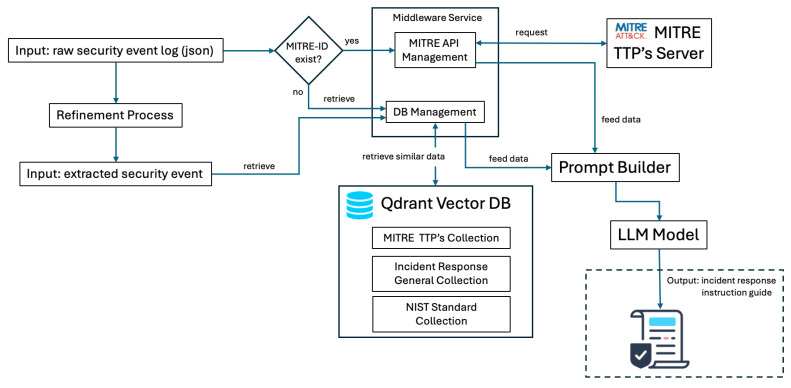
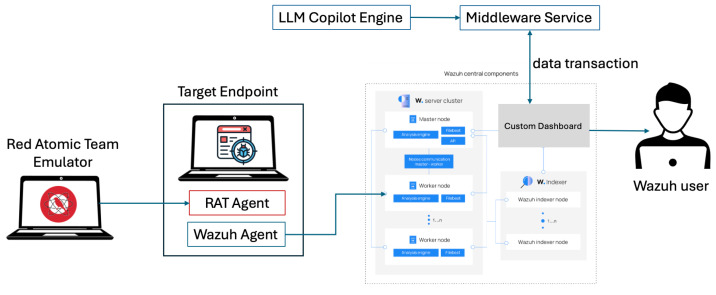
The sophistication of cyberthreats demands more efficient and intelligent tools to support Security Operations Centers (SOCs) in managing and mitigating incidents. To address this, we developed the Security Event Response Copilot (SERC), a system designed to assist analysts in responding to and mitigating security breaches more effectively. SERC integrates two core components: (1) security event data extraction using Retrieval-Augmented Generation (RAG) methods, and (2) LLM-based incident response guidance. This paper specifically utilizes Wazuh, an open-source Security Information and Event Management (SIEM) platform, as the foundation for capturing, analyzing, and correlating security events from endpoints. SERC leverages Wazuh’s capabilities to collect real-time event data and applies a RAG approach to retrieve context-specific insights from three vectorized data collections: incident response knowledge, the MITRE ATT&CK framework, and the NIST Cybersecurity Framework (CSF) 2.0. This integration bridges strategic risk management and tactical intelligence, enabling precise identification of adversarial tactics and techniques while adhering to best practices in cybersecurity. The results demonstrate the potential of combining structured threat intelligence frameworks with AI-driven models, empowered by Wazuh’s robust SIEM capabilities, to address the dynamic challenges faced by SOCs in today’s complex cybersecurity environment.
Overview
The claims and statistics of this paper haven’t been checked yet.
Free: it reads the open-access text and checks the first 5 claims that cite a source we can check. Create a free account to check every claim.
Integrity signals
Registry
Cites
Statistics
Figures
Verification
Claims the paper makes
The claims and statistics of this paper haven’t been checked yet.
Free: it reads the open-access text and checks the first 5 claims that cite a source we can check. Create a free account to check every claim.
Claims other papers make about this one
Each is checked against this paper’s own text: does it say what the citing paper says it does?
The source backs part of the claim, not all of it — or backs it for a different population, condition or comparison.
In the citing paper
“When augmented with machine-learning analytics and retrieval-augmented generation (RAG), these platforms can translate high-level intent and contextual asset data into actionable responses that close the semantic gap between zero-trust policy objectives and low-level device configurations [14-16].”
From Low-Capital Expenditure AI-Assisted Zero-Trust Control Plane for Brownfield Ethernet Environments (2026) · cites this paper as [15]
Experimental — accuracy not yet measured
Self-check
Percentages, sums and reported differences re-computed from the paper’s own numbers.
The self-check needs the paper’s full text.
Citations
Cites
BERT: Pre-training of Deep Bidirectional Transformers for Language Understanding
Devlin, J., Chang, M.-W., Lee, K., & Toutanova, K. (2018) · arXiv · doi:10.48550/arxiv.1810.04805 · Cited by 73,173
LoRA: Low-Rank Adaptation of Large Language Models
Hu, E. J., Shen, Y., Wallis, P., Allen-Zhu, Z., Li, Y., Wang, S., Wang, L., & Chen, W. (2021) · arXiv · doi:10.48550/arxiv.2106.09685 · Cited by 13,453
BERTScore: Evaluating Text Generation with BERT
Zhang, T., Kishore, V., Wu, F., Weinberger, K. Q., & Artzi, Y. (2019) · arXiv · doi:10.48550/arxiv.1904.09675 · Cited by 2,865
Retrieval-Augmented Generation for Large Language Models: A Survey
Gao, Y., Xiong, Y., Gao, X., Jia, K., Pan, J., Bi, Y., Dai, Y., Sun, J., Wang, M., & Wang, H. (2023) · arXiv · doi:10.48550/arxiv.2312.10997 · Cited by 876
ReAct: Synergizing Reasoning and Acting in Language Models
Yao, S., Zhao, J., Yu, D., Du, N., Shafran, I., Narasimhan, K., & Cao, Y. (2022) · arXiv · doi:10.48550/arxiv.2210.03629 · Cited by 608
Cichonski, P., Millar, T., Grance, T., & Scarfone, K. (2012) · doi:10.6028/nist.sp.800-61r2 · Cited by 485
Full Stack Optimization of Transformer Inference: a SurveyPreprint
Kim, S., Hooper, C. R. C., Wattanawong, T., Kang, M., Yan, R., Genc, H., Dinh, G., Huang, Q., Keutzer, K., Mahoney, M. W., et al. (2023) · arXiv (Cornell University) · doi:10.48550/arxiv.2302.14017 · Cited by 218
Security Operations Center: A Systematic Study and Open Challenges
Vielberth, M., Bohm, F., Fichtinger, I., & Pernul, G. (2020) · IEEE Access · doi:10.1109/access.2020.3045514 · Cited by 214
SecureBERT: A Domain-Specific Language Model for Cybersecurity
Aghaei, E., Niu, X., Shadid, W., & Al-Shaer, E. (2023) · Lecture Notes of the Institute for Computer Sciences, Social Informatics and Telecommunications Engineering · doi:10.1007/978-3-031-25538-0_3 · Cited by 210
Is Cosine-Similarity of Embeddings Really About Similarity?
Steck, H., Ekanadham, C., & Kallus, N. (2024) · Companion Proceedings of the ACM Web Conference 2024 · doi:10.1145/3589335.3651526 · Cited by 137
Research works printed but not linked: 13
- 7. Kaliyaperumal, L.N. The Evolution of Security Operations and Strategies for Building an Effective SOC. ISACA J. 2021, 5, 1-7.
- 10. Abo El Rob, M.F.; Islam, M.A.; Gondi, S.; Mansour, O. The Application of MITRE ATT&CK Framework in Mitigating Cybersecurity Threats in the Public Sector. Issues Inf. Syst. 2024, 25, 62-80. [CrossRef]
- 24. Khamis, R., Buallay, A., Eds.; Springer Nature: Cham, Switzerland, 2024; pp. 57-63. [CrossRef]
- 33. eWeek. QRadar vs. Splunk: SIEM Tools Review|eWeek. Available online: https://www.eweek.com/security/splunk-vs-ibm- qradar-siem-head-to-head/ (accessed on 18 December 2024).
- 38. Dunsin, D.; Ghanem, M.C.; Ouazzane, K.; Vassilev, V. A Comprehensive Analysis of the Role of Artificial Intelligence and Machine Learning in Modern Digital Forensics and Incident Response Article info. Forensic Sci. Int. Digit. Investig. 2023, 48, 301675.
- 45. Al-Sada, B.; Sadighian, A.; Oligeri, G. MITRE ATT&CK: State of the Art and Way Forward. ACM Comput. Surv. 2023, 57, 1-37.
- 46. National Institute of Standards and Technology. Framework for Improving Critical Infrastructure Cybersecurity, Version 1.1; NIST: Gaithersburg, MD, USA, 2018. Available online: http://nvlpubs.nist.gov/nistpubs/CSWP/NIST.CSWP.04162018.pdf (accessed on 20 December 2024). [CrossRef]
- 48. Chio, C.; Freeman, D. Machine Learning and Security: Protecting Systems with Data and Algorithms; O'Reilly Media: Sebastopol, CA, USA, 2018.
- 65. Fortinet. Meet Fortinet Advisor, a Generative AI Assistant that Accelerates Threat Investigation and Remediation; Fortinet: Sunnyvale, CA, USA, 2023. Available online: https://www.fortinet.com/corporate/about-us/newsroom/press-releases/2023/fortinet- advisor-a-generative-ai-assistant-accelerating-threat-investigation-and-remediation (accessed on 16 December 2024).
- 78. Landauer, M.; Mayer, K.; Skopik, F.; Wurzenberger, M.; Kern, M. Red Team Redemption: A Structured Comparison of Open- Source Tools for Adversary Emulation. arXiv 2024, arXiv:2408.15645. · arXiv
- 80. Qdrant. GitHub-Qdrant/Qdrant-Rag-Eval: This Repo Is the Central Repo for All the RAG Evaluation Reference Material and Partner Workshop. Available online: https://qdrant.tech/documentation/overview/ (accessed on 18 December 2024).
- 85. Burstein, J., Doran, C., Solorio, T., Eds.; Association for Computational Linguistics: Minneapolis, MN, USA, 2019; pp. 4171-4186. Available online: https://aclanthology.org/N19-1423/ (accessed on 23 December 2024). [CrossRef]
- Zhang, T., Kishore, V., Wu, F., Weinberger, K.Q., and Artzi, Y. (2019). BERTScore: Evaluating Text Generation with BERT. arXiv.
Cited by
Ismail, Kurnia, R., Brata, Z. A., Nelistiani, G. A., Heo, S., Kim, H., & Kim, H. (2025) · Information · doi:10.3390/info16050365 · Cited by 50
Self-citationImproving Threat Detection in Wazuh Using Machine Learning Techniques
Chamkar, S. A., Zaydi, M., Maleh, Y., & Gherabi, N. (2025) · Journal of Cybersecurity and Privacy · doi:10.3390/jcp5020034 · Cited by 26
LogRESP-Agent: A Recursive AI Framework for Context-Aware Log Anomaly Detection and TTP Analysis
Lee, J., Jeong, Y., Han, T., & Lee, T. (2025) · Applied Sciences · doi:10.3390/app15137237 · Cited by 18
LogRESP-Agent: A Recursive AI Framework for Context-Aware Log Anomaly Detection and TTP Analysis
Lee, J., Jeong, Y., Han, T., & Lee, T. (2025) · doi:10.20944/preprints202506.0235.v1 · Cited by 9
Saura, P. F., Bernabé, J. B., & Gómez, A. S. (2025) · Future Generation Computer Systems · doi:10.1016/j.future.2025.108319 · Cited by 4
Metadata
- Authors
- Ismail, Kurnia, R., Widyatama, F., Wibawa, I. M., Brata, Z. A., Ukasyah, Nelistiani, G. A., & Kim, H.
- Affiliations
- School of Computer Science and Engineering, Pusan National University, Busan 46241, Republic of Korea
- SmartM2M Co., Ltd., 701, 702, Building A, Centum Skybiz, 97 Centumjungang-ro, Haeundae-gu, Busan 48058, Republic of Korea
- Pusan National University (KR)
- Corresponding author
- Kim, Howon
- Venue
- Sensors
- Publisher
- MDPI AG
- Published
- 2025-01-31
- Volume
- 25
- Issue
- 3
- Pages
- 870
- ISSN
- 1424-8220 (ISSN-L)
- PMC
- PMC11820992
- OpenAlex
- W4407006955
- Cited by
- 16
- References
- 22
- Citations by year
- 2026: 12 · 2025: 4
- FWCI
- 6.72
- Type
- journal article
- Language
- en
- Open access
- gold
- doi.org
- Licence
- Locations
- Sensors (publishedVersion, cc-by)
- Preprints.org (acceptedVersion, cc-by)
- PubMed Central (publishedVersion, cc-by)
- PubMed (publishedVersion)
- DOAJ (DOAJ: Directory of Open Access Journals) (submittedVersion, cc-by-sa)
- Funders
- Korea government(MSIT) (RS-2024-00402782)
- Topics
- Physical Sciences › Computer Science › Computer Networks and Communications › Network Security and Intrusion Detection
- Physical Sciences › Computer Science › Information Systems › Information and Cyber Security
- Physical Sciences › Computer Science › Information Systems › Digital and Cyber Forensics
- Keywords
- security operations center, incident response, Wazuh, security information and event management, retrieval-augmented generation, large language models, security event analysis, MITRE ATT&CK, NIST Cybersecurity Framework, threat intelligence, endpoint security, AI copilots
About these checks
Registry, retraction, Cites and statistics results are computed, not judged, with one exception: a printed reference that no index lists is read once by a model before it counts as a citation error. Claims are extracted by a model and kept only when their quote appears verbatim in the text; each cited source is then checked, with a model’s help, for whether it says what the claim relies on. Those verdicts can be wrong — read the claim’s quote and the cited source before relying on one.
Statistics and arithmetic are recomputed, not judged.
Confidence bands are shown only for fields calibrated on our annotated test set. None is calibrated yet, so no band is shown.
What counts as a claim ›How we measure confidence ›How we check this ›
Are you an author, or do you see a problem with this page? Request a review
Data sources
Bibliographic data: Semantic Scholar, OpenAlex, Crossref.
Contains information from the Semantic Scholar Academic Graph Datasets, made available under the ODC Attribution License (ODC-BY 1.0).
Semantic Scholar’s data is described in: Kinney, R., et al. (2023). The Semantic Scholar Open Data Platform. arXiv:2301.10140.
