

Identifying a Test to Monitor Weightlifting Performance in Competitive Male and Female Weightlifters
Open accessThe DOI matches its Crossref record; 33 of the 33 references it cites were found in a registry or an index.
Abstract
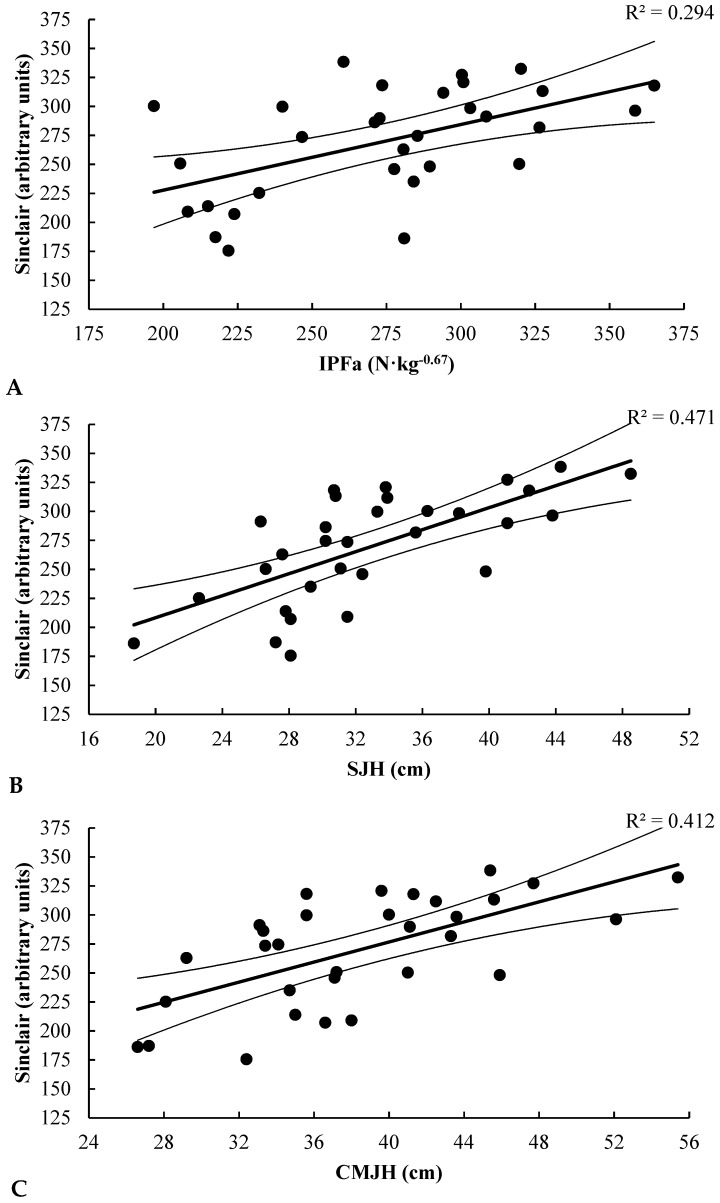
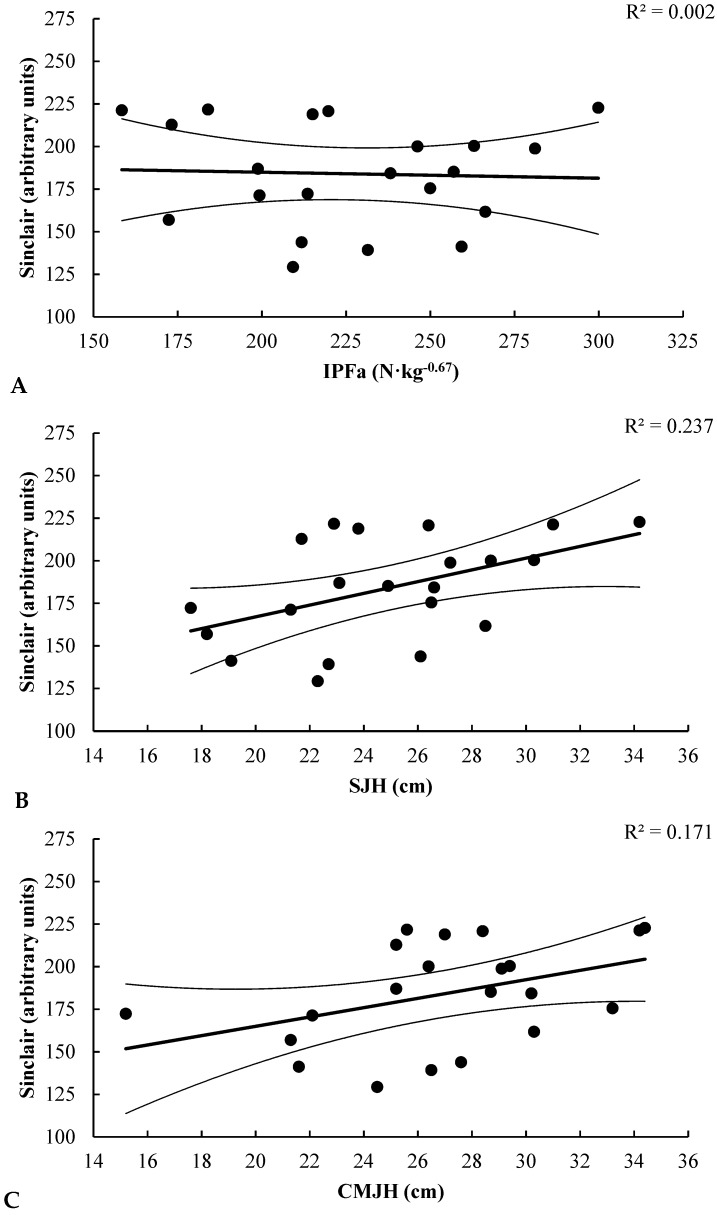
Monitoring tests are commonly used to assess weightlifter’s preparedness for competition. Although various monitoring tests have been used, it is not clear which test is the strongest indicator of weightlifting performance. Therefore, the purpose of this study was to (1) determine the relationships between vertical jump, isometric mid-thigh pull (IMTP) and weightlifting performance; and (2) compare vertical jumps to IMTP as monitoring tests of weightlifting performance in a large cohort of male and female weightlifters. Methods: Fifty-two competitive weightlifters (31 males, 21 females) participated in squat and countermovement jump testing (SJ, CMJ), and IMTP testing performed on force plates. All laboratory testing data was correlated to a recent competition where the athletes had attempted to peak. Results: Squat jump height (SJH) was the strongest correlate for men and women with the Sinclair Total (r = 0.686, p ≤ 0.01; r = 0.487, p ≤ 0.05, respectively) compared to countermovement jump height (r = 0.642, p ≤ 0.01; r = 0.413, p = 0.063), IMTP peak force allometrically scaled to body mass (r = 0.542, p ≤ 0.01; r = −0.044, p = 0.851) and rate of force development at 200 ms (r = 0.066, p = 0.723; r = 0.086, p = 0.711), respectively. Further, SJH was a stronger correlate of relative weightlifting performance compared to IMTP peak force in females (p = 0.042), but not male weightlifters (p = 0.191). Conclusions: Although CMJ and IMTP are still considered strong indicators of weightlifting performance, SJH appears to be the most indicative measure of weightlifting performance across a wide-range of performance levels. Thus, SJH can be used as a reliable measure to monitor weightlifting performance in male and female weightlifters.
Overview
The claims and statistics of this paper haven’t been checked yet.
Free: it reads the open-access text and checks the first 5 claims that cite a source we can check. Create a free account to check every claim.
Integrity signals
Registry
Cites
Statistics
Figures
Verification
Claims the paper makes
The claims and statistics of this paper haven’t been checked yet.
Free: it reads the open-access text and checks the first 5 claims that cite a source we can check. Create a free account to check every claim.
Claims other papers make about this one
Each is checked against this paper’s own text: does it say what the citing paper says it does?
The source backs part of the claim, not all of it — or backs it for a different population, condition or comparison.
In the citing paper
“This notion is supported by research that has shown SJ height to be the strongest correlate (r = 0.64) with weightlifting performance when compared with CMJ height and IMTP variables [71].”
From Comparison of weightlifting, traditional resistance training and plyometrics on strength, power and speed: a systematic review with meta-analysis. (2022) · cites this paper as [71]
Experimental — accuracy not yet measured
Self-check
Percentages, sums and reported differences re-computed from the paper’s own numbers.
The self-check needs the paper’s full text.
Citations
Cites
A Simple Sequentially Rejective Multiple Test Procedure
(1979) · Scandinavian Journal of Statistics · doi:10.2307/4615733 · Cited by 21,526 · cited 1×
“A Holm’s sequential Bonferroni procedure was used to control Type I error inflation [28].”
MethodRate of force development: physiological and methodological considerations
Maffiuletti, N. A., Aagaard, P., Blazevich, A. J., Folland, J., Tillin, N., & Duchateau, J. (2016) · European Journal of Applied Physiology · doi:10.1007/s00421-016-3346-6 · Cited by 1,424 · cited 3×
“The start of each pull was identified by visual inspection [23].”
BackgroundMethodInfluentialWhy is countermovement jump height greater than squat jump height?
BOBBERT, M. F., GERRITSEN, K. G. M., LITJENS, M. C. A., & VAN SOEST, A. J. (1996) · Medicine & Science in Sports & Exercise · doi:10.1097/00005768-199611000-00009 · Cited by 812 · cited 1×
“The act of holding the start position is thought to remove the contribution of series elastic components in the hip, knee, and ankle extensors so that the jumper must rely on concentric muscle action instead of the stretch-shortening cycle to generate high take-off velocities [33,34].”
BackgroundAnalysis of standing vertical jumps using a force platform
Linthorne, N. P. (2001) · American Journal of Physics · doi:10.1119/1.1397460 · Cited by 804
Nuzzo, J. L., McBride, J. M., Cormie, P., & McCaulley, G. O. (2008) · Journal of Strength and Conditioning Research · doi:10.1519/jsc.0b013e31816d5eda · Cited by 407
BOSCO, C., VIITASALO, J. T., KOMI, P. V., & LUHTANEN, P. (1982) · Acta Physiologica Scandinavica · doi:10.1111/j.1748-1716.1982.tb07024.x · Cited by 342 · cited 1×
“The act of holding the start position is thought to remove the contribution of series elastic components in the hip, knee, and ankle extensors so that the jumper must rely on concentric muscle action instead of the stretch-shortening cycle to generate high take-off velocities [33,34].”
BackgroundCarlock, J. M., Smith, S. L., Hartman, M. J., Morris, R. T., Ciroslan, D. A., Pierce, K. C., Newton, R. U., Harman, E. A., Sands, W. A., & Stone, M. H. (2004) · Journal of Strength and Conditioning Research · doi:10.1519/00124278-200408000-00025 · Cited by 318 · cited 2×
“76) have been observed in national level male and female weightlifters [8].”
BackgroundRelationship Between Strength Characteristics and Unweighted and Weighted Vertical Jump Height
Kraska, J. M., Ramsey, M. W., Haff, G. G., Fethke, N., Sands, W. A., Stone, M. E., & Stone, M. H. (2009) · International Journal of Sports Physiology and Performance · doi:10.1123/ijspp.4.4.461 · Cited by 270 · cited 3×
“, 1-RM back squat, IMTP peak force) than CMJs [14,30,32].”
BackgroundMethodMaximum Strength-Power-Performance Relationships in Collegiate Throwers
STONE, M. H., SANBORN, K., OʼBRYANT, H. S., HARTMAN, M., STONE, M. E., PROULX, C., WARD, B., & HRUBY, J. (2003) · Journal of Strength and Conditioning Research · doi:10.1519/00124278-200311000-00019 · Cited by 254
HAFF, G. G., CARLOCK, J. M., HARTMAN, M. J., KILGORE, J. L., KAWAMORI, N., JACKSON, J. R., MORRIS, R. T., SANDS, W. A., & STONE, M. H. (2005) · Journal of Strength and Conditioning Research · doi:10.1519/00124278-200511000-00004 · Cited by 251 · cited 2×
“80, respectively) were also reported in a group of elite female weightlifters [13].”
BackgroundRelationship of maximum strength to weightlifting performance.
Stone, M. H., Sands, W. A., Pierce, K. C., Carlock, J., Cardinale, M., & Newton, R. U. (2005) · PubMed · Cited by 210
MCBRIDE, J. M., TRIPLETT-MCBRIDE, T., DAVIE, A., & NEWTON, R. U. (1999) · The Journal of Strength and Conditioning Research · doi:10.1519/1533-4287(1999)013<0058:acosap>2.0.co;2 · Cited by 204
Validity of vertical jump measurement devices
Buckthorpe, M., Morris, J., & Folland, J. P. (2012) · Journal of Sports Sciences · doi:10.1080/02640414.2011.624539 · Cited by 198 · cited 1×
“Therefore, an analysis with more robust instrumentation is needed to confirm these relationships [17,18].”
Background(2003) · Wiley eBooks · doi:10.1002/9780470757215 · Cited by 164
Manipulating Resistance Training Program Variables to Optimize Maximum Strength in Men: A Review
TAN, B. (1999) · Journal of Strength and Conditioning Research · doi:10.1519/00124278-199908000-00019 · Cited by 154
Häkkinen, K., Komi, P., & Kauhanen, H. (1986) · International Journal of Sports Medicine · doi:10.1055/s-2008-1025752 · Cited by 133 · cited 1×
“, 200 and 250 ms), has been shown to be closely related to maximal isometric force and weightlifting performance [13,14,30,31].”
BackgroundThe pull in olympic weightlifting.
Enoka, R. M. (1979) · PubMed · Cited by 126
Propulsion Forces as a Function of Intensity for Weightlifting and Vertical Jumping
Garhammer, J., & Gregor, R. (1992) · Journal of Strength and Conditioning Research · doi:10.1519/00124278-199208000-00001 · Cited by 126
Effect of Body Position on Force Production During the Isometric Midthigh Pull
Beckham, G. K., Sato, K., Santana, H. A. D. P., Mizuguchi, S., Haff, G. G., & Stone, M. H. (2017) · The Journal of Strength and Conditioning Research · doi:10.1519/jsc.0000000000001968 · Cited by 122 · cited 1×
“It has been suggested that giving verbal encouragement to achieve a higher IPF for each trial allows variables such as RFD to be measured appropriately [22].”
BackgroundSelf-citationANTHROPOMETRIC AND PERFORMANCE VARIABLES DISCRIMINATING ELITE AMERICAN JUNIOR MEN WEIGHTLIFTERS
FRY, A. C., CIROSLAN, D., FRY, M. D., LEROUX, C. D., SCHILLING, B. K., & CHIU, L. Z. F. (2006) · Journal of Strength and Conditioning Research · doi:10.1519/00124278-200611000-00023 · Cited by 121
Kinematic and Kinetic Relationships Between an Olympic-Style Lift and the Vertical Jump
Canavan, P. K., Garrett, G. E., & Armstrong, L. E. (1996) · Journal of Strength and Conditioning Research · doi:10.1519/00124278-199605000-00014 · Cited by 109
Haff, G. G., Jackson, J. R., Kawamori, N., Carlock, J., Hartman, M. J., Kilgore, J. L., Morris, R. T., Ramsey, M. W., Sands, W. A., & Stone, M. H. (2008) · The Journal of Strength and Conditioning Research · doi:10.1519/jsc.0b013e31816191be · Cited by 99 · cited 4×
“, 1-RM back squat, IMTP peak force) than CMJs [14,30,32].”
BackgroundResultInfluentialHornsby, W. G., Gentles, J. A., MacDonald, C., Mizuguchi, S., Ramsey, M. W., & Stone, M. H. (2017) · Sports · doi:10.3390/sports5040078 · Cited by 97 · cited 4×
“Athletes were positioned with an upright torso and hip angle of approximately 145 ± 5◦ [1].”
BackgroundMethodResultInfluentialThe Effects of Strength Training and Detraining on Children
Faigenbaum, A. D., Westcott2, W. L., Micheli, L. J., Outerbridge, A. R., Long, C. J., LaRosa-Loud, R., & Zaichkowsky, L. D. (1996) · The Journal of Strength and Conditioning Research · doi:10.1519/1533-4287(1996)010<0109:teosta>2.3.co;2 · Cited by 64
Vertical jump as a tool in assessment of muscular power and anaerobic performance
Ostojić, S. M., Stojanović, M. D. M., & Ahmetović, Z. (2010) · Medicinski pregled · doi:10.2298/mpns1006371o · Cited by 49 · cited 1×
“Vertical jumps have been widely used to evaluate general athletic ability [16] and are biomechanically similar to weightlifting movements [8–10].”
BackgroundCould the Deep Squat Jump Predict Weightlifting Performance?
Pérez, F. J. V., Viana, O., Fernández‐del‐Olmo, M., & Acero, R. M. (2009) · The Journal of Strength and Conditioning Research · doi:10.1519/jsc.0b013e3181a04dc3 · Cited by 38 · cited 2×
“However, some of these studies used contact mats, possibly leading to lower estimations of these relationships compared to force platforms or motion analysis software [7].”
BackgroundResultBazyler, C. D., Mizuguchi, S., Sole, C. J., Suchomel, T. J., Sato, K., Kavanaugh, A. A., DeWeese, B. H., & Stone, M. H. (2017) · The Journal of Strength and Conditioning Research · doi:10.1519/jsc.0000000000001912 · Cited by 38
Self-citationNormalizing the performances of athletes in Olympic weightlifting.
Rg, S. (1985) · PubMed · Cited by 29
Carroll, K. M., Wagle, J. P., Sato, K., DeWeese, B. H., Mizuguchi, S., & Stone, M. H. (2017) · Sports Biomechanics · doi:10.1080/14763141.2017.1372514 · Cited by 27
DiNaso, J., Pritschet, B. L., Emmett, J. D., Owen, J. D., Willardson, J. M., Beck, T. W., DeFreitas, J. M., & Fontana, F. E. (2012) · Journal of Collective Bargaining in the Academy · Cited by 16
Harbili, S. (2015) · Isokinetics and Exercise Science · doi:10.3233/ies-150569 · Cited by 16
Bazyler, C. D., Mizuguchi, S., Kavanaugh, A. A., McMahon, J. J., Comfort, P., & Stone, M. H. (2017) · International Journal of Sports Physiology and Performance · doi:10.1123/ijspp.2017-0474 · Cited by 16
Self-citation(2013) · PubMed
Self-citation
Research works printed but not linked: 1
- Stone M.H. Kenton B. Kirksey Physiology of Weight Lifting Exercise and Sport Science Lippincott Williams & Wilkins Philadelphia, PA, USA 2000 941 954
Cited by
Morris, S. J., Oliver, J. L., Pedley, J. S., Haff, G. G., & Lloyd, R. S. (2022) · Sports Medicine · doi:10.1007/s40279-021-01627-2 · Cited by 103
“64) with weightlifting performance when compared with CMJ height and IMTP variables [71].”
BackgroundRelationship of Limb Lengths and Body Composition to Lifting in Weightlifting
Pérez, D. V., Sanz, J. M. M., Férriz-Valero, A., Gómez‐Vicente, V., & Ausó, E. (2021) · International Journal of Environmental Research and Public Health · doi:10.3390/ijerph18020756 · Cited by 66
“Other studies also show similar weights and statures for men and women weightlifters [32,33].”
ResultThe Effects of Caffeine on Jumping Performance and Maximal Strength in Female Collegiate Athletes
Burke, B. I., Travis, S. K., Gentles, J. A., Sato, K., Lang, H. M., & Bazyler, C. D. (2021) · Nutrients · doi:10.3390/nu13082496 · Cited by 42
Self-citationPreparing for a National Weightlifting Championship: A Case Series
Travis, S. K., Mizuguchi, S., Stone, M. H., Sands, W. A., & Bazyler, C. D. (2019) · The Journal of Strength and Conditioning Research · doi:10.1519/jsc.0000000000003312 · Cited by 35
Self-citationPrediction of competition performance via selected strength-power tests in junior weightlifters
İnce, İ., & Ulupınar, S. (2020) · The Journal of Sports Medicine and Physical Fitness · doi:10.23736/s0022-4707.19.10085-0 · Cited by 24
Metadata
- Authors
- Travis, S. K., Goodin, J. R., Beckham, G. K., & Bazyler, C. D.
- Affiliations
- East Tennessee State University (US)
- Kinesiology Department, California State University, Seaside, CA 93955, USA
- Corresponding author
- Travis, S. Kyle
- Venue
- Sports
- Publisher
- MDPI AG
- Published
- 2018-05-23
- Volume
- 6
- Issue
- 2
- Pages
- 46
- ISSN
- 2075-4663 (ISSN-L)
- PMC
- PMC6026842
- OpenAlex
- W2804463389
- Semantic Scholar
- 6e037f69de37bf970d5cae8956c48014adb4f6f8
- Cited by
- 36
- References
- 31
- Citations by year
- 2026: 1 · 2025: 2 · 2024: 1 · 2023: 3 · 2022: 6 · 2021: 12 · 2020: 4 · 2019: 7
- FWCI
- 6.27
- Type
- journal article
- Language
- en
- Open access
- gold
- doi.org
- Licence
- Locations
- Sports (publishedVersion, cc-by)
- Europe PMC (PubMed Central) (publishedVersion, cc-by)
- PubMed Central (publishedVersion, cc-by)
- PubMed (publishedVersion)
- Digital Commons - East Tennessee State University (East Tennessee State University) (submittedVersion, cc-by)
- DOAJ (DOAJ: Directory of Open Access Journals) (submittedVersion, cc-by-sa)
- Topics
- Health Sciences › Medicine › Orthopedics and Sports Medicine › Sports Performance and Training
- Health Sciences › Health Professions › Physical Therapy, Sports Therapy and Rehabilitation › Physical Education and Training Studies
- Social Sciences › Psychology › Developmental and Educational Psychology › Sport Psychology and Performance
- Keywords
- weightlifting performance, countermovement jump, isometric mid-thigh pull, rate of force development, sex differences, performance prediction
About these checks
Registry, retraction, Cites and statistics results are computed, not judged, with one exception: a printed reference that no index lists is read once by a model before it counts as a citation error. Claims are extracted by a model and kept only when their quote appears verbatim in the text; each cited source is then checked, with a model’s help, for whether it says what the claim relies on. Those verdicts can be wrong — read the claim’s quote and the cited source before relying on one.
Statistics and arithmetic are recomputed, not judged.
Confidence bands are shown only for fields calibrated on our annotated test set. None is calibrated yet, so no band is shown.
What counts as a claim ›How we measure confidence ›How we check this ›
Are you an author, or do you see a problem with this page? Request a review
Data sources
Bibliographic data: Semantic Scholar, OpenAlex, Crossref.
Contains information from the Semantic Scholar Academic Graph Datasets, made available under the ODC Attribution License (ODC-BY 1.0).
Semantic Scholar’s data is described in: Kinney, R., et al. (2023). The Semantic Scholar Open Data Platform. arXiv:2301.10140.
