

The DOI matches its Crossref record; the references it cites are not checked yet.
Effect of Exercise-Induced Muscle Damage on Bowling-Specific Motor Skills in Male Adolescent Cricketers
Open accessAbstract
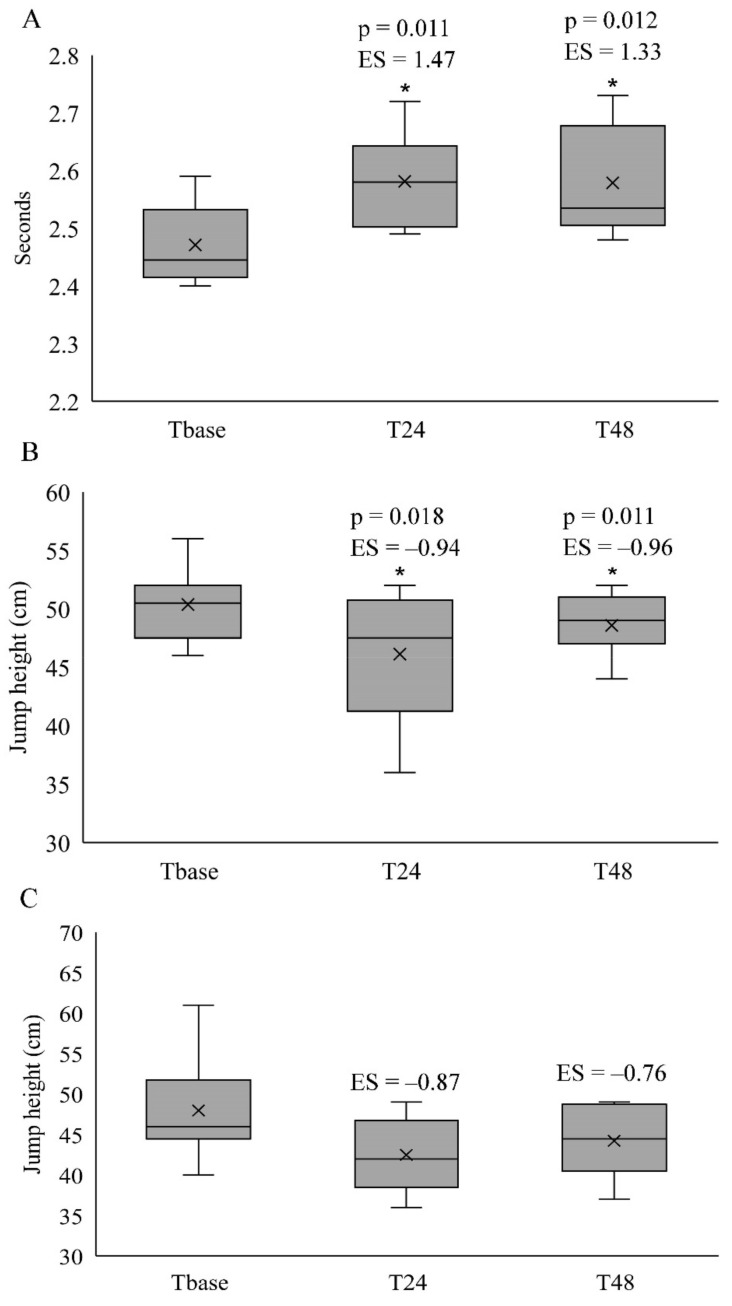
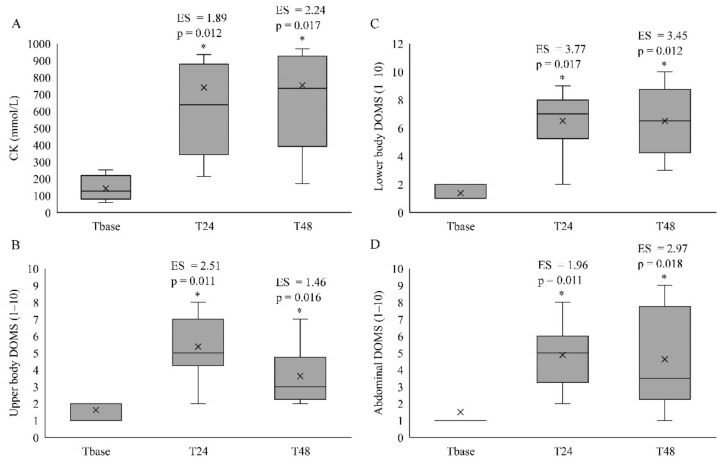
The current study examined the acute effects of a bout of resistance training on cricket bowling-specific motor performance. Eight sub-elite, resistance-untrained, adolescent male fast bowlers (age 15 ± 1.7 years; height 1.8 ± 0.1 m; weight 67.9 ± 7.9 kg) completed a bout of upper and lower body resistance exercises. Indirect markers of muscle damage (creatine kinase [CK] and delayed onset of muscle soreness [DOMS]), anaerobic performance (15-m sprint and vertical jump), and cricket-specific motor performance (ball speed, run-up time, and accuracy) were measured prior to and 24 (T24) and 48 (T48) hours following the resistance training bout. The resistance training bout significantly increased CK (~350%; effect size [ES] = 1.89-2.24), DOMS (~240%; ES = 1.46-3.77) and 15-m sprint times (~4.0%; ES = 1.33-1.47), whilst significantly reducing vertical jump height (~7.0%; ES = 0.76-0.96) for up to 48 h. The ball speed (~3.0%; ES = 0.50-0.61) and bowling accuracy (~79%; ES = 0.39-0.70) were significantly reduced, whilst run-up time was significantly increased (~3.5%; ES = 0.36-0.50) for up to 24 h. These findings demonstrate that a bout of resistance training evokes exercise-induced muscle damage amongst sub-elite, adolescent male cricketers, which impairs anaerobic performance and bowling-specific motor performance measures. Cricket coaches should be cautious of incorporating bowling sessions within 24-h following a bout of resistance training for sub-elite adolescent fast bowlers, particularly for those commencing a resistance training program.
Overview
The claims and statistics of this paper haven’t been checked yet.
Run the check — free, no account needed. It reads the open-access text and checks the sources it cites.
Integrity signals
Registry
Cites
Statistics
Figures
Verification
Claims the paper makes
The claims and statistics of this paper haven’t been checked yet.
Run the check — free, no account needed. It reads the open-access text and checks the sources it cites.
Claims other papers make about this one
Each is checked against this paper’s own text: does it say what the citing paper says it does?
The source backs part of the claim, not all of it — or backs it for a different population, condition or comparison.
In the citing paper
“Although a significant increase in CK has been shown to reduce ball release speed (~3%) and bowling accuracy (~79%) in fast bowlers [25] however, this was in response to resistance training and not as a result of bowling.”
From Creatine kinase and neuromuscular fatigue responses following differing spells of simulated cricket fast bowling (2025) · cites this paper as [25]
Experimental — accuracy not yet measuredThe source backs part of the claim, not all of it — or backs it for a different population, condition or comparison.
In the citing paper
“Repeated high-intensity bouts of eccentric exercise, impose high mechanical strain and may result in lower limb muscle or tissue damage [9, 24–26].”
From Creatine kinase and neuromuscular fatigue responses following differing spells of simulated cricket fast bowling (2025) · cites this paper as [25]
Experimental — accuracy not yet measuredThe source backs part of the claim, not all of it — or backs it for a different population, condition or comparison.
In the citing paper
“Despite the significant increases in CK concentrations, no change in bowling accuracy was demonstrated, post resistance training, despite changes in run-up speed and 15-m sprint time.”
From Creatine kinase and neuromuscular fatigue responses following differing spells of simulated cricket fast bowling (2025) · cites this paper as [25]
Experimental — accuracy not yet measuredThe source backs part of the claim, not all of it — or backs it for a different population, condition or comparison.
In the citing paper
“Doma, et al., [25] induced muscle damage through a bowling-specific resistance training session”
From Creatine kinase and neuromuscular fatigue responses following differing spells of simulated cricket fast bowling (2025) · cites this paper as [25]
Experimental — accuracy not yet measuredThe source backs part of the claim, not all of it — or backs it for a different population, condition or comparison.
In the citing paper
“Repeated high-intensity bouts of exercise, particularly that of the fast-bowling action, place large eccentric strain on the body and are documented as a cause of muscle damage [9, 24–26, 49].”
From Creatine kinase and neuromuscular fatigue responses following differing spells of simulated cricket fast bowling (2025) · cites this paper as [25]
Experimental — accuracy not yet measured
The cited source says what the claim attributes to it.
In the citing paper
“The sample size attained in this study (n = 11), is similar to those implemented in previous simulated cricket fast-bowling research [19, 23–25, 35].”
From Creatine kinase and neuromuscular fatigue responses following differing spells of simulated cricket fast bowling (2025) · cites this paper as [25]
The cited source says what the claim attributes to it.
In the citing paper
“Doma, Leicht [25] reported a significant increase in CK concentrations at both 24- and 48-hours post exercise.”
From Creatine kinase and neuromuscular fatigue responses following differing spells of simulated cricket fast bowling (2025) · cites this paper as [25]
Self-check
Percentages, sums and reported differences re-computed from the paper’s own numbers.
The self-check needs the paper’s full text.
Citations
The citation lists are queued
They are fetched later and appear here then.
References 39 · Cited by 5
Metadata
- Authors
- Doma, K., Leicht, A., Woods, C., Harrison, D., McGuckin, T., & Connor, J.
- Affiliations
- James Cook University (AU)
- Victoria University (AU)
- Sport and Exercise Science, College of Healthcare Sciences, James Cook University, Townsville, QLD 4811, Australia
- Corresponding author
- Doma, Kenji
- Venue
- Sports
- Publisher
- MDPI AG
- Published
- 2021-07-19
- Volume
- 9
- Issue
- 7
- Pages
- 103
- ISSN
- 2075-4663 (ISSN-L)
- PMC
- PMC8309793
- OpenAlex
- W3183811612
- Cited by
- 5
- References
- 39
- Citations by year
- 2025: 1 · 2024: 1 · 2023: 1 · 2022: 2
- FWCI
- 0.98
- Type
- journal article
- Language
- en
- Open access
- gold
- doi.org
- Licence
- Locations
- Sports (publishedVersion, cc-by)
- PubMed Central (publishedVersion, cc-by)
- PubMed (publishedVersion)
- Victoria University Research Repository (Victoria University) (submittedVersion, cc-by)
- ResearchOnline - JCU (James Cook University) (submittedVersion)
- DOAJ (DOAJ: Directory of Open Access Journals) (submittedVersion, cc-by-sa)
- Topics
- Health Sciences › Medicine › Orthopedics and Sports Medicine › Sports Performance and Training
- Health Sciences › Medicine › Physiology (medical) › Exercise and Physiological Responses
- Social Sciences › Psychology › Developmental and Educational Psychology › Sport Psychology and Performance
- Keywords
- exercise-induced muscle damage, resistance training, cricket bowling, fast bowlers, youth athletes, creatine kinase, delayed onset muscle soreness, anaerobic performance, sprint performance, vertical jump, ball speed, training scheduling
About these checks
Registry, retraction, Cites and statistics results are computed, not judged, with one exception: a printed reference that no index lists is read once by a model before it counts as a citation error. Claims are extracted by a model and kept only when their quote appears verbatim in the text; each cited source is then checked, with a model’s help, for whether it says what the claim relies on. Those verdicts can be wrong — read the claim’s quote and the cited source before relying on one.
Statistics and arithmetic are recomputed, not judged.
Confidence bands are shown only for fields calibrated on our annotated test set. None is calibrated yet, so no band is shown.
What counts as a claim ›How we measure confidence ›How we check this ›
Are you an author, or do you see a problem with this page? Request a review
How to cite
Cite CoChat for the checks on this page, and the paper for its own findings.
- This page
- CoChat. (2026). Citation check: Effect of Exercise-Induced Muscle Damage on Bowling-Specific Motor Skills in Male Adolescent Cricketers. https://app.cochat.ai/papers/10.3390/sports9070103
- The paper
- Doma, K., Leicht, A., Woods, C., Harrison, D., McGuckin, T., & Connor, J. (2021). Effect of Exercise-Induced Muscle Damage on Bowling-Specific Motor Skills in Male Adolescent Cricketers. Sports. https://doi.org/10.3390/sports9070103
