

Assessing the Impact of COVID-19 on Consumer Food Safety Perceptions—A Choice-Based Willingness to Pay Study
Open accessThe DOI matches its Crossref record; 51 of the 52 references it cites were found in a registry or an index.
Abstract
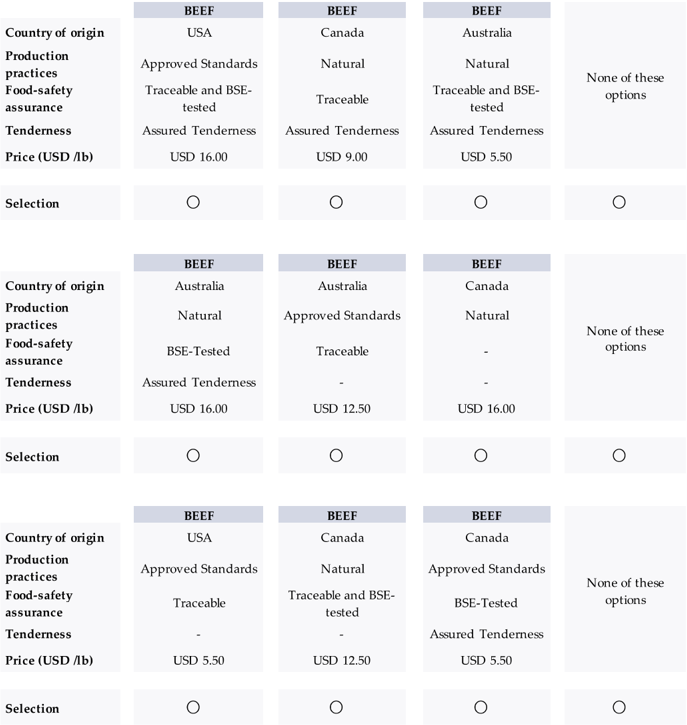
As the COVID-19 pandemic brings about sudden change in societies across the globe and likely heralds the start of a recession, we examine the pandemic’s impact on consumer food safety perceptions. Due to its origin, COVID-19, likely spurring from an animal-to-human transmission in the context of a wet market, may impact consumer food perceptions in similar ways to the avian flu (H5N1) and the swine flu (H1N1). We examine this effect by studying preferences for beef meat in a consumer survey in the United States (n = 999) using a choice-based experiment. We compare our findings to Lim et al. (2014), who elicited consumer beef willingness to pay (WTP). Additionally, we investigate the impact of the looming recession by analyzing several attributes and their effect on consumer preferences. Our findings suggest that food safety concerns have become more important. As a result, production standards and the country of origin have lost importance. Additionally, we show that the socioeconomic impact for some respondents impacts their shopping preferences. Finally, we outline potential areas for future research as well as managerial implications.
Overview
The claims and statistics of this paper haven’t been checked yet.
Free: it reads the open-access text and checks the first 5 claims that cite a source we can check. Create a free account to check every claim.
Integrity signals
Registry
Cites
Statistics
Figures
Verification
Claims the paper makes
The claims and statistics of this paper haven’t been checked yet.
Free: it reads the open-access text and checks the first 5 claims that cite a source we can check. Create a free account to check every claim.
Claims other papers make about this one
Each is checked against this paper’s own text: does it say what the citing paper says it does?
The source backs part of the claim, not all of it — or backs it for a different population, condition or comparison.
In the citing paper
“The pandemic has significantly altered how individuals approach food safety and foodborne illness prevention. Heightened awareness of contamination pathways has led to increased adherence to hand hygiene practices and a reduction in common food handling errors [12,13].”
From Assessing food safety practices and foodborne illness risk factors in Brazilian households. (2025) · cites this paper as [12]
Experimental — accuracy not yet measured
Self-check
Percentages, sums and reported differences re-computed from the paper’s own numbers.
The self-check needs the paper’s full text.
Citations
Cites
1 retracted
RETRACTED ARTICLE: Determinants of consumer willingness to pay for certified safe vegetables
Amfo, B., Donkoh, S. A., & Ansah, I. G. K. (2018) · International Journal of Vegetable Science · doi:10.1080/19315260.2018.1484836 · Cited by 13 · cited 1×
“[28] WTP estimation for certified safe vegetables Consumer survey in Ghana (n = 300) Contingent valuation Higher WTP for certified safe vegetables to avoid health-related risks Need to strengthen consumer trust in certification institutions”
RetractedA pneumonia outbreak associated with a new coronavirus of probable bat origin
Zhou, P., Yang, X.-L., Wang, X.-G., Hu, B., Zhang, L., Zhang, W., Si, H.-R., Zhu, Y., Li, B., Huang, C.-L., et al. (2020) · Nature · doi:10.1038/s41586-020-2012-7 · Cited by 21,969 · cited 1×
“With COVID-19 caused by the SARS-CoV-2 virus, probably originating from bats [7] with a suspected animal-to-human transmission in the context of a wet market [2], creating a pandemic of proportions unseen since the Spanish flu, we seek to examine what impact this pandemic may have on food safety perceptions.”
BackgroundConditional logit analysis of qualitative choice behavior
McFadden, D. L. (1972) · eScholarship (California Digital Library) · Cited by 14,203
Conducting behavioral research on Amazon’s Mechanical Turk
Mason, W., & Suri, S. (2012) · Behavior Research Methods · doi:10.3758/s13428-011-0124-6 · Cited by 3,172
Economic Effects of Coronavirus Outbreak (COVID-19) on the World Economy
Fernandes, N. (2020) · SSRN Electronic Journal · doi:10.2139/ssrn.3557504 · Cited by 1,881 · cited 1×
“When the World Health Organization declared the novel coronavirus (COVID-19) a pandemic, governments across the globe took restrictive action that is likely to lead to a severe economic recession resulting in increased unemployment and decreased economic welfare [1].”
BackgroundThe outbreak of COVID-19: An overview
Wu, Y.-C., Chen, C.-S., & Chan, Y.-J. (2020) · Journal of the Chinese Medical Association · doi:10.1097/jcma.0000000000000270 · Cited by 1,768 · cited 2×
“With COVID-19 caused by the SARS-CoV-2 virus, probably originating from bats [7] with a suspected animal-to-human transmission in the context of a wet market [2], creating a pandemic of proportions unseen since the Spanish flu, we seek to examine what impact this pandemic may have on food safety perceptions.”
Reputation as a sufficient condition for data quality on Amazon Mechanical Turk
Peer, E., Vosgerau, J., & Acquisti, A. (2014) · Behavior Research Methods · doi:10.3758/s13428-013-0434-y · Cited by 1,618 · cited 1×
“To ensure reliable and valid results, we followed guidelines for recruiting respondents through MTurk, such as restricting survey-takers to respondents with high approval ratings [31,32].”
MethodConsumer behavior and purchase intention for organic food: A review and research agenda
Rana, J., & Paul, J. (2017) · Journal of Retailing and Consumer Services · doi:10.1016/j.jretconser.2017.06.004 · Cited by 1,026 · cited 1×
“Over the last decades, food culture has shifted in advanced economies, often driven by both environmental and health concerns [11], to a more balanced and broad variety of food choices, such as organics.”
BackgroundAre Choice Experiments Incentive Compatible? A Test with Quality Differentiated Beef Steaks
Lusk, J. L., & Schroeder, T. C. (2004) · American Journal of Agricultural Economics · doi:10.1111/j.0092-5853.2004.00592.x · Cited by 809 · cited 1×
“Further, confirming literature WTP approximated by choice experiments is comparable to other commonly used measures to assess WTP, like experimental auctions [46,47].”
MethodA REVIEW OF METHODS FOR MEASURING WILLINGNESS-TO-PAY
Breidert, C., Hahsler, M., & Reutterer, T. (2006) · WU Research · Cited by 754
Cited by
de Araújo, P. D., Araújo, W. M. C., Patarata, L., & Fraqueza, M. J. (2022) · Meat Science · doi:10.1016/j.meatsci.2022.108952 · Cited by 186
Qi, X., & Ploeger, A. (2021) · Foods · doi:10.3390/foods10061200 · Cited by 146
“The pandemic has greatly increased an individual’s safety and health concerns, and people are increasingly focused on health benefits, which also supports findings from Meixner and Katt [3].”
BackgroundBrandtner, P., Darbanian, F., Falatouri, T. N., & Udokwu, C. J. (2021) · Sustainability · doi:10.3390/su13031464 · Cited by 156
“In line with this, [54] also found that food safety concerns have become more important in pandemic times.”
BackgroundThøgersen, J. B. (2023) · Food Policy · doi:10.1016/j.foodpol.2023.102503 · Cited by 134
Xiaohui, K., Mather, D., Ott, D. L., Fang, E. S., Bremer, P. J., & Mirosa, M. (2021) · International Journal of Retail & Distribution Management · doi:10.1108/ijrdm-04-2021-0184 · Cited by 113
Qi, X., Tian, X., & Ploeger, A. (2021) · Foods · doi:10.3390/foods10112729 · Cited by 48
“Meixner and Katt [18] IOC2 I feel the coronavirus pandemic will change my consumption pattern.”
BackgroundQi, X., Mou, J., Meng, C., & Ploeger, A. (2023) · Foods · doi:10.3390/foods12081636 · Cited by 51
“[81] IOC2 I consider the coronavirus pandemic has changed my consumption pattern.”
BackgroundThe Impact of COVID-19 on Food Consumption and Dietary Quality of Rural Households in China
Tian, X., Zhou, Y., & Wang, H. (2022) · Foods · doi:10.3390/foods11040510 · Cited by 37
FoodTech startups: Technological solutions to achieve SDGs
Numa, I. A. N., Wolf, K. E., & Pastore, G. M. (2023) · Food and Humanity · doi:10.1016/j.foohum.2023.06.011 · Cited by 36
Raj, V. A., Rai, S. S., & Jasrotia, S. S. (2023) · Social Responsibility Journal · doi:10.1108/srj-01-2022-0022 · Cited by 35
Ali, B. M., Ang, F., & van der Fels‐Klerx, H. J. (2021) · PLoS ONE · doi:10.1371/journal.pone.0260488 · Cited by 37
Rūtītis, D., Smoca, A., Uvarova, I., Brizga, J., Atstāja, D., & Mavļutova, I. (2022) · Energies · doi:10.3390/en15020466 · Cited by 37
Yue, W., Liu, N., Zheng, Q., & Wang, H. H. (2021) · Foods · doi:10.3390/foods10092156 · Cited by 25
“Meixner found that consumers were inclined to be willing to pay a higher premium for ensured beef during the COVID-19 pandemic [57].”
BackgroundLee, P. Y., Leong, S. Y., & Oey, I. (2024) · International Journal of Food Science & Technology · doi:10.1111/ijfs.17515 · Cited by 31
Żurek, J., & Rudy, M. (2024) · Foods · doi:10.3390/foods13060933 · Cited by 47
“Meixner and Katt [120] investigated beef preferences through a consumer survey conducted in the United States ( n = 999), utilizing a choice-based experiment.”
BackgroundMethodKolber, A., & Meixner, O. (2023) · Foods · doi:10.3390/foods12152941 · Cited by 23
“Using DCE for the approximation of WTP is a common approach in consumer research [108] and has been applied within a vast scientific body of comparable food studies [29,32,35,95,110].”
MethodSelf-citationBifaretti, A. E., Pavan, E., & Grigioni, G. (2023) · Agriculture · doi:10.3390/agriculture13030560 · Cited by 24
Booncharoen, C., & Anal, A. K. (2021) · Sustainability · doi:10.3390/su13095194 · Cited by 14
Abebe, G. K., Charlebois, S., & Music, J. (2022) · Sustainability · doi:10.3390/su14094893 · Cited by 22
Food Handling Practices for Apple Drying in Home Kitchens in the United States: A Survey
Low, M., Scharff, R. L., Tang, J., Grasso‐Kelley, E. M., & Feng, Y. (2022) · Journal of Food Protection · doi:10.4315/jfp-22-106 · Cited by 15
Belmonte, Z. J., Prasetyo, Y., Ong, A. K., Chuenyindee, T., Yuduang, N., Kusonwattana, P., Nadlifatin, R., Persada, S., & Buaphiban, T. (2022) · Heliyon · doi:10.1016/j.heliyon.2022.e11205 · Cited by 16
“This study incorporated the Conjoint Analysis Approach (Meixner and Katt, 2020; Ong et al., 2021a,b; Phan et al., 2020) utilizing an Orthogonal Design in deciding an understudy's inclination in choosing a college with the given certain attributes.”
RetractedThe impacts of food certificate adoption on e-commerce income among small online agri-food sellers
Permani, R., Sahara, S., Satria, D., Suprehatin, S., & Nuryartono, N. R. (2023) · Journal of Agribusiness in Developing and Emerging Economies · doi:10.1108/jadee-10-2022-0231 · Cited by 23
Analyzing consumer perceptions about food safety by applying the food-related lifestyle approach
Miftari, I., Imami, D., Kaliji, S. A., Canavari, M., & Gjokaj, E. (2024) · Italian Journal of Food Safety · doi:10.4081/ijfs.2024.11315 · Cited by 25
“Recent research findings suggest that food safety concerns have become more important following the COVID-19 pandemic (Meixner and Katt, 2020; Borsellino et al ., 2020).”
BackgroundPandey, S., Bohl, A., Favari, V., Mora, P., Phuyal, S., Sojková, E., Budhathoki, M., & Thomsen, M. (2024) · Frontiers in Nutrition · doi:10.3389/fnut.2024.1371634 · Cited by 21
Jonathan, S., & Tjokrosaputro, M. (2022) · Advances in economics, business and management research/Advances in Economics, Business and Management Research · doi:10.2991/aebmr.k.220501.086 · Cited by 24
“Furthermore, several studies have found that health consciousness has a positive and significant impact on organic food purchase intention [25] [5].”
BackgroundResultInfluentialLiu, Z., Mutukumira, A. N., & Shen, C. (2021) · PLoS ONE · doi:10.1371/journal.pone.0261832 · Cited by 16
Liu, M. (2021) · Sustainability · doi:10.3390/su14010055 · Cited by 18
Wei, Y.-P. (2021) · Sustainability · doi:10.3390/su131910554 · Cited by 22
Roy, N., Aktarujjaman, M., Siddiky, A., Mollick, K., Rosby, R., Rogers, B. T., Hossain, E., Al‐Mamun, F., & Mamun, M. A. (2024) · Health Science Reports · doi:10.1002/hsr2.70307 · Cited by 13
“The COVID ‐ 19 pandemic has further complicated these challenges, as it has had a profound impact on consumer behavior and food safety practices worldwide [13].”
Fakhreddine, L. B., Martínez, M. G., Sánchez, M., & Schnettler, B. (2023) · Journal of Agriculture and Food Research · doi:10.1016/j.jafr.2023.100523 · Cited by 17
“Consequently, a high unemployment rate coupled with rising prices has been observed and might affect consumers’ WTP for health claims [16].”
Effect of Food Quality and Nutritional Attributes on Consumer Choices during the COVID-19 Pandemic
Anis, Z. B., Rahman, H. U. U., & Khalid, N. (2022) · Sustainability · doi:10.3390/su142215172 · Cited by 13
Citizen attitudes towards present and future beef consumption before and after the COVID-19 pandemic
de la Fuente, V. M., Hötzel, M. J., Teixeira, D. L., Larraín, R., & Enríquez-Hidalgo, D. (2024) · Meat Science · doi:10.1016/j.meatsci.2024.109467 · Cited by 8
Liu, Z., Fan, T., Li, C., & Wang, S. (2025) · Frontiers in Sustainable Food Systems · doi:10.3389/fsufs.2025.1484396 · Cited by 10
Addressing retail meat waste: A focus group study on discolored beef
Thies, A. J., Holloway, M., Altmann, B. A., Countryman, A. M., Smith, C., & Nair, M. N. (2025) · Food and Humanity · doi:10.1016/j.foohum.2025.100639 · Cited by 7
“This response behavior aligns with findings of Meixner and Katt (2020), who observed that although food safety concerns have gained importance due to the COVID-19 pandemic, U.S. consumers continue to prefer and trust domestically produced beef and its associated food safety and quality standards.”
The Implications of COVID-19 on Chinese Consumer Preferences for Lamb Meat
Hutchings, S. C., Guerrero, L., Mirosa, M., Bremer, P. J., Mather, D., Pavan, E., Hicks, T. M., Day, L., & Realini, C. E. (2021) · Foods · doi:10.3390/foods10061324 · Cited by 8
“An online survey of 999 US consumers reported that the importance of food safety attributes of beef increased significantly following COVID-19 [21].”
BackgroundAbbas, H., Ullah, H., Gong, X., Jiang, M., Faiz, N., & Zhao, L. (2022) · The Economics and Finance Letters · doi:10.18488/29.v9i2.3064 · Cited by 7
“Currently, food safety assurance is achieved through consumers' willingness to demand high-quality food with information transparency and safety promises (Meixner & Katt, 2020; Tao, Iftekhar, Cai, & Cui, 2021).”
BackgroundSato, A., Watanabe, D., & Saito, Y. (2024) · GM crops & food · doi:10.1080/21645698.2024.2435709 · Cited by 7
“Concerns about food safety and security have risen during the COVID-19 pandemic 76 and the Russia-Ukraine conflict, which may also impact public acceptance of GE technology in the MED field.”
The Threshold Effect of Swine Epidemics on the Pig Supply in China
Jia, Y., Sun, W., Su, G., Hua, J., & He, Z. (2022) · Animals · doi:10.3390/ani12192595 · Cited by 6
“On the demand side, consumers are sensitive to food safety problems such as the outbreak of animal diseases [7,8], so the outbreak of swine epidemics directly causes great panic in pig consumers, having a huge impact on consumer demand for food.”
BackgroundMeixner, O., Haas, R., Imami, D., & Miftari, I. (2024) · Journal of Consumer Protection and Food Safety · doi:10.1007/s00003-024-01497-6 · Cited by 6
“In this study, the approximation methodology outlined by Meixner and Katt (2020) was employed.”
InfluentialSelf-citationRandom forest models of food safety behavior during the COVID-19 pandemic
Berglund, Z., Kontor-Manu, E., Jacundino, S. B., & Feng, Y. (2024) · International Journal of Environmental Health Research · doi:10.1080/09603123.2024.2354441 · Cited by 6
“Meixner and Katt (2020) found that during the COVID-19 pandemic, the importance of food safety attributes increased substantially to consumers when buying food, despite COVID-19 being a foodborne disease (Duda-Chodak et al. 2020).”
Consumers’ Preferences for Game Meat Safety: Results from a Choice Experiment
Riccioli, F., Dominici, A., Russo, C., & Boncinelli, F. (2024) · Journal of International Food & Agribusiness Marketing · doi:10.1080/08974438.2024.2363389 · Cited by 7
“Lim, Hu, Maynard, and Goddard (2014) and Meixner and Katt (2020) have demonstrated that if a traceability claim was added to the safety claim “BSE-Tested” on a beefsteak label, consumers were willing to pay a higher premium price compared to when each information was presented separately.”
Pre- and during COVID-19: Households’ Willingness to Pay for Local Organic Food in Italy
Bigerna, S., Marchini, A., Micheli, S., & Polinori, P. (2023) · Sustainability · doi:10.3390/su151310247 · Cited by 4
Consumer behavior to Thai fruit consumption during COVID-19 pandemic in Jakarta, Indonesia
Vivithkeyoonvong, S., Chairunnisa, S., Onngernthayakorn, K., & Sathapatyanon, J. (2021) · Journal of Socioeconomics and Development · doi:10.31328/jsed.v4i2.2367 · Cited by 4
“During COVID-19 pandemic, many people are growing more concerned in choosing fruit especially in terms of safety and quality, and are more aware in terms of nutritional content, price, purchase location, and packaging (Meixner & Katt, 2020).”
BackgroundHow Do Preference and Perception of Risks Affect Willingness-To-Pay for Food Safety?
Huang, K., Etienne, X. L., & Sant’Anna, A. C. (2025) · Journal of Agricultural and Applied Economics · doi:10.1017/aae.2025.14 · Cited by 3
“The positive coefficient (though not significant at a 10% significance level) for the COVID-19 severity level is consistent with the findings from Meixner and Katt (2020), which indicated that consumer WTP for food safety attributes on beef products increased significantly after COVID-19.”
Emerging trends in food hygiene: Innovations and applications of food technology
Jang, H. J., Lee, H., & Paik, H. (2025) · Current Opinion in Food Science · doi:10.1016/j.cofs.2025.101366 · Cited by 3
Joya, K., Ramli, N. N., Younisi, H., Amin, M. W., & Farid, Z. (2024) · Food and Humanity · doi:10.1016/j.foohum.2024.100493 · Cited by 4
Food systems during the COVID-19 pandemic: vulnerabilities, adaptations, and resilience
Hobbs, J. E. (2022) · CABI Reviews · doi:10.1079/cabireviews202217014 · Cited by 3
Leyva-Hernández, S. N., Arango-Ramírez, P. M., Rosales, V. M. G., & Mendoza, Ó. G. (2022) · Estudios Sociales Revista de Alimentación Contemporánea y Desarrollo Regional · doi:10.24836/es.v32i60.1237 · Cited by 6
Walaszczyk, A., Kowalska, A., & Staniec, I. (2023) · DECISION · doi:10.1007/s40622-023-00352-1 · Cited by 6
Rumerung, D., & Siaila, S. (2023) · Khazanah Sosial · doi:10.15575/ks.v5i2.25632 · Cited by 7
“Intrinsic value is related to the value of positive willingness to pay if someone does not intend to use it (Meixner & Katt, 2020 The data to estimate the equation is in the form of costs incurred during recreational trips, such as round trip costs, consumption costs, documentation costs, and other…”
BackgroundBensko, J., Graham, D. J., Kang, S. K., Mui, Y., & Mueller, M. P. (2024) · Journal of Nutrition Education and Behavior · doi:10.1016/j.jneb.2024.07.011 · Cited by 2
“35 We also investigated the importance of transportation (ie, What type of transportation did you use when traveling to/from the restaurant?”
Food safety in the age of transparency: clean label products in the post- COVID-19 ERA
Crivei, I. C., Crivei, L. A., Cozma, A., Veleşcu, I. D., Rațu, R. N., Stoica, F., & Postolache, A. N. (2023) · Lucrări Ştiinţifice - Medicină Veterinară, Universitatea de Ştiinţe Agricole şi Medicină Veterinară "Ion Ionescu de la Brad" Iaşi · doi:10.61900/spjvs.2023.04.08 · Cited by 2
Özbek, K. G. K., Özcan, S., & Çalışkan, F. A. (2021) · TURKISH JOURNAL OF MARKETING · doi:10.30685/tujom.v6i3.129 · Cited by 2
Impact of coronavirus disease 2019 on consumers’ perceptions of genetically modified food
Ding, Q., Qiao, F., & Huang, J. (2023) · GM crops & food · doi:10.1080/21645698.2023.2204051 · Cited by 2
“We record respondents’ answers to each question.(6) The variable, Knowledge, reflects the total number of questions that respondents answer correctly.”
BackgroundAssessing food safety practices and foodborne illness risk factors in Brazilian households.
Fernandes Viana, G. G., Arruda, A. G., & Marques Rossi, G. A. (2025) · PloS One · doi:10.1371/journal.pone.0325070 · Cited by 3
“Heightened awareness of contamination pathways has led to increased adherence to hand hygiene practices and a reduction in common food handling errors [12,13].”
A qualitative analysis of Iranian consumers’ perspectives on improving sausage quality
Bazhan, M., Shahamati, D., Sabet, F. S., & Aminzare, M. (2025) · Scientific Reports · doi:10.1038/s41598-025-03590-8 · Cited by 2
“Research has consistently demonstrated that consumer perceptions of food safety are significantly influenced by their level of trust in both the production system and regulatory bodies 81 .”
Ganguly, K. K. (2025) · Journal of Quality Assurance in Hospitality & Tourism · doi:10.1080/1528008x.2025.2539873 · Cited by 3
From risk perception to informed choices: how consumers use food labels in health-related contexts
Fakhreddine, L. B., Sánchez, M., & Martínez, M. G. (2025) · Journal of Risk Research · doi:10.1080/13669877.2025.2553076 · Cited by 3
“Recent research has examined how risk perception associated with such events influences food choices, consumption patterns (Bender et al. 2022; Gordon 2021; Kursan Milaković 2021), and concerns about food safety and security (Meixner and Katt 2020; Djekic et al. 2021), among other factors.”
Food safety knowledge, attitudes, and eating behavior under the global coronavirus pandemic v1Preprint
Liu, Z. (2021) · doi:10.17504/protocols.io.bywvpxe6 · Cited by 1
Bachmann, S., Reichel, R., & Wrede, M. (2023) · Zeitschrift für das gesamte Genossenschaftswesen · doi:10.1515/zfgg-2023-0007
Lebedeva-Nesevrya, N. A., Barg, A. О., & Сирковская, Т. В. (2025) · Hygiene and Sanitation · doi:10.47470/0016-9900-2025-104-5-607-614
Bonato, M., Dawson, M., Engelbrecht, A., & Cloete, S. (2026) · Tropical Animal Health and Production · doi:10.1007/s11250-026-05422-x
“While the pandemic influenced food purchasing behavior and heightened concerns about food safety, farm animal welfare has remained an important factor in consumer attitudes and purchasing decisions (Meixner and Katt 2020; Naicker et al. 2021; Yang 2021).”
Metadata
- Authors
- Meixner, O., & Katt, F.
- Affiliations
- BOKU University (AT)
- Corresponding author
- Meixner, Oliver
- Venue
- Sustainability
- Publisher
- MDPI AG
- Published
- 2020-09-04
- Volume
- 12
- Issue
- 18
- Pages
- 7270
- ISSN
- 2071-1050 (ISSN-L)
- OpenAlex
- W3083754735
- Cited by
- 62
- References
- 52
- Citations by year
- 2026: 1 · 2025: 9 · 2024: 12 · 2023: 14 · 2022: 12 · 2021: 14
- FWCI
- 8.50
- Type
- journal article
- Language
- en
- Open access
- gold
- doi.org
- Licence
- Locations
- Sustainability (publishedVersion, cc-by)
- RePEc: Research Papers in Economics (submittedVersion)
- DOAJ (DOAJ: Directory of Open Access Journals) (submittedVersion, cc-by-sa)
- Funders
- Universität für Bodenkultur Wien
- Topics
- Social Sciences › Economics, Econometrics and Finance › Economics and Econometrics › Economic and Environmental Valuation
- Life Sciences › Agricultural and Biological Sciences › Food Science › Food Safety and Hygiene
- Social Sciences › Economics, Econometrics and Finance › Economics and Econometrics › Economics of Agriculture and Food Markets
- Keywords
- COVID-19 pandemic, willingness to pay, economic recession, country of origin, production standards, socioeconomic factors, avian influenza, swine influenza
About these checks
Registry, retraction, Cites and statistics results are computed, not judged, with one exception: a printed reference that no index lists is read once by a model before it counts as a citation error. Claims are extracted by a model and kept only when their quote appears verbatim in the text; each cited source is then checked, with a model’s help, for whether it says what the claim relies on. Those verdicts can be wrong — read the claim’s quote and the cited source before relying on one.
Statistics and arithmetic are recomputed, not judged.
Confidence bands are shown only for fields calibrated on our annotated test set. None is calibrated yet, so no band is shown.
What counts as a claim ›How we measure confidence ›How we check this ›
Are you an author, or do you see a problem with this page? Request a review
Data sources
Bibliographic data: Semantic Scholar, OpenAlex, Crossref.
Contains information from the Semantic Scholar Academic Graph Datasets, made available under the ODC Attribution License (ODC-BY 1.0).
Semantic Scholar’s data is described in: Kinney, R., et al. (2023). The Semantic Scholar Open Data Platform. arXiv:2301.10140.
