

Teachers’ Perception towards the Use of Quizizz in the Teaching and Learning of English: A Systematic Review
Open accessThe DOI matches its Crossref record; 55 of the 61 references it cites were found in a registry or an index.
Abstract
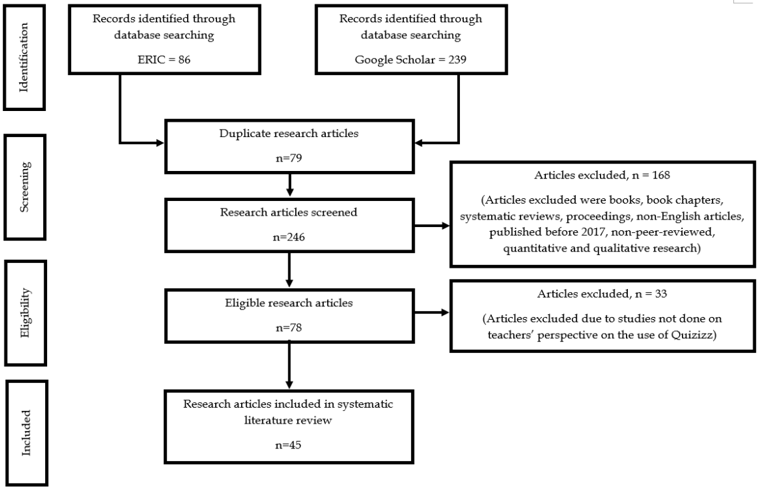
The teaching and learning of English as a second language have always been emphasized by the Ministry of Education (MOE). In the Malaysia Education Blueprint (2013–2025), among the many goals is to produce learners who can comprehend the language for various purposes, including for information and enjoyment. Over the years, the teaching and learning of English have changed from conventional chalk-and-talk methods to modern methods that involve various platforms such as Quizizz, which is free and easy to use. This systematic literature review focuses on teachers’ perception on the use of Quizizz in the teaching and learning of English. Using the Preferred Reporting Items for Systematic Review and Meta-Analyses (PRISMA) review methodology, a total of 45 articles related to the use of Quizizz in the English language classroom were identified from the ERIC and Google Scholar databases. Based on the articles from the year 2017 to 2021, the results show that the mixed-method research design was most used to gather teachers’ perspectives on the use of Quizizz in the teaching and learning of English. Overall, the results of this study show that Quizizz is accepted positively among teachers due to its effectiveness, feasibility, ease of use, and motivating nature for learners. As a suggestion for future research, more focus can be put on investigating the effectiveness of Quizizz from the perspective of parents and issues related to the implementation of gamified learning, such as Internet connection and device availability.
Overview
The claims and statistics of this paper haven’t been checked yet.
Free: it reads the open-access text and checks the first 5 claims that cite a source we can check. Create a free account to check every claim.
Integrity signals
Registry
Cites
Statistics
Figures
Verification
Claims the paper makes
The claims and statistics of this paper haven’t been checked yet.
Free: it reads the open-access text and checks the first 5 claims that cite a source we can check. Create a free account to check every claim.
Self-check
Percentages, sums and reported differences re-computed from the paper’s own numbers.
The self-check needs the paper’s full text.
Citations
Cites
Gamification in Science Education. A Systematic Review of the Literature
Kalogiannakis, M., Papadakis, S., & Zourmpakis, A.-I. (2021) · Education Sciences · doi:10.3390/educsci11010022 · Cited by 637 · cited 2×
“learning process, students only need a game code from their teachers in order to access a game that can be played in real-time mode or student-paced mode [26,41].”
BackgroundAlqahtani, A. Y., & Rajkhan, A. A. (2020) · Education Sciences · doi:10.3390/educsci10090216 · Cited by 615 · cited 1×
“Learners are also motivated to learn when they use Quizizz because they are learning in a fun, comfortable, and conducive environment with a little bit of friendly competition [35,38,47,57,58].”
BackgroundBetween Level Up and Game Over: A Systematic Literature Review of Gamification in Education
Manzano-León, A., Camacho-Lazarraga, P., Guerrero, M. A., Guerrero-Puerta, L., Aguilar-Parra, J. M., Trigueros, R., & Alias, A. (2021) · Sustainability · doi:10.3390/su13042247 · Cited by 512 · cited 2×
“Learners are also motivated to learn when they use Quizizz because they are learning in a fun, comfortable, and conducive environment with a little bit of friendly competition [35,38,47,57,58].”
BackgroundEffectiveness of gamification in the engagement of students
da Rocha Seixas, L., Gomes, A. S., & de Melo Filho, I. J. (2016) · Computers in Human Behavior · doi:10.1016/j.chb.2015.11.021 · Cited by 382 · cited 2×
“[25], it was found that 87% of the teachers who were the research participants agreed that their learners showed positive progress in their level of proficiency after using Quizizz in the classroom.”
BackgroundThe Role of Serious Games, Gamification and Industry 4.0 Tools in the Education 4.0 Paradigm
Almeida, F., & Simoes, J. (2019) · Contemporary Educational Technology · doi:10.30935/cet.554469 · Cited by 300 · cited 1×
“learning process, students only need a game code from their teachers in order to access a game that can be played in real-time mode or student-paced mode [26,41].”
BackgroundCOVID-19 Emergency eLearning and Beyond: Experiences and Perspectives of University Educators
Müller, A. M., Goh, C., Lim, L. Z., & Gao, X. (2021) · Education Sciences · doi:10.3390/educsci11010019 · Cited by 240
Bereczki, E. O., & Kárpáti, A. (2021) · Thinking Skills and Creativity · doi:10.1016/j.tsc.2021.100791 · Cited by 236 · cited 3×
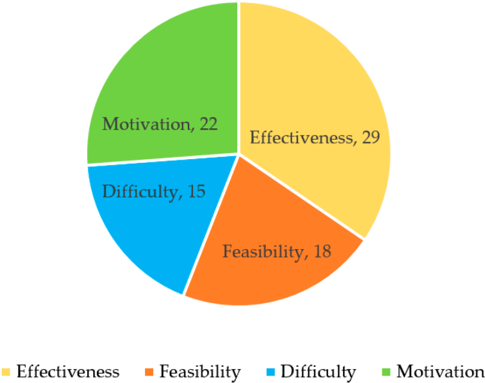
“Authors Perspective Effectiveness Feasibility Difficulty Motivation [14] ✓ ✓ ✓ [15] ✓ ✓ [53] ✓ [16] ✓ ✓ [43] ✓ ✓ [17] ✓ ✓ ✓ [44] ✓ ✓ [54] ✓ [18] ✓ [19] ✓ ✓ ✓ [55] ✓ [20] ✓ ✓ [21] ✓ [49] ✓ ✓ [22] ✓ ✓ [23] ✓ ✓ [45] ✓ ✓ .”
BackgroundGamified flipped EFL classroom for primary education: student and teacher perceptions
Zou, D. (2020) · Journal of Computers in Education · doi:10.1007/s40692-020-00153-w · Cited by 203 · cited 1×
“With this, Quizizz eventually helps improve learners’ performance in the language due to their eagerness to be actively involved in the learning process [27,28,30].”
BackgroundFactors influencing EFL students’ motivation in online learning: A qualitative case study
Meşe, E., & Sevilen, Ç. (2021) · Journal of Educational Technology and Online Learning · doi:10.31681/jetol.817680 · Cited by 198
Exploring a Gamified Learning Tool in the ESL Classroom: The Case of Quizizz
Yunus, C. C. A., & Hua, T. K. (2021) · Journal of Education and e-Learning Research · doi:10.20448/journal.509.2021.81.103.108 · Cited by 182 · cited 2×
“Authors Perspective Effectiveness Feasibility Difficulty Motivation [14] ✓ ✓ ✓ [15] ✓ ✓ [53] ✓ [16] ✓ ✓ [43] ✓ ✓ [17] ✓ ✓ ✓ [44] ✓ ✓ [54] ✓ [18] ✓ [19] ✓ ✓ ✓ [55] ✓ [20] ✓ ✓ [21] ✓ [49] ✓ ✓ [22] ✓ ✓ [23] ✓ ✓ [45] ✓ ✓ .”
ResultGamification and physical education. Viability and preliminary views from students and teachers
Fernandez-Rio, J., de las Heras, E., González, T., Trillo, V., & Palomares, J. (2020) · Physical Education and Sport Pedagogy · doi:10.1080/17408989.2020.1743253 · Cited by 180
Yunus, M. M., Ang, W. S., & Hashim, H. B. (2021) · Sustainability · doi:10.3390/su13063524 · Cited by 133 · cited 1×
“Although it is more common in higher-level education, interactive learning is, in fact, beneficial for all levels of education, including primary and secondary education [10].”
BackgroundSelf-citationEnglish Scholarly Publishing Activities in the Industrial Revolution 4.0: What, Why, and How?
Turmudi, D. (2020) · English Language Teaching Educational Journal · doi:10.12928/eltej.v3i1.1890 · Cited by 126 · cited 1×
“0), English is now even more important than ever due to the demand for proficient English language speakers from most employers [6].”
BackgroundPapadakis, S. (2019) · International Journal of Technology Enhanced Learning · doi:10.1504/ijtel.2020.106282 · Cited by 101
Quintas‐Hijós, A., Lozano, C. P., & Bustamante, J. C. (2020) · PLoS ONE · doi:10.1371/journal.pone.0231269 · Cited by 95 · cited 4×
“Authors Perspective Effectiveness Feasibility Difficulty Motivation [14] ✓ ✓ ✓ [15] ✓ ✓ [53] ✓ [16] ✓ ✓ [43] ✓ ✓ [17] ✓ ✓ ✓ [44] ✓ ✓ [54] ✓ [18] ✓ [19] ✓ ✓ ✓ [55] ✓ [20] ✓ ✓ [21] ✓ [49] ✓ ✓ [22] ✓ ✓ [23] ✓ ✓ [45] ✓ ✓ .”
BackgroundInfluentialEvaluating the Learning Process: The “ThimelEdu” Educational Game Case Study
Papadakis, S., Trampas, A. M., Barianos, A. K., Kalogiannakis, M., & Vidakis, N. (2020) · International Conference on Computer Supported Education · doi:10.5220/0009379902900298 · Cited by 88
Pupils’ Motivation and Perceptions on ESL Lessons through Online Quiz-Games
Halim, M. S. A. A., Hashim, H. B., & Yunus, M. M. (2020) · Journal of Education and e-Learning Research · doi:10.20448/journal.509.2020.73.229.234 · Cited by 83 · cited 2×
“Authors Perspective Effectiveness Feasibility Difficulty Motivation [14] ✓ ✓ ✓ [15] ✓ ✓ [53] ✓ [16] ✓ ✓ [43] ✓ ✓ [17] ✓ ✓ ✓ [44] ✓ ✓ [54] ✓ [18] ✓ [19] ✓ ✓ ✓ [55] ✓ [20] ✓ ✓ [21] ✓ [49] ✓ ✓ [22] ✓ ✓ [23] ✓ ✓ [45] ✓ ✓ .”
BackgroundSelf-citationWhat do prospective teachers think about educational gamification?
Kepceoğlu, İ. (2019) · Science education international · doi:10.33828/sei.v30.i1.8 · Cited by 79
A Systematic Review of Digital Games in Second Language Learning Studies
Poole, F. J., & Clarke‐Midura, J. (2020) · International Journal of Game-Based Learning · doi:10.4018/ijgbl.2020070101 · Cited by 78 · cited 3×
“This is supported by Poole and Midura [39], Moakofhi et al. [48], and Weng et al. [52], who claimed that Internet connection hinders the maximum exploitation of various online platforms such as Quizizz.”
BackgroundResultInfluentialFactors influencing classroom participation: a case study of Malaysian undergraduate students
Mustapha, S. M., Rahman, N. S. N. A., & Md.Yunus, M. (2010) · Procedia - Social and Behavioral Sciences · doi:10.1016/j.sbspro.2010.12.289 · Cited by 77 · cited 1×
“Being an independent learner permits them to be more responsible, aside from motivating learners to be better, and this will lead them to achieve better results and proficiency in the language [59,60].”
BackgroundSelf-citationThe Potential Use of Social Media on Malaysian Primary Students to Improve Writing
Yunus, M. M., Zakaria, S., & Suliman, A. (2019) · International Journal of Education and Practice · doi:10.18488/journal.61.2019.74.450.458 · Cited by 77 · cited 1×
“It is also a major goal of the MOE to make sure that all learners can use the language at its optimum level so that they can communicate effectively in the future global competitive economy [8].”
BackgroundSelf-citationPriyanti, N. W. I., Santosa, M. H., & Dewi, K. S. (2019) · Language and Education Journal Undiksha · doi:10.23887/leju.v2i2.20323 · Cited by 76
e-Learning readiness and perceived learning workload among students in an Indonesian university
Widyanti, A., Hasudungan, S., Park, J., & |, |. (2020) · Knowledge Management & E-Learning An International Journal · doi:10.34105/j.kmel.2020.12.002 · Cited by 75 · cited 1×
“Furthermore, e-learning disseminates information in a different yet effective and long-lasting manner [1].”
BackgroundNochumson, T. C. (2019) · Professional Development in Education · doi:10.1080/19415257.2019.1585382 · Cited by 67
Innovating Higher Education via Game-Based Learning on Misconceptions
Belova, N., & Zowada, C. (2020) · Education Sciences · doi:10.3390/educsci10090221 · Cited by 57 · cited 1×
“When games are used in the classroom, learners can participate more actively [13].”
BackgroundRazali, N., Nasir, N. A., Ismail, M. E., Sari, N. M., & Salleh, K. M. (2020) · IOP Conference Series: Materials Science and Engineering · doi:10.1088/1757-899x/917/1/012024 · Cited by 55 · cited 3×
“Thus, it is safe to say that generally, teachers agree that Quizizz is a good tool to be used in the teaching and learning of the English language, as it is able to motivate learners to learn and improve positively [31,32,44,45,54,55].”
BackgroundInnovative Redesign of Teacher Education ICT Courses: How Flipped Classrooms Impact Motivation?
Turan, Z., & Göktaş, Y. (2018) · Journal of Education and Future · Cited by 51
Enhancing Malaysian Primary Pupils’ Vocabulary Skills using Pocable Game and Pear Deck
Ni, C. K., Jong, B., Dison, M. A., Thomas, S. A., Yunus, M. M., & Suliman, A. (2020) · International Journal of Learning Teaching and Educational Research · doi:10.26803/ijlter.19.6.9 · Cited by 50
Self-citationVocational English Teachers’ Challenges on Shifting Towards Virtual Classroom Teaching
Hoang, N. T., & Le, D. H. (2021) · AsiaCALL Online Journal · Cited by 47
Göksün, D. O., & Gürsoy, G. (2019) · Contemporary Educational Technology · doi:10.30935/cet.634168 · Cited by 44
Gamifying the foreign language classroom for brain‐friendly learning
Rueckert, D., Pico, K., Kim, D., & Sánchez, X. A. C. (2020) · Foreign Language Annals · doi:10.1111/flan.12490 · Cited by 42 · cited 2×
“Authors Perspective Effectiveness Feasibility Difficulty Motivation [14] ✓ ✓ ✓ [15] ✓ ✓ [53] ✓ [16] ✓ ✓ [43] ✓ ✓ [17] ✓ ✓ ✓ [44] ✓ ✓ [54] ✓ [18] ✓ [19] ✓ ✓ ✓ [55] ✓ [20] ✓ ✓ [21] ✓ [49] ✓ ✓ [22] ✓ ✓ [23] ✓ ✓ [45] ✓ ✓ .”
BackgroundThe Use of English in Teaching Mathematics and Science: The PPSMI Policy vis-à-vis The DLP
Yunus, M. M., & Sukri, S. I. A. (2017) · Advances in Language and Literary Studies · doi:10.7575/aiac.alls.v.8n.1p.133 · Cited by 41 · cited 1×
“This is supported by Yunus and Sukri [11], who stated that self-discovery acts as a very important tool in the classroom because learners will get to learn at their own pace and understand new things based on their own respective abilities.”
BackgroundSelf-citationEmbedding E-Learning in Accounting Modules: The Educators’ Perspective
Grabiński, K., Kędzior, M., Krasodomska, J., & Herdan, A. (2020) · Education Sciences · doi:10.3390/educsci10040097 · Cited by 41
Implementation of the Digital Assessment Tool ‘Kahoot in Elementary School
ÇETİN, H. S. (2018) · International Technology and Education Journal · doi:10.71410/esapub.itej.2018.5 · Cited by 37 · cited 3×
“Authors Perspective Effectiveness Feasibility Difficulty Motivation [14] ✓ ✓ ✓ [15] ✓ ✓ [53] ✓ [16] ✓ ✓ [43] ✓ ✓ [17] ✓ ✓ ✓ [44] ✓ ✓ [54] ✓ [18] ✓ [19] ✓ ✓ ✓ [55] ✓ [20] ✓ ✓ [21] ✓ [49] ✓ ✓ [22] ✓ ✓ [23] ✓ ✓ [45] ✓ ✓ .”
BackgroundUlla, M. B., Perales, W. F., & Tarrayo, V. N. (2020) · Issues in educational research · Cited by 37
Educationally Game-Based Learning Encourages Learners to be Actively Engaged in their Own Learning
Hilliard, A. T., & Kargbo, H. F. (2017) · International Journal of Education and Practice · doi:10.18488/journal.61.2017.54.45.60 · Cited by 25 · cited 1×
“In the field of education, specifically the teaching and learning of the English language, game-based learning has been the center of attention as of late, as people are now seeing the high potential of games in improving learners’ performance in their education [12].”
BackgroundEltahir, M. E., Al-Qatawneh, S. S., Al-Ramahi, N., & Alsalhi, N. R. (2019) · Journal of Technology and Science Education · doi:10.3926/jotse.590 · Cited by 22
Teachers’ use of Web 2.0: Education Bag Project Experiences
Kurt, A. A., Sarsar, F., Filiz, O., Telli, E., Göksün, D. O., & Bardakçı, S. (2019) · Malaysian Online Journal of Educational Technology · doi:10.17220/mojet.2019.04.008 · Cited by 22
Hall, A., Uribe-Flórez, L. J., & Rice, K. (2019) · The Journal of Technology and Teacher Education · doi:10.70725/897684bqegeb · Cited by 20
ALTUN, L., & DİNÇER, R. (2020) · Bartın University Journal of Faculty of Education · doi:10.14686/buefad.601184 · Cited by 19 · cited 1×
“Quizizz has a high potential to be exploited in a myriad of ways, including for assessment and classroom exercises [29,31,32,37,38].”
BackgroundPromotion of Learner Autonomy: Beliefs and Practices from the ESL Teachers’ Perspectives
Ismail, F. B., Yunus, M. M., & Zahidi, A. M. (2020) · International Journal of Academic Research in Progressive Education and Development · doi:10.6007/ijarped/v9-i2/7304 · Cited by 13
Self-citationSTUDENT AS TEACHER – ALTERNATIVE REVISION METHOD VIA QUIZIZZ APP
MOHAMAD, A. M. (2020) · MALIM JURNAL PENGAJIAN UMUM ASIA TENGGARA (SEA JOURNAL OF GENERAL STUDIES) · doi:10.17576/malim-2020-2101-12 · Cited by 11 · cited 2×
“Authors Perspective Effectiveness Feasibility Difficulty Motivation [14] ✓ ✓ ✓ [15] ✓ ✓ [53] ✓ [16] ✓ ✓ [43] ✓ ✓ [17] ✓ ✓ ✓ [44] ✓ ✓ [54] ✓ [18] ✓ [19] ✓ ✓ ✓ [55] ✓ [20] ✓ ✓ [21] ✓ [49] ✓ ✓ [22] ✓ ✓ [23] ✓ ✓ [45] ✓ ✓ .”
BackgroundAlzu’bi, M. A. (2018) · The Turkish Online Journal of Educational Technology · Cited by 10
The Use of 'VocScape' in Vocabulary Acquisition Among Year 2 Pupils in Sarawak
Jerry, M., & Yunus, M. M. (2021) · Malaysian Journal of Social Sciences and Humanities (MJSSH) · doi:10.47405/mjssh.v6i4.750 · Cited by 8 · cited 1×
“Teaching and Learning of English It has become a norm everywhere for people to communicate using the English language, as it is a common lingua franca [3].”
BackgroundSelf-citationRubio-Valdehita, S., López-Núñez, M. I., & Díaz-Ramiro, E. M. (2017) · Ergonomics International Journal · doi:10.23880/eoij-16000106 · Cited by 7
Suryaman, M., Akbar, F., & Salsabila, S. (2020) · Cited by 7
Vocabulary Learning Through a Gamified Question and Answer Application
Kayseroglu, M. A., & Samur, Y. (2018) · DergiPark (Istanbul University) · Cited by 6
Understanding Teachers' Design Thinking in Designing Game-Based Activities
Jan, M., & Yang, W.-L. (2018) · IIAI International Congress on Advanced Applied Informatics (IIAI-AAI) · doi:10.1109/iiai-aai.2018.00066 · Cited by 5 · cited 1×
“Many would have to save on their Internet quota and thus, they would rather not take part in online sessions such as Quizizz [19,46,49,50].”
BackgroundZhou, Q. (2018) · English Language Teaching · doi:10.5539/elt.v11n12p205 · Cited by 5 · cited 1×
“As asserted by Qin [5], aside from being the language of business and communication, the English language is also important for one’s employability when entering the workforce.”
BackgroundTHE EXPERIENCE OF THE APPLICATION OF A GAMIFIED VIRTUAL LEARNING ENVIRONMENT IN HIGHER EDUCATION
Tenório, M. M., Lopes, R. P., de Góis, L. A., Mesquita, C., & dos Santos, G. (2018) · ICERI proceedings · doi:10.21125/iceri.2018.2009 · Cited by 4 · cited 2×
“Teachers understood that with enough practice, they will be accustomed to the various features of the website [28,51].”
BackgroundHOW EFL TEACHER TRAINEES IN A TESOL GRADUATE PROGRAM INTEGRATE TOOLS AND PLATFORMS INTO TEACHING EAP
Love, M. (2020) · Teaching English With Technology · Cited by 3
Sardone, N. B. (2017) · International Association for Development of the Information Society · Cited by 3
Nobre, A., & Moura, A. (2017) · Portuguese National Funding Agency for Science, Research and Technology (RCAAP Project by FCT) · Cited by 3
Shanmugavelu, G., & Sundaram, M. A. R. K. (2020) · Shanlax International Journal of Education · doi:10.34293/education.v8i4.3249 · Cited by 3 · cited 1×
“Considering this, the MOE is invested in making sure that teachers and learners are always up to date with the latest teaching and learning methods that can be used and accessed inside and outside of the classroom [7].”
BackgroundHYBRID ENGLISH VOCABULARY LEARNING FOR YOUNG LEARNERS
Nur, S. A. A. (2019) · Eprints (Universitas Negeri Makassar) · Cited by 2
Research works printed but not linked: 7
- Ahmad, J.; Mahmud, N.; Jabbar, A.; Ikbal, M. Opportunities and challenges in the use of information and communication technology: Study for "Teaching From Home" for pandemic COVID-19. Int. J. Sci. Technol. Res. 2020, 9, 294-299.
- Onal, N.T. Investigation of technology integration knowledge of teachers: A case study. Int. J. Curric. Instr. 2021, 13, 773-793.
- Degirmenci, R. The use of Quizizz in language learning and teaching from the teachers' and students' perspectives: A literature review. Lang. Educ. Technol. 2021, 1, 1-11.
- Junior, J.B. Assessment for learning with mobile apps: Exploring the potential of Quizizz in the educational context. Int. J. Dev. Res. 2020, 10, 33366-33371.
- Moakofhi, M.; Leteane, O.; Phiri, T.; Pholele, T.; Sebalatlheng, P. Challenges of introducing e-learning at Botswana University of Agriculture and Natural Resources: Lecturers' perspective. Int. J. Educ. Dev. Using Inf. Commun. Technol. 2017, 13, 4-20.
- Weng, X.; Jong, M.; Chiu, T. Implementation challenges of STEM Education: From teachers' perspective. Asia-Pac. Comput. Educ. 2020, 1, 1-4.
- Huong, T.L. Enhancing student motivation in foreign language learning with computer-based concept mapping: An evidence from Vietnam. Int. J. Educ. Sci. Lang. Arts 2020, 1, 1-12.
Cited by
The Pedagogical Use of Gamification in English Vocabulary Training and Learning in Higher Education
Panmei, B., & Waluyo, B. (2022) · Education Sciences · doi:10.3390/educsci13010024 · Cited by 176
“The number of studies investigating the integration of other gamification apps into vocabulary learning outside the classroom is still scarce [23,24].”
BackgroundRamalingam, S., Yunus, M. M., & Hashim, H. B. (2022) · Sustainability · doi:10.3390/su14138051 · Cited by 163
“A number of authors have discussed this in their articles [26,27,56,57,61,62,65,67,68].”
BackgroundSelf-citationRafiq, K. R. M., Hashim, H. B., & Yunus, M. M. (2021) · Sustainability · doi:10.3390/su13179768 · Cited by 103
“Despite the growing trends of research in ESP, systematic reviews are more towards the ESL [12–14], EFL [15–17], and ELT fields [18], thereby leaving a gap.”
Self-citationInayati, N., & Waloyo, A. A. (2022) · Journal on English as a Foreign Language · doi:10.23971/jefl.v12i2.3546 · Cited by 80
“One factor that contributes to increased engagement is the userfriendly interface, which makes it easy to operate (Lim & Yunus, 2021).”
BackgroundPelatihan Pengembangan Soal HOTS dengan Memanfaatkan Quizizz untuk Guru Sekolah Dasar Pedesaan
Rulyansah, A. (2022) · Indonesia Berdaya · doi:10.47679/ib.2022195 · Cited by 53
Metadata
- Authors
- Lim, T. M., & Yunus, M. M.
- Affiliations
- National University of Malaysia (MY)
- Corresponding author
- Lim, Thomas Mason
- Venue
- Sustainability
- Publisher
- MDPI AG
- Published
- 2021-06-05
- Volume
- 13
- Issue
- 11
- Pages
- 6436
- ISSN
- 2071-1050 (ISSN-L)
- OpenAlex
- W3171915126
- Cited by
- 117
- References
- 61
- Citations by year
- 2026: 12 · 2025: 11 · 2024: 17 · 2023: 45 · 2022: 28 · 2021: 4
- FWCI
- 5.10
- Type
- journal article
- Language
- en
- Open access
- gold
- doi.org
- Licence
- Locations
- Sustainability (publishedVersion, cc-by)
- RePEc: Research Papers in Economics (submittedVersion)
- DOAJ (DOAJ: Directory of Open Access Journals) (submittedVersion, cc-by-sa)
- Greater South Information System
- Funders
- Universiti Kebangsaan Malaysia (GG-2020-024)
- Topics
- Social Sciences › Psychology › Developmental and Educational Psychology › Educational Games and Gamification
- Social Sciences › Education › English Language Learning and Teaching
- Social Sciences › Education › Technology-Enhanced Education Studies
- Keywords
- Quizizz, teacher perceptions, English as a second language, gamified learning, gamification, online quizzes, English language teaching, student motivation, Malaysia Education Blueprint
About these checks
Registry, retraction, Cites and statistics results are computed, not judged, with one exception: a printed reference that no index lists is read once by a model before it counts as a citation error. Claims are extracted by a model and kept only when their quote appears verbatim in the text; each cited source is then checked, with a model’s help, for whether it says what the claim relies on. Those verdicts can be wrong — read the claim’s quote and the cited source before relying on one.
Statistics and arithmetic are recomputed, not judged.
Confidence bands are shown only for fields calibrated on our annotated test set. None is calibrated yet, so no band is shown.
What counts as a claim ›How we measure confidence ›How we check this ›
Are you an author, or do you see a problem with this page? Request a review
Data sources
Bibliographic data: Semantic Scholar, OpenAlex, Crossref.
Contains information from the Semantic Scholar Academic Graph Datasets, made available under the ODC Attribution License (ODC-BY 1.0).
Semantic Scholar’s data is described in: Kinney, R., et al. (2023). The Semantic Scholar Open Data Platform. arXiv:2301.10140.
