

The DOI matches its Crossref record.
Strategic Challenges for Sustainable Governance of the Bioeconomy: Preventing Conflict between SDGs
Abstract
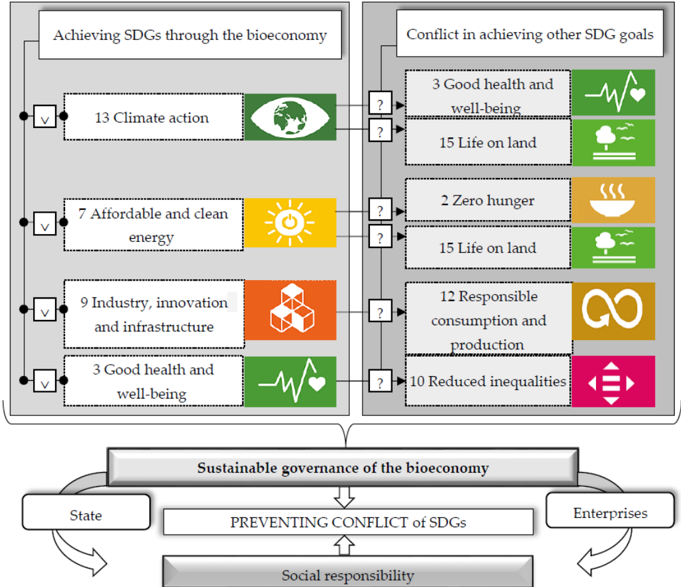
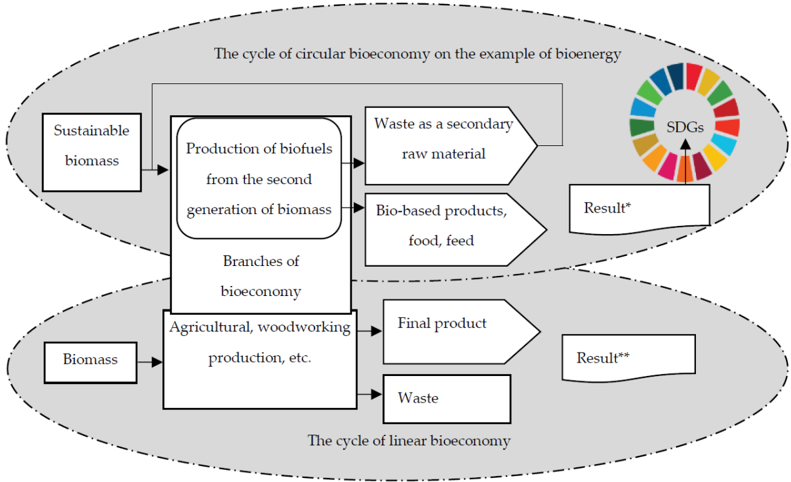
The paper analyzes approaches to understanding the concept of the bioeconomy in highly cited journals, and bioeconomy strategies in associations of countries (the OECD and EU) and at the national level. Strategic challenges for sustainable bioeconomy governance are identified and an understanding of this concept is presented. The main aims, such as decoupling, the use of biotechnology, the use of sustainable biomass in the production process, and a high level of corporate social responsibility, are proposed for the identification of industries related to the bioeconomy. Specific goal achievement within the bioeconomy strategy and possible risks of conflict between SDGs are presented in the model. The bioeconomy should be considered a tool for achieving SDGs; the most relevant being 2, 3, 7, 9, 12, and 13–15. However, the achievement of bioeconomy goals can lead to a conflict between SDGs in practice. Therefore, this aspect must be taken into account at the stage of developing bioeconomy strategy and regulated in governance, to prevent conflicts between SDGs and to involve citizens and stakeholders in participating consciously in this process.
Overview
The claims and statistics of this paper haven’t been checked yet.
Run the check — free, no account needed. It reads the open-access text and checks the sources it cites.
Integrity signals
Registry
Cites
Statistics
Figures
Verification
Claims the paper makes
The claims and statistics of this paper haven’t been checked yet.
Run the check — free, no account needed. It reads the open-access text and checks the sources it cites.
Claims other papers make about this one
Each is checked against this paper’s own text: does it say what the citing paper says it does?
In the citing paper
“This poses a challenge to sustainable circular bioeconomy development”
From Governance Strategies for Sustainable Circular Bioeconomy Development in Europe: Insights and Typologies (2024) · cites this paper as [22]
Self-check
Percentages, sums and reported differences re-computed from the paper’s own numbers.
The self-check needs the paper’s full text.
Citations
Cites
No references could be resolved yet.
Research works printed but not linked: 38
- Brundtland, G. (1987). Our common future. Report of the World Commission on Environment and Development, Oxford University Press.
- Zilberman, 2018, Economics of Sustainable Development and the Bioeconomy, Appl. Econ. Perspect. Policy, 40, 22, 10.1093/aepp/ppx051 · DOI
- 2018, Sustainable development—A ‘selling point’ of the emerging EU bioeconomy policy framework?, J. Clean. Prod., 172, 4170, 10.1016/j.jclepro.2016.12.157 · DOI
- Wisz, 2018, Impact of Advanced Research on Development of Renewable Energy Policy: Case of Ukraine (Review), Int. J. Renew. Energy Res., 8, 2567
- Staffas, 2013, Strategies and Policies for the Bioeconomy and Bio-Based Economy: An Analysis of Official National Approaches, Sustainability, 5, 2751, 10.3390/su5062751 · DOI
- Georgescu-Roegen, N. (1971). The Entropy Law and the Economic Process, Harvard University Press. · DOI
- 1977, What thermodynamics and biology can teach economists, Atl. Econ. J., 5, 13, 10.1007/BF02315384 · DOI
- 1977, The Steady State and Ecological Salvation: A Thermodynamic Analysis, Bioscience, XXVII, 266
- Missemer, 2017, Nicholas Georgescu-Roegen and Degrowth, Eur. J. Hist. Econ. Thought, 24, 493, 10.1080/09672567.2016.1189945 · DOI
- Bobulescu, 2012, The making of a Schumpeterian economist: Nicholas GeorgescuRoegen, Eur. J. Hist. Econ. Thought, 19, 625, 10.1080/09672567.2010.540344 · DOI
- Bobulescu, 2015, From Lotka’s biophysics to Georgescu-Roegen’s bioeconomics, Ecol. Econ., 120, 194, 10.1016/j.ecolecon.2015.10.016 · DOI
- Bonaiuti, M. (2011). From Bioeconomics to degrowth. Georgescu-Roegen’s ‘New Economics’ in Eight Essays, Routledge.
- Cleveland, 1997, When, where, and by how much do biophysical limits constrain the economic process? A survey of Nicholas Georgescu-Roegen’s contribution to ecological economics, Ecol. Econ., 22, 203, 10.1016/S0921-8009(97)00079-7 · DOI
- Kurz, 2003, Fund-flow versus flow-flow in production theory: Reflections on Georgescu-Roegen’s contribution, J. Econ. Behav. Organ., 51, 487, 10.1016/S0167-2681(02)00143-9 · DOI
- Tei, 2018, From Bioeconomics to Bioeconopysis in the Context of (Bio) Diversity and Modern Morality, Amfiteatru Econ., 20, 759, 10.24818/EA/2018/49/754 · DOI
- Braun, V., and Sahn, D. (2015). Bioeconomy–Science and Technology Policy to Harmonize Biologization of Economies with Food Security. The Fight against Hunger and Malnutrition, Oxford University Press. · DOI
- 2010, Land grabbing. Ursachen und Konsequenzen internationaler Landakquirierung in Entwicklungsländern, Z. Außen Sicherh., 3, 299, 10.1007/s12399-010-0142-y · DOI
- Swinnen, 2013, The global bio-economy, Agric. Econ., 44, 1, 10.1111/agec.12045 · DOI
- 2017, Environmental and Ecological Aspects in the Overall Assessment of Bioeconomy, J. Agric. Environ. Ethics, 30, 153, 10.1007/s10806-017-9651-1 · DOI
- Gutzler, 2015, Agricultural land use changes—A scenario-based sustainability impact assessment for Brandenburg, Germany, Ecol. Indic., 1, 505, 10.1016/j.ecolind.2014.09.004 · DOI
- Maksymiv, 2016, Reporting as an important tool in ensuring interaction between stakeholders, Actual Probl. Econ., 4, 304
- Boiar, 2018, Towards the theory of supranational finance, Cogent Bus. Manag., 5, 1482594, 10.1080/23311975.2018.1482594 · DOI
- Dietz, T., Börner, J., Förster, J., and Braun, J. (2018). Governance of the Bioeconomy: A Global Comparative Study of National Bioeconomy Strategies. Sustainability, 10. · DOI · Paper page
- Issa, I., Delbrück, S., and Hamm, U. (2019). Bioeconomy from experts’ perspectives—Results of a global expert survey. PLoS ONE, 14. · DOI
- Korhonen, 2018, Circular economy as an essentially contested concept, J. Clean. Prod., 175, 544, 10.1016/j.jclepro.2017.12.111 · DOI · Paper page
- Viaggi, D. (2018). The Bioeconomy: Delivering Sustainable Green Growth. Department of Agricultural Sciences (DipSA), CABI. · DOI
- Bugge, M., Hansen, T., and Klitkou, A. (2016). What is the bioeconomy? A review of the literature. Sustainability, 8. · DOI
- Rosegrant, 2013, Water and food in the bioeconomy: Challenges and opportunities for development, Agric. Econ., 44, 139, 10.1111/agec.12058 · DOI
- Sheppard, 2011, Biosecurity and sustainability within the growing global Bioeconomy, Curr. Opin. Environ. Sustain., 3, 4, 10.1016/j.cosust.2010.12.011 · DOI
- Birch, 2013, Theorizing the bioeconomy: Biovalue, biocapital, bioeconomics or... what?, Sci. Technol. Hum. Values, 38, 299, 10.1177/0162243912442398 · DOI
- 1998, Genomics and the world’s economy, Science, 281, 925, 10.1126/science.281.5379.925 · DOI
- Asada, 2018, Competitive Bioeconomy? Comparing Bio-Based and Non-Bio-Based Primary Sectors of the World, Ecol. Econ., 149, 120, 10.1016/j.ecolecon.2018.03.014 · DOI
- McCormick, 2013, The Bioeconomy in Europe: An Overview, Sustainability, 5, 2589, 10.3390/su5062589 · DOI
- Zabaniotou, 2018, Redesigning a bioenergy sector in EU in the transition to circular waste-based Bioeconomy-A multidisciplinary review, J. Clean. Prod., 177, 197, 10.1016/j.jclepro.2017.12.172 · DOI
- Pylypiv, 2020, Balanced scorecard for implementing united territorial communities’ social responsibility, Probl. Perspect. Manag., 18, 128
- Yakubiv, 2019, Development of Renewable Energy Sources in the Context of Energy Management, J. Vasyl Stefanyk Precarpathian Natl. Univ., 6, 77, 10.15330/jpnu.6.3-4.77-87 · DOI
- Yakubiv, 2020, Application of Economic and Legal Instruments at the Stage of Transition to Bioeconomy, Proceedings of the Advances in Artificial Intelligence, Software and Systems Engineering, Volume 965, 656
- Popadynets, 2016, Development of the market of solid biofuel in Ukraine under current conditions, Econ. Ann.-XXI, 159, 93
Cited by
Sorted by citations
Skondras, A., Nastis, S. A., Skalidi, I., Theofilou, A., Bakousi, A., Mone, T., Tsifodimou, Z. E., Gaffey, J., Ludgate, R., O’Connor, T., et al. (2024) · Sustainability · doi:10.3390/su16125140 · Cited by 19
Metadata
- Authors
- Maksymiv, Y., Yakubiv, V., Pylypiv, N., Hryhoruk, I., Piatnychuk, I., & Popadynets, N.
- Venue
- Sustainability
- Publisher
- MDPI AG
- Published
- 2021-07-26
- Volume
- 13
- Issue
- 15
- Pages
- 8308
- ISSN
- 2071-1050
- Cited by
- 21
- References
- 0
- Language
- en
About these checks
Registry, retraction, Cites and statistics results are computed, not judged, with one exception: a printed reference that no index lists is read once by a model before it counts as a citation error. Claims are extracted by a model and kept only when their quote appears verbatim in the text; each cited source is then checked, with a model’s help, for whether it says what the claim relies on. Those verdicts can be wrong — read the claim’s quote and the cited source before relying on one.
Statistics and arithmetic are recomputed, not judged.
Confidence bands are shown only for fields calibrated on our annotated test set. None is calibrated yet, so no band is shown.
What counts as a claim ›How we measure confidence ›How we check this ›
Are you an author, or do you see a problem with this page? Request a review
How to cite
Cite CoChat for the checks on this page, and the paper for its own findings.
- This page
- CoChat. (2026). Citation check: Strategic Challenges for Sustainable Governance of the Bioeconomy: Preventing Conflict between SDGs. https://app.cochat.ai/papers/10.3390/su13158308
- The paper
- Maksymiv, Y., Yakubiv, V., Pylypiv, N., Hryhoruk, I., Piatnychuk, I., & Popadynets, N. (2021). Strategic Challenges for Sustainable Governance of the Bioeconomy: Preventing Conflict between SDGs. Sustainability. https://doi.org/10.3390/su13158308
