

The DOI matches its Crossref record; 1 of the 1 references it cites were found in a registry or an index.
Current Status and Emerging Trends on the Adaptive Reuse of Buildings: A Bibliometric Analysis
Abstract
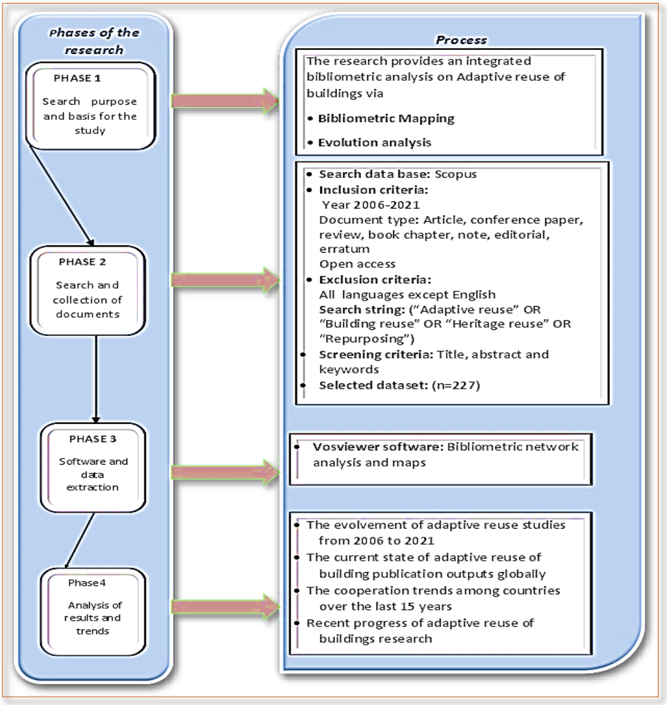
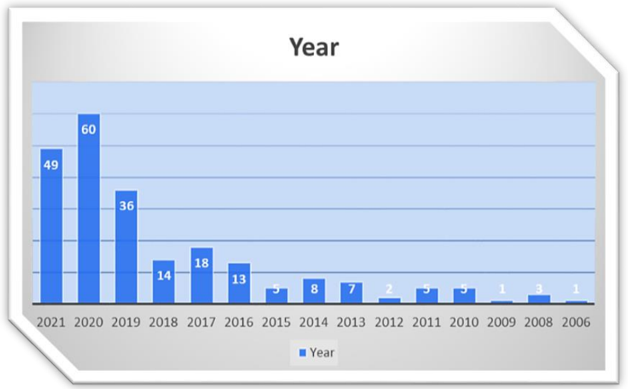
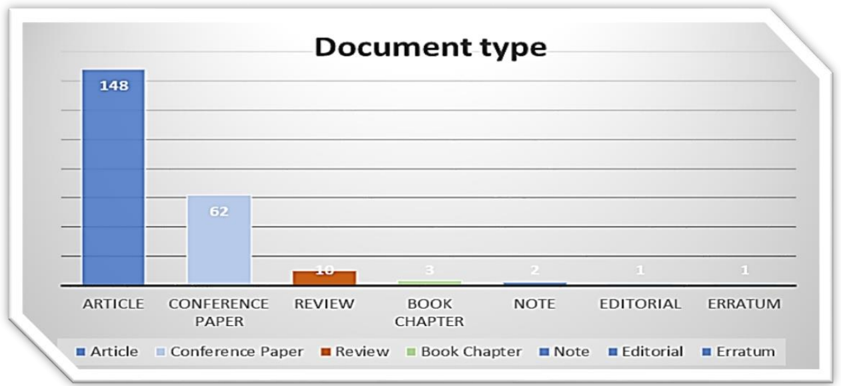
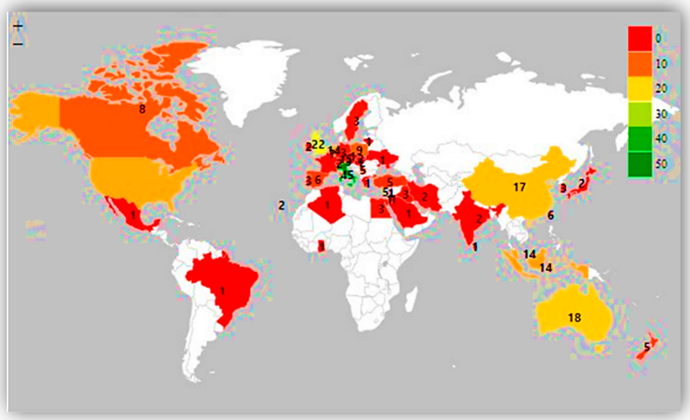
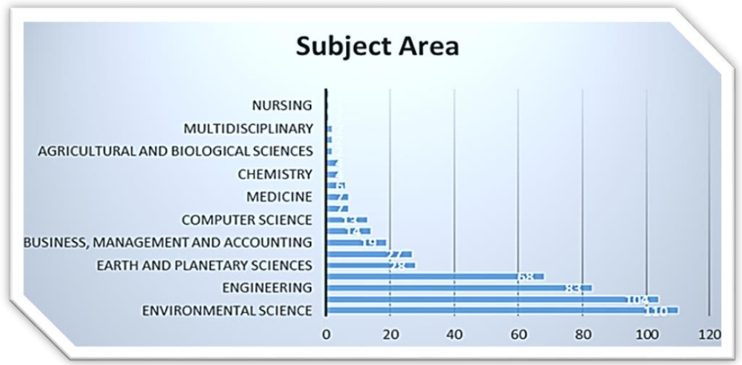
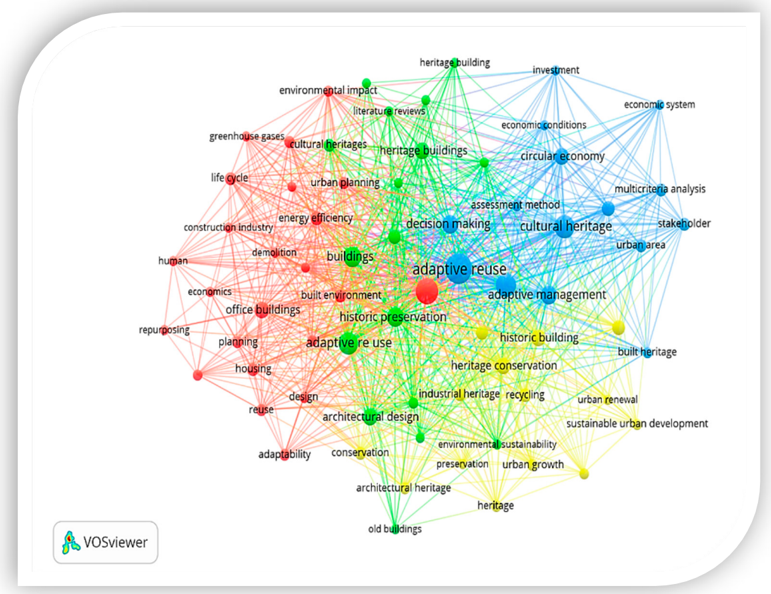
The emerging demand for sustainable development and the need for efficient use of resources across the built environment have stirred research efforts globally. The construction sector is often regarded as one of the major world consumers of resources, so many international establishments are trying to create a sustainable environment through adaptive reuse of existing building stocks, a concept which has been receiving momentous recognition by reason of its richly diversified applicability for circular economy. Thus, profound knowledge of the topic and research trends is requisite to promote scholarship. For this analysis, the global research developments in adaptive reuse are assessed according to published documents, co-authorship, geographical distribution and keyword- co-occurrences. From the Scopus directory, 227 journal articles published from 2006 to 2021 were retrieved. Results showed that from 2006, published documents rose by 221 articles. About 29% of the publications were from Italy and the United Kingdom. Among the articles, 110 were from the subject area of environmental science (48.5%), while the subject area of engineering represents 104 publications (45.8%). Recent progress in adaptive reuse in building and construction includes, but not limited to: (i) component and materials reuse and technology, (ii) life cycle assessment, (iii) economic assessment and multi-criteria decision making and (iv) regulatory policies and stakeholders’ analysis. The findings are important to furnish all relevant personnel in the academic and industries with a broad perception of the status and potential emerging trends on the adaptive reuse of buildings.
Overview
The claims and statistics of this paper haven’t been checked yet.
Run the check — free, no account needed. It reads the open-access text and checks the sources it cites.
Integrity signals
Registry
Cites
Statistics
Figures
Verification
Claims the paper makes
The claims and statistics of this paper haven’t been checked yet.
Run the check — free, no account needed. It reads the open-access text and checks the sources it cites.
Claims other papers make about this one
Each is checked against this paper’s own text: does it say what the citing paper says it does?
The source backs part of the claim, not all of it — or backs it for a different population, condition or comparison.
In the citing paper
“ARCH has been receiving recognition for its diversified applicability of a CE [44,45].”
From Smart, circular and renewable: The role of cooperative governance in accelerating a sustainable energy transition (2025) · cites this paper as [45]
Experimental — accuracy not yet measured
Self-check
Percentages, sums and reported differences re-computed from the paper’s own numbers.
The self-check needs the paper’s full text.
Citations
Cites
Bibliometrics: Tracking Research Impact by Selecting the Appropriate Metrics
Agarwal, A., Durairajanayagam, D., Tatagari, S., Esteves, S., Harlev, A., Henkel, R., Roychoudhury, S., Homa, S., Puchalt, N., Ramasamy, R., et al. (2016) · Asian Journal of Andrology · doi:10.4103/1008-682x.171582 · Cited by 639
Research works printed but not linked: 69
- Abastante, F., Lami, I., and Gaballo, M. (2021). Pursuing the SDG11 targets: The role of the sustainability protocols. Sustainability, 13. · DOI
- Pintossi, N., Kaya, D.I., and Roders, A.P. (2021). Assessing cultural heritage adaptive reuse practices: Multi-scale challenges and solutions in Rijeka. Sustainability, 13. · DOI
- Viola, S., and Diano, D. (2019). Repurposing the built environment: Emerging challenges and key entry points for future research. Sustainability, 11. · DOI
- Butina-Watson, G., and Bentley, I. (2007). Identity by Design, Routledge. [1st ed.]. · DOI
- Grin, J., Rotmans, J., and Schot, J. (2010). Transitions to Sustainable Development: New Directions in the Study of Long Term Transformative Change, Routledge. · DOI · Paper page
- Gosling, 2013, Adaptable buildings: A systems approach, Sustain. Cities Soc., 7, 44, 10.1016/j.scs.2012.11.002 · DOI
- Abdulameer, 2020, Adaptive reuse as an approach to sustainability, IOP Conf. Series Mater. Sci. Eng., 881, 012010, 10.1088/1757-899X/881/1/012010 · DOI
- Perera, 2019, Adaptive reuse of buildings: The case of Sri Lanka, J. Financ. Manag. Prop. Constr., 24, 79
- Wijesiri, W.M.M., Devapriya, K.A.K., Rathnasiri, P., and Karunaratne, T.L.W. (2021). A framework to implement green adaptive reuse for existing buildings in Sri Lanka. Intell. Build. Int., 1–25. · DOI
- Zulkanain, 2021, Exploring the adaptive reuse concept and benefits in managing public building quarters in Malaysia, Malays. Constr. Res. J., 12, 258
- Langston, 2007, Strategic assessment of building adaptive reuse opportunities in Hong Kong, Build. Environ., 43, 1709, 10.1016/j.buildenv.2007.10.017 · DOI
- Remoy, 2014, Adaptive reuse of office buildings into housing: Opportunities and risks, Build. Res. Inf., 42, 381, 10.1080/09613218.2014.865922 · DOI
- Vural, 2008, An example to renovation–revitalization works in historical city centres: Kunduracılar Street/Trabzon-Turkey, Build. Environ., 43, 950, 10.1016/j.buildenv.2006.10.053 · DOI
- Shen, 2010, Adaptive reuse potential, Facilities, 28, 6, 10.1108/02632771011011369 · DOI
- Günçe, K., and Mısırlısoy, D. (2019). Assessment of adaptive reuse practices through user experiences: Traditional houses in the walled city of Nicosia. Sustainability, 11. · DOI
- Kalaci, E., and Dervishi, S. (2014, January 8–10). Implementation challenges to the adaptive reuse of a heritage building in Tirana, Albania. Proceedings of the 2nd ICAUD International Conference in Architecture and Urban Design, Tirana, Albania.
- Mohamed, 2017, Adaptive reuse: A review and analysis of its relationship to the 3 Es of sustainability, Facilities, 35, 138, 10.1108/F-12-2014-0108 · DOI
- Kalibatas, 2019, A bibliometric data analysis of multi-criteria decision making methods in heritage buildings, J. Civ. Eng. Manag., 25, 76, 10.3846/jcem.2019.8315 · DOI
- Plevoets, B., and van Cleempoel, K. (2019). Adaptive Reuse of the Built Heritage, Routledge. · DOI
- Bullen, 2007, Adaptive reuse and sustainability of commercial buildings, Facilities, 25, 20, 10.1108/02632770710716911 · DOI
- Li, 2021, Research frameworks, methodologies, and assessment methods concerning the adaptive reuse of architectural heritage: A review, Built Herit., 5, 1
- Farjami, E., and Türker, Ö.O. (2021). The extraction of prerequisite criteria for environmentally certified adaptive reuse of heritage buildings. Sustainability, 13. · DOI
- Foster, G., and Saleh, R. (2021). The adaptive reuse of cultural heritage in European circular city plans: A systematic review. Sustainability, 13. · DOI
- Gravagnuolo, A., Micheletti, S., and Bosone, M. (2021). A participatory approach for “circular” adaptive reuse of cultural heritage. Building a heritage community in Salerno, Italy. Sustainability, 13. · DOI
- Joensuu, 2020, Circular economy practices in the built environment, J. Clean. Prod., 276, 124215, 10.1016/j.jclepro.2020.124215 · DOI
- Marika, G., Beatrice, M., and Francesca, A. (2021). Adaptive reuse and sustainability protocols in Italy: Relationship with circular economy. Sustainability, 13. · DOI
- Pimonsathean, 2002, Current issues concerning adaptive reuse in the conservation of urban cultural heritage, RC Rev. Cult. Rev. Cult., 4, 45
- Bullen, 2011, Adaptive reuse of heritage buildings, Structural Survey, 29, 411, 10.1108/02630801111182439 · DOI
- Sandberg, 2011, Ways of constructing research questions: Gap-spotting or problematization?, Organization, 18, 23, 10.1177/1350508410372151 · DOI
- Mostafa, 2016, Lean and agile integration within offsite construction using discrete event simulation: A systematic literature review, Constr. Innov., 16, 483, 10.1108/CI-09-2014-0043 · DOI
- Song, 2020, A bibliometric analysis of worldwide educational artificial intelligence research development in recent twenty years, Asia Pac. Educ. Rev., 21, 473, 10.1007/s12564-020-09640-2 · DOI
- Ahmadvand, 2019, Trends and visibility of “digital health” as a keyword in articles by JMIR publications in the new millennium: Bibliographic-bibliometric analysis, J. Med. Internet Res., 21, e10477, 10.2196/10477 · DOI · Paper page
- Benckendorff, 2013, A network analysis of tourism research, Ann. Tour. Res., 43, 121, 10.1016/j.annals.2013.04.005 · DOI
- Gallego-Valero, L., Moral-Parajes, E., and Román-Sánchez, I. (2021). Wastewater treatment costs: A research overview through bibliometric analysis. Sustainability, 13. · DOI
- Mihalic, T., Mohamadi, S., Abbasi, A., and Dávid, L. (2021). Mapping a sustainable and responsible tourism paradigm: A bibliometric and citation network analysis. Sustainability, 13. · DOI
- Alkahtani, M., Ziout, A., Salah, B., Alatefi, M., Elgawad, A.E.E.A., Badwelan, A., and Syarif, U. (2021). An insight into reverse logistics with a focus on collection systems. Sustainability, 13. · DOI
- Su, Z., Zhang, M., and Wu, W. (2021). Visualizing sustainable supply chain management: A systematic scientometric review. Sustainability, 13. · DOI
- Li, 2015, Mapping publication trends and identifying hot spots of research on internet health information seeking behavior: A quantitative and co-word biclustering analysis, J. Med. Internet Res., 17, e81, 10.2196/jmir.3326 · DOI
- Hosseini, 2018, Analysis of citation networks in building information modeling research, J. Constr. Eng. Manag., 144, 04018064, 10.1061/(ASCE)CO.1943-7862.0001492 · DOI
- Olawumi, 2017, Evolution in the intellectual structure of bim research: A bibliometric analysis, J. Civ. Eng. Manag., 23, 1060, 10.3846/13923730.2017.1374301 · DOI
- Cobo, 2011, Science mapping software tools: Review, analysis, and cooperative study among tools, J. Am. Soc. Inf. Sci. Technol., 62, 1382, 10.1002/asi.21525 · DOI
- Vigneshkumar, 2020, A scientometric analysis and review of fall from height research in construction, Constr. Econ. Build., 20, 17
- Ding, Y., Rousseau, R., and Wolfram, D. (2014). Visualizing bibliometric networks. Measuring Scholarly Impact: Methods and Practice, Springer. · DOI
- Foster, 2020, Circular economy strategies for adaptive reuse of cultural heritage buildings to reduce environmental impacts, Resour. Conserv. Recycl., 152, 104507, 10.1016/j.resconrec.2019.104507 · DOI
- Vecchio, 2020, Promoting adaptive reuse in Ontario: A planning policy tool for making the best of manufacturing decline, Urban Plan., 5, 338, 10.17645/up.v5i3.3188 · DOI
- Wilkinson, S., James, K., and Reed, R. (2009, January 18–21). Delivering sustainability through the adaptive reuse of commercial buildings: The Melbourne CBD challenge. Proceedings of the Pacific Rim Real Estate Society 15th Annual Conference, Sydney, Australia.
- Macknight, E.C. (2021, August 20). Introduction, Historical Reflections/Réflexions Historiques. Available online: https://www.berghahnjournals.com/view/journals/historical-reflections/47/1/hrrh470101.xml. · DOI
- De Medici, S. (2021). Italian architectural heritage and photovoltaic systems. matching style with sustainability. Sustainability, 13. · DOI
- Department of Environment (2021, August 20). The Australian Government Department of Environment, Available online: https://www.researchgate.net/deref/http%3A%2F%2Fwww.environment.gov.au%2Fheritage.
- Halog, A., and Anieke, S. (2021). A review of circular economy studies in developed countries and its potential adoption in developing countries. Circ. Econ. Sustain., 1–22. · DOI
- Douglas, J. (2006). Building Adaptation, Butterworth-Heinemann. [2nd ed.]. · DOI
- Thornton, 2011, The greenest building (is the one that you don’t build!): Effective techniques for sustainable adaptive reuse/renovation, J. Green Build., 6, 1, 10.3992/jgb.6.1.1 · DOI
- Wilkinson, 2014, The preliminary assessment of adaptation potential in existing office buildings, Int. J. Strat. Prop. Manag., 18, 77, 10.3846/1648715X.2013.853705 · DOI
- Hsueh, 2013, DFAHP multicriteria risk assessment model for redeveloping derelict public buildings, Int. J. Strat. Prop. Manag., 17, 333, 10.3846/1648715X.2013.852995 · DOI
- Tan, 2014, A Fuzzy approach for adaptive reuse selection of industrial buildings in Hong Kong, Int. J. Strat. Prop. Manag., 18, 66, 10.3846/1648715X.2013.864718 · DOI
- Tu, H.-M. (2020). The attractiveness of adaptive heritage reuse: A theoretical framework. Sustainabilty, 12. · DOI
- Dewiyana, 2016, The green aspects of adaptive reuse of Hotel Penaga, Procedia—Soc. Behav. Sci., 222, 631, 10.1016/j.sbspro.2016.05.220 · DOI
- Parpas, 2020, On the determinants of a successful, sustainable-driven adaptive reuse: A multiple regression approach, Int. J. Sus. Dev. Plann., 15, 1
- Kaya, 2021, Subjective circularity performance analysis of adaptive heritage reuse practices in the Netherlands, Sustain. Cities Soc., 70, 102869, 10.1016/j.scs.2021.102869 · DOI
- Oppio, A., Bottero, M., and Ferretti, V. (2017). Designing adaptive reuse strategies for cultural heritage with choice experiments. Energy Performance in the Australian Built Environment, Springer. · DOI
- Della Spina, L. (2020). Adaptive sustainable reuse for cultural heritage: A multiple criteria decision aiding approach supporting urban development processes. Sustainability, 12. · DOI
- Salerno, E. (2020). Identifying value-increasing actions for cultural heritage assets through sensitivity analysis of multicriteria evaluation results. Sustainability, 12. · DOI
- Wilkinson, 2011, Examining and quantifying the drivers behind alterations and extensions to commercial buildings in a central business district, Constr. Manag. Econ., 29, 725, 10.1080/01446193.2011.588954 · DOI
- Laefer, 2008, Building reuse assessment for sustainable urban reconstruction, J. Constr. Eng. Manag., 134, 217, 10.1061/(ASCE)0733-9364(2008)134:3(217) · DOI
- Shao, 2019, Design for sustainability and innovation: A kansei engineering evaluation of the adaptive reuse of old buildings, Proc. Des. Soc. Int. Conf. Eng. Des., 1, 3221, 10.1017/dsi.2019.329 · DOI
- Hsu, 2016, Ann-based decision model for the reuse of vacant buildings in urban areas, Int. J. Strat. Prop. Manag., 20, 31, 10.3846/1648715X.2015.1101626 · DOI
- Pinto, 2017, Building reuse: Multi-criteria assessment for compatible design, Int. J. Des. Sci. Technol., 22, 165
- Bottero, M., D’Alpaos, C., and Oppio, A. (2019). Ranking of adaptive reuse strategies for abandoned industrial heritage in vulnerable contexts: A multiple criteria decision aiding approach. Sustainability, 11. · DOI
- Lombardi, 2017, Case studies of environmental the quality of buildings damaged by earthquakes, prior to adaptive reconstruction: Palazzo moscardelli in ofena and ex-colonia ix maggio at Monteluco Di Roio, L’aquila, Italy, WIT Trans. Ecol. Environ., 226, 59, 10.2495/SDP170061 · DOI
Cited by
Sorted by citations
Van Opstal, W., Bocken, N., & Brusselaers, J. (2025) · Energy Research & Social Science · doi:10.1016/j.erss.2025.104049 · Cited by 20
Metadata
- Authors
- Owojori, O., Okoro, C., & Chileshe, N.
- Affiliations
- Department of Finance and Investment Management, University of Johannesburg, P.O. Box 524, Johannesburg 2006, South Africa
- UniSA STEM, Scarce Resources and Circular Economy (ScaRCE), University of South Australia, Adelaide 5001, Australia
- Venue
- Sustainability
- Publisher
- MDPI AG
- Published
- 2021-10-21
- Volume
- 13
- Issue
- 21
- Pages
- 11646
- ISSN
- 2071-1050
- Cited by
- 53
- References
- 1
- Language
- en
About these checks
Registry, retraction, Cites and statistics results are computed, not judged, with one exception: a printed reference that no index lists is read once by a model before it counts as a citation error. Claims are extracted by a model and kept only when their quote appears verbatim in the text; each cited source is then checked, with a model’s help, for whether it says what the claim relies on. Those verdicts can be wrong — read the claim’s quote and the cited source before relying on one.
Statistics and arithmetic are recomputed, not judged.
Confidence bands are shown only for fields calibrated on our annotated test set. None is calibrated yet, so no band is shown.
What counts as a claim ›How we measure confidence ›How we check this ›
Are you an author, or do you see a problem with this page? Request a review
