

The DOI matches its Crossref record; 41 of the 41 references it cites were found in a registry or an index.
Land–Sea Interactions: A Spatial Planning Perspective
Abstract
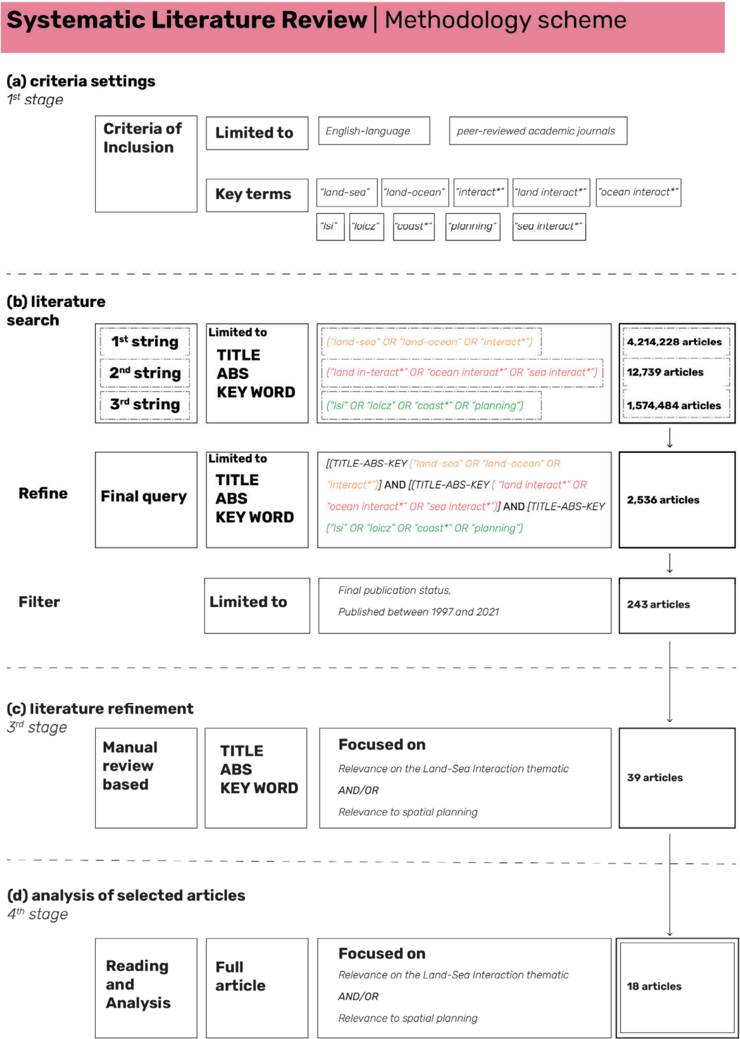
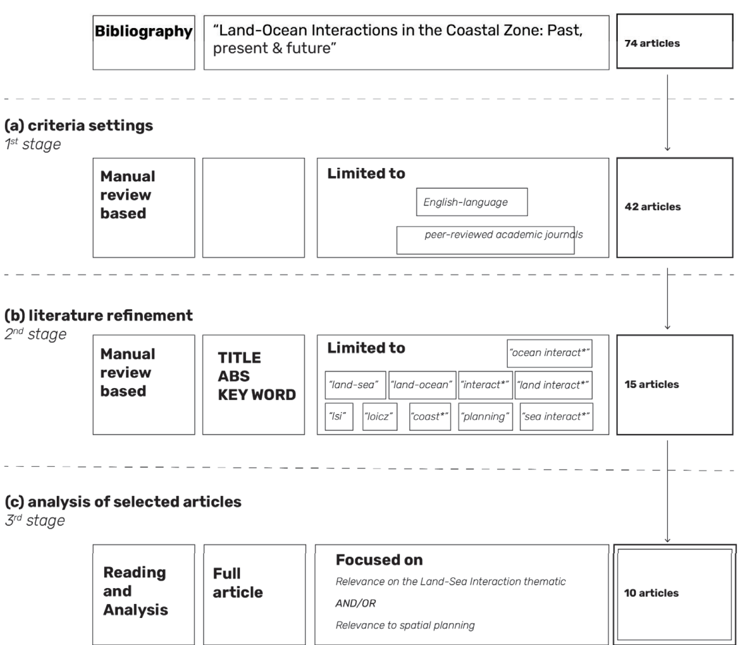
Coastal areas are the most populated areas on the planet and are the most attractive areas due to the richness of the biodiversity, natural resources, and trading reasons. Coastal cities are enlarging their boundaries fast by reclaiming land to place new growing economic sectors such as tourism, oil and gas, aquaculture, and fishery. These processes will put an extra strain on the interactions between land and sea. A crucial initiative regarding Land–Sea Interactions comes from the European Union through Directive 2014/89/EU. The directive pays special attention to the discourse surrounding Land–Sea Interactions. This study aims to analyze the existing research on Land–Sea Interactions to develop a base knowledge to determine elements and interactions with a spatial planning perspective. The research is based on a double literature review, a systematic literature review based on an open-source database, and a bibliographic search based on a key Land–Sea Interactions paper. The results identify economic sectors, natural elements, and their functions in the discourse of Land–Sea Interaction. Furthermore, this study identifies shared features and terminologies to define Land–Sea Interactions clearly. The main conclusion is that Land–Sea Interactions are human-induced and, in most cases, happen from land to sea, not vice versa. The other crucial conclusion is that specific types of natural elements can decrease the negative impact that those interactions can have either on the environment or among other human activities.
Overview
The claims and statistics of this paper haven’t been checked yet.
Run the check — free, no account needed. It reads the open-access text and checks the sources it cites.
Integrity signals
Registry
Cites
Statistics
Figures
Verification
Claims the paper makes
The claims and statistics of this paper haven’t been checked yet.
Run the check — free, no account needed. It reads the open-access text and checks the sources it cites.
Claims other papers make about this one
Each is checked against this paper’s own text: does it say what the citing paper says it does?
The source backs part of the claim, not all of it — or backs it for a different population, condition or comparison.
In the citing paper
“Human activities along the coast, particularly those driven by tourism and recreation, significantly affect sandy shore landscapes (Innocenti and Musco 2023).”
From Agent-based modelling of beach visitation patterns: insights for sustainable coastal design and management (2025) · cites this paper as Innocenti and Musco 2023
Experimental — accuracy not yet measured
Self-check
Percentages, sums and reported differences re-computed from the paper’s own numbers.
The self-check needs the paper’s full text.
Citations
Cites
(2014) · Cambridge University Press eBooks · doi:10.1017/cbo9781107415379 · Cited by 11,249
McGranahan, G., Balk, D., & Anderson, B. (2007) · Environment and Urbanization · doi:10.1177/0956247807076960 · Cited by 2,609
Effects of nutrient enrichment in the nation's estuaries: A decade of change
Bricker, S. B., Longstaff, B., Dennison, W., Jones, A., Boicourt, K., Wicks, C., & Woerner, J. (2008) · Harmful Algae · doi:10.1016/j.hal.2008.08.028 · Cited by 921
The Value of Coastal Wetlands for Hurricane Protection
Costanza, R., Pérez-Maqueo, O., Martinez, M. L., Sutton, P., Anderson, S. J., & Mulder, K. (2008) · AMBIO: A Journal of the Human Environment · doi:10.1579/0044-7447(2008)37[241:tvocwf]2.0.co;2 · Cited by 736
Newton, A., Icely, J., Cristina, S., Brito, A., Cardoso, A. C., Colijn, F., Riva, S. D., Gertz, F., Hansen, J. W., Holmer, M., et al. (2014) · Estuarine, Coastal and Shelf Science · doi:10.1016/j.ecss.2013.05.023 · Cited by 418
NITROGEN LOADING FROM COASTAL WATERSHEDS TO RECEIVING ESTUARIES: NEW METHOD AND APPLICATION
Valiela, I., Collins, G., Kremer, J., Lajtha, K., Geist, M., Seely, B., Brawley, J., & Sham, C. H. (1997) · Ecological Applications · doi:10.1890/1051-0761(1997)007[0358:nlfcwt]2.0.co;2 · Cited by 417
Coastal Fluxes in the Anthropocene
(2005) · Global Change — The IGBP Series · doi:10.1007/3-540-27851-6 · Cited by 386
The SAGE Dictionary of Qualitative Management Research
Thorpe, R., & Holt, R. (2008) · SAGE Publications Ltd eBooks · doi:10.4135/9780857020109 · Cited by 296
Land–Ocean Interactions in the Coastal Zone: Past, present & future
Ramesh, R., Chen, Z., Cummins, V., Day, J. W., D’Elia, C. F., Dennison, B., Forbes, D. L., Glaeser, B., Glaser, M., Glavovic, B., et al. (2015) · Anthropocene · doi:10.1016/j.ancene.2016.01.005 · Cited by 252
Sekovski, I., Newton, A., & Dennison, W. C. (2011) · Estuarine Coastal and Shelf Science · doi:10.1016/j.ecss.2011.07.011 · Cited by 211
Research works printed but not linked: 2
- Kolman, 2012, New land in the water economically and socially land reclamation pays, Terra Aqua, 128, 6
- Hartwig, H., Kremer, B.G., and Kannen, A. (2009). Risk and Management of Current and Future Storm Surges, Springer.
Cited by
Bakhshianlamouki, E., Augustijn, E.-W., Brugnach, M., Voinov, A., & Wijnberg, K. (2025) · Environmental Research Communications · doi:10.1088/2515-7620/adc353 · Cited by 1
Metadata
- Authors
- Innocenti, A., & Musco, F.
- Affiliations
- Department of Technology and Innovation, University of Southern Denmark, 5230 Odense, Denmark
- Department of Architecture and Arts, University Iuav of Venice, 30135 Venice, Italy
- Venue
- Sustainability
- Publisher
- MDPI AG
- Published
- 2023-06-12
- Volume
- 15
- Issue
- 12
- Pages
- 9446
- ISSN
- 2071-1050
- Cited by
- 18
- References
- 41
- Language
- en
About these checks
Registry, retraction, Cites and statistics results are computed, not judged, with one exception: a printed reference that no index lists is read once by a model before it counts as a citation error. Claims are extracted by a model and kept only when their quote appears verbatim in the text; each cited source is then checked, with a model’s help, for whether it says what the claim relies on. Those verdicts can be wrong — read the claim’s quote and the cited source before relying on one.
Statistics and arithmetic are recomputed, not judged.
Confidence bands are shown only for fields calibrated on our annotated test set. None is calibrated yet, so no band is shown.
What counts as a claim ›How we measure confidence ›How we check this ›
Are you an author, or do you see a problem with this page? Request a review
How to cite
Cite CoChat for the checks on this page, and the paper for its own findings.
- This page
- CoChat. (2026). Citation check: Land–Sea Interactions: A Spatial Planning Perspective. https://app.cochat.ai/papers/10.3390/su15129446
- The paper
- Innocenti, A., & Musco, F. (2023). Land–Sea Interactions: A Spatial Planning Perspective. Sustainability. https://doi.org/10.3390/su15129446
Data sources
Bibliographic data: Semantic Scholar, OpenAlex, Crossref.
Contains information from the Semantic Scholar Academic Graph Datasets, made available under the ODC Attribution License (ODC-BY 1.0).
Semantic Scholar’s data is described in: Kinney, R., et al. (2023). The Semantic Scholar Open Data Platform. arXiv:2301.10140.
