

The DOI matches its Crossref record; 1 of the 1 references it cites were found in a registry or an index.
Floods as a Consequence of Climate Change: Comprehensive Meteorological and Hydrological Analysis of the 2024 Flood Course in the Bóbr River Basin (Southwestern Poland)
Abstract
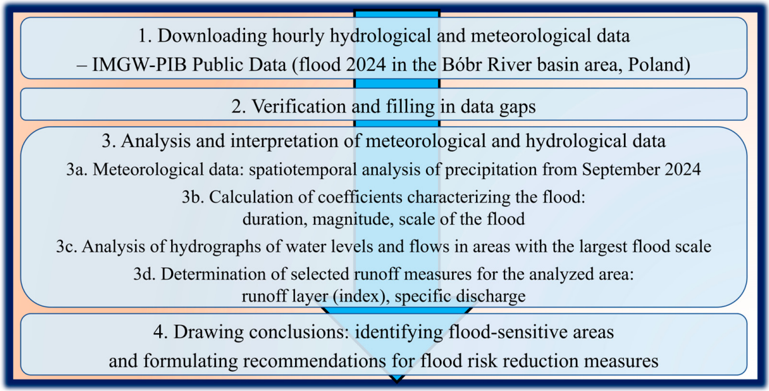
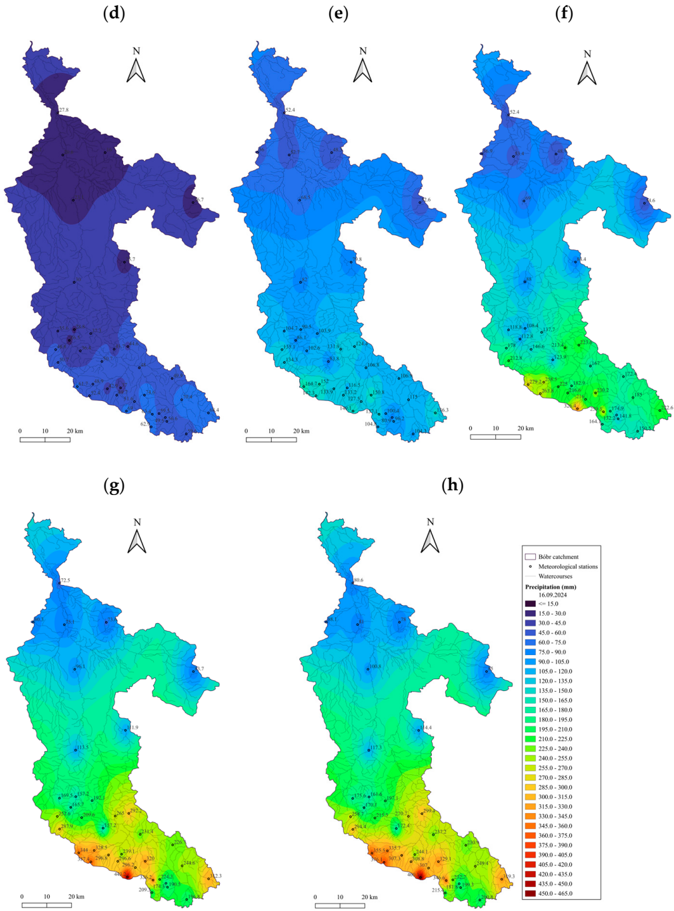
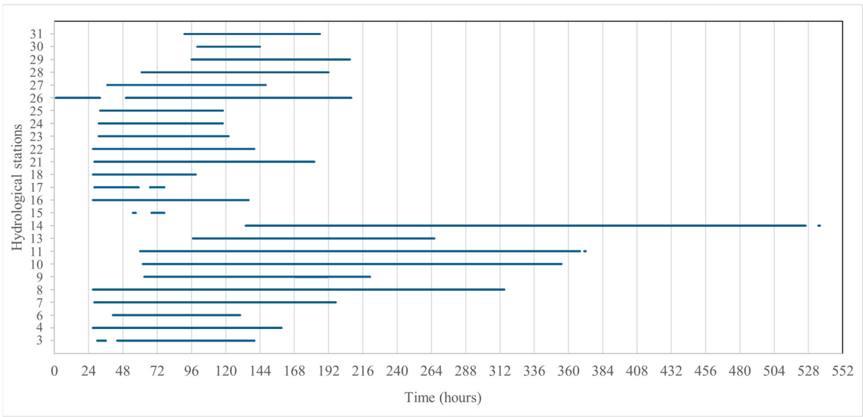
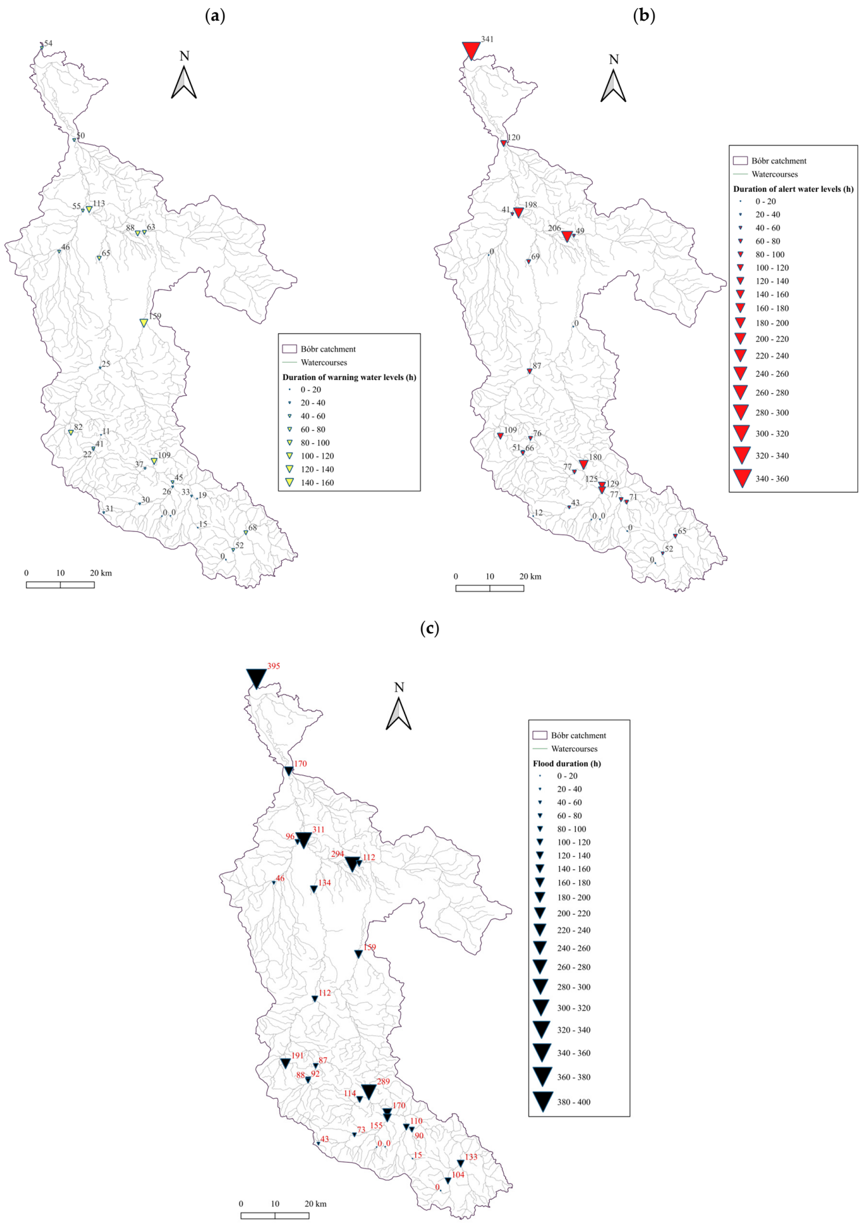
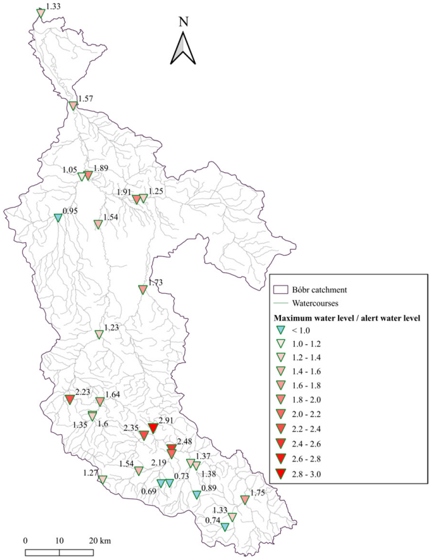
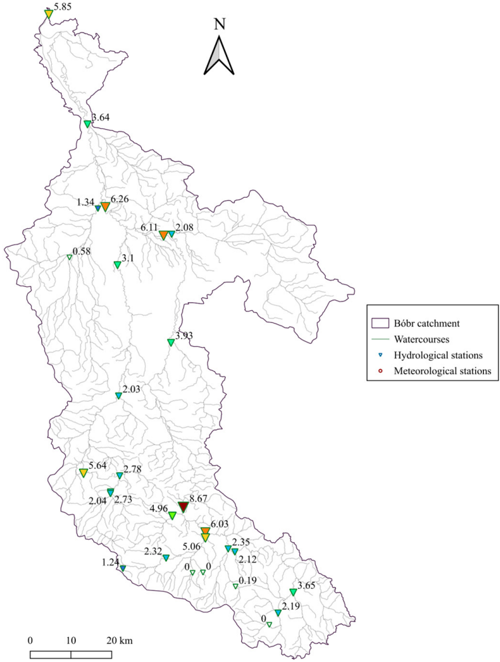
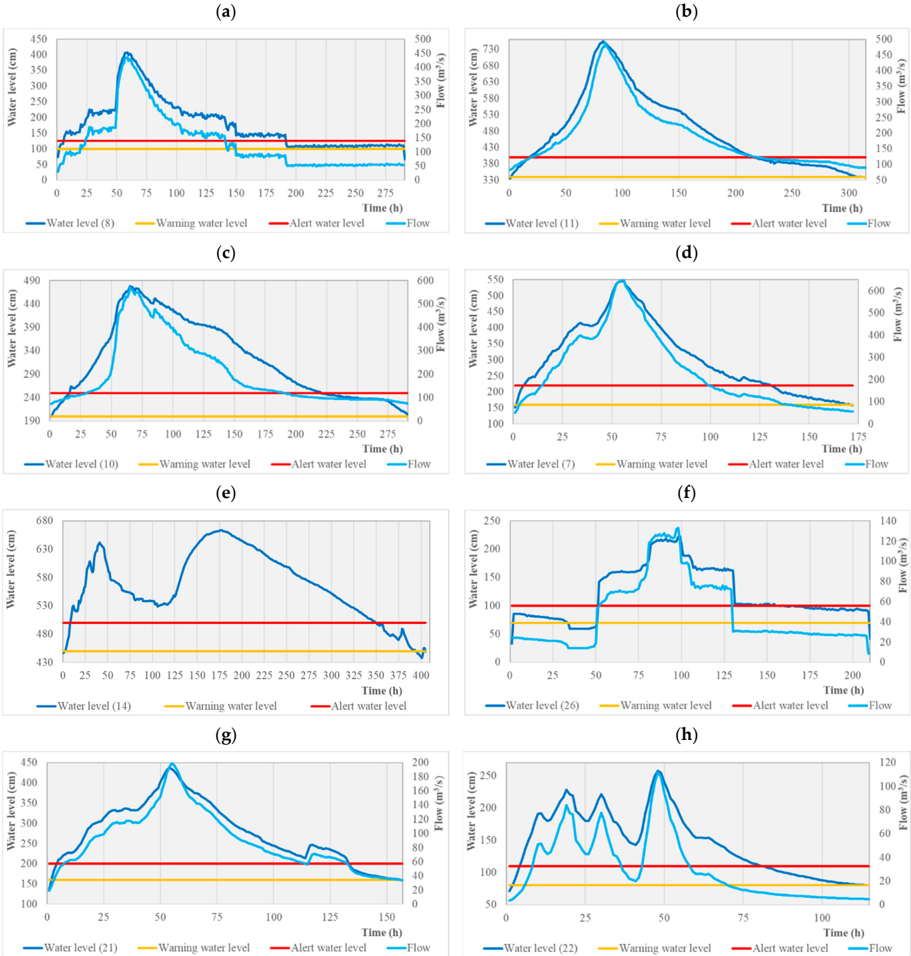
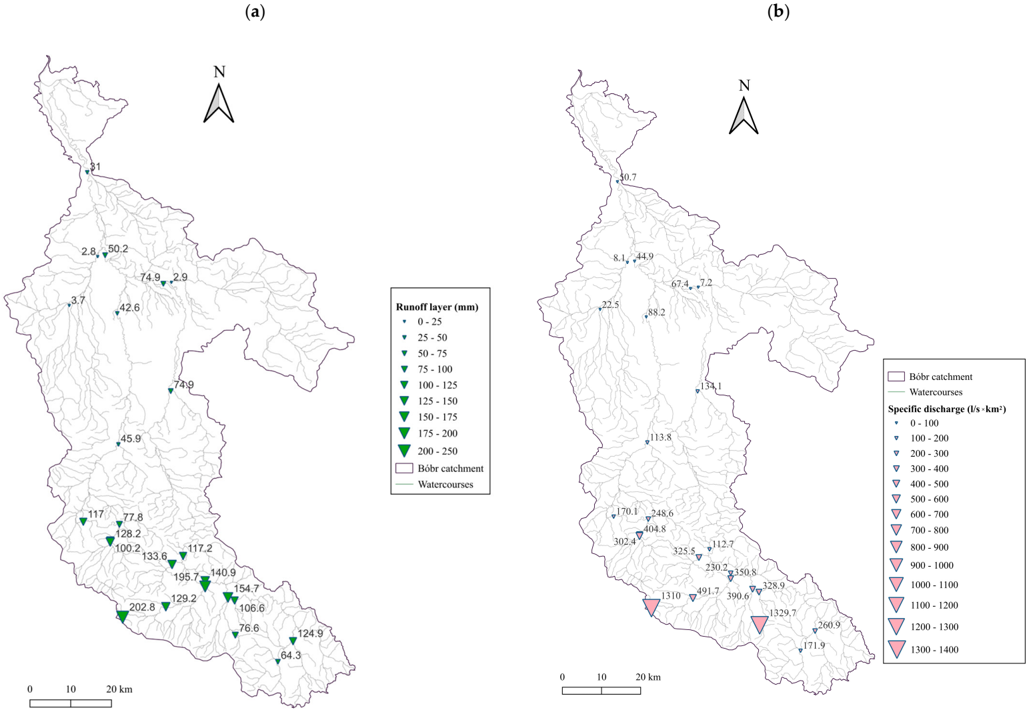
Flooding is a phenomenon that has become more frequent in recent years due to climate change. This also includes Poland, where a flood occurred in 2024 due to the inflow of the Genoese low. The main objective of the article is to comprehensively characterize this phenomenon in the Bóbr River Basin. To achieve this objective, available hourly hydro-meteorological data from stations monitored by the Polish Institute of Meteorology and Water Management were used. On this basis, the duration, magnitude, scale of the flood, and selected runoff measures were determined. Data shows that the flood was caused by rainfall, which occurred at the highest intensity between 13.09 and 15.09. The duration of the flood was 536 h, assuming warning levels as boundary points. The average duration of the flood in all stations was 125.32 h, and its average magnitude (ratio of the highest level to the alert level)—1.53. The 10-point flood scale adopted in the article indicates that the flood affected the area around Jelenia Góra the most (average 3.10 for the entire basin). In 6 out of 22 stations, the highest water flow measurements in history were recorded in 2024. The area around Jelenia Góra was selected as the region most exposed to flooding. This work can be a compendium of knowledge in the field of understanding the mechanisms related to flooding. It may be important in the context of formulating the future water policy, developing documents related to flood protection, adaptation to climate change and sustainable development goals.
Overview
The claims and statistics of this paper haven’t been checked yet.
Run the check — free, no account needed. It reads the open-access text and checks the sources it cites.
Integrity signals
Registry
Cites
Statistics
Figures
Verification
Claims the paper makes
The claims and statistics of this paper haven’t been checked yet.
Run the check — free, no account needed. It reads the open-access text and checks the sources it cites.
Claims other papers make about this one
Each is checked against this paper’s own text: does it say what the citing paper says it does?
In the citing paper
“Recent extreme weather events, such as the 2024 floods in Central Europe and the 2025 cyclone-induced flooding in Southeast Asia, have demonstrated that traditional static flood defence models are failing to predict the compound risks of vegetation growth and extreme precipitation 13-15 .”
From AI-driven digital twinning quantifies the trade-off between flood conveyance and riparian stability under climate extremes (2026) · cites this paper as [13]
Self-check
Percentages, sums and reported differences re-computed from the paper’s own numbers.
The self-check needs the paper’s full text.
Citations
Cites
Stanke, C., Murray, V., Amlôt, R., Nurse, J., & Williams, R. (2012) · PLoS Currents · doi:10.1371/4f9f1fa9c3cae · Cited by 254
Research works printed but not linked: 75
- Saharia, 2017, Characterization of floods in the United States, J. Hydrol., 548, 524, 10.1016/j.jhydrol.2017.03.010 · DOI
- Kalinauskas, 2021, Implementation of the European Union Floods Directive—Requirements and national transposition and practical application: Lithuanian case study, Land. Use Policy, 100, 104924, 10.1016/j.landusepol.2020.104924 · DOI
- Hundecha, Y., Parajka, J., and Viglione, A. (2017). Flood type classification and assessment of their past changes across Europe. Hydrol. Earth Syst. Sci. Discuss. · DOI
- Doocy, S., Daniels, A., Murray, S., and Kirsch, T.D. (2013). The human impact of floods: A historical review of events 1980–2009 and systematic literature review. PLoS Curr., 5, ecurrents.dis.f4deb457904936b07c09daa98ee8171a. · DOI
- Alfieri, 2017, Global projections of river flood risk in a warmer world, Earth’s Future, 5, 171, 10.1002/2016EF000485 · DOI
- Dottori, 2018, Increased human and economic losses from river flooding with anthropogenic warming, Nat. Clim. Change, 8, 781, 10.1038/s41558-018-0257-z · DOI
- Slater, 2021, Global changes in 20-year, 50-year, and 100-year river floods, Geophys. Res. Lett., 48, e2020GL091824, 10.1029/2020GL091824 · DOI
- Charalampous, 2025, The 2024 Spain Floods: A Callfor Resilience and the Duty of Memory, Int. J. Public Health, 70, 1608236, 10.3389/ijph.2025.1608236 · DOI
- Castro-Melgar, I., Falaras, T., Basiou, E., and Parcharidis, I. (2025). Assessment of the October 2024 Cut-Off Low Event Floods Impact in Valencia (Spain) with Satellite and Geospatial Data. Remote Sens., 17. · DOI
- Rojas, 2013, Climate change and river floods in the European Union: Socio-economic consequences and the costs and benefits of adaptation, Glob. Environ. Change, 23, 1737, 10.1016/j.gloenvcha.2013.08.006 · DOI
- Paprotny, 2025, Attribution of flood impacts shows strong benefits of adaptation in Europe since 1950, Sci. Adv., 11, 7068, 10.1126/sciadv.adt7068 · DOI
- Ghazi, 2023, The frequency, intensity, and origin of floods in Poland in the 11th–15th centuries based on documentary evidence, J. Hydrol., 623, 129778, 10.1016/j.jhydrol.2023.129778 · DOI
- Ghazi, 2023, An assessment of flood occurrences in Poland in the 16th century, J. Hydrol. Reg. Stud., 50, 101597, 10.1016/j.ejrh.2023.101597 · DOI
- Ghazi, 2024, A comprehensive study of floods in Poland in the 17th–18th centuries, J. Hydrol. Reg. Stud., 53, 101796, 10.1016/j.ejrh.2024.101796 · DOI
- Kundzewicz, 2022, Detection of trends in observed river floods in Poland, J. Hydrol. Reg. Stud., 41, 101098, 10.1016/j.ejrh.2022.101098 · DOI
- Kundzewicz, Z., Stoffel, M., Niedźwiedź, T., and Wyżga, B. (2016). Flood Risk Management in the Upper Vistula Basin in Perspective: Traditional versus Alternative Measures. Flood Risk in the Upper Vistula Basin. GeoPlanet: Earth and Planetary Sciences, Springer. · DOI
- Otop, 2014, Precipitation extremes during flooding in the Odra River Basin in May–June 2010, Meteorol. Hydrol. Water Manag., 2, 13, 10.26491/mhwm/22918 · DOI
- Romanowicz, 2014, Zagrożenia związane z nadmiarem wody, Disasters Relat. Water Excess. Nauka, 1, 123
- Piniewski, 2017, Changes in low and high flows in the Vistula and the Odra basins: Model projections in the European-scale context, Hydrol. Process., 31, 2210, 10.1002/hyp.11176 · DOI
- Woś, K., Radoń, R., Tekielak, T., Wrzosek, K., Pieron, Ł., and Piórecki, M. (2022). Role of multifunctional water reservoirs in the Upper Vistula Basin in reducing flood risk. Water, 14. · DOI
- Walczykiewicz, 2014, Multi-criteria analysis for selection of activity options limiting flood risk, Water Resour., 42, 124, 10.1134/S0097807815010121 · DOI
- Dysarz, 2020, Development of methodology for assessment of long-term morphodynamic impact on flood hazard, J. Flood Risk Manag., 13, e12654, 10.1111/jfr3.12654 · DOI
- Zeleňáková, M., Kubiak-Wójcicka, K., and Negm, A.M. (2021). Flood risk management system in Poland. Management of Water Resources in Poland, Springer. Springer Water. · DOI
- Kundzewicz, Z.W., Januchta-Szostak, A., Nachlik, E., Pińskwar, I., and Zaleski, J. (2023). Challenges for flood risk reduction in Poland’s changing climate. Water, 15. · DOI
- Faganello, 2005, Flood management strategy for the Upper and Middle Odra River Basin: Feasibility study of Raciborz Reservoir, Nat. Hazards, 36, 273, 10.1007/s11069-004-4553-8 · DOI
- Pavlinec, 2024, Heavy rains and flood in Poland. Are we facing a catastrophe?, Wodne Sprawy, 16, 13
- Zalewski, 2015, Sustainable floodplain management for flood prevention and water quality improvement, Nat. Hazards, 76, 955, 10.1007/s11069-014-1529-1 · DOI
- Kuroczycki, 2016, Wezbrania na Bobrze w Żaganiu w świetle obserwacji historycznych, Zesz. Nauk. Inż. Środ., 162, 129
- 2018, Typologia reżimu odpływu rzek w Polsce w różnych fazach Oscylacji Północnoatlantyckiej, Bad. Fizjogr. Ser. A Geogr. Fiz., 9, 249
- Hudak, 2018, The analysis of the degree of flood risk in the middle Bobr valley, Civil Environ. Eng. Rep., 27, 68, 10.2478/ceer-2018-0019 · DOI
- 2017, Flood risk of Lower Silesia Voivodship, Civ. Environ. Eng. Rep., 10, 7
- Malczewska, 2010, Variability of water energy resources on example of Bóbr River, Infrastrukt. Ekol. Teren. Wiej., 13, 167
- Machajski, 2010, Model investigations of side channel spillway of the Pilchowice storage reservoir on the Bóbr River, Stud. Geotech. Et Mech., 32, 65
- Mokwa, 2008, The silting influence on the capacity of the Krzywaniec reservoir, Ann. Wars. Univ. Life Sci. SGGW Land. Reclam., 39, 121
- Olearczyk, 2015, Regional relationships of maximum outflow in the Upper Bóbr River Basin, J. Ecol. Eng., 16, 206, 10.12911/22998993/60479 · DOI
- Piniarski, 2023, Challenges of a GIS-based physical-geographical regionalization of Poland, Environ. Monit. Assess., 195, 11734, 10.1007/s10661-023-11734-4 · DOI
- Kundzewicz, 2005, Summer floods in Central Europe–Climate change track?, Nat. Hazards, 36, 165, 10.1007/s11069-004-4547-6 · DOI
- Kundzewicz, 2014, Adapting flood preparedness tools to changing flood risk conditions: The situation in Poland, Oceanologia, 56, 385, 10.5697/oc.56-2.385 · DOI
- Kuźmiński, Ł., Nadolny, M., and Wojtaszek, H. (2020). Probabilistic quantification in the analysis of flood risks in cross-border areas of Poland and Germany. Energies, 13. · DOI
- Wibig, 2023, Comparison and combination of interpolation methods for daily precipitation in Poland: Evaluation using the correlation coefficient and correspondence ratio, Meteorol. Hydrol. Water Manag., 11, 1
- Chen, 2012, Estimation of the spatial rainfall distribution using inverse distance weighting (IDW) in the middle of Taiwan, Paddy Water Environ., 10, 209, 10.1007/s10333-012-0319-1 · DOI
- Chin, R.J., Lai, S.H., Loh, W.S., Ling, L., and Soo, E.Z.X. (2023). Assessment of Inverse Distance Weighting and Local Polynomial Interpolation for Annual Rainfall: A Case Study in Peninsular Malaysia. Eng. Proc., 38. · DOI
- Jeong, 2020, Improvement of daily precipitation estimations using PRISM with inverse-distance weighting, Theor. Appl. Climatol., 139, 923, 10.1007/s00704-019-03012-6 · DOI
- Li, Z. (2021). An enhanced dual IDW method for high-quality geospatial interpolation. Sci. Rep., 11. · DOI
- Hauer, 2017, Discharge measurements and streamflow analysis, Methods in Stream Ecology, Volume 1, 49
- Acquaotta, 2019, Increased flash flooding in Genoa Metropolitan Area: A combination of climate changes and soil consumption?, Meteorol. Atmos. Phys., 131, 1099, 10.1007/s00703-018-0623-4 · DOI
- Lollino, G., Manconi, A., Guzzetti, F., Culshaw, M., Bobrowsky, P., and Luino, F. (2015). Flash flood events and urban development in Genoa (Italy): Lost in translation. Engineering Geology for Society and Territory, Volume 5, Springer. · DOI
- Mioduszewski, 2003, Ideas of flood protection in Poland, J. Water Land. Dev., 7, 3
- Piwowar, A., and Dzikuć, M. (2022). Water Energy in Poland in the Context of Sustainable Development. Energies, 15. · DOI
- Nithila Devi, N., Sridharan, B., Bindhu, V.M., Narasimhan, B., Bhallamudi, S.M., Bhatt, C.M., Usha, T., Vasan, D.T., and Kuiry, S.N. (2020). Investigation of Role of Retention Storage in Tanks (Small Water Bodies) on Future Urban Flooding: A Case Study of Chennai City, India. Water, 12. · DOI
- 2012, Investigation of Mechanical Properties and Flow Resistance of Flexible Riverbank Vegetation, Pol. J. Environ. Stud., 21, 201
- Bezak, N., Kovačević, M., Johnen, G., Lebar, K., Zupanc, V., Vidmar, A., and Rusjan, S. (2021). Exploring Options for Flood Risk Management with Special Focus on Retention Reservoirs. Sustainability, 13. · DOI
- Ritzema, 2018, Integration of water management and land consolidation in rural areas to adapt to climate change: Experiences from Poland and the Netherlands, Land. Use Policy, 77, 498, 10.1016/j.landusepol.2018.06.005 · DOI
- Alfieri, 2016, Increasing flood risk under climate change: A pan-European assessment of the benefits of four adaptation strategies, Clim. Change, 136, 507, 10.1007/s10584-016-1641-1 · DOI
- Kazak, 2015, Flood risk factors in suburban area in the context of climate change adaptation policies—Case study of Wrocław, Poland, J. Ecol. Eng., 16, 13, 10.12911/22998993/1854 · DOI
- Mrozik, K.D. (2022). Problems of local flooding in functional urban areas in Poland. Water, 14. · DOI
- PAP—Polish Press Agency (2024, October 14). Szef KPRM: Do tej pory 57 tys. osób Jest Realnie Dotkniętych Powodzią. PAP, Available online: https://www.pap.pl/aktualnosci/szef-kprm-do-tej-pory-57-tys-osob-jest-realnie-dotknietych-powodzia.
- Piepiora, 2016, Counteracting flood effects in Jelenia Góra, Słup. Pr. Geogr., 13, 139
- Moreira, 2021, Review article: A systematic review and future prospects of flood vulnerability indices, Nat. Hazards Earth Syst. Sci., 21, 1513, 10.5194/nhess-21-1513-2021 · DOI
- Fawwaz, 2021, Floods and Their Impact on the Environment, Acad. Perspect. Procedia, 4, 42, 10.33793/acperpro.04.02.24 · DOI
- Allaire, 2018, Socio-economic impacts of flooding: A review of the empirical literature, Water Secur., 3, 18, 10.1016/j.wasec.2018.09.002 · DOI
- Merz, 2021, Causes, impacts and patterns of disastrous river floods, Nat. Rev. Earth Environ., 2, 592, 10.1038/s43017-021-00195-3 · DOI
- Grelot, 2013, Economic evaluation of flood damage to agriculture-review and analysis of existing methods, Hazards Earth Syst. Sci., 13, 2493, 10.5194/nhess-13-2493-2013 · DOI
- Kim, 2023, Flood impacts on global crop production: Advances and limitations, Environ. Res. Lett., 18, 054007, 10.1088/1748-9326/accd85 · DOI
- Filipe, J.F., Herrera, V., Curone, G., Vigo, D., and Riva, F. (2020). Floods, Hurricanes, and Other Catastrophes: A Challenge for the Immune System of Livestock and Other Animals. Front. Vet. Sci., 7. · DOI
- Saljnikov, 2019, Impact of a severe flood on large-scale contamination of arable soils by potentially toxic elements (Serbia), Environ. Geochem. Health, 41, 249, 10.1007/s10653-018-0138-4 · DOI
- Parasiewicz, 2019, The role of floods and droughts on riverine ecosystems under a changing climate, Fish. Manag. Ecol., 26, 461, 10.1111/fme.12388 · DOI
- Cardoso, 2008, The impact of extreme flooding events and anthropogenic stressors on the macrobenthic communities’ dynamics, Estuar. Coast. Shelf Sci., 76, 553, 10.1016/j.ecss.2007.07.026 · DOI
- Hrdinka, 2012, Possible impacts of floods and droughts on water quality, J. Hydro-Environ. Res., 6, 145, 10.1016/j.jher.2012.01.008 · DOI
- Alderman, 2012, Floods and human health: A systematic review, Environ. Int., 47, 37, 10.1016/j.envint.2012.06.003 · DOI
- Rogger, 2017, Land use change impacts on floods at the catchment scale: Challenges and opportunities for future research, Water Resour. Res., 53, 5209, 10.1002/2017WR020723 · DOI · Paper page
- Odijk, 2001, Assessing the effects of land use changes on floods in the meuse and oder catchment, Phys. Chem. Earth Part B Hydrol. Ocean. Atmos., 26, 593, 10.1016/S1464-1909(01)00054-5 · DOI
- Wdowczyk, 2025, Assessment of changes occurring in biochar/zeolite substrates used in the vegetation-activated sludge process in the treatment of leachate from landfills, Water Resour. Ind., 33, 100280, 10.1016/j.wri.2025.100280 · DOI
- Wdowczyk, 2024, Application of selected indicators to assess contamination of municipal landfill leachate and its impact on groundwater, Water Resour. Ind., 32, 100265, 10.1016/j.wri.2024.100265 · DOI
- Abegaz, 2024, History, causes, and trend of floods in the U.S.: A review, Nat. Hazards, 120, 13715, 10.1007/s11069-024-06791-y · DOI
Cited by
Shin, J. H., Go, S. H., & Park, J. H. (2026) · Scientific Reports · doi:10.1038/s41598-026-63704-8
Metadata
- Authors
- Tomczyk, P., Wiatkowski, M., Kasperek, R., Gruss, Ł., & Pokładek, R.
- Affiliations
- Institute of Environmental Engineering, Wroclaw University of Environmental and Life Sciences, pl. Grunwaldzki 24, 50-363 Wrocław, Poland
- Department of Environmental Protection and Development, Wroclaw University of Environmental and Life Sciences, pl. Grunwaldzki 24, 50-363 Wrocław, Poland
- Venue
- Sustainability
- Publisher
- MDPI AG
- Published
- 2025-11-27
- Volume
- 17
- Issue
- 23
- Pages
- 10640
- ISSN
- 2071-1050
- Cited by
- 3
- References
- 1
- Language
- en
- Funders
- Bekker Programme of the Polish National Agency for Academic Exchange (BPN/BEK/2023/1/00079)
About these checks
Registry, retraction, Cites and statistics results are computed, not judged, with one exception: a printed reference that no index lists is read once by a model before it counts as a citation error. Claims are extracted by a model and kept only when their quote appears verbatim in the text; each cited source is then checked, with a model’s help, for whether it says what the claim relies on. Those verdicts can be wrong — read the claim’s quote and the cited source before relying on one.
Statistics and arithmetic are recomputed, not judged.
Confidence bands are shown only for fields calibrated on our annotated test set. None is calibrated yet, so no band is shown.
What counts as a claim ›How we measure confidence ›How we check this ›
Are you an author, or do you see a problem with this page? Request a review
How to cite
Cite CoChat for the checks on this page, and the paper for its own findings.
- This page
- CoChat. (2026). Citation check: Floods as a Consequence of Climate Change: Comprehensive Meteorological and Hydrological Analysis of the 2024 Flood Course in the Bóbr River Basin (Southwestern Poland). https://app.cochat.ai/papers/10.3390/su172310640
- The paper
- Tomczyk, P., Wiatkowski, M., Kasperek, R., Gruss, Ł., & Pokładek, R. (2025). Floods as a Consequence of Climate Change: Comprehensive Meteorological and Hydrological Analysis of the 2024 Flood Course in the Bóbr River Basin (Southwestern Poland). Sustainability. https://doi.org/10.3390/su172310640
