

The DOI matches its Crossref record; 29 of the 29 references it cites were found in a registry or an index.
Computational Experiment Approach to Controlled Evolution of Procurement Pattern in Cluster Supply Chain
Open accessAbstract
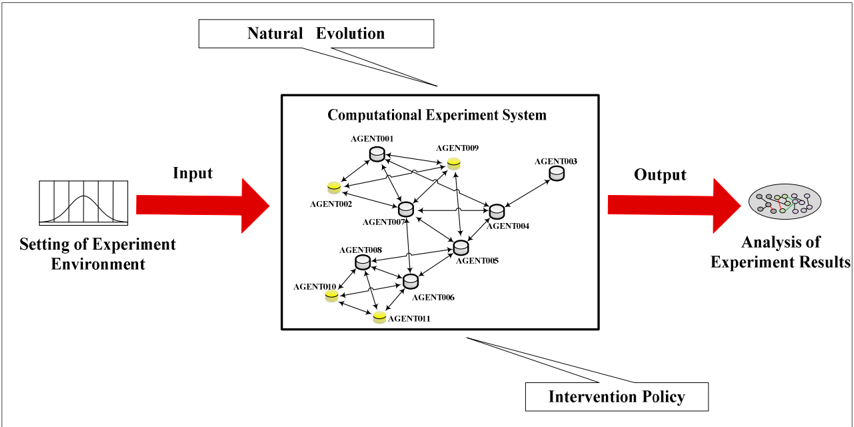
Companies have been aware of the benefits of developing Cluster Supply Chains (CSCs), and they are spending a great deal of time and money attempting to develop the new business pattern. Yet, the traditional techniques for identifying CSCs have strong theoretical antecedents, but seem to have little traction in the field. We believe this is because the standard techniques fail to capture evolution over time, nor provide useful intervention measures to reach goals. To address these problems, we introduce an agent-based modeling approach to evaluate CSCs. Taking collaborative procurement as research object, our approach is composed of three parts: model construction, model instantiation, and computational experiment. We use the approach to explore the service charging policy problem in collaborative procurement. Three kinds of service charging polices are compared in the same experiment environment. Finally, “Fixed Cost” is identified as the optimal policy under the stable market environment. The case study can help us to understand the workflow of applying the approach, and provide valuable decision support applications to industry.
Overview
The claims and statistics of this paper haven’t been checked yet.
Run the check — free, no account needed. It reads the open-access text and checks the sources it cites.
Integrity signals
Registry
Cites
Statistics
Figures

Verification
Claims the paper makes
The claims and statistics of this paper haven’t been checked yet.
Run the check — free, no account needed. It reads the open-access text and checks the sources it cites.
Claims other papers make about this one
Each is checked against this paper’s own text: does it say what the citing paper says it does?
The source backs part of the claim, not all of it — or backs it for a different population, condition or comparison.
In the citing paper
“purchasing raw materials in bulk or wholesale lowers overall production costs for businesses, and manufacturing on a larger scale allows a more efficient use of products that would otherwise be wasted [139].”
From From Efficiency Gains to Rebound Effects: The Problem of Jevons' Paradox in AI's Polarized Environmental Debate (2025) · cites this paper as [139]
Experimental — accuracy not yet measured
Self-check
Percentages, sums and reported differences re-computed from the paper’s own numbers.
The self-check needs the paper’s full text.
Citations
Cites
Intelligent agents: theory and practice
Wooldridge, M., & Jennings, N. R. (1995) · The Knowledge Engineering Review · doi:10.1017/s0269888900008122 · Cited by 6,810
Large-Scale Dynamic Systems: Stability and Structure
Šiljak, D. D. (1978) · Cited by 864
Social Computing: From Social Informatics to Social Intelligence
Wang, F.-Y., Carley, K. M., Zeng, D., & Mao, W. (2007) · IEEE Intelligent Systems · doi:10.1109/mis.2007.41 · Cited by 569
Kordić, V. (2008) · Cited by 448
The Contingent Effects of Transactive Memory: When Is It More Beneficial to Know What Others Know?
Ren, Y., Carley, K. M., & Argote, L. (2006) · Management Science · doi:10.1287/mnsc.1050.0496 · Cited by 242
Local Industrial Clusters: Existence, Emergence and Evolution
Brenner, T. (2004) · Max Planck Institute for Plasma Physics · Cited by 179
Analysing supply chain performance using a balanced measurement method
Bullinger, H., Kühner, M., & van Hoof, A. (2002) · International Journal of Production Research · doi:10.1080/00207540210161669 · Cited by 148
Ioppolo, G., Saija, G., & Salomone, R. (2012) · Land Use Policy · doi:10.1016/j.landusepol.2012.08.010 · Cited by 91
MASON RebeLand: An Agent-Based Model of Politics, Environment, and Insurgency
Cioffi‐Revilla, C. A., & Rouleau, M. D. (2010) · International Studies Review · doi:10.1111/j.1468-2486.2009.00911.x · Cited by 91
Ioppolo, G., Saija, G., & Salomone, R. (2011) · Land Use Policy · doi:10.1016/j.landusepol.2011.10.005 · Cited by 56
Research works printed but not linked: 8
- Li, J. (2006). Study on Cluster Supply Chain and its Management. [Ph.D. Thesis, Huazhong Agriculture University].
- Li, 2005, Study on the cluster supply chain and its reverse logistics—The case study of IT industry in Donggua, Sci. Res. Manag., 26, 86
- Biswas, S., Roy, S., and Seshagiri, S. (2007, January 28–30). Collaboration in Indian SME Clusters: A Case Study. Proceedings of the 3rd International Conference on Communities and Technologies, East Lansing, MI, USA.
- Zhong, N. (2009). Research on the Risk Management and Control Strategies for the Supply Chain Based on Industrial Clusters, Wuhan University Press.
- Wu, 2007, The embodiment and improvement of the structure competitiveness of cluster supply chain, Econ. Probl. Explor., 6, 91
- Huang, 2005, Dynamic modeling of urban transportation networks and analysis of its travel behaviors, Chin. J. Manag., 2, 18
- Huang, 2004, Simulation SARS: Small world epidemiological modeling and public health policy assessments, J. Artif. Soc. Soc. Simul., 7, Article 4
- Lawler, E., Markovsky, B., Ridgeway, C., and Walker, H. (1990). Advances in Group Processes: Theory and Research, JAI Press.
Cited by
Luccioni, A. S., Strubell, E., & Crawford, K. (2025) · Proceedings of the 2025 ACM Conference on Fairness, Accountability, and Transparency · doi:10.1145/3715275.3732007 · Cited by 71
“For instance, purchasing raw ma-terialsin bulkorwholesale lowers overall productioncostsforbusi-nesses, and manufacturing on a larger scale allows a more efficient use of products that would otherwise be wasted [139].”
Computational Experiment-Based Evaluation on Context-Aware O2O Service Recommendation
Xue, X., Han, H., Wang, S., & Qin, C.-Z. (2016) · IEEE Transactions on Services Computing · doi:10.1109/tsc.2016.2638083 · Cited by 32
“By far, the computational experiment method has been widely used in analysis and prediction of complex social system, such as traffic system [16], war simulation system [17], socio-economic system [18], physiological/pathological system [19], political ecosystem [20], etc.”
MethodSelf-citationResearch on Escaping the Big-Data Traps in O2O Service Recommendation Strategy
Xue, X., Huangfu, S., Zhang, L., & Wang, S. (2019) · IEEE Transactions on Big Data · doi:10.1109/tbdata.2019.2915798 · Cited by 8
“[35], traffic system [36], war simulation system [37], physiological /political ecosystem [38], etc.”
BackgroundSelf-citationUsing TRIZ to Improve the Procurement Process of Spare Parts in the Taiwan Navy
Wang, C., Lin, M.-H., Huang, C.-J., Huang, C.-C., & Liao, R.-Y. (2017) · Sustainability · doi:10.3390/su9101908 · Cited by 4
“[6] introduced an agent-based modeling approach to evaluate cluster supply chains.”
BackgroundLong, Q., Song, K., & Yang, S. (2019) · IEEE Access · doi:10.1109/access.2019.2908979 · Cited by 3
“[43] introduced an agent-based computational experiment approach for exploring the service charging policy problem in collaborative procurement in cluster SC.”
Background
Metadata
- Authors
- Xue, X., Wang, S., & Lu, B.
- Affiliations
- Henan Polytechnic University (CN)
- Corresponding author
- Xue, Xiao
- Venue
- Sustainability
- Publisher
- MDPI AG
- Published
- 2015-01-30
- Volume
- 7
- Issue
- 2
- Pages
- 1516-1541
- ISSN
- 2071-1050 (ISSN-L)
- OpenAlex
- W2076489445
- Cited by
- 8
- References
- 29
- Citations by year
- 2025: 3 · 2019: 2 · 2017: 2 · 2016: 1
- FWCI
- 2.19
- Type
- journal article
- Language
- en
- Open access
- gold
- dx.doi.org
- Licence
- Locations
- Sustainability (publishedVersion, cc-by)
- RePEc: Research Papers in Economics (submittedVersion)
- DOAJ (DOAJ: Directory of Open Access Journals) (submittedVersion, cc-by-sa)
- Funders
- National Natural Science Foundation of China (61175066, 60905041, 61300124)
- Program for Science&Technology Innovation Talents in Universities of Henan Province (2012HASTIT013)
- Foundation for The Excellent Youth Scholars of University of Henan Province (2011GGJS-056)
- Program for Innovative Research Team of Henan Polytechnic University (T2013-3)
- Topics
- Social Sciences › Decision Sciences › Management Science and Operations Research › Supply Chain and Inventory Management
- Social Sciences › Business, Management and Accounting › Strategy and Management › Sustainable Supply Chain Management
- Social Sciences › Business, Management and Accounting › Management Information Systems › Quality and Supply Management
- Keywords
- cluster supply chain, collaborative procurement, agent-based modeling, numerical experiments, supply chain evolution, decision support
About these checks
Registry, retraction, Cites and statistics results are computed, not judged, with one exception: a printed reference that no index lists is read once by a model before it counts as a citation error. Claims are extracted by a model and kept only when their quote appears verbatim in the text; each cited source is then checked, with a model’s help, for whether it says what the claim relies on. Those verdicts can be wrong — read the claim’s quote and the cited source before relying on one.
Statistics and arithmetic are recomputed, not judged.
Confidence bands are shown only for fields calibrated on our annotated test set. None is calibrated yet, so no band is shown.
What counts as a claim ›How we measure confidence ›How we check this ›
Are you an author, or do you see a problem with this page? Request a review
How to cite
Cite CoChat for the checks on this page, and the paper for its own findings.
- This page
- CoChat. (2026). Citation check: Computational Experiment Approach to Controlled Evolution of Procurement Pattern in Cluster Supply Chain. https://app.cochat.ai/papers/10.3390/su7021516
- The paper
- Xue, X., Wang, S., & Lu, B. (2015). Computational Experiment Approach to Controlled Evolution of Procurement Pattern in Cluster Supply Chain. Sustainability. https://doi.org/10.3390/su7021516
Data sources
Bibliographic data: Semantic Scholar, OpenAlex, Crossref.
Contains information from the Semantic Scholar Academic Graph Datasets, made available under the ODC Attribution License (ODC-BY 1.0).
Semantic Scholar’s data is described in: Kinney, R., et al. (2023). The Semantic Scholar Open Data Platform. arXiv:2301.10140.
