

IntruDTree: A Machine Learning Based Cyber Security Intrusion Detection Model
Open accessPublished version of a preprint
The DOI matches its Crossref record; 52 of the 55 references it cites were found in a registry or an index.
Abstract
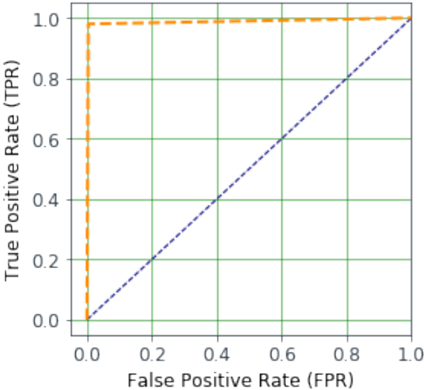
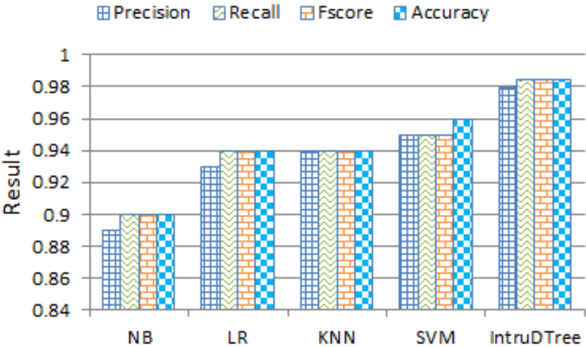
Cyber security has recently received enormous attention in today’s security concerns, due to the popularity of the Internet-of-Things (IoT), the tremendous growth of computer networks, and the huge number of relevant applications. Thus, detecting various cyber-attacks or anomalies in a network and building an effective intrusion detection system that performs an essential role in today’s security is becoming more important. Artificial intelligence, particularly machine learning techniques, can be used for building such a data-driven intelligent intrusion detection system. In order to achieve this goal, in this paper, we present an Intrusion Detection Tree (“IntruDTree”) machine-learning-based security model that first takes into account the ranking of security features according to their importance and then build a tree-based generalized intrusion detection model based on the selected important features. This model is not only effective in terms of prediction accuracy for unseen test cases but also minimizes the computational complexity of the model by reducing the feature dimensions. Finally, the effectiveness of our IntruDTree model was examined by conducting experiments on cybersecurity datasets and computing the precision, recall, fscore, accuracy, and ROC values to evaluate. We also compare the outcome results of IntruDTree model with several traditional popular machine learning methods such as the naive Bayes classifier, logistic regression, support vector machines, and k-nearest neighbor, to analyze the effectiveness of the resulting security model.
Overview
The claims and statistics of this paper haven’t been checked yet.
Free: it reads the open-access text and checks the first 5 claims that cite a source we can check. Create a free account to check every claim.
Integrity signals
Registry
Cites
Statistics
Figures
Verification
Claims the paper makes
The claims and statistics of this paper haven’t been checked yet.
Free: it reads the open-access text and checks the first 5 claims that cite a source we can check. Create a free account to check every claim.
Claims other papers make about this one
Each is checked against this paper’s own text: does it say what the citing paper says it does?
The cited source says what the claim attributes to it.
In the citing paper
“In addition, BehavDT recently proposed by Sarker et al. [109], and IntrudTree [106] can be used for building effective classification or prediction models in the relevant tasks within the domain of data science and analytics.”
From Data Science and Analytics: An Overview from Data-Driven Smart Computing, Decision-Making and Applications Perspective (2021) · cites this paper as [106]
In the citing paper
“A right and optimal subset of the selected features in a problem domain is capable to minimize the overfitting problem through simplifying and generalizing the model as well as increases the model’s accuracy [97].”
From Machine learning: Algorithms, real-world applications and research directions (2021) · cites this paper as [97]
Self-check
Percentages, sums and reported differences re-computed from the paper’s own numbers.
The self-check needs the paper’s full text.
Citations
Cites
Data mining: concepts and techniques
(2012) · Choice Reviews Online · doi:10.5860/choice.49-3305 · Cited by 28,531
Data Mining: Practical Machine Learning Tools and Techniques
(2011) · Elsevier eBooks · doi:10.1016/c2009-0-19715-5 · Cited by 25,437
Quinlan, J. R. (1986) · Machine Learning · doi:10.1007/bf00116251 · Cited by 21,439
Fast algorithms for mining association rules
Agrawal, R., & Srikant, R. (1998) · Cited by 11,307
A Survey of Data Mining and Machine Learning Methods for Cyber Security Intrusion Detection
Buczak, A. L., & Guven, E. (2016) · IEEE Communications Surveys & Tutorials · doi:10.1109/comst.2015.2494502 · Cited by 3,332
Outside the Closed World: On Using Machine Learning for Network Intrusion Detection
Sommer, R., & Paxson, V. (2010) · 2010 IEEE Symposium on Security and Privacy · doi:10.1109/sp.2010.25 · Cited by 2,085
Machine Learning and Deep Learning Methods for Cybersecurity
Xin, Y., Kong, L., Liu, Z., Chen, Y., Li, Y., Zhu, H., Gao, M., Hou, H., & Wang, C. (2018) · IEEE Access · doi:10.1109/access.2018.2836950 · Cited by 1,228
Intrusion detection by machine learning: A review
Tsai, C.-F., Hsu, Y.-F., Lin, C.-Y., & Lin, W.-Y. (2009) · Expert Systems with Applications · doi:10.1016/j.eswa.2009.05.029 · Cited by 969
Cybersecurity data science: an overview from machine learning perspective
Sarker, I. H., Kayes, A. S. M., Badsha, S., Alqahtani, H., Watters, P., & Ng, A. (2020) · Journal of Big Data · doi:10.1186/s40537-020-00318-5 · Cited by 766
Self-citationMutual information-based feature selection for intrusion detection systems
Amiri, F., Rezaei Yousefi, M., Lucas, C., Shakery, A., & Yazdani, N. (2011) · Journal of Network and Computer Applications · doi:10.1016/j.jnca.2011.01.002 · Cited by 471
Li, Y., Xia, J., Zhang, S., Yan, J., Ai, X., & Dai, K. (2012) · Expert Systems with Applications · doi:10.1016/j.eswa.2011.07.032 · Cited by 386
Bayesian event classification for intrusion detection
Kruegel, C., Mutz, D., Robertson, W., & Valeur, F. (2004) · 19th Annual Computer Security Applications Conference, 2003. Proceedings. · doi:10.1109/csac.2003.1254306 · Cited by 344
Data-Driven Cybersecurity Incident Prediction: A Survey
Sun, N., Zhang, J., Rimba, P., Gao, S., Zhang, L. Y., & Xiang, Y. (2019) · IEEE Communications Surveys & Tutorials · doi:10.1109/comst.2018.2885561 · Cited by 323
A network intrusion detection system based on a Hidden Naïve Bayes multiclass classifier
Koc, L., Mazzuchi, T. A., & Sarkani, S. (2012) · Expert Systems with Applications · doi:10.1016/j.eswa.2012.07.009 · Cited by 310
Cyber intrusion detection by combined feature selection algorithm
Mohammadi, S., Mirvaziri, H., Ghazizadeh-Ahsaee, M., & Karimipour, H. (2019) · Journal of Information Security and Applications · doi:10.1016/j.jisa.2018.11.007 · Cited by 295
Sarker, I. H., Kayes, A. S. M., & Watters, P. (2019) · Journal of Big Data · doi:10.1186/s40537-019-0219-y · Cited by 287
Self-citationToward Credible Evaluation of Anomaly-Based Intrusion-Detection Methods
Tavallaee, M., Stakhanova, N., & Ghorbani, A. A. (2010) · IEEE Transactions on Systems, Man, and Cybernetics, Part C (Applications and Reviews) · doi:10.1109/tsmcc.2010.2048428 · Cited by 280
An application of machine learning to network intrusion detection
Sinclair, C., Pierce, L., & Matzner, S. (2003) · Proceedings 15th Annual Computer Security Applications Conference (ACSAC'99) · doi:10.1109/csac.1999.816048 · Cited by 271
Practical real-time intrusion detection using machine learning approaches
Sangkatsanee, P., Wattanapongsakorn, N., & Charnsripinyo, C. (2011) · Computer Communications · doi:10.1016/j.comcom.2011.07.001 · Cited by 267
NETWORK INTRUSION DETECTION USING NAÏVE BAYES
Panda, M., & Patra, M. R. (2007) · Cited by 241
Feature selection and intrusion classification in NSL-KDD cup 99 dataset employing SVMs
Pervez, M. S., & Farid, D. M. (2014) · The 8th International Conference on Software, Knowledge, Information Management and Applications (SKIMA 2014) · doi:10.1109/skima.2014.7083539 · Cited by 218
DDoS detection and analysis in SDN-based environment using support vector machine classifier
Kokila, R. T., Thamarai Selvi, S., & Govindarajan, K. (2014) · 2014 Sixth International Conference on Advanced Computing (ICoAC) · doi:10.1109/icoac.2014.7229711 · Cited by 207
Evaluating Computer Intrusion Detection Systems: A Survey of Common Practices
Milenkoski, A., Vieira, M., Kounev, S., Avritzer, A., & Payne, B. D. (2015) · ACM Computing Surveys · doi:10.1145/2808691 · Cited by 194
Robust Support Vector Machines for Anomaly Detection in Computer Security.
Hu, W., Liao, Y., & Vemuri, V. R. (2003) · International Conference on Machine Learning and Applications · Cited by 186
A machine learning framework for network anomaly detection using SVM and GA
Shon, T., Kim, Y., Lee, C., & Moon, J. (2005) · Proceedings from the Sixth Annual IEEE Systems, Man and Cybernetics (SMC) Information Assurance Workshop, 2005. · doi:10.1109/iaw.2005.1495950 · Cited by 171
Distributed denial of service attack detection using an ensemble of neural classifier
Raj Kumar, P. A., & Selvakumar, S. (2011) · Computer Communications · doi:10.1016/j.comcom.2011.01.012 · Cited by 164
LR-HIDS: logistic regression host-based intrusion detection system for cloud environments
Besharati, E., Naderan, M., & Namjoo, E. (2019) · Journal of Ambient Intelligence and Humanized Computing · doi:10.1007/s12652-018-1093-8 · Cited by 161
Moon, D., Im, H., Kim, I., & Park, J. H. (2015) · The Journal of Supercomputing · doi:10.1007/s11227-015-1604-8 · Cited by 151
Decision Tree Based Intrusion Detection System for NSL-KDD Dataset
Ingre, B., Yadav, A., & Soni, A. K. (2018) · Smart Innovation, Systems and Technologies · doi:10.1007/978-3-319-63645-0_23 · Cited by 150
BehavDT: A Behavioral Decision Tree Learning to Build User-Centric Context-Aware Predictive Model
Sarker, I. H., Colman, A., Han, J., Khan, A. I., Abushark, Y. B., & Salah, K. (2020) · Mobile Networks and Applications · doi:10.1007/s11036-019-01443-z · Cited by 142
Self-citationA Survey on the Development of Self-Organizing Maps for Unsupervised Intrusion Detection
Qu, X., Yang, L., Guo, K., Ma, L., Sun, M., Ke, M., & Li, M. (2019) · Mobile Networks and Applications · doi:10.1007/s11036-019-01353-0 · Cited by 128
Using feature selection for intrusion detection system
Alazab, A., Hobbs, M., Abawajy, J., & Alazab, M. (2012) · 2012 International Symposium on Communications and Information Technologies (ISCIT) · doi:10.1109/iscit.2012.6380910 · Cited by 118
A machine learning based robust prediction model for real-life mobile phone data
Sarker, I. H. (2019) · Internet of Things · doi:10.1016/j.iot.2019.01.007 · Cited by 113
Self-citationContext-aware rule learning from smartphone data: survey, challenges and future directions
Sarker, I. H. (2019) · Journal of Big Data · doi:10.1186/s40537-019-0258-4 · Cited by 105
Self-citationDetection of unknown computer worms based on behavioral classification of the host
Moskovitch, R., Elovici, Y., & Rokach, L. (2008) · Computational Statistics & Data Analysis · doi:10.1016/j.csda.2008.01.028 · Cited by 104
Malik, A. J., & Khan, F. A. (2017) · Cluster Computing · doi:10.1007/s10586-017-0971-8 · Cited by 104
Machine Learning Approach for IP-Flow Record Anomaly Detection
Wagner, C., François, J., State, R., & Engel, T. (2011) · Lecture Notes in Computer Science · doi:10.1007/978-3-642-20757-0_3 · Cited by 89
Machine Learning for Automatic Defence Against Distributed Denial of Service Attacks
Seufert, S., & O’Brien, D. (2007) · International Conference on Communications · doi:10.1109/icc.2007.206 · Cited by 80
Intrusion Detection using a Novel Hybrid Method Incorporating an Improved KNN
Shapoorifard, H., & Shamsinejad, P. (2017) · International Journal of Computer Applications · doi:10.5120/ijca2017914340 · Cited by 73
Intrusion Detection in KDD99 Dataset using SVM-PSO and Feature Reduction with Information Gain
Saxena, H., & Richariya, V. (2014) · International Journal of Computer Applications · doi:10.5120/17188-7369 · Cited by 66
Classification of Attacks Using Support Vector Machine (SVM) on KDDCUP'99 IDS Database
Kotpalliwar, M. V., & Wajgi, R. (2015) · 2015 Fifth International Conference on Communication Systems and Network Technologies · doi:10.1109/csnt.2015.185 · Cited by 63
Implementation of network intrusion detection system using variant of decision tree algorithm
Relan, N. G., & Patil, D. R. (2015) · 2015 International Conference on Nascent Technologies in the Engineering Field (ICNTE) · doi:10.1109/icnte.2015.7029925 · Cited by 59
Identifying malicious botnet traffic using logistic regression
Bapat, R., Mandya, A., Liu, X., Abraham, B., Brown, D. E., Kang, H., & Veeraraghavan, M. (2018) · 2018 Systems and Information Engineering Design Symposium (SIEDS) · doi:10.1109/sieds.2018.8374749 · Cited by 53
A cascade architecture for DoS attacks detection based on the wavelet transform
Dainotti, A., Pescapé, A., & Ventre, G. (2009) · Journal of Computer Security · doi:10.3233/jcs-2009-0350 · Cited by 50
Worm Traffic Analysis and Characterization
Dainotti, A., Pescape, A., & Ventre, G. (2007) · 2007 IEEE International Conference on Communications · doi:10.1109/icc.2007.241 · Cited by 49
A Naive Bayes Approach for Detecting Coordinated Attacks
Benferhat, S., Kenaza, T., & Mokhtari, A. (2008) · 2008 32nd Annual IEEE International Computer Software and Applications Conference · doi:10.1109/compsac.2008.213 · Cited by 46
Mining User Behavioral Rules from Smartphone Data Through Association Analysis
Sarker, I. H., & Salim, F. D. (2018) · Lecture notes in computer science · doi:10.1007/978-3-319-93034-3_36 · Cited by 45
Self-citationKey-Recovery Attacks on KIDS, a Keyed Anomaly Detection System
Tapiador, J., Orfila, A., Ribagorda, A., & Ramos, B. (2013) · IEEE Transactions on Dependable and Secure Computing · doi:10.1109/tdsc.2013.39 · Cited by 44
Improving the Detection of Unknown Computer Worms Activity Using Active Learning
Moskovitch, R., Nissim, N., Stopel, D., Feher, C., Englert, R. A., & Elovici, Y. (2007) · Lecture notes in computer science · doi:10.1007/978-3-540-74565-5_47 · Cited by 39
Cybersecurity Data Science: An Overview from Machine Learning PerspectivePreprint
Sarker, I. H. (2020) · Preprints.org · doi:10.20944/preprints202006.0139.v1 · Cited by 34
Self-citationAn Intrusion Detection System using KNN-ACO Algorithm
Vishwakarma, S., Sharma, V., & Tiwari, A. (2017) · International Journal of Computer Applications · doi:10.5120/ijca2017914079 · Cited by 29
Intrusion Detection Using Improved Decision Tree Algorithm with Binary and Quad Split
Puthran, S., & Shah, K. (2016) · Communications in computer and information science · doi:10.1007/978-981-10-2738-3_37 · Cited by 28
Research works printed but not linked: 3
- Sharifi, 2015, Intrusion detection based on joint of K-means and KNN, J. Converg. Inf. Technol., 10, 42
- Quinlan, J.R. (1993). C4.5: Programs for Machine Learning, Morgan Kaufmann Publishers, Inc.
- Rai, 2016, Decision tree based algorithm for intrusion detection, Int. J. Adv. Netw. Appl., 7, 2828
Cited by
Machine learning: Algorithms, real-world applications and research directions
Sarker, I. H. (2021) · SN Computer Science · doi:10.1007/s42979-021-00592-x · Cited by 5,583
Self-citationSarker, I. H. (2021) · SN Computer Science · doi:10.1007/s42979-021-00815-1 · Cited by 2,678
Self-citationSarker, I. H. (2022) · SN Computer Science · doi:10.1007/s42979-022-01043-x · Cited by 1,208
Self-citationCybersecurity data science: an overview from machine learning perspective
Sarker, I. H., Kayes, A. S. M., Badsha, S., Alqahtani, H., Watters, P., & Ng, A. (2020) · Journal of Big Data · doi:10.1186/s40537-020-00318-5 · Cited by 766
Self-citationSarker, I. H. (2021) · SN Computer Science · doi:10.1007/s42979-021-00765-8 · Cited by 570
Self-citation
Metadata
- Authors
- Sarker, I. H., Abushark, Y. B., Alsolami, F., & Khan, A. I.
- Affiliations
- Chittagong University of Engineering & Technology (BD)
- King Abdulaziz University (SA)
- Corresponding author
- Sarker, Iqbal H.
- Venue
- Symmetry
- Publisher
- MDPI AG
- Published
- 2020-05-06
- Volume
- 12
- Issue
- 5
- Pages
- 754
- ISSN
- 2073-8994 (ISSN-L)
- OpenAlex
- W3017881119
- Cited by
- 356
- References
- 55
- Citations by year
- 2026: 26 · 2025: 54 · 2024: 81 · 2023: 69 · 2022: 61 · 2021: 54 · 2020: 11
- FWCI
- 22.91
- Type
- journal article
- Language
- en
- Open access
- gold
- dx.doi.org
- Licence
- Locations
- Symmetry (publishedVersion, cc-by)
- Preprints.org (acceptedVersion)
- DOAJ (DOAJ: Directory of Open Access Journals) (submittedVersion, cc-by-sa)
- Swinburne figshare (Swinburne University of Technology) (submittedVersion)
- Funders
- King Abdulaziz University
- Topics
- Physical Sciences › Computer Science › Computer Networks and Communications › Network Security and Intrusion Detection
- Physical Sciences › Computer Science › Artificial Intelligence › Artificial Immune Systems Applications
- Physical Sciences › Computer Science › Hardware and Architecture › Network Packet Processing and Optimization
- Keywords
- intrusion detection, decision tree, feature selection, feature ranking, dimensionality reduction, network security, cyberattack detection, Internet of Things security, computational complexity reduction
About these checks
Registry, retraction, Cites and statistics results are computed, not judged, with one exception: a printed reference that no index lists is read once by a model before it counts as a citation error. Claims are extracted by a model and kept only when their quote appears verbatim in the text; each cited source is then checked, with a model’s help, for whether it says what the claim relies on. Those verdicts can be wrong — read the claim’s quote and the cited source before relying on one.
Statistics and arithmetic are recomputed, not judged.
Confidence bands are shown only for fields calibrated on our annotated test set. None is calibrated yet, so no band is shown.
What counts as a claim ›How we measure confidence ›How we check this ›
Are you an author, or do you see a problem with this page? Request a review
Data sources
Bibliographic data: Semantic Scholar, OpenAlex, Crossref.
Contains information from the Semantic Scholar Academic Graph Datasets, made available under the ODC Attribution License (ODC-BY 1.0).
Semantic Scholar’s data is described in: Kinney, R., et al. (2023). The Semantic Scholar Open Data Platform. arXiv:2301.10140.
