

Context-aware rule learning from smartphone data: survey, challenges and future directions
Open accessThe DOI matches its Crossref record; 134 of the 135 references it cites were found in a registry or an index.
Abstract
Smartphones are considered as one of the most essential and highly personal devices of individuals in our current world. Due to the popularity of context-aware technology and recent developments in smartphones, these devices can collect and process raw contextual data about users’ surrounding environment and their corresponding behavioral activities with their phones. Thus,smartphone data analytics and building data-driven context-aware systems have gained wide attention from both academia and industry in recent days. In order to build intelligent context-aware applications on smartphones, effectively learning a set of context-aware rules from smartphone data is the key. This requires advanced data analytical techniques with high precision and intelligent decision making strategies based on contexts. In comparison to traditional approaches,machine learning based techniques provide more effective and efficient results for smartphone data analytics and corresponding context-aware rule learning. Thus, this article first makes a survey on previous work in the area of contextual smartphone data analytics and then presents a discussion of challenges and future directions for effectively learning context-aware rules from smartphone data, in order to build rule-based automated and intelligent systems.
Overview
The claims and statistics of this paper haven’t been checked yet.
Free: it reads the open-access text and checks the first 5 claims that cite a source we can check. Create a free account to check every claim.
Integrity signals
Registry
Cites
Statistics
Figures
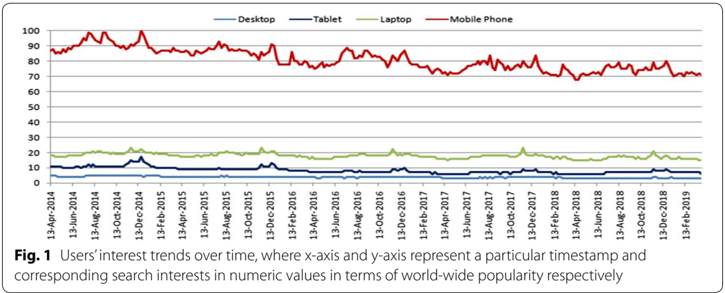
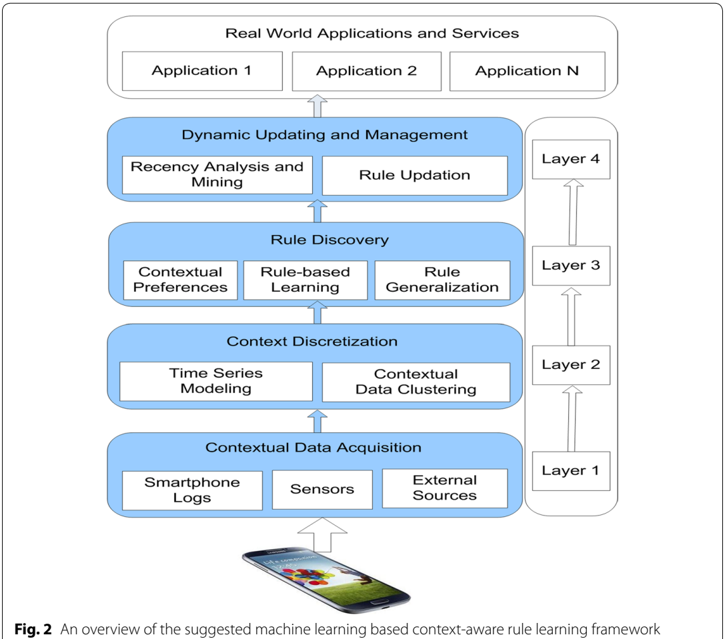
Verification
Claims the paper makes
The claims and statistics of this paper haven’t been checked yet.
Free: it reads the open-access text and checks the first 5 claims that cite a source we can check. Create a free account to check every claim.
Claims other papers make about this one
Each is checked against this paper’s own text: does it say what the citing paper says it does?
The cited source says what the claim attributes to it.
In the citing paper
“Besides, incorporating contextual information such as temporal context, spatial context, social context, environmental context, etc. [100] can be used for building an adaptive, context-aware, and dynamic model or framework, depending on the problem domain.”
From Data Science and Analytics: An Overview from Data-Driven Smart Computing, Decision-Making and Applications Perspective (2021) · cites this paper as [100]
Self-check
Percentages, sums and reported differences re-computed from the paper’s own numbers.
The self-check needs the paper’s full text.
Citations
Cites
Data Mining: Practical Machine Learning Tools and Techniques
(2011) · Elsevier eBooks · doi:10.1016/c2009-0-19715-5 · Cited by 25,437
(1992) · Cited by 23,431
Quinlan, J. R. (1986) · Machine Learning · doi:10.1007/bf00116251 · Cited by 21,439
Fast algorithms for mining association rules
Agrawal, R., & Srikant, R. (1998) · Cited by 11,307
Mining frequent patterns without candidate generation
Han, J., Pei, J., & Yin, Y. (2000) · ACM SIGMOD Record · doi:10.1145/335191.335372 · Cited by 6,402
Survey of Clustering Algorithms
Xu, R., & WunschII, D. (2005) · IEEE Transactions on Neural Networks · doi:10.1109/tnn.2005.845141 · Cited by 6,197
Top 10 algorithms in data mining
Wu, X., Kumar, V., Ross Quinlan, J., Ghosh, J., Yang, Q., Motoda, H., McLachlan, G. J., Ng, A., Liu, B., Yu, P. S., et al. (2008) · Knowledge and Information Systems · doi:10.1007/s10115-007-0114-2 · Cited by 5,667
Understanding and Using Context
Dey, A. K. (2001) · Personal and Ubiquitous Computing · doi:10.1007/s007790170019 · Cited by 5,012
Context-Aware Computing Applications
Schilit, B., Adams, N., & Want, R. (1994) · 1994 First Workshop on Mobile Computing Systems and Applications · doi:10.1109/wmcsa.1994.16 · Cited by 3,231 · cited 1×
“[20] the important aspects of context are: (i) where you are, (ii) whom you are with, and (iii) what resources are nearby.”
BackgroundBobadilla, J., Ortega, F., Hernando, A., & Gutiérrez, A. (2013) · Knowledge-Based Systems · doi:10.1016/j.knosys.2013.03.012 · Cited by 3,158
Research works printed but not linked: 6
- Hull R, Neaves P, Bedford-Roberts J. Towards situated computing. In: Wearable computers, 1997. Digest of papers., first international symposium On, IEEE; 1997. p. 146–53.
- Karatzoglou A, Baltrunas L, Church K, Böhmer M. Climbing the app wall: enabling mobile app discovery through context-aware recommendations. In: Proceedings of the international conference on information and knowledge management, Maui, Hawaii, USA, 29 October–02 November, p. 2527–30. ACM, New York, USA; 2012.
- MacQueen J. Some methods for classification and analysis of multivariate observations. In: Fifth Berkeley symposium on mathematical statistics and probability, vol. 1; 1967.
- Sorensen T. Method of establishing groups of equal amplitude in plant sociology based on similarity of species. Biol Skr. 1948;5:1–34.
- Ma BLWHY. Integrating classification and association rule mining. In: Proceedings of the fourth international conference on knowledge discovery and data mining; 1998.
- Abbaspour R, Samadzadegan F. Building a context-aware mobile tourist guide system base on a service oriented architecture. Int Arch Photogramm Remote Sens Spatial Inform Sci. 2008;37:871–4.
Cited by
Machine learning: Algorithms, real-world applications and research directions
Sarker, I. H. (2021) · SN Computer Science · doi:10.1007/s42979-021-00592-x · Cited by 5,583
“…etc. and in the distribution phase - the inventory management, consumer analysis, etc. – User Behavior Analytics and Context-Aware Smart-phone Applications: Context-awareness is a system’s ability to capture knowledge about its surroundings at any moment and modify behaviors accordingly [28] [93].”
Self-citationSarker, I. H. (2021) · SN Computer Science · doi:10.1007/s42979-021-00815-1 · Cited by 2,678
Self-citationCybersecurity data science: an overview from machine learning perspective
Sarker, I. H., Kayes, A. S. M., Badsha, S., Alqahtani, H., Watters, P., & Ng, A. (2020) · Journal of Big Data · doi:10.1186/s40537-020-00318-5 · Cited by 766
“In an expert system, the rules are usually manually defined by a knowledge engineer working in collaboration with a domain expert [37, 140, 146].”
BackgroundSelf-citationSarker, I. H. (2021) · SN Computer Science · doi:10.1007/s42979-021-00765-8 · Cited by 570
“[100] can be used for building an adaptive, context-aware, and dynamic model or framework, depending on the problem domain.”
Self-citationAI-Driven Cybersecurity: An Overview, Security Intelligence Modeling and Research Directions
Sarker, I. H., Furhad, M. H., & Nowrozy, R. (2021) · SN Computer Science · doi:10.1007/s42979-021-00557-0 · Cited by 543
Self-citation
Metadata
- Authors
- Sarker, I. H.
- Affiliations
- Chittagong University of Engineering & Technology (BD)
- Corresponding author
- Sarker, Iqbal H.
- ORCID
- Sarker, Iqbal H.
- Venue
- Journal of Big Data
- Published
- 2019-10-31
- Volume
- 6
- Issue
- 1
- ISSN
- 2196-1115 (ISSN-L)
- OpenAlex
- W2982291760
- Cited by
- 105
- References
- 135
- Citations by year
- 2026: 3 · 2025: 9 · 2024: 8 · 2023: 24 · 2022: 18 · 2021: 20 · 2020: 20 · 2019: 2
- FWCI
- 6.72
- Type
- journal article
- Language
- en
- Open access
- gold
- doi.org
- Licence
- cc-by
- creativecommons.org/licenses/by/4.0 (tdm)
- creativecommons.org/licenses/by/4.0 (vor)
- Locations
- Journal Of Big Data (publishedVersion, cc-by)
- DOAJ (DOAJ: Directory of Open Access Journals) (submittedVersion, cc-by-sa)
- Swinburne figshare (Swinburne University of Technology) (submittedVersion, cc-by)
- Funders
- Swinburne University of Technology
- Topics
- Physical Sciences › Computer Science › Computer Vision and Pattern Recognition › Context-Aware Activity Recognition Systems
- Social Sciences › Transportation › Human Mobility and Location-Based Analysis
- Physical Sciences › Computer Science › Information Systems › Data Mining Algorithms and Applications
- Keywords
- context-aware systems, contextual information, user behavior modeling, rule-based systems, decision strategies
About these checks
Registry, retraction, Cites and statistics results are computed, not judged, with one exception: a printed reference that no index lists is read once by a model before it counts as a citation error. Claims are extracted by a model and kept only when their quote appears verbatim in the text; each cited source is then checked, with a model’s help, for whether it says what the claim relies on. Those verdicts can be wrong — read the claim’s quote and the cited source before relying on one.
Statistics and arithmetic are recomputed, not judged.
Confidence bands are shown only for fields calibrated on our annotated test set. None is calibrated yet, so no band is shown.
What counts as a claim ›How we measure confidence ›How we check this ›
Are you an author, or do you see a problem with this page? Request a review
How to cite
Cite CoChat for the checks on this page, and the paper for its own findings.
- This page
- CoChat. (2026). Citation check: Context-aware rule learning from smartphone data: survey, challenges and future directions. https://app.cochat.ai/papers/10.1186/s40537-019-0258-4
- The paper
- Sarker, I. H. (2019). Context-aware rule learning from smartphone data: survey, challenges and future directions. Journal of Big Data. https://doi.org/10.1186/s40537-019-0258-4
Data sources
Bibliographic data: Semantic Scholar, OpenAlex, Crossref.
Contains information from the Semantic Scholar Academic Graph Datasets, made available under the ODC Attribution License (ODC-BY 1.0).
Semantic Scholar’s data is described in: Kinney, R., et al. (2023). The Semantic Scholar Open Data Platform. arXiv:2301.10140.
