

T-2 and HT-2 Toxins: Toxicity, Occurrence and Analysis: A Review
Open accessThe DOI matches its Crossref record; 178 of the 184 references it cites were found in a registry or an index.
Abstract
One of the major classes of mycotoxins posing serious hazards to humans and animals and potentially causing severe economic impact to the cereal industry are the trichothecenes, produced by many fungal genera. As such, indicative limits for the sum of T-2 and HT-2 were introduced in the European Union in 2013 and discussions are ongoing as to the establishment of maximum levels. This review provides a concise assessment of the existing understanding concerning the toxicological effects of T-2 and HT-2 in humans and animals, their biosynthetic pathways, occurrence, impact of climate change on their production and an evaluation of the analytical methods applied to their detection. This study highlights that the ecology of F. sporotrichioides and F. langsethiae as well as the influence of interacting environmental factors on their growth and activation of biosynthetic genes are still not fully understood. Predictive models of Fusarium growth and subsequent mycotoxin production would be beneficial in predicting the risk of contamination and thus aid early mitigation. With the likelihood of regulatory maximum limits being introduced, increased surveillance using rapid, on-site tests in addition to confirmatory methods will be required. allowing the industry to be proactive rather than reactive.
Overview
The claims and statistics of this paper haven’t been checked yet.
Free: it reads the open-access text and checks the first 5 claims that cite a source we can check. Create a free account to check every claim.
Integrity signals
Registry
Cites
Statistics
Figures
Verification
Claims the paper makes
The claims and statistics of this paper haven’t been checked yet.
Free: it reads the open-access text and checks the first 5 claims that cite a source we can check. Create a free account to check every claim.
Claims other papers make about this one
Each is checked against this paper’s own text: does it say what the citing paper says it does?
The source backs part of the claim, not all of it — or backs it for a different population, condition or comparison.
In the citing paper
“Sample extraction or pre-con centration is, therefore, always required prior to instrumen tal analysis using gas chromatography (GC) and liquid chromatography (LC) coupled with mass spectrometry, enzyme-linked immunosorbent assays, biosensors, and lateral flow immunoassays (6).”
From Evaluating the green credentials and performance of deep eutectic solvents in the extraction of antibiotics and mycotoxins in foods (2024) · cites this paper as [6]
Experimental — accuracy not yet measuredThe source backs part of the claim, not all of it — or backs it for a different population, condition or comparison.
In the citing paper
“Naturally occurring toxins (mycotoxins, phycotoxins, and marine biotoxins), antibiotics, and pesticides are the most prevalent chemi cal contaminants in agricultural commodities worldwide (6,7).”
From Evaluating the green credentials and performance of deep eutectic solvents in the extraction of antibiotics and mycotoxins in foods (2024) · cites this paper as [6]
Experimental — accuracy not yet measured
Self-check
Percentages, sums and reported differences re-computed from the paper’s own numbers.
The self-check needs the paper’s full text.
Citations
Cites
Bennett, J. W., & Klich, M. (2003) · Clinical Microbiology Reviews · doi:10.1128/cmr.16.3.497-516.2003 · Cited by 3,127 · cited 7×
“Analysing for other Fusarium mycotoxins such as DON and ZEN, as well as some of the more important emerging mycotoxins according to EFSA, may also be advantageous, as although they are not regulated at present, routine analysis may highlight emerging threats brought about by climate change, which may aid the implement…”
InfluentialHeading for disaster: Fusarium graminearum on cereal crops
GOSWAMI, R. S., & KISTLER, H. C. (2004) · Molecular Plant Pathology · doi:10.1111/j.1364-3703.2004.00252.x · Cited by 1,283 · cited 1×
“Factors such as temperature, agricultural practices and moisture markedly a ff ect fungal”
A review of worldwide contamination of cereal grains and animal feed with Fusarium mycotoxins
Placinta, C. M., D'Mello, J. P. F., & Macdonald, A. M. C. (1999) · Animal Feed Science and Technology · doi:10.1016/s0377-8401(98)00278-8 · Cited by 912 · cited 1×
“In addition, the necrosis of lymphoid tissues was shown to be triggered by T-2 toxin [37], and bovine infertility and abortion resulting from consumption of T-2toxin-contaminated feed has been reported [38].”
BackgroundToxic effects of mycotoxins in humans.
Peraica, M., Radić, B., Lucić, A., & Pavlović, M. (1999) · Europe PMC (PubMed Central) · Cited by 764
Sulyok, M., Berthiller, F., Krska, R., & Schuhmacher, R. (2006) · Rapid Communications in Mass Spectrometry · doi:10.1002/rcm.2640 · Cited by 681 · cited 1×
“Some examples of this modified approach in the analysis of mycotoxins include: the analysis of 4 major Fusarium mycotoxins including HT-2 and T-2 toxins in oats, the multi-detection of 22 mycotoxins in various animal feeds, the simultaneous determination of 23 mycotoxins in grains, and the analysis of 14 mycotoxins in…”
BackgroundFusarium mycotoxins: a review of global implications for animal health, welfare and productivity
D’Mello, J. P. F., Placinta, C. M., & Macdonald, A. M. C. (1999) · Animal Feed Science and Technology · doi:10.1016/s0377-8401(99)00059-0 · Cited by 673
Effects of trichothecene mycotoxins on eukaryotic cells: A review
Rocha, O., Ansari, K., & Doohan, F. M. (2005) · Food Additives and Contaminants · doi:10.1080/02652030500058403 · Cited by 591 · cited 2×
“Moreover, these toxins are potent inhibitors of protein synthesis and are immunosuppressive [7,13].”
BackgroundIMMUNOMODULATION BY FUNGAL TOXINS
Genevieve S. Bondy, J. J. P. (2000) · Journal of Toxicology and Environmental Health, Part B · doi:10.1080/109374000281113 · Cited by 575 · cited 1×
“Moreover, these toxins are potent inhibitors of protein synthesis and are immunosuppressive [7,13].”
BackgroundTrichothecenes: From Simple to Complex Mycotoxins
McCormick, S. P., Stanley, A. M., Stover, N. A., & Alexander, N. J. (2011) · Toxins · doi:10.3390/toxins3070802 · Cited by 532 · cited 2×
“However, type A, including HT-2 and T-2 toxins, and B (3-acetyldeoxynivalenol, nivalenol (NIV), and deoxynivalenol (DON)) are the most prevalent in agricultural commodities worldwide [1,64].”
BackgroundFusarium graminearum Trichothecene Mycotoxins: Biosynthesis, Regulation, and Management
Chen, Y., Kistler, H. C., & Ma, Z. (2019) · Annual Review of Phytopathology · doi:10.1146/annurev-phyto-082718-100318 · Cited by 469 · cited 3×
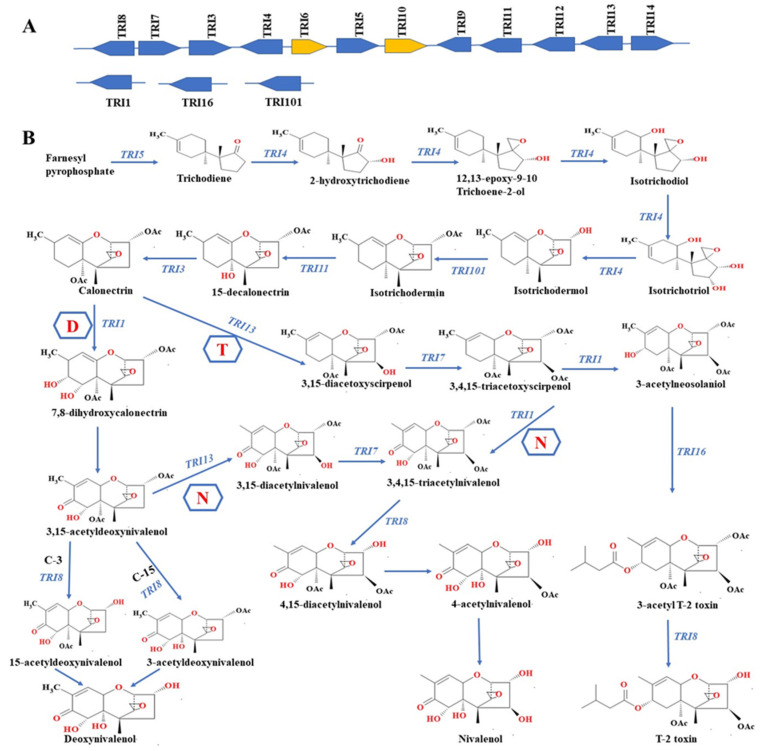
“A gene (TRI5) encoding trichodiene synthase enzyme cyclises FFP to yield trichodiene [65,67].”
Background
Research works printed but not linked: 2
- Yiannikouris, A.; Jouany, J.P. Mycotoxins in feeds for ruminants; fate and effects on animals. Prod. Anim. 2002, 15, 3-16.
- Diaz, D.E. The Mycotoxin Blue Book; Nottingham University Press: Nottingham, UK, 2005.
Cited by
Items 101–122 of 122
Völsch, A. M., Veerkamp, J., Nikfardjam, M. P., Cramer, B., & Humpf, H. (2026) · Food Control · doi:10.1016/j.foodcont.2026.112409
Bucoń, K., Skrzydlewski, P., Kosicki, R., & Twarużek, M. (2026) · Toxins · doi:10.3390/toxins18070283
“In animals, they caused reduced feed intake, weight loss, vomiting, diarrhea, gastrointestinal bleeding, as well as skin damage (necrosis) [20].”
Bari, N. (2026) · Kufa Journal For Veterinary Medical Sciences · doi:10.36326/kjvs/2026/v17i121736
“For future studies, confirmation of positive samples using chromatographic methods such as LC-MS/MS would provide additional accuracy and allow for multi-mycotoxin profiling [23].”
Occurrence and Co-Occurrence of Regulated and Emerging Mycotoxins in Foods Marketed to U.S. Toddlers
Gonya, S., Brunkhorst, J., & Laviolette, M. (2026) · International Journal of Environmental Research and Public Health · doi:10.3390/ijerph23080949
“These toxins are readily absorbed by the GI tract, skin, and lungs [56].”
Wheat Ear Microbiome State as a Transferable Indicator of Within-Season Mycotoxin Risk
Kolawole, O., van Diepeningen, A. D., Grzetic, J., Arrizabalaga-Larrañaga, A., Black, L., & van Overbeek, L. (2026) · Microbial Ecology · doi:10.1007/s00248-026-02837-9
“The wheat ear microbiome provides a potential biologi - cal layer for improving field scale risk assessment [ 9 ].”
Self-citationLi, L., Liu, H., Tian, Y., Pan, J., Qiu, M., Qu, B., Zhao, F., Zhang, X., & Jiang, Y. (2026) · Coordination Chemistry Reviews · doi:10.1016/j.ccr.2026.218266
Jiang, H., Shi, J., He, C., Chen, Y., Wu, K., Deng, A., & Li, J. (2026) · Analytica Chimica Acta · doi:10.1016/j.aca.2026.346075
Yu, F.-F., Dou, Y.-J., Sha, T., Zhang, H.-X., Li, Y., Li, Q., Dong, Z.-C., & Kou, G.-N. (2026) · Chemico-Biological Interactions · doi:10.1016/j.cbi.2026.112301
Yuliastri, W. O., Sanatang, Syaban, A. R., Purnamasari, W. O. G., Isrul, M., Yuhadi, A., Iswanto, R., Anzalna, A., Burhan, R. A. A., Yuniar, R., et al. (2026) · RASAYAN Journal of Chemistry · doi:10.31788/rjc.2026.1939667
Souei, D., Hammami, R., Riolo, M., Dopazo, V., Haddad, M., Moreno, A., Calpe, J., Caro, G. M. D., & Sadfi‐Zouaoui, N. (2026) · Journal of Plant Diseases and Protection · doi:10.1007/s41348-026-01349-5
Three common environmental mycotoxins: An update on their neurotoxicities and action mechanisms
Tang, B., Long, M., & Sun, Y. (2026) · Ecotoxicology and Environmental Safety · doi:10.1016/j.ecoenv.2026.120763
Vörösházi, J., Mackei, M., Márton, R. A., Kámán‐Tóth, E., Kemény, Á., Neogrády, Z., & Mátis, G. (2026) · Poultry Science · doi:10.1016/j.psj.2026.107793
Stability and Transfer of Fusarium Mycotoxins During Oat Processing: A Review
Teixido-Orries, I., Gahete, F. M., Verheecke‐Vaessen, C., Tittlemier, S. A., & Marín, S. (2026) · Foods · doi:10.3390/foods15193429
“Type A trichothecenes are of particular relevance in oats, where T-2 (Figure 1( 1 )) and HT-2 (Figure 1( 2 )) toxins are among the most frequently reported Fusarium mycotoxins [37].”
Chen, C., Xing, J., Wan, Y., Ruan, S., Wang, Y., Liu, Y., Ouyang, D., & Luo, X. (2026) · Microchemical Journal · doi:10.1016/j.microc.2026.119907
Wu, L., Yao, Z., Waseem, M., & Chen, X. (2026) · Food Bioscience · doi:10.1016/j.fbio.2026.110274
Zhu, C., Yuan, L., Zhu, C., Wang, Y., Yuan, X., Cai, Y., Pan, S., Manyelo, T. G., Tyasi, T. L., Kim, I. H., et al. (2026) · Metabolites · doi:10.3390/metabo16110815
T-2 toxin toxicity: what do we currently know about the most toxic trichothecene mycotoxin?
Jurowski, K., Frydrych, A., Nepovimová, E., & Kuča, K. (2026) · Archives of Toxicology · doi:10.1007/s00204-026-04573-y
Screening of Bacillus bacterial strains with capability of degrading T-2 toxinPreprint
Nguyen, T. D., Lu, Y., 沈晓静, Ma, L., & Feng, Y. (2026) · Research Square · doi:10.21203/rs.3.rs-10924385/v1
The Global Mycotoxin–Kidney Exposome: A Critical Review and Framework for an Evidence Atlas
Puspitasari, M., Kuswadi, I., Wardhani, Y., Rohmah, S. N., Kuswadi, D. P., Hadinata, E., Tjandrawinata, R. R., Santini, A., & Nurkolis, F. (2026) · Toxics · doi:10.3390/toxics14110986
Yang, M.-M., Zhao, M.-J., Du, Z., Meng-yao, X., Qu, Z., Jiang, T.-T., Wei, X.-H., Wei, H., Liu, D., Ding, Y.-M., et al. (2026) · Mycology: An International Journal on Fungal Biology · doi:10.1080/21501203.2026.2740852
Khoris, I. M., Nugroho, D., Goh, Y. C., Park, T. J., & Lee, J. (2026) · Journal of Food Hygiene and Safety · doi:10.13103/jfhs.2026.41.5.323
Metadata
- Authors
- Meneely, J., Greer, B., Kolawole, O., & Elliott, C.
- Affiliations
- Queen's University Belfast (GB)
- Thammasat University (TH)
- Corresponding author
- Meneely, Julie
- Venue
- Toxins
- Publisher
- MDPI AG
- Published
- 2023-07-29
- Volume
- 15
- Issue
- 8
- Pages
- 481
- ISSN
- 2072-6651 (ISSN-L)
- PMC
- PMC10467144
- OpenAlex
- W4385423396
- Cited by
- 107
- References
- 184
- Citations by year
- 2026: 27 · 2025: 43 · 2024: 35 · 2023: 2
- FWCI
- 2.56
- Type
- journal article
- Language
- en
- Open access
- gold
- doi.org
- Licence
- Locations
- Toxins (publishedVersion, cc-by)
- PubMed Central (publishedVersion, cc-by)
- PubMed (publishedVersion)
- Research Portal (Queen's University Belfast) (publishedVersion, cc-by)
- DOAJ (DOAJ: Directory of Open Access Journals) (submittedVersion, cc-by-sa)
- Funders
- safefood (01-2021)
- Topics
- Life Sciences › Agricultural and Biological Sciences › Plant Science › Mycotoxins in Agriculture and Food
- Life Sciences › Agricultural and Biological Sciences › Plant Science › Plant Pathogens and Fungal Diseases
- Life Sciences › Immunology and Microbiology › Applied Microbiology and Biotechnology › Microbial Natural Products and Biosynthesis
- Keywords
- T-2 toxin, HT-2 toxin, trichothecenes, mycotoxins, Fusarium sporotrichioides, Fusarium langsethiae, mycotoxin biosynthesis, mycotoxin toxicity, cereal contamination, mycotoxin detection, upper limits
- MeSH terms
- Animals, Humans, Mycotoxins, T-2 Toxin, Trichothecenes, Climate Change
About these checks
Registry, retraction, Cites and statistics results are computed, not judged, with one exception: a printed reference that no index lists is read once by a model before it counts as a citation error. Claims are extracted by a model and kept only when their quote appears verbatim in the text; each cited source is then checked, with a model’s help, for whether it says what the claim relies on. Those verdicts can be wrong — read the claim’s quote and the cited source before relying on one.
Statistics and arithmetic are recomputed, not judged.
Confidence bands are shown only for fields calibrated on our annotated test set. None is calibrated yet, so no band is shown.
What counts as a claim ›How we measure confidence ›How we check this ›
Are you an author, or do you see a problem with this page? Request a review
Data sources
Bibliographic data: Semantic Scholar, OpenAlex, Crossref.
Contains information from the Semantic Scholar Academic Graph Datasets, made available under the ODC Attribution License (ODC-BY 1.0).
Semantic Scholar’s data is described in: Kinney, R., et al. (2023). The Semantic Scholar Open Data Platform. arXiv:2301.10140.
