

Threats to safe transitions from hospital to home: a consensus study in North West London primary care
Open accessThe DOI matches its Crossref record; 37 of the 37 references it cites were found in a registry or an index.
Abstract
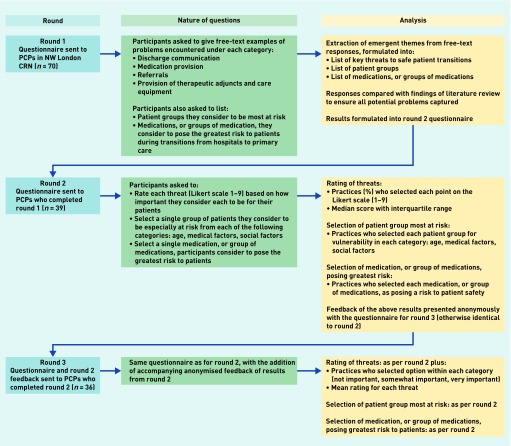
Background: Transitions between healthcare settings are vulnerable points for patients. Aim: To identify key threats to safe patient transitions from hospital to primary care settings. Design and setting: Three-round web-based Delphi consensus process among clinical and non-clinical staff from 39 primary care practices in North West London, England. Method: Round 1 was a free-text idea-generating round. Rounds 2 and 3 were consensus-obtaining rating rounds. Practices were encouraged to complete the questionnaires at team meetings. Aggregate ratings of perceived level of importance for each threat were calculated (1–3: ‘not important’, 4–6: ‘somewhat important’, 7–9: ‘very important’). Percentage of votes cast for each patient or medication group were recorded; consensus was defined as ≥75%. Results: A total of 39 practices completed round 1, 36/39 (92%) completed round 2, and 30/36 (83%) completed round 3. Round 1 identified nine threats encompassing problems involving communication, service organisation, medication provision, and patients who were most at risk. ‘Poor quality of handover instructions from secondary to primary care teams’ achieved the highest rating (mean rating at round 3 = 8.43) and a 100% consensus that it was a ‘very important’ threat. Older individuals (97%) and patients with complex medical problems taking >5 medications (80%) were voted the most vulnerable. Anticoagulants (77%) were considered to pose the greatest risk to patients. Conclusion: This study identified specific threats to safe patient transitions from hospital to primary care, providing policymakers and healthcare providers with targets for quality improvement strategies. Further work would need to identify factors underpinning these threats so that interventions can be tailored to the relevant behavioural and environmental contexts in which these threats arise.
Overview
The claims and statistics of this paper haven’t been checked yet.
Free: it reads the open-access text and checks the first 5 claims that cite a source we can check. Create a free account to check every claim.
Integrity signals
Registry
Cites
Statistics
Figures
Verification
Claims the paper makes
The claims and statistics of this paper haven’t been checked yet.
Free: it reads the open-access text and checks the first 5 claims that cite a source we can check. Create a free account to check every claim.
Claims other papers make about this one
Each is checked against this paper’s own text: does it say what the citing paper says it does?
The cited source says what the claim attributes to it.
In the citing paper
“Barriers to effective coordination at transitions of care include incomplete, unclear content and instructions in discharge summaries. 33”
From Interventions at Hospital Discharge to Guide Caregivers in Medication Management for People Living with Dementia: a Systematic Review (2021) · cites this paper as [33]
Self-check
Percentages, sums and reported differences re-computed from the paper’s own numbers.
The self-check needs the paper’s full text.
Citations
Cites
Michie, S., van Stralen, M. M., & West, R. (2011) · Implementation Science · doi:10.1186/1748-5908-6-42 · Cited by 13,697 · cited 1×
“18,19,45 Implications for research Although this study has identified real and relevant threats to safe patient transitions from hospital to community settings, further work must explore why these threats arise, and include a secondary care perspective.”
Scottish Intercollegiate Guidelines Network
Twaddle, S., & Qureshi, S. (2005) · Evidence-based Healthcare and Public Health · doi:10.1016/j.ehbc.2005.09.008 · Cited by 4,084
Qualitative Research: Consensus methods for medical and health services research
Jones, J., & Hunter, D. (1995) · BMJ · doi:10.1136/bmj.311.7001.376 · Cited by 3,471
Frailty as a predictor of surgical outcomes in older patients
Makary, M. A., Segev, D. L., Pronovost, P. J., Syin, D., Bandeen-Roche, K., Patel, P., Takenaga, R., Devgan, L., Holzmueller, C. G., Tian, J., et al. (2010) · Journal of the American College of Surgeons · doi:10.1016/j.jamcollsurg.2010.01.028 · Cited by 2,184
Kripalani, S., LeFevre, F., Phillips, C. O., Williams, M. V., Basaviah, P., & Baker, D. W. (2007) · JAMA · doi:10.1001/jama.297.8.831 · Cited by 2,103
Emergency Hospitalizations for Adverse Drug Events in Older Americans
Budnitz, D. S., Lovegrove, M. C., Shehab, N., & Richards, C. L. (2011) · New England Journal of Medicine · doi:10.1056/nejmsa1103053 · Cited by 1,820 · cited 2×
“…patient transitions, recently found to be the top scoring medication-related problem in primary care in London, 34 and polypharmacy are known risk factors for hospital readmission, 35,36 and patients with higher numbers of comorbidities are known to have more medication discrepancies at discharge.”
Baker, R., Camosso-Stefinovic, J., Gillies, C., Shaw, E. J., Cheater, F., Flottorp, S., & Robertson, N. (2010) · Cochrane Database of Systematic Reviews · doi:10.1002/14651858.cd005470.pub2 · Cited by 1,003 · cited 2×
“18,19,45 Implications for research Although this study has identified real and relevant threats to safe patient transitions from hospital to community settings, further work must explore why these threats arise, and include a secondary care perspective.”
Kripalani, S., Jackson, A. T., Schnipper, J. L., & Coleman, E. A. (2007) · Journal of Hospital Medicine · doi:10.1002/jhm.228 · Cited by 821 · cited 1×
“Despite ample research into transitions of care over the last decade, 1,13,16,17,43,44 many interventions developed to improve handover between hospital and primary care have had variable results in practice.”
Adverse events among medical patients after discharge from hospital.
(2004) · Europe PMC (PubMed Central) · Cited by 744
Association of frailty with survival: A systematic literature review
Shamliyan, T., Talley, K. M. C., Ramakrishnan, R., & Kane, R. L. (2013) · Ageing Research Reviews · doi:10.1016/j.arr.2012.03.001 · Cited by 666 · cited 1×
“28-32 Furthermore, the second highest-ranking threat to safe patient transitions identified in this study was patients being discharged before arrangements for care were in place at home or in the community.”
Cited by
Sawan, M. J., Wennekers, D., Sakiris, M., & Gnjidic, D. (2021) · Journal of general internal medicine · doi:10.1007/s11606-020-06442-5 · Cited by 36
“Barriers to effective coordination at transitions of care include incomplete, unclear content and instructions in discharge summaries.(33) To address the challenge of care transitions for patients and their caregivers, interventions to support effective communication and team-work across transitions of care are import…”
BackgroundBennett, M. J., & Perry, L. (2023) · Osteoporosis International · doi:10.1007/s00198-023-06748-0 · Cited by 36
Chartrand, J., Shea, B., Hutton, B., Dingwall, O., Kakkar, A., Chartrand, M., Poulin, A., & Backman, C. (2023) · International Journal for Quality in Health Care · doi:10.1093/intqhc/mzad102 · Cited by 39
“T h e i n t e r v e n t i on c on s i s t e d o f [ 1 ] a n a ss e ss - m e n t o f t h e p a t i e n t ’ s o v e r a ll s i t u a t i on , [ 2 ] a n a ss e ss m e n t o f t h e i r c o m - p r e h e n s i on o f d i s c h a r g e r ec - o mm e nd a t i on s , [ 3 ] [35].”
BackgroundAgerholm, J., Jensen, N. K., & Liljas, A. E. M. (2023) · BMC Geriatrics · doi:10.1186/s12877-023-03754-z · Cited by 47
“From previous studies poor communication with primary care physicians during hospital discharge have been found to threatens the transition of care during hospital discharge [36].”
BackgroundJennings, A., Doherty, A. S., Clyne, B., Boland, F., Moriarty, F., Fahey, T. P., Hally, L., Kennelly, S., & Wallace, E. (2024) · Age and Ageing · doi:10.1093/ageing/afae116 · Cited by 26
“A recent UK Delphi consensus study identified key threats to safe patients transitions from secondary to primary care [34].”
Background
Metadata
- Authors
- Markiewicz, O., Lavelle, M., Lorencatto, F., Judah, G., Ashrafian, H., & Darzi, A.
- Affiliations
- National Institute for Health and Care Research (GB)
- University College London (GB)
- Venue
- British Journal of General Practice
- Published
- 2019-12-17
- Volume
- 70
- Issue
- 690
- Pages
- e9-e19
- ISSN
- 0960-1643 (ISSN-L)
- 1478-5242
- PMC
- PMC6917362
- OpenAlex
- W2995569814
- Semantic Scholar
- d2fb854e6ae118196ee58ec0f11d98be7753d7f8
- Cited by
- 41
- References
- 37
- Citations by year
- 2026: 2 · 2025: 5 · 2024: 13 · 2023: 10 · 2022: 3 · 2021: 7 · 2020: 1
- FWCI
- 3.19
- Type
- journal article
- Language
- en
- Open access
- hybrid
- doi.org
- Licence
- cc-by-nc
- Locations
- British Journal of General Practice (publishedVersion, cc-by-nc)
- Europe PMC (PubMed Central) (publishedVersion, cc-by-nc)
- PubMed Central (publishedVersion, cc-by-nc)
- PubMed (publishedVersion)
- City Research Online (City University London) (acceptedVersion)
- UCL Discovery (University College London) (submittedVersion)
- Spiral (Imperial College London) (submittedVersion, cc-by-nc)
- Funders
- National Institute for Health and Care Research (NIHR-INF-0716, NF-SI-0510-10186, NF-SI-0617-10038, 1215-20013)
- Patient Safety Translational Research Centre
- NIHR Imperial Biomedical Research Centre (1215-20013)
- Topics
- Health Sciences › Nursing › Leadership and Management › Hospital Admissions and Outcomes
- Health Sciences › Medicine › Public Health, Environmental and Occupational Health › Patient Safety and Medication Errors
- Health Sciences › Medicine › Geriatrics and Gerontology › Pharmaceutical Practices and Patient Outcomes
- Keywords
- hospital-to-home transition, patient safety, patient handover, primary care, drug safety, anticoagulants, elderly patients, polypharmacy, service organizations, vulnerable patients
- MeSH terms
- Aged, Aged, 80 and over, Attitude of Health Personnel, Child, Child Health Services, Delphi Technique, Female, Health Personnel, Health Services for the Aged, Humans, London, Male, Patient Discharge, Primary Health Care, Frail Elderly, Consensus, Patient Safety, Patient Handoff
About these checks
Registry, retraction, Cites and statistics results are computed, not judged, with one exception: a printed reference that no index lists is read once by a model before it counts as a citation error. Claims are extracted by a model and kept only when their quote appears verbatim in the text; each cited source is then checked, with a model’s help, for whether it says what the claim relies on. Those verdicts can be wrong — read the claim’s quote and the cited source before relying on one.
Statistics and arithmetic are recomputed, not judged.
Confidence bands are shown only for fields calibrated on our annotated test set. None is calibrated yet, so no band is shown.
What counts as a claim ›How we measure confidence ›How we check this ›
Are you an author, or do you see a problem with this page? Request a review
Data sources
Bibliographic data: Semantic Scholar, OpenAlex, Crossref.
Contains information from the Semantic Scholar Academic Graph Datasets, made available under the ODC Attribution License (ODC-BY 1.0).
Semantic Scholar’s data is described in: Kinney, R., et al. (2023). The Semantic Scholar Open Data Platform. arXiv:2301.10140.
