

The DOI matches its Crossref record; 106 of the 107 references it cites were found in a registry or an index.
Potential toxicity of superparamagnetic iron oxide nanoparticles (SPION)
Open accessAbstract
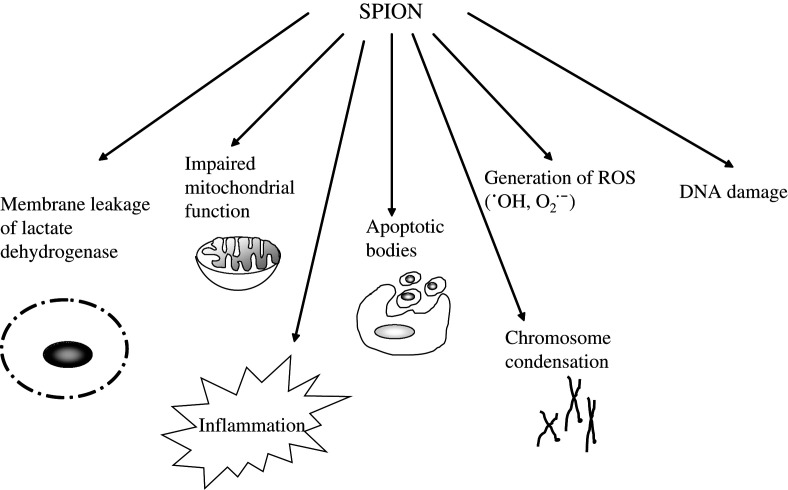
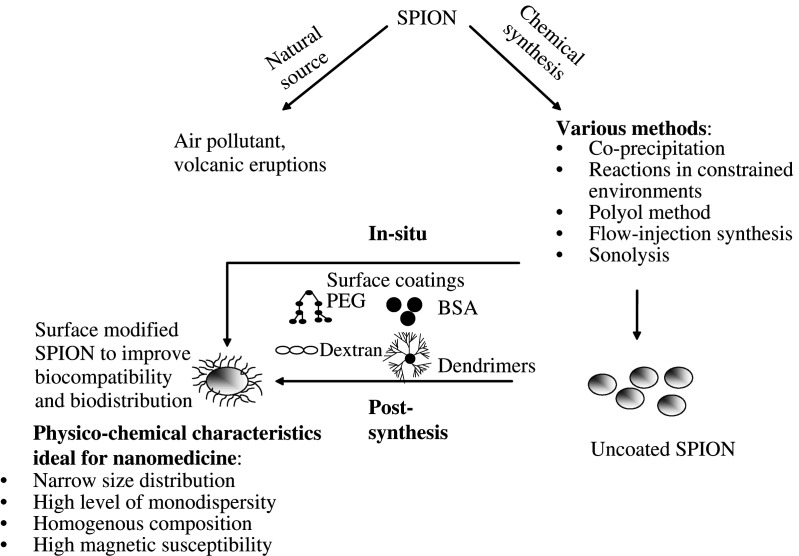
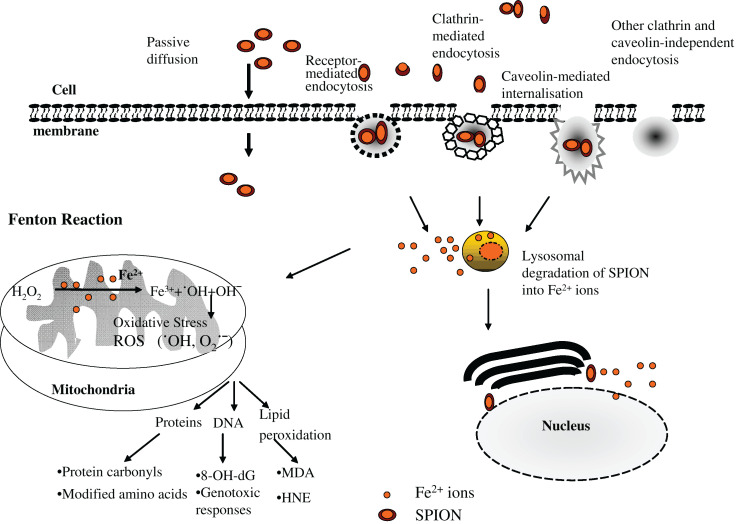
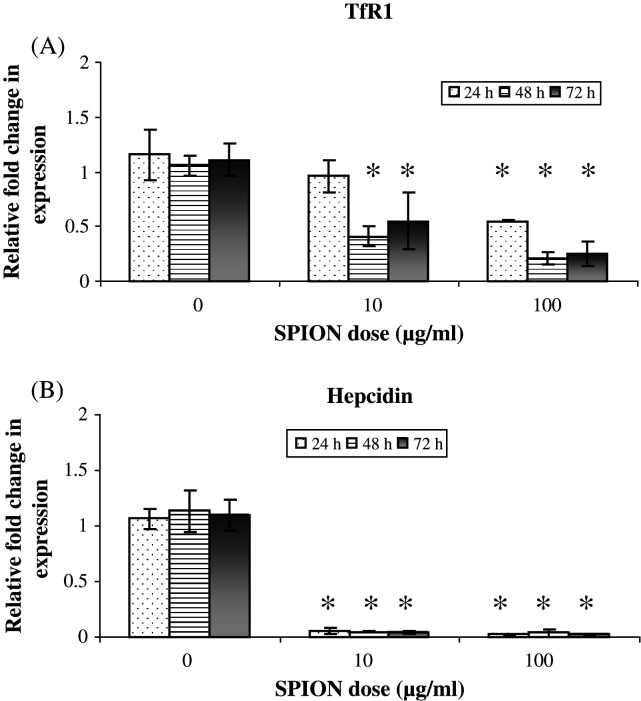
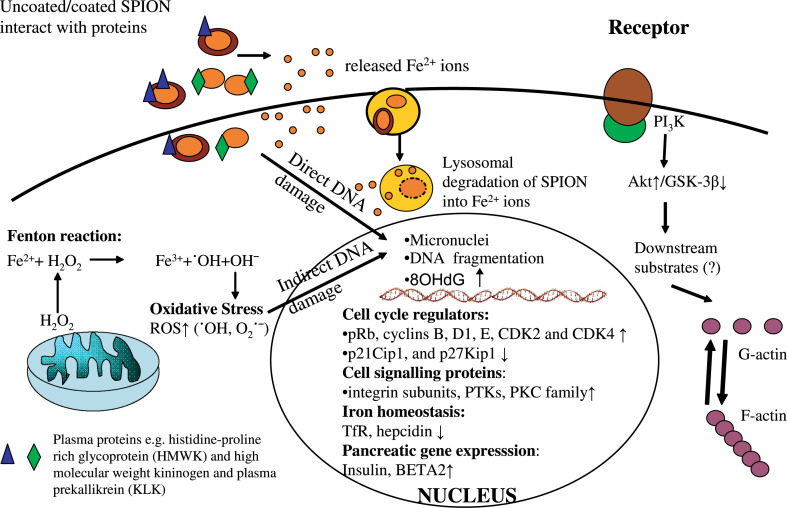
Superparamagnetic iron oxide nanoparticles (SPION) are being widely used for various biomedical applications, for example, magnetic resonance imaging, targeted delivery of drugs or genes, and in hyperthermia. Although, the potential benefits of SPION are considerable, there is a distinct need to identify any potential cellular damage associated with these nanoparticles. Besides focussing on cytotoxicity, the most commonly used determinant of toxicity as a result of exposure to SPION, this review also mentions the importance of studying the subtle cellular alterations in the form of DNA damage and oxidative stress. We review current studies and discuss how SPION, with or without different surface coating, may cause cellular perturbations including modulation of actin cytoskeleton, alteration in gene expression profiles, disturbance in iron homeostasis and altered cellular responses such as activation of signalling pathways and impairment of cell cycle regulation. The importance of protein-SPION interaction and various safety considerations relating to SPION exposure are also addressed.
Overview
The claims and statistics of this paper haven’t been checked yet.
Run the check — free, no account needed. It reads the open-access text and checks the sources it cites.
Integrity signals
Registry
Cites
Statistics
Figures
Verification
Claims the paper makes
The claims and statistics of this paper haven’t been checked yet.
Run the check — free, no account needed. It reads the open-access text and checks the sources it cites.
Claims other papers make about this one
Each is checked against this paper’s own text: does it say what the citing paper says it does?
The source backs part of the claim, not all of it — or backs it for a different population, condition or comparison.
In the citing paper
“Metallic NPs are valuable for their theragnostic capabilities but face significant barriers to translation due to potential long-term toxicity and bioaccumulation, which limit clinical progress [102, 103].”
From Targeted Nanoparticles for Drug Delivery Across the Blood–Brain Barrier in Early and Late Stages of Alzheimer's Disease: A Review (2026) · cites this paper as [102]
Experimental — accuracy not yet measuredIn the citing paper
“In vitro, upon prolonged incubation, surface-coated SPION are typically nontoxic at iron concentration up to and 10 μg/ml, while slight cytotoxicity is seen at 100 μg/ml.”
From Iron oxide nanoparticles: Diagnostic, therapeutic and theranostic applications (2019) · cites this paper as [120]
In the citing paper
“In general, SPION toxicity depends on a variety of factors, including - besides dosing and exposure time - also the nature of the coating material, the hydrodynamic diameter of the particle and SPION-protein interactions [119–122].”
From Iron oxide nanoparticles: Diagnostic, therapeutic and theranostic applications (2019) · cites this paper as [120]
Self-check
Percentages, sums and reported differences re-computed from the paper’s own numbers.
The self-check needs the paper’s full text.
Citations
Cites
Free radicals in biology and medicine
Gutteridge, J. M. C. (1991) · General Pharmacology The Vascular System · doi:10.1016/0306-3623(91)90478-o · Cited by 17,178
Free radicals and antioxidants in normal physiological functions and human disease
Valko, M., Leibfritz, D., Moncol, J., Cronin, M. T. D., Mazur, M., & Telser, J. (2007) · The International Journal of Biochemistry & Cell Biology · doi:10.1016/j.biocel.2006.07.001 · Cited by 14,269
Toxic potential of materials at the nanolevel
Nel, A., Xia, T., Mädler, L., & Li, N. (2006) · Science · doi:10.1126/science.1114397 · Cited by 9,324
Free Radicals in Biology and Medicine
Halliwell, B., & Gutteridge, J. M. C. (2015) · doi:10.1093/acprof:oso/9780198717478.001.0001 · Cited by 8,990
Synthesis and surface engineering of iron oxide nanoparticles for biomedical applications
Gupta, A. K., & Gupta, M. S. (2004) · Biomaterials · doi:10.1016/j.biomaterials.2004.10.012 · Cited by 6,906
Laurent, S., Forge, D., Port, M., Roch, A., Robic, C., Vander Elst, L., & Muller, R. N. (2008) · Chemical Reviews · doi:10.1021/cr068445e · Cited by 6,852
Hepcidin Regulates Cellular Iron Efflux by Binding to Ferroportin and Inducing Its Internalization
Nemeth, E., Tuttle, M. S., Powelson, J., Vaughn, M. B., Donovan, A., Ward, D. M., Ganz, T., & Kaplan, J. (2004) · Science · doi:10.1126/science.1104742 · Cited by 4,803
Biodegradable nanoparticles for drug and gene delivery to cells and tissue
Panyam, J., & Labhasetwar, V. D. (2003) · Advanced Drug Delivery Reviews · doi:10.1016/s0169-409x(02)00228-4 · Cited by 3,417
Fischer, D., Li, Y., Ahlemeyer, B., Krieglstein, J., & Kissel, T. (2003) · Biomaterials · doi:10.1016/s0142-9612(02)00445-3 · Cited by 2,329
In vitro toxicity of nanoparticles in BRL 3A rat liver cells
Hussain, S. M., Hess, K. L., Gearhart, J. M., Geiss, K. T., & Schlager, J. J. (2005) · Toxicology in Vitro · doi:10.1016/j.tiv.2005.06.034 · Cited by 2,025
Research works printed but not linked: 3
- Gould P, 2006, Nano Today, 1, 34
- 10.1016/j.biomaterials.2004.10.012 · DOI
- Sodum RS, 1988, Cancer Res, 48, 320
Cited by
Sorted by citations
Reddy, L. H., Arias, J. L., Nicolas, J., & Couvreur, P. (2012) · Chemical Reviews · doi:10.1021/cr300068p · Cited by 2,010
Chemistry of MRI Contrast Agents: Current Challenges and New Frontiers
Wahsner, J., Gale, E. M., Rodríguez‐Rodríguez, A., & Caravan, P. D. (2018) · Chemical Reviews · doi:10.1021/acs.chemrev.8b00363 · Cited by 1,647
Nanochemistry and Nanomedicine for Nanoparticle-based Diagnostics and Therapy
Chen, G., Roy, I., Yang, C., & Prasad, P. N. (2016) · Chemical Reviews · doi:10.1021/acs.chemrev.5b00148 · Cited by 1,528
Diverse Applications of Nanomedicine
Pelaz, B., Alexiou, C., Alvarez-Puebla, R. A., Alves, F., Andrews, A. M., Ashraf, S., Balogh, L. P., Ballerini, L., Bestetti, A., Brendel, C., et al. (2017) · ACS Nano · doi:10.1021/acsnano.6b06040 · Cited by 1,350
Iron oxide nanoparticles: Diagnostic, therapeutic and theranostic applications
Dadfar, S. M., Roemhild, K., Drude, N. I., von Stillfried, S., Knüchel, R., Kiessling, F., & Lammers, T. (2019) · Advanced Drug Delivery Reviews · doi:10.1016/j.addr.2019.01.005 · Cited by 1,181
Metadata
- Authors
- Singh, N., Jenkins, G. J. S., Asadi, R., & Doak, S. H.
- Affiliations
- Swansea University (GB)
- Cardiff University (GB)
- Corresponding author
- Singh, Neenu
- Venue
- Nano Reviews
- Publisher
- Informa UK Limited
- Published
- 2010-01-01
- Volume
- 1
- Issue
- 1
- Pages
- 5358
- ISSN
- 2000-5121 (ISSN-L)
- PMC
- PMC3215220
- OpenAlex
- W2045080998
- Cited by
- 1,112
- References
- 107
- Citations by year
- 2026: 30 · 2025: 63 · 2024: 69 · 2023: 70 · 2022: 87 · 2021: 109 · 2020: 91 · 2019: 78 · 2018: 92 · 2017: 83 · 2016: 83 · 2015: 92 · 2014: 57 · 2013: 60 · 2012: 33
- FWCI
- 16.82
- Type
- journal article
- Language
- en
- Open access
- hybrid
- doi.org
- Licence
- cc-by-nc
- Locations
- Nano Reviews (publishedVersion, cc-by-nc)
- Europe PMC (PubMed Central) (publishedVersion, cc-by-nc)
- PubMed Central (publishedVersion, cc-by-nc)
- PubMed (publishedVersion)
- DOAJ (DOAJ: Directory of Open Access Journals) (submittedVersion)
- Topics
- Physical Sciences › Materials Science › Materials Chemistry › Nanoparticles: synthesis and applications
- Physical Sciences › Engineering › Biomedical Engineering › Characterization and Applications of Magnetic Nanoparticles
- Physical Sciences › Materials Science › Biomaterials › Nanoparticle-Based Drug Delivery
- Keywords
- superparamagnetic iron oxide nanoparticles, nanoparticle toxicity, cytotoxicity, DNA damage, oxidative stress, actin cytoskeleton, gene expression profiling, iron homeostasis, signaling pathways, cell cycle regulation, nanoparticle-protein interactions, surface coating, MRI contrast agents, drug delivery, hyperthermia
About these checks
Registry, retraction, Cites and statistics results are computed, not judged, with one exception: a printed reference that no index lists is read once by a model before it counts as a citation error. Claims are extracted by a model and kept only when their quote appears verbatim in the text; each cited source is then checked, with a model’s help, for whether it says what the claim relies on. Those verdicts can be wrong — read the claim’s quote and the cited source before relying on one.
Statistics and arithmetic are recomputed, not judged.
Confidence bands are shown only for fields calibrated on our annotated test set. None is calibrated yet, so no band is shown.
What counts as a claim ›How we measure confidence ›How we check this ›
Are you an author, or do you see a problem with this page? Request a review
