

The DOI matches its Crossref record; none of the 59 sources its claims cite is checked for support yet.
Modelos de caminos óptimos entre la cuenca superior y media del río Santa Cruz (Santa Cruz, Argentina)
Open accessAbstract
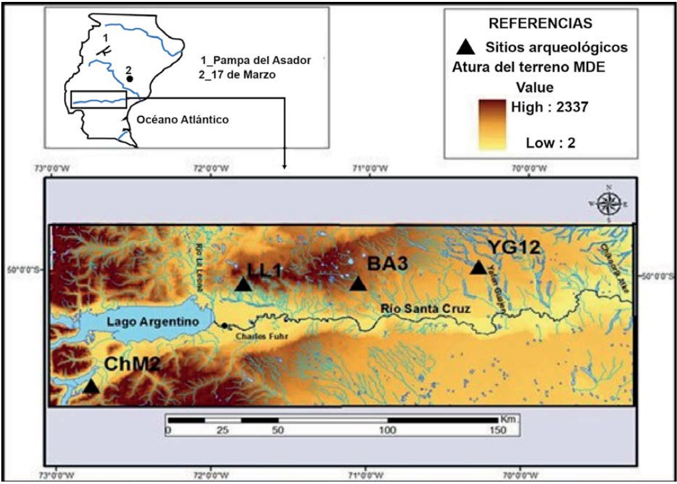
El objetivo de este trabajo consiste en evaluar potenciales sectores de cruce pedestre del río Santa Cruz (provincia de Santa Cruz) mediante el modelado de caminos de menor costo energético en el marco de un Sistema de Información Geográfica (SIG). Para ello se cruzan diferentes variables: pendiente del terreno, cobertura de basalto, fuentes de agua, niveles de profundidad del río Santa Cruz y presencia de bancos e islas. Se evalúan los caminos óptimos entre sitios arqueológicos de la margen norte y sur de la cuenca del río Santa Cruz: La Laurita 1 (cuenca superior, margen norte), Bi Aike 3 (cuenca media, margen norte), Yaten Guajen 12 (cuenca media, margen norte) y Chorrillo Malo 2 (cuenca superior, margen sur). Estos sitios comparten cronologías del Holoceno tardío y la presencia de artefactos líticos de obsidiana negra, materia prima que de acuerdo con la evidencia disponible provendría de áreas localizadas al norte de la cuenca. Los resultados obtenidos se comparan con la distribución del registro arqueológico superficial y estratigráfico previamente detectado, no utilizado para la generación del modelo, como así también con los sectores de paso del río mencionados por cronistas para momentos históricos.
Overview
AI snapshot
Written from the paper’s full text.
TL;DR
The paper uses GIS least-cost path modeling to identify potential pedestrian crossing sectors of the Santa Cruz River between archaeological sites on its north and south margins. It identifies five crossing sectors—four in the upper basin and one in the middle basin—and argues that crossing 1 (Model A) is the least difficult, while crossing 2 (Model B) aligns with historical chroniclers and is the only crossing with black obsidian artifacts nearby.
Key findings
- Five potential river crossings were modeled; depths range from 1.3 to 5.6 m, with four in the upper basin and one in the middle basin. Sites detected near the crossings are open-air.
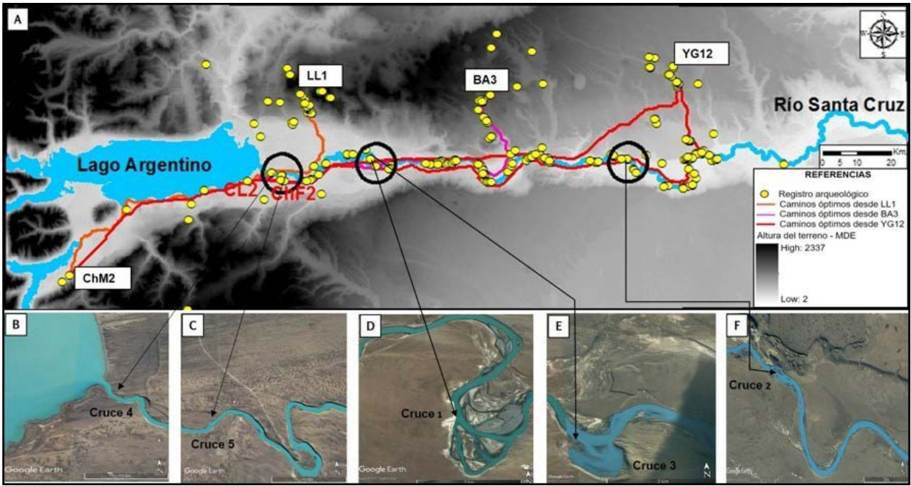
- Model A, which considered banks/islands as attractors, produced crossings 1 and 4; Model B, without banks/islands, produced crossings 2, 3, and 5. Crossing 1 (Model A) is described as the least difficult: the river runs at low velocity, the channel is wider, and islands would have facilitated crossing; it has a depth of 2.5 m, no black obsidian within 5 km, and 3 concentrations on each margin with 0 sites.
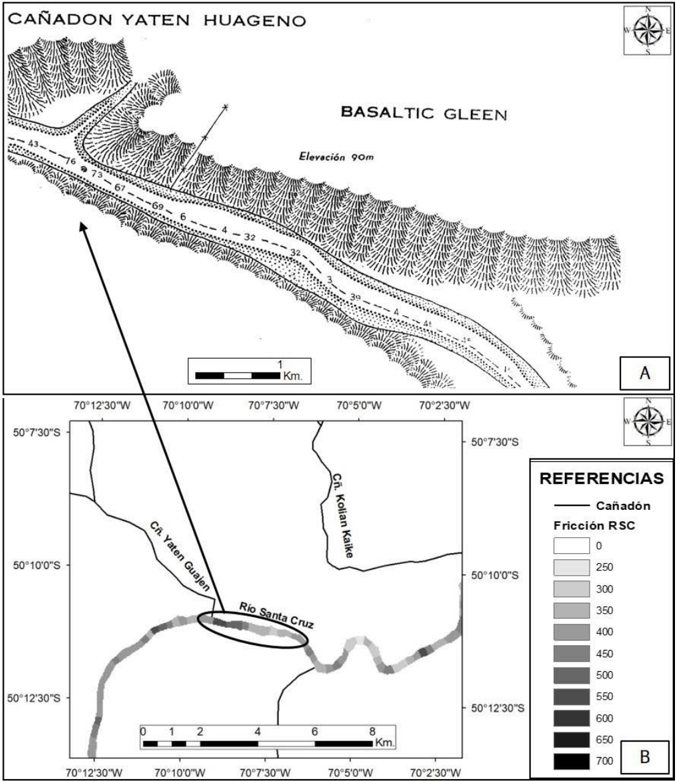
- Crossing 2 (Yaten Guajen 12 to Chorrillo Malo 2, Model B) is in the middle basin, 21 km west of the Yaten Guajen cañadón mouth, at 1.7 m depth. It is the only crossing where black obsidian artifacts were recorded (one concentration on the north margin), has the highest site frequency (7 south, 5 north), and includes the most extensive site near the crossings; it may coincide with historical chroniclers’ mention of Yaten Guajen as a crossing.
- Other crossings: crossing 3 (Bi Aike 3 to Chorrillo Malo 2, Model B) is 4 km east of crossing 1 at 4.8 m depth; crossing 4 (La Laurita 1 to Chorrillo Malo 2, Model A) is at 5.6 m depth; crossing 5 (La Laurita 1 to Chorrillo Malo 2, Model B) is 2.9 km east of Charles Fuhr at 1.3 m depth, near Charles Fuhr 2 dated ca. 1,120 years AP. No obsidian was recorded at crossings 4 or 5.
Methods
- Least-cost paths were modeled in ArcGIS 9.3, QGIS 2.18, and Google Earth. A friction surface was built from slope, basalt cover, water sources (permanent and non-permanent), Santa Cruz River depth levels, and presence of banks/islands; costs ranged from 1 to 750. Slope costs were 1 for 0–10°, 10 for 10–20°, 20 for 20–30°, 40 for 30–40°, 60 for 40–60°, 80 for 60–70°, and 90 for >70°; basalt cover cost was 15; banks/islands cost was 10; Santa Cruz depth costs ranged from 250 (0–2 m) to 700 (10.1–11.6 m). Areas of influence of 1–2,000 m around water sources were subtracted as attractors.
- Origins were north-margin sites La Laurita 1, Bi Aike 3, and Yaten Guajen 12; destination was south-margin site Chorrillo Malo 2. Model A included banks/islands as attractors; Model B excluded them. Modeled paths were compared with archaeological surface and stratigraphic record within a 5 km radius of each crossing and with historical chroniclers’ crossing sectors.
- Data sources included ASTER GDEM (~30 m resolution), IGN SIG250 water courses/bodies at 1:250,000, SEGEMAR geological sheets at 1:250,000, 1969 hydrographic charts of the Santa Cruz River at 1:25,000, Landsat/Copernicus 2017 imagery for banks/islands, and GPS-located archaeological evidence.
Limitations
- The paper states this is a first approximation to mobility modeling. It calls for incorporating other lines of evidence (technological similarities, other raw materials), completing sampling near and far from proposed crossings, better understanding how water sources affect friction values, reviewing ethnographic and ethnoarchaeological literature, using more complex algorithms for effort–slope relationships, and testing whether proposed crossings hold when friction costs—especially river depth—are modified.
- The paper states that friction costs are difficult to assign because they are not derived from empirical data; there are no quantified experiences relating cost, time, calories, and water sources. It also notes that crossing environmental variables would not have generated the same difficulty for past hunter-gatherers as for modern groups, and that the mallines layer has lower cartographic precision and that basalt friction by surface block size lacks quantified information.
- Evident from the text: the model relies on modern, 1969, and 2017 environmental data and assumes current conditions approximate past ones; validation is comparative rather than independent archaeological testing of the modeled crossings.
Model-written summary. Check it against the paper before relying on it.
Integrity signals
Registry
Cites
Statistics
Figures
Verification
Claims the paper makes
30 Sources not found · 30 Own result · 9 Own interpretation · 5 No basis given · 4 Own method · 1 Not checked yet
The paper states this without a source or data behind it here, so there is nothing to check it against. The quote shows it is in the paper.
In the paper
“La Laurita 1 a Chorrillo Malo 2: el camino desciende por el cañadón La Laurita hasta su desembocadura en el valle del río Santa Cruz.”
§ Modelos de caminos óptimos entre la cuenca superior y media > Resultados
plain- Asserted: passes — The authors put it forward as true.
- Checkable: passes — It can be checked against evidence.
- Load-bearing: passes — The paper’s conclusions depend on it.
- Based: passes — The paper gives a reason why it holds.
- Rests on an assumption: Los caminos óptimos calculados con el modelo de costo representan rutas de movilidad efectivamente usadas por los grupos cazadores-recolectores.
A result the paper reports from its own data — it cites no other source for it, so there is none to check. The quote shows it is in the paper.
In the paper
“No se registraron artefactos de obsidiana negra en el área de 5 km definida en torno al cruce 1 (Figuras 4A y 4D; Tabla 3).”
§ Modelos de caminos óptimos entre la cuenca superior y media > Resultados
plain- Asserted: passes — The authors put it forward as true.
- Checkable: passes — It can be checked against evidence.
- Load-bearing: unclear — It is unclear whether the paper’s conclusions depend on it.
- Based: passes — The paper gives a reason why it holds.
A result the paper reports from its own data — it cites no other source for it, so there is none to check. The quote shows it is in the paper.
In the paper
“No se registraron artefactos líticos de obsidiana (Figuras 4A y 4B; Tabla 3).”
§ Modelos de caminos óptimos entre la cuenca superior y media > Resultados
plain- Asserted: passes — The authors put it forward as true.
- Checkable: passes — It can be checked against evidence.
- Load-bearing: unclear — It is unclear whether the paper’s conclusions depend on it.
- Based: passes — The paper gives a reason why it holds.
A result the paper reports from its own data — it cites no other source for it, so there is none to check. The quote shows it is in the paper.
In the paper
“Se registra mayor frecuencia de sitios que concentraciones y son mayoría en la margen sur (Figura 4C; Tabla 3).”
§ Modelos de caminos óptimos entre la cuenca superior y media > Resultados
plaincorrelational- Asserted: passes — The authors put it forward as true.
- Checkable: passes — It can be checked against evidence.
- Load-bearing: unclear — It is unclear whether the paper’s conclusions depend on it.
- Based: passes — The paper gives a reason why it holds.
A result the paper reports from its own data — it cites no other source for it, so there is none to check. The quote shows it is in the paper.
In the paper
“Allí se registra la mayor frecuencia de sitios y el sitio arqueológico más extenso ubicado en cercanías de los cruces considerados, lo cual podría indicar una reutilización de este sector del espacio a lo largo del tiempo.”
§ Modelos de caminos óptimos entre la cuenca superior y media > Síntesis y perspectivas futuras
plain- Asserted: passes — The authors put it forward as true.
- Checkable: passes — It can be checked against evidence.
- Load-bearing: unclear — It is unclear whether the paper’s conclusions depend on it.
- Based: passes — The paper gives a reason why it holds.
A result the paper reports from its own data — it cites no other source for it, so there is none to check. The quote shows it is in the paper.
In the paper
“Los modelos indican que el sector de menor dificultad de cruce es el 1-Modelo A (Figura 4D), ya que allí el río corre a baja velocidad, el cauce es más ancho que en los otros cruces y presenta distintas islas que habrían facilitado atravesarlo.”
§ Modelos de caminos óptimos entre la cuenca superior y media > Síntesis y perspectivas futuras
plain- Asserted: passes — The authors put it forward as true.
- Checkable: passes — It can be checked against evidence.
- Load-bearing: passes — The paper’s conclusions depend on it.
- Based: passes — The paper gives a reason why it holds.
A result the paper reports from its own data — it cites no other source for it, so there is none to check. The quote shows it is in the paper.
In the paper
“Luego se dirige hacia el Oeste bordeando la margen sur del lago Argentino hasta llegar al sitio Chorrillo Malo 2.”
§ Modelos de caminos óptimos entre la cuenca superior y media > Resultados
plain- Asserted: passes — The authors put it forward as true.
- Checkable: passes — It can be checked against evidence.
- Load-bearing: passes — The paper’s conclusions depend on it.
- Based: passes — The paper gives a reason why it holds.
A result the paper reports from its own data — it cites no other source for it, so there is none to check. The quote shows it is in the paper.
In the paper
“Además, es el único cruce donde se registran artefactos líticos de obsidiana, materia prima que circuló entre ambos espacios.”
§ Modelos de caminos óptimos entre la cuenca superior y media > Síntesis y perspectivas futuras
plain- Asserted: passes — The authors put it forward as true.
- Checkable: passes — It can be checked against evidence.
- Load-bearing: passes — The paper’s conclusions depend on it.
- Based: passes — The paper gives a reason why it holds.
A result the paper reports from its own data — it cites no other source for it, so there is none to check. The quote shows it is in the paper.
In the paper
“Luego cruza el río por la cuenca superior en un sector de 1,3 m de profundidad a una distancia de 2,9 km al este de Charles Fuhr.”
§ Modelos de caminos óptimos entre la cuenca superior y media > Resultados
plain- Asserted: passes — The authors put it forward as true.
- Checkable: passes — It can be checked against evidence.
- Load-bearing: unclear — It is unclear whether the paper’s conclusions depend on it.
- Based: passes — The paper gives a reason why it holds.
- Rests on an assumption: Las profundidades y condiciones del río Santa Cruz en los sectores de cruce considerados son representativas de las condiciones en el pasado.
A result the paper reports from its own data — it cites no other source for it, so there is none to check. The quote shows it is in the paper.
In the paper
“A modo de síntesis cabe destacar que los caminos óptimos (Figura 4) descienden, en general, por los cañadones hasta el valle del río Santa Cruz.”
§ Modelos de caminos óptimos entre la cuenca superior y media > Síntesis y perspectivas futuras
plain- Asserted: passes — The authors put it forward as true.
- Checkable: passes — It can be checked against evidence.
- Load-bearing: passes — The paper’s conclusions depend on it.
- Based: passes — The paper gives a reason why it holds.
- Rests on an assumption: Los caminos óptimos calculados con el modelo de costo representan rutas de movilidad efectivamente usadas por los grupos cazadores-recolectores.
- Rests on an assumption: Las profundidades y condiciones del río Santa Cruz en los sectores de cruce considerados son representativas de las condiciones en el pasado.
- It may state two separate claims as one. 22
- Probably not a substantial claim. 18
- The quote only partly states this claim. 3
A result the paper reports from its own data — it cites no other source for it, so there is none to check. The quote shows it is in the paper.
In the paper
“1.1.1Bi Aike 3 a Chorrillo Malo 2: el camino óptimo desciende por el cañadón El Lechuza hasta su desembocadura en el valle del río Santa Cruz.Luego se dirige hacia el Oeste y en la cuenca superior cruza el río en el primer laberinto de islas en un sector de 2,5 m de profundidad y se dirige hacia el Oeste bordeando la margen sur del lago Argentino hasta llegar al sitio Chorrillo Malo 2 (Figuras 4A”
§ Modelos de caminos óptimos entre la cuenca superior y media > Resultados
plain- Asserted: passes — The authors put it forward as true.
- Checkable: passes — It can be checked against evidence.
- Load-bearing: passes — The paper’s conclusions depend on it.
- Based: passes — The paper gives a reason why it holds.
It may state two separate claims as one.
The paper states this without a source or data behind it here, so there is nothing to check it against. The quote shows it is in the paper.
In the paper
“En este sector de cruce del río se registra mayor número de concentraciones de artefactos que de sitios, distribuidos en igual frecuencia en ambas márgenes del río.”
§ Modelos de caminos óptimos entre la cuenca superior y media > Resultados
plain- Asserted: passes — The authors put it forward as true.
- Checkable: passes — It can be checked against evidence.
- Load-bearing: unclear — It is unclear whether the paper’s conclusions depend on it.
- Based: passes — The paper gives a reason why it holds.
It may state two separate claims as one.
A result the paper reports from its own data — it cites no other source for it, so there is none to check. The quote shows it is in the paper.
In the paper
“LL1 a ChM2 Modelo A/ Cruce 4 Cuenca superior/ Valle del lago Argentino 5,6 m Margen sur 3 0 Margen norte 0 0”
§ Modelos de caminos óptimos entre la cuenca superior y media > Síntesis y perspectivas futuras
plainSingle case- Asserted: passes — The authors put it forward as true.
- Checkable: passes — It can be checked against evidence.
- Load-bearing: fails — The paper’s conclusions may not depend on it.
- Based: passes — The paper gives a reason why it holds.
Probably not a substantial claim. The paper’s conclusions may not depend on it.
- Rests on an assumption: Las profundidades y condiciones del río Santa Cruz en los sectores de cruce considerados son representativas de las condiciones en el pasado.
In the paper
“1.2.1 La Laurita 1 a Chorrillo Malo 2: el camino desciende por el cañadón La Laurita hasta su desembocadura en el valle del río Santa Cruz.Luego cruza el río por la cuenca superior en un sector de 5,6 m de profundidad y continúa por la margen sur del lago Argentino, pasando por el sitio Campo de Lago 2, con un fechado de ca.2.940 años (Carballo Marina et al., 1999), hasta llegar al sitio Chorrillo”
§ Modelos de caminos óptimos entre la cuenca superior y media > Resultados
What the sources say
- Not matchedcites Carballo Marina et al., 1999
Couldn’t be matched to a paper in Crossref, so it can’t be checked.
plain- Asserted: passes — The authors put it forward as true.
- Checkable: passes — It can be checked against evidence.
- Load-bearing: unclear — It is unclear whether the paper’s conclusions depend on it.
- Based: passes — The paper gives a reason why it holds.
It may state two separate claims as one.
- Not matched
A result the paper reports from its own data — it cites no other source for it, so there is none to check. The quote shows it is in the paper.
In the paper
“Se observa una mayor frecuencia de sitios que de concentraciones, y son más numerosos en margen sur.”
§ Modelos de caminos óptimos entre la cuenca superior y media > Resultados
plaincorrelational- Asserted: passes — The authors put it forward as true.
- Checkable: passes — It can be checked against evidence.
- Load-bearing: unclear — It is unclear whether the paper’s conclusions depend on it.
- Based: passes — The paper gives a reason why it holds.
It may state two separate claims as one.
A result the paper reports from its own data — it cites no other source for it, so there is none to check. The quote shows it is in the paper.
In the paper
“Luego el camino continúa hacia el oeste bordeando la margen sur del lago Argentino hasta llegar al sitio Chorrillo Malo 2.”
§ Modelos de caminos óptimos entre la cuenca superior y media > Resultados
plainSingle case- Asserted: passes — The authors put it forward as true.
- Checkable: passes — It can be checked against evidence.
- Load-bearing: unclear — It is unclear whether the paper’s conclusions depend on it.
- Based: passes — The paper gives a reason why it holds.
It may state two separate claims as one.
A result the paper reports from its own data — it cites no other source for it, so there is none to check. The quote shows it is in the paper.
In the paper
“2 Modelo B: En este modelo no se consideró la presencia de bancos e islas en el cauce del rio Santa Cruz en el trazado del camino.Los cruces correspondientes a este modelo son el 2, 3 y 5. El cruce 2 tiene como punto de origen el sitio Yaten Guajen 12, el cruce 3 Bi Aike 3 y el cruce 5 La Laurita 1 (Figuras 4A, 4C, 4E y 4F; Tabla 3).”
§ Modelos de caminos óptimos entre la cuenca superior y media > Resultados
plain- Asserted: passes — The authors put it forward as true.
- Checkable: passes — It can be checked against evidence.
- Load-bearing: unclear — It is unclear whether the paper’s conclusions depend on it.
- Based: passes — The paper gives a reason why it holds.
It may state two separate claims as one.
A result the paper reports from its own data — it cites no other source for it, so there is none to check. The quote shows it is in the paper.
In the paper
“los Menucos en sentido perpendicular.Transita sobre la cobertura de basalto por sectores donde esta ocupa un área poco extensa.A continuación se dirige hacia el Oeste y en la cuenca superior cruza el río en el primer laberinto de islas, en un sector de 2,5 m de profundidad.Luego se dirige hacia el Oeste bordeando la margen sur del lago Argentino hasta llegar al sitio Chorrillo Malo 2”
§ Modelos de caminos óptimos entre la cuenca superior y media > Resultados
plain- Asserted: passes — The authors put it forward as true.
- Checkable: passes — It can be checked against evidence.
- Load-bearing: unclear — It is unclear whether the paper’s conclusions depend on it.
- Based: passes — The paper gives a reason why it holds.
It may state two separate claims as one. The quote only partly states this claim.
A result the paper reports from its own data — it cites no other source for it, so there is none to check. The quote shows it is in the paper.
In the paper
“En este sector de cruce se registra una mayor frecuencia de sitios que de concentraciones (sensu Borrero, Lanata y Ventura, 1992), siendo más frecuentes en la margen sur que en la margen norte.”
§ Modelos de caminos óptimos entre la cuenca superior y media > Resultados
plaincorrelational- Asserted: passes — The authors put it forward as true.
- Checkable: passes — It can be checked against evidence.
- Load-bearing: unclear — It is unclear whether the paper’s conclusions depend on it.
- Based: passes — The paper gives a reason why it holds.
It may state two separate claims as one.
A result the paper reports from its own data — it cites no other source for it, so there is none to check. The quote shows it is in the paper.
In the paper
“2.1.1Yaten Guajen 12 a Chorrillo Malo 2: el camino óptimo desciende por el cañadón Yaten Guajen, pasa por el sitio Yaten Guajen 1 y continúa hasta su desembocadura en el valle del río Santa Cruz.Luego sigue en dirección oeste y atraviesa el río en la cuenca media a 21 km al Oeste de la desembocadura de cañadón Yaten Guajen, en un sector de 1,7 m de profundidad.Luego se dirige hacia el Oeste borde”
§ Modelos de caminos óptimos entre la cuenca superior y media > Resultados
plain- Asserted: passes — The authors put it forward as true.
- Checkable: passes — It can be checked against evidence.
- Load-bearing: passes — The paper’s conclusions depend on it.
- Based: passes — The paper gives a reason why it holds.
It may state two separate claims as one.
A result the paper reports from its own data — it cites no other source for it, so there is none to check. The quote shows it is in the paper.
In the paper
“YG12 a ChM2/ BA3 a ChM2 Modelo A/ Cruce 1 Cuenca superior/ Primer laberinto de islas 2,5 m Margen sur 0 3 Margen norte 0 3”
§ Modelos de caminos óptimos entre la cuenca superior y media > Síntesis y perspectivas futuras
plain- Asserted: passes — The authors put it forward as true.
- Checkable: passes — It can be checked against evidence.
- Load-bearing: fails — The paper’s conclusions may not depend on it.
- Based: passes — The paper gives a reason why it holds.
Probably not a substantial claim. The paper’s conclusions may not depend on it.
- Rests on an assumption: Las profundidades y condiciones del río Santa Cruz en los sectores de cruce considerados son representativas de las condiciones en el pasado.
A result the paper reports from its own data — it cites no other source for it, so there is none to check. The quote shows it is in the paper.
In the paper
“No se observaron artefactos líticos de obsidiana.”
§ Modelos de caminos óptimos entre la cuenca superior y media > Resultados
plainSingle case- Asserted: passes — The authors put it forward as true.
- Checkable: passes — It can be checked against evidence.
- Load-bearing: fails — The paper’s conclusions may not depend on it.
- Based: passes — The paper gives a reason why it holds.
Probably not a substantial claim. The paper’s conclusions may not depend on it.
A result the paper reports from its own data — it cites no other source for it, so there is none to check. The quote shows it is in the paper.
In the paper
“1) Modelo A: este modelo consideró en el trazado del camino la presencia de bancos de islas en el cauce del rio Santa Cruz.Los cruces correspondientes a este modelo son el 1 y 4. El primero tiene como puntos de origen los sitios Bi Aike 3 y Yaten Guajen 12, mientras que el segundo, el sitio La Laurita 1 (Figuras 4A, 4B y 4D; Tabla 3).”
§ Modelos de caminos óptimos entre la cuenca superior y media > Resultados
plain- Asserted: passes — The authors put it forward as true.
- Checkable: passes — It can be checked against evidence.
- Load-bearing: passes — The paper’s conclusions depend on it.
- Based: passes — The paper gives a reason why it holds.
It may state two separate claims as one.
The paper states this without a source or data behind it here, so there is nothing to check it against. The quote shows it is in the paper.
In the paper
“Luego se dirige hacia el Oeste y en la cuenca superior cruza el río a 4 km al Este de cruce 1, en un sector de 4,8 m de profundidad.”
§ Modelos de caminos óptimos entre la cuenca superior y media > Resultados
plain- Asserted: passes — The authors put it forward as true.
- Checkable: passes — It can be checked against evidence.
- Load-bearing: passes — The paper’s conclusions depend on it.
- Based: passes — The paper gives a reason why it holds.
It may state two separate claims as one.
- Rests on an assumption: Las profundidades y condiciones del río Santa Cruz en los sectores de cruce considerados son representativas de las condiciones en el pasado.
A result the paper reports from its own data — it cites no other source for it, so there is none to check. The quote shows it is in the paper.
In the paper
“YG12 a ChM2 Modelo B/ Cruce 2 Cuenca media/ 21 km al oeste de desembocadura de cañadón Yaten Guajen 1,7 m Margen sur 7 0 Margen norte 5 4”
§ Modelos de caminos óptimos entre la cuenca superior y media > Síntesis y perspectivas futuras
plain- Asserted: passes — The authors put it forward as true.
- Checkable: passes — It can be checked against evidence.
- Load-bearing: fails — The paper’s conclusions may not depend on it.
- Based: passes — The paper gives a reason why it holds.
Probably not a substantial claim. The paper’s conclusions may not depend on it.
- Rests on an assumption: Las profundidades y condiciones del río Santa Cruz en los sectores de cruce considerados son representativas de las condiciones en el pasado.
In the paper
“las frecuencias de obsidiana negra obtenidas para el Holoceno tardío oscilan entre 0,76% y 12,54%.”
§ Modelos de caminos óptimos entre la cuenca superior y media > Abstract
What the sources say
- Not matchedcites Franco, Cirigliano, Vetrisano y Ambrústolo, 2015
Couldn’t be matched to a paper in Crossref, so it can’t be checked.
plain- Asserted: passes — The authors put it forward as true.
- Checkable: passes — It can be checked against evidence.
- Load-bearing: unclear — It is unclear whether the paper’s conclusions depend on it.
- Based: passes — The paper gives a reason why it holds.
The quote only partly states this claim.
- Not matched
None of the sources cited for this claim could be matched to a paper in Crossref, so there is nothing to check it against.
In the paper
“Los caminos o rutas son ejes a través de los cuales se desarrollan, por ejemplo, procesos de poblamiento (Borrero y Manzi, 2007; Miotti y Salemme, 2004) y se articulan espacios, poblaciones humanas y recursos (Botero Páez, 2007;Castro, 2010).”
§ Modelos de caminos óptimos entre la cuenca superior y media > Abstract
What the sources say
- Not matchedcites Borrero y Manzi, 2007
Couldn’t be matched to a paper in Crossref, so it can’t be checked.
- Not matchedcites Miotti y Salemme, 2004
Couldn’t be matched to a paper in Crossref, so it can’t be checked.
- Not matchedcites Botero Páez, 2007
Couldn’t be matched to a paper in Crossref, so it can’t be checked.
plaindirect- Asserted: passes — The authors put it forward as true.
- Checkable: fails — It may be too vague to check against evidence.
- Load-bearing: fails — The paper’s conclusions may not depend on it.
- Based: passes — The paper gives a reason why it holds.
Probably not a substantial claim. It may be too vague to check against evidence. The paper’s conclusions may not depend on it. It may state two separate claims as one.
- Not matched
None of the sources cited for this claim could be matched to a paper in Crossref, so there is nothing to check it against.
In the paper
“indican que esta materia prima provendría de la fuente secundaria Pampa del Asador y su área cercana (Belardi, Tiberi, Stern y Súnico, 2006a;Espinosa y Goñi, 1999;Stern, 1999) localizada a aproximadamente 250 km al noroeste de nuestra área de estudio, o de la fuente secundaria 17 de Marzo, ubicada al norte del río Chico”
§ Modelos de caminos óptimos entre la cuenca superior y media > Abstract
What the sources say
- Not matchedcites Stern, Gómez Otero y Belardi, 2000
Couldn’t be matched to a paper in Crossref, so it can’t be checked.
- Not matchedcites Franco et al., 2014a
Couldn’t be matched to a paper in Crossref, so it can’t be checked.
- Not matchedcites Belardi, Tiberi, Stern y Súnico, 2006a
Couldn’t be matched to a paper in Crossref, so it can’t be checked.
hedgeddirect- Asserted: passes — The authors put it forward as true.
- Checkable: passes — It can be checked against evidence.
- Load-bearing: passes — The paper’s conclusions depend on it.
- Based: passes — The paper gives a reason why it holds.
It may state two separate claims as one.
- Not matched
What the paper did — it cites no source for this, so there is none to check. The quote shows it is in the paper.
In the paper
“Por otra parte, la fricción aumenta con el tamaño de los basaltos sobre la superficie, pero se carece en este momento de información cuantificada al respecto.”
§ Modelos de caminos óptimos entre la cuenca superior y media > Cobertura basáltica
plaindirect- Asserted: passes — The authors put it forward as true.
- Checkable: passes — It can be checked against evidence.
- Load-bearing: fails — The paper’s conclusions may not depend on it.
- Based: fails — The paper may give no reason why it holds.
Probably not a substantial claim. The paper’s conclusions may not depend on it. The paper may give no reason why it holds. It may state two separate claims as one.
What the paper did — it cites no source for this, so there is none to check. The quote shows it is in the paper.
In the paper
“Cabe destacar que para cada variable se tuvieron en cuenta sus características actuales, que no necesariamente coinciden con aquéllas existentes en el pasado.”
§ Modelos de caminos óptimos entre la cuenca superior y media > Materiales y métodos
plain- Asserted: passes — The authors put it forward as true.
- Checkable: passes — It can be checked against evidence.
- Load-bearing: fails — The paper’s conclusions may not depend on it.
- Based: passes — The paper gives a reason why it holds.
Probably not a substantial claim. The paper’s conclusions may not depend on it.
- Rests on an assumption: Las características ambientales actuales usadas en el modelo (pendiente, cobertura basáltica, fuentes de agua, profundidad del río Santa Cruz, bancos e islas) son suficientemente representativas de las condiciones del pasado para modelar la circulación humana.
None of the sources cited for this claim could be matched to a paper in Crossref, so there is nothing to check it against.
In the paper
“Por el contrario, los cañadones formados en basalto pudieron funcionar como posibles corredores debido a que presentan bajo costo energético de circulación y conectan sectores espacialmente distantes.”
§ Modelos de caminos óptimos entre la cuenca superior y media > Cobertura basáltica
What the sources say
- Not matchedcites Franco et al., 2016a
Couldn’t be matched to a paper in Crossref, so it can’t be checked.
- Not matchedcites Mazzoni y Rabassa, 2010
Couldn’t be matched to a paper in Crossref, so it can’t be checked.
hedgedconditional- Asserted: passes — The authors put it forward as true.
- Checkable: passes — It can be checked against evidence.
- Load-bearing: passes — The paper’s conclusions depend on it.
- Based: passes — The paper gives a reason why it holds.
It may state two separate claims as one.
- Not matched
In the paper
“La materia prima predominantemente utilizada para la manufactura de artefactos es la dacita, que se ha recuperado en porcentajes que oscilan entre el 42% y 84%.”
- Also stated in: § Abstract · plain
“las rocas de grano fino oscuras tienen porcentajes que oscilan entre el 2% y el 15%.La calcedonia varía entre el 2% y el 20%.La madera petrificada y silicificada está muy escasamente representada en los muestreos, con un valor de 0,35%.”
§ Modelos de caminos óptimos entre la cuenca superior y media > Abstract
What the sources say
- Not matchedcites Franco et al., 2007b
Couldn’t be matched to a paper in Crossref, so it can’t be checked.
plain- Asserted: passes — The authors put it forward as true.
- Checkable: passes — It can be checked against evidence.
- Load-bearing: unclear — It is unclear whether the paper’s conclusions depend on it.
- Based: passes — The paper gives a reason why it holds.
It may state two separate claims as one. The quote only partly states this claim.
- Also stated in: § Abstract · plain
None of the sources cited for this claim could be matched to a paper in Crossref, so there is nothing to check it against.
In the paper
“De acuerdo con Mateucci y Sheinsohn (2004) y Mateucci et al. (2011), se considera que las pendientes abruptas dificultan la circulación y que los humanos que se mueven a pie se trasladan preferentemente por tierras planas o de pendientes suaves, como así también por orillas de ríos y lagunas.”
§ Modelos de caminos óptimos entre la cuenca superior y media > Pendiente del terreno
What the sources say
- Not matchedcites Mateucci y Sheinsohn (2004)
Couldn’t be matched to a paper in Crossref, so it can’t be checked.
- Not matchedcites Mateucci et al. (2011)
Couldn’t be matched to a paper in Crossref, so it can’t be checked.
plaindirect- Asserted: passes — The authors put it forward as true.
- Checkable: passes — It can be checked against evidence.
- Load-bearing: passes — The paper’s conclusions depend on it.
- Based: passes — The paper gives a reason why it holds.
It may state two separate claims as one.
- Not matched
The paper states this without a source or data behind it here, so there is nothing to check it against. The quote shows it is in the paper.
In the paper
“Estos sitios comparten cronologías del Holoceno tardío y la presencia de artefactos líticos de obsidiana negra, materia prima que de acuerdo con la evidencia disponible provendría de áreas localizadas al norte de la cuenca.”
§ Modelos de caminos óptimos entre la cuenca superior y media > Abstract
plaincorrelational- Asserted: passes — The authors put it forward as true.
- Checkable: passes — It can be checked against evidence.
- Load-bearing: passes — The paper’s conclusions depend on it.
- Based: passes — The paper gives a reason why it holds.
It may state two separate claims as one.
A conclusion the paper draws from its own results — it cites no other source for it, so there is none to check. The quote shows it is in the paper.
In the paper
“Además, se estableció un área de influencia en torno a las márgenes de las fuentes de agua, ya que estas habrían actuado como atractoras para el desplazamiento humano.”
§ Modelos de caminos óptimos entre la cuenca superior y media > Fuentes de agua
hedgedconditional- Asserted: passes — The authors put it forward as true.
- Checkable: passes — It can be checked against evidence.
- Load-bearing: passes — The paper’s conclusions depend on it.
- Based: fails — The paper may give no reason why it holds.
Probably not a substantial claim. The paper may give no reason why it holds.
None of the sources cited for this claim could be matched to a paper in Crossref, so there is nothing to check it against.
In the paper
“Cabe aclarar que la morfología de los mantos lávicos ha sido modificada por diferentes procesos erosivos según su edad.Las coladas más antiguas han quedado sobreelevadas formando mesetas de pendientes escarpadas (Cobos et al., 2009;Mazzoni y Rabassa, 2010).”
§ Modelos de caminos óptimos entre la cuenca superior y media > Cobertura basáltica
What the sources say
- Not matchedcites Cobos et al., 2009
Couldn’t be matched to a paper in Crossref, so it can’t be checked.
- Not matchedcites Mazzoni y Rabassa, 2010
Couldn’t be matched to a paper in Crossref, so it can’t be checked.
plaindirect- Asserted: passes — The authors put it forward as true.
- Checkable: passes — It can be checked against evidence.
- Load-bearing: passes — The paper’s conclusions depend on it.
- Based: passes — The paper gives a reason why it holds.
It may state two separate claims as one.
- Not matched
None of the sources cited for this claim could be matched to a paper in Crossref, so there is nothing to check it against.
In the paper
“En este sentido, según López Romero (2005) y García Moreno (2010), el análisis de la superficie de fricción es la base para resolver los problemas de rutas óptimas.”
§ Modelos de caminos óptimos entre la cuenca superior y media > Superficie de fricción, costo y distancia
What the sources say
- Not matchedcites López Romero, 2005
Couldn’t be matched to a paper in Crossref, so it can’t be checked.
- Not matchedcites García Moreno, 2010
Couldn’t be matched to a paper in Crossref, so it can’t be checked.
plaindirect- Asserted: passes — The authors put it forward as true.
- Checkable: passes — It can be checked against evidence.
- Load-bearing: passes — The paper’s conclusions depend on it.
- Based: passes — The paper gives a reason why it holds.
Probably not a substantial claim.
- Not matched
In the paper
“Las localizaciones de alta accesibilidad son más fácilmente alcanzadas y generan que más individuos puedan circular entre ellas.De este modo, estos espacios tendrán una mayor conexión o integración con otros sectores (Rissetto y Landau, 2014).”
§ Modelos de caminos óptimos entre la cuenca superior y media > Abstract
What the sources say
- Not matchedcites Rissetto y Landau, 2014
Couldn’t be matched to a paper in Crossref, so it can’t be checked.
plaindirect- Asserted: passes — The authors put it forward as true.
- Checkable: passes — It can be checked against evidence.
- Load-bearing: passes — The paper’s conclusions depend on it.
- Based: passes — The paper gives a reason why it holds.
Probably not a substantial claim. It may state two separate claims as one.
- Not matched
In the paper
“Desde una perspectiva antropológica se plantea que los caminos son el resultado de una construcción histórica que permitió mediante ensayo y error y, a través de sucesivas generaciones, trazar los mejores sectores para circular, aunque estos pueden modificarse a lo largo del tiempo (Castro, 2010).”
§ Modelos de caminos óptimos entre la cuenca superior y media > Abstract
What the sources say
- Not matchedcites Castro, 2010
Couldn’t be matched to a paper in Crossref, so it can’t be checked.
plaindirect- Asserted: passes — The authors put it forward as true.
- Checkable: passes — It can be checked against evidence.
- Load-bearing: fails — The paper’s conclusions may not depend on it.
- Based: passes — The paper gives a reason why it holds.
Probably not a substantial claim. The paper’s conclusions may not depend on it. It may state two separate claims as one.
- Not matched
None of the sources cited for this claim could be matched to a paper in Crossref, so there is nothing to check it against.
In the paper
“Una capa de pendientes, por ejemplo, es una capa de costo ya que la dificultad de desplazarse sobre el terreno aumenta conforme lo hacen los valores de la pendiente (López Romero, 2005;Murrieta-Flores, et al., 2013;Volaya, 2014).”
§ Modelos de caminos óptimos entre la cuenca superior y media > Superficie de fricción, costo y distancia
What the sources say
- Not matchedcites López Romero, 2005
Couldn’t be matched to a paper in Crossref, so it can’t be checked.
- Not matchedcites Murrieta-Flores, et al., 2013
Couldn’t be matched to a paper in Crossref, so it can’t be checked.
- Not matchedcites Volaya, 2014
Couldn’t be matched to a paper in Crossref, so it can’t be checked.
plaindirect- Asserted: passes — The authors put it forward as true.
- Checkable: passes — It can be checked against evidence.
- Load-bearing: passes — The paper’s conclusions depend on it.
- Based: passes — The paper gives a reason why it holds.
Probably not a substantial claim.
- Not matched
None of the sources cited for this claim could be matched to a paper in Crossref, so there is nothing to check it against.
In the paper
“Además, distintos autores han sostenido que las poblaciones eligen para su traslado zonas de baja altura y suaves pendientes y, por otra parte, los valles ofrecen diversos recursos disponibles en sus márgenes(Anderson y Gillam, 2000; Belardi, Carballo Marina y Espinosa, 2006b; Borrero et.al., 2008; Franco, 2008; Mateucci y Sheinsohn, 2004; Mateucci, Scheinsohn, Rizzo y Leonardt, 2011; Miotti y Sal”
§ Modelos de caminos óptimos entre la cuenca superior y media > Síntesis y perspectivas futuras
What the sources say
- Not matchedcites Anderson y Gillam, 2000
Couldn’t be matched to a paper in Crossref, so it can’t be checked.
- Not matchedcites Belardi, Carballo Marina y Espinosa, 2006b
Couldn’t be matched to a paper in Crossref, so it can’t be checked.
- Not matchedcites Borrero et.al., 2008
Couldn’t be matched to a paper in Crossref, so it can’t be checked.
plain- Asserted: passes — The authors put it forward as true.
- Checkable: passes — It can be checked against evidence.
- Load-bearing: fails — The paper’s conclusions may not depend on it.
- Based: passes — The paper gives a reason why it holds.
Probably not a substantial claim. The paper’s conclusions may not depend on it.
- Not matched
In the paper
“A una distancia de 3,7 km de este cruce, en la margen sur se encuentra el sitio Charles Fuhr 2 (ChF2) con un fechado de ca.1.120 años AP (Carballo Marina et al., 1999).”
§ Modelos de caminos óptimos entre la cuenca superior y media > Resultados
What the sources say
- Not matchedcites Carballo Marina et al., 1999
Couldn’t be matched to a paper in Crossref, so it can’t be checked.
plainSingle case- Asserted: passes — The authors put it forward as true.
- Checkable: passes — It can be checked against evidence.
- Load-bearing: fails — The paper’s conclusions may not depend on it.
- Based: passes — The paper gives a reason why it holds.
Probably not a substantial claim. The paper’s conclusions may not depend on it.
- Not matched
A conclusion the paper draws from its own results — it cites no other source for it, so there is none to check. The quote shows it is in the paper.
In the paper
“Allí se registra la mayor frecuencia de sitios y el sitio arqueológico más extenso ubicado en cercanías de los cruces considerados, lo cual podría indicar una reutilización de este sector del espacio a lo largo del tiempo.”
§ Modelos de caminos óptimos entre la cuenca superior y media > Síntesis y perspectivas futuras
hedgedconditional- Asserted: passes — The authors put it forward as true.
- Checkable: passes — It can be checked against evidence.
- Load-bearing: unclear — It is unclear whether the paper’s conclusions depend on it.
- Based: passes — The paper gives a reason why it holds.
It may state two separate claims as one.
- Rests on an assumption: La presencia de sitios arqueológicos y concentraciones en las proximidades de los cruces indica el uso de esos sectores de cruce.
A conclusion the paper draws from its own results — it cites no other source for it, so there is none to check. The quote shows it is in the paper.
In the paper
“Si bien los resultados obtenidos son de carácter exploratorio, esta información integrada con otras líneas de evidencia será útil para comprender la movilidad de los grupos cazadores recolectores que circularon en este sector del espacio y, a su vez, permitirá orientar futuras prospecciones.”
§ Modelos de caminos óptimos entre la cuenca superior y media > Síntesis y perspectivas futuras
plainconditional- Asserted: passes — The authors put it forward as true.
- Checkable: fails — It may be too vague to check against evidence.
- Load-bearing: passes — The paper’s conclusions depend on it.
- Based: passes — The paper gives a reason why it holds.
Probably not a substantial claim. It may be too vague to check against evidence.
None of the sources cited for this claim could be matched to a paper in Crossref, so there is nothing to check it against.
In the paper
“Además, distintos autores han sostenido que las poblaciones eligen para su traslado zonas de baja altura y suaves pendientes y, por otra parte, los valles ofrecen diversos recursos disponibles en sus márgenes(Anderson y Gillam, 2000; Belardi, Carballo Marina y Espinosa, 2006b; Borrero et.al., 2008; Franco, 2008; Mateucci y Sheinsohn, 2004; Mateucci, Scheinsohn, Rizzo y Leonardt, 2011; Miotti y Sal”
§ Modelos de caminos óptimos entre la cuenca superior y media > Síntesis y perspectivas futuras
What the sources say
- Not matchedcites Anderson y Gillam, 2000
Couldn’t be matched to a paper in Crossref, so it can’t be checked.
- Not matchedcites Belardi, Carballo Marina y Espinosa, 2006b
Couldn’t be matched to a paper in Crossref, so it can’t be checked.
- Not matchedcites Borrero et.al., 2008
Couldn’t be matched to a paper in Crossref, so it can’t be checked.
plaindirect- Asserted: passes — The authors put it forward as true.
- Checkable: passes — It can be checked against evidence.
- Load-bearing: passes — The paper’s conclusions depend on it.
- Based: passes — The paper gives a reason why it holds.
Probably not a substantial claim.
- Not matched
What the paper did — it cites no source for this, so there is none to check. The quote shows it is in the paper.
In the paper
“Si bien los resultados obtenidos son de carácter exploratorio, esta información integrada con otras líneas de evidencia será útil para comprender la movilidad de los grupos cazadores recolectores que circularon en este sector del espacio y, a su vez, permitirá orientar futuras prospecciones.”
§ Modelos de caminos óptimos entre la cuenca superior y media > Síntesis y perspectivas futuras
plain- Asserted: passes — The authors put it forward as true.
- Checkable: passes — It can be checked against evidence.
- Load-bearing: passes — The paper’s conclusions depend on it.
- Based: passes — The paper gives a reason why it holds.
Probably not a substantial claim.
None of the sources cited for this claim could be matched to a paper in Crossref, so there is nothing to check it against.
In the paper
“A su vez, los estudios etnoarqueológicos también señalan múltiples formas en que los grupos cazadores recolectores construyen, se trasladan y guían en el espacio (Binford, 1980(Binford, , 2001;;Golledge, 2003;Kelly, 1995Kelly, , 2003;;Mithen, 1989).”
§ Modelos de caminos óptimos entre la cuenca superior y media > Síntesis y perspectivas futuras
What the sources say
- Not matchedcites Binford, 1980
Couldn’t be matched to a paper in Crossref, so it can’t be checked.
- Not matchedcites Golledge, 2003
Couldn’t be matched to a paper in Crossref, so it can’t be checked.
- Not matchedcites Kelly, 1995
Couldn’t be matched to a paper in Crossref, so it can’t be checked.
plain- Asserted: passes — The authors put it forward as true.
- Checkable: passes — It can be checked against evidence.
- Load-bearing: fails — The paper’s conclusions may not depend on it.
- Based: passes — The paper gives a reason why it holds.
Probably not a substantial claim. The paper’s conclusions may not depend on it.
- Not matched
The paper relies on this without support.
Las características ambientales actuales usadas en el modelo (pendiente, cobertura basáltica, fuentes de agua, profundidad del río Santa Cruz, bancos e islas) son suficientemente representativas de las condiciones del pasado para modelar la circulación humana.
“Cabe destacar que para cada variable se tuvieron en cuenta sus características actuales, que no necesariamente coinciden con aquéllas existentes en el pasado.”
The paper relies on this without support.
Los costos de fricción asignados por los investigadores reflejan el costo energético o la dificultad real de desplazamiento de un individuo humano en el pasado.
“Los costos de fricción de las distintas variables y sus categorías se ponderaron de manera preliminar a partir de la experiencia previa en el terreno.”
The paper relies on this without support.
El registro arqueológico superficial dentro de un radio de 5 km de cada cruce es un proxy válido del uso humano pasado de ese cruce.
“El trazado de las vías de circulación se comparó con la frecuencia de sitios y concentraciones, ubicados en un radio de 5 km de distancia con respecto al cruce del camino en ambas márgenes del río, registrados en el marco de investigaciones y estudios de Impacto Ambiental (ESIA) (Serman y Asociados, 2015).”
The paper relies on this without support.
La obsidiana es una materia prima que circuló entre ambos espacios (cuenca superior y media del río Santa Cruz).
“Además, es el único cruce donde se registran artefactos líticos de obsidiana, materia prima que circuló entre ambos espacios.”
The paper relies on this without support.
El río Santa Cruz es difícil de atravesar actualmente, especialmente en verano, con posterioridad al deshielo.
“El río es difícil de atravesar actualmente, especialmente en verano, con posterioridad al deshielo.”
The paper relies on this without support.
No existen experiencias cuantificadas que relacionen factores de costo, tiempo, calorías y fuentes de agua.
“En este sentido cabe destacar la dificultad de asignar costos de fricción al no deducirse de datos empíricos, pues no existen experiencias cuantificadas que relacionen factores de costo, tiempo, calorías y fuentes de agua.”
The paper relies on this without support.
Los costos de fricción asignados a cada variable (y a los distintos niveles de profundidad del río Santa Cruz) representan adecuadamente la dificultad de tránsito para los grupos cazadores-recolectores.
“En este sentido cabe destacar la dificultad de asignar costos de fricción al no deducirse de datos empíricos, pues no existen experiencias cuantificadas que relacionen factores de costo, tiempo, calorías y fuentes de agua.”
The paper relies on this without support.
La presencia de sitios arqueológicos y concentraciones en las proximidades de los cruces indica el uso de esos sectores de cruce.
“Allí se registra la mayor frecuencia de sitios y el sitio arqueológico más extenso ubicado en cercanías de los cruces considerados, lo cual podría indicar una reutilización de este sector del espacio a lo largo del tiempo.”
The paper relies on this without support.
Los caminos óptimos calculados con el modelo de costo representan rutas de movilidad efectivamente usadas por los grupos cazadores-recolectores.
“Los modelos indican que el sector de menor dificultad de cruce es el 1-Modelo A (Figura 4D), ya que allí el río corre a baja velocidad, el cauce es más ancho que en los otros cruces y presenta distintas islas que habrían facilitado atravesarlo.”
The paper relies on this without support.
Las profundidades y condiciones del río Santa Cruz en los sectores de cruce considerados son representativas de las condiciones en el pasado.
“En todos los cruces las profundidades oscilan entre 1,3 y 5,6 m y los sitios detectados en sus proximidades son a cielo abierto”
Self-check
Percentages, sums and reported differences re-computed from the paper’s own numbers.
Each contradiction between two passages listed here was confirmed by an independent check.
Rated minor: it would not touch a result — a value no result rests on, a p-value that stays on the same side of the significance level, or a conflict that is clerical, resolved elsewhere in the paper, or outside its own findings.
In the paper
§ Modelos de caminos óptimos entre la cuenca superior y media > Abstract
“A continuación, desde los ca.3800 años AP, no se registró la presencia de esta roca volcánica”
§ Modelos de caminos óptimos entre la cuenca superior y media > Abstract
“obtenida probablemente mediante intercambio con posterioridad a los ca.3800 años AP”
Citations
Cites
Still being checked.
Cited by
Sorted by citations
Gilio, B. L., Franco, N. V., & Vetrisano, L. (2022) · InterSecciones En Antropología · doi:10.37176/iea.23.2.2022.768 · Cited by 3
Self-citationRuta y camino: memoria, historia y arqueología del Qhapaq Ñan
Yépez, A., Sevilla, A. M., Anhalzer, J., & Vásquez, M. A. (2023) · Dialnet (Universidad de la Rioja) · doi:10.5281/zenodo.10037191 · Cited by 1
Metadata
- Authors
- Gilio, B. L.
- Venue
- Arqueología
- Published
- 2018-12-10
- Volume
- 24
- Issue
- 3
- Pages
- 143
- ISSN
- 0327-5159 (ISSN-L)
- 1853-8126
- OpenAlex
- W2904901736
- Semantic Scholar
- 346980778a997aaca80444efa13dde2e27934541
- Cited by
- 1
- References
- 0
- Citations by year
- 2023: 1
- FWCI
- 0.00
- Type
- journal article
- Language
- es
- Open access
- diamond
- doi.org
- Licence
- cc-by-nc-sa
- Locations
- Arqueología (publishedVersion, cc-by-nc-sa)
- Repositorio Digital Institucional de la Universidad de Buenos Aires (Universidad de Buenos Aires) (publishedVersion)
- LA Referencia (Red Federada de Repositorios Institucionales de Publicaciones Científicas) (publishedVersion, other-oa)
- Americanae (AECID Library) (submittedVersion, cc-by-nc-sa)
- DOAJ (DOAJ: Directory of Open Access Journals) (submittedVersion)
- Topics
- Social Sciences › Archeology › Archaeological Research and Protection
- Social Sciences › Arts and Humanities › Archeology (arts and humanities) › Archaeology and Cultural Heritage
- Social Sciences › Arts and Humanities › Archeology (arts and humanities) › Archaeological and Geological Studies
- Keywords
- Santa Cruz River, energy costs, Holocene, obsidian raw material, lithic artifacts, archaeological site, river depth, basalt, landscape archaeology, chronicles
About these checks
Registry, retraction, Cites and statistics results are computed, not judged, with one exception: a printed reference that no index lists is read once by a model before it counts as a citation error. Claims are extracted by a model and kept only when their quote appears verbatim in the text; each cited source is then checked, with a model’s help, for whether it says what the claim relies on. Those verdicts can be wrong — read the claim’s quote and the cited source before relying on one.
A language model drew the claims from the paper on 2026-11-10, under version 3 of the claim definition (model deepseek-v4.1-flash, prompt extract-v3).
A second model labelled each claim on 2026-11-10 (model jev-1.13-20260917, definition revision gold-guideline-v0.2).
Statistics and arithmetic are recomputed, not judged.
Confidence bands are shown only for fields calibrated on our annotated test set. None is calibrated yet, so no band is shown.
What counts as a claim ›How we measure confidence ›How we check this ›
Are you an author, or do you see a problem with this page? Request a review
How to cite
Cite CoChat for the checks on this page, and the paper for its own findings.
- This page
- CoChat. (2026). Citation check: Modelos de caminos óptimos entre la cuenca superior y media del río Santa Cruz (Santa Cruz, Argentina). https://app.cochat.ai/papers/10.34096/arqueologia.t24.n3.5385
- The paper
- Gilio, B. L. (2018). Modelos de caminos óptimos entre la cuenca superior y media del río Santa Cruz (Santa Cruz, Argentina). Arqueología. https://doi.org/10.34096/arqueologia.t24.n3.5385
