

The DOI matches its Crossref record.
The Moderating Role of Social Support on the Effect of Academic Stress on Students’ Engagement
Abstract
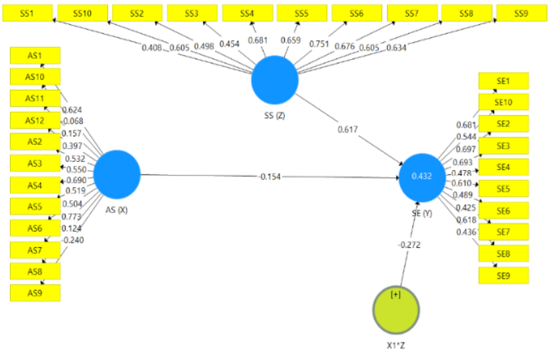
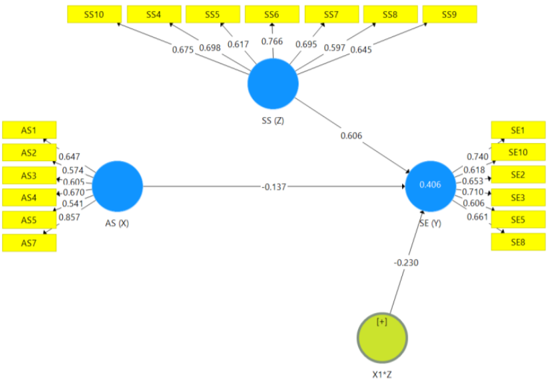
This study aims to identify the relationship between academic stress and students' engagement among santri in Islamic Boarding Schools and explore the moderating role of social support in mitigating the negative impact of academic stress on learning engagement. This research was conducted at SMP Muhammadiyah Boarding School Palopo. The population consisted of 207 students from grades VII to IX. A sample of 136 students was selected using the stratified random sampling technique. Data were collected using questionnaires measuring academic stress, social support, and student engagement, and analyzed using Partial Least Squares Structural Equation Modeling (PLS-SEM) with SmartPLS 4 software. The results show that academic stress has a positive but not statistically significant effect on students' engagement. Conversely, social support has a positive and significant effect and is a considerable moderator that reduces the negative impact of academic stress on learning engagement. In other words, santri who receive strong social support tend to remain actively engaged in the learning process despite facing academic pressures. The limitation of this study lies in the small sample size and its focus on a single Islamic Boarding Schools. Therefore, the findings cannot be widely generalized.
Overview
The claims and statistics of this paper haven’t been checked yet.
Run the check — free, no account needed. It reads the open-access text and checks the sources it cites.
Integrity signals
Registry
Cites
Statistics
Figures
Verification
Claims the paper makes
The claims and statistics of this paper haven’t been checked yet.
Run the check — free, no account needed. It reads the open-access text and checks the sources it cites.
Claims other papers make about this one
Each is checked against this paper’s own text: does it say what the citing paper says it does?
In the citing paper
“Galugu et al. (2025) indicated that social support moderates the negative impact of academic stress on student engagement through a significant interaction effect (p < .05)”
From The Relationship between Academic Stress and Academic Integrity among University Students Moderated by Social Support (2026) · cites this paper as Galugu et al. (2025)
In the citing paper
“Galugu et al. (2025) regarding the role of social support in enhancing academic engagement”
From The Relationship between Academic Stress and Academic Integrity among University Students Moderated by Social Support (2026) · cites this paper as Galugu et al. (2025)
Self-check
Percentages, sums and reported differences re-computed from the paper’s own numbers.
The self-check needs the paper’s full text.
Citations
Cites
No references could be resolved yet.
Research works printed but not linked: 33
- Achmadin, B. Z. … Amrullah, A. M. K. (2024). The Future of Pesantren: Reconciling Tradition with Global Educational Trends. Jurnal Pendidikan Agama Islam (Journal of Islamic Education Studies), 12(2), 197-222. https://doi.org/10.15642/jpai.2024.12.2.197-222 · DOI
- af Ursin, P. … Pihlaja, P. (2021). The Role of Academic Buoyancy and Social Support in Mediating Associations Between Academic Stress and School Engagement in Finnish Primary School Children. Scandinavian Journal of Educational Research, 65(4), 661-675. https://doi.org/10.1080/00313831.2020.1739135 · DOI
- Asri, Y. … Manga, Y. B. (2024). Depression Among Islamic Boarding Schools Students During the COVID-19 Pandemic in East Java, Indonesia. Kesmas, 19(1), 51-58. https://doi.org/10.21109/kesmas.v19i1.7437 · DOI
- Azmi, I. N., & Rosiana, D. (2024). Hubungan Stres Akademik dengan Student Engagement Pondok Pesantren di Kota Bandung. Bandung Conference Series: Psychology Science, 4(1), 226-230. https://doi.org/10.29313/bcsps.v4i1.10008 · DOI
- Barratt, J. M., & Duran, F. (2021). Does psychological capital and social support impact engagement and burnout in online distance learning students? Internet and Higher Education, 51(February), 100821. https://doi.org/10.1016/j.iheduc.2021.100821 · DOI
- Chen, C. … Zhu, Y. (2023). The relationship between social support and academic engagement among university students: the chain mediating effects of life satisfaction and academic motivation. BMC Public Health, 23(1), 1-13. https://doi.org/10.1186/s12889-023-17301-3 · DOI
- Doggrell, S. A. (2023). Differences between students in various programs in a biochemistry course in lecture attendance, engagement, and academic outcomes. Biochemistry and Molecular Biology Education, 51(4), 377-388. https://doi.org/10.1002/bmb.21729 · DOI
- Galugu, N. S., & Samsinar, S. (2019). Academic self-concept, teacher's supports and student's engagement in the school. Jurnal Psikologi Pendidikan Dan Konseling: Jurnal Kajian Psikologi Pendidikan Dan Bimbingan Konseling, 5(2), 141. https://doi.org/10.26858/jppk.v5i2.10549 · DOI
- Gunuc, S., & and Kuzu, A. (2015). Student engagement scale: development, reliability and validity. Assessment & Evaluation in Higher Education, 40(4), 587- 610. https://doi.org/10.1080/02602938.2014.938019 · DOI
- Gupta, R. K. (2020). Academic stress and mental health among adolescent students Rajeev. The International Journal of Indian Psychology, 8(2), 384-390. https://doi.org/10.25215/0802.045 · DOI
- Hair, J. F. … Mena, J. A. (2012). An assessment of the use of partial least squares structural equation modeling in marketing research. Journal of the Academy of Marketing Science, 40(3), 414-433. https://doi.org/10.1007/s11747-011-0261-6 · DOI · Paper page
- Khafifah, K. A. … Zulfa, V. (2023). Hubungan Antara Stres Akademik Dengan Academic Performance Pada Santri Madrasah Aliyah Pondok Pesantren Al Hamid. JKKP (Jurnal Kesejahteraan Keluarga Dan Pendidikan), 10(1), 27-37. https://doi.org/10.21009/jkkp.101.03 · DOI
- Koob, C. … Schmidt, N. (2021). Factors influencing study engagement during the Covid-19 pandemic: A cross-sectional study among health and social professions students. PLoS ONE, 16(7 July), 1-19. https://doi.org/10.1371/journal.pone.0255191 · DOI
- Latifa, R., & Islami, L. A. (2020). The Adversity Quotient Of Pesantren Students: The Effects Of Academic Stress, Emotional Intelligence, Academic Self-Concept and Social Supports. Psikis : Jurnal Psikologi Islami, 6(2), 153-163. https://doi.org/10.19109/psikis.v6i2.4268 · DOI
- Li, H. (2022). Classroom Enjoyment: Relations With EFL Students' Disengagement and Burnout. Frontiers in Psychology, 12(January), 10-13. e-ISSN: 2599-3046 (online) | Volume 9, Issue 2 | 2025 p-ISSN: 2657-1781 (print) DOI: https://doi.org/10.35723/ajie.v9i2.174 https://doi.org/10.3389/fpsyg.2021.824443 · DOI
- Li, Z. … Xiong, Z. (2021). Psychological Distress, Social Support, Coping Style, and Perceived Stress Among Medical Staff and Medical Students in the Early Stages of the COVID-19 Epidemic in China. Frontiers in Psychiatry, 12(June), 1- 11. https://doi.org/10.3389/fpsyt.2021.664808 · DOI
- Lin, X. J. … Yu, H. (2020). Stress and its association with academic performance among dental undergraduate students in Fujian, China: A cross-sectional online questionnaire survey. BMC Medical Education, 20(1), 1-9. https://doi.org/10.1186/s12909-020-02095-4 · DOI
- Liu, X. (2024). Effect of teacher-student relationship on academic engagement: the mediating roles of perceived social support and academic pressure. Frontiers in Psychology, 15(June). https://doi.org/10.3389/fpsyg.2024.1331667 · DOI
- Lutfiana, D., & Zakiyah, E. (2021). Hubungan Konsep Diri Akademik dan Self Regulated Learning dengan Stres Akademik Santri dalam Mengikuti Pembelajaran Daring. Journal of Indonesian Psychological Science (JIPS), 1(1). https://doi.org/10.18860/jips.v1i01.14922 · DOI
- Malecki, C., & Demaray, M. (2003). What Type of Support Do They Need? Investigating Student Adjustment as Related to Emotional, Informational, Appraisal, and Instrumental Support. School Psychology Quarterly, 18, 231-252. https://doi.org/10.1521/scpq.18.3.231.22576 · DOI
- Parikh, R. … Patel, V. (2019). Priorities and preferences for school-based mental health services in India: a multi-stakeholder study with adolescents, parents, school staff, and mental health providers. Global Mental Health, 6. https://doi.org/10.1017/gmh.2019.16 · DOI
- Pérez-Jorge, D. … Pérez-Pérez, I. (2025). Examining the effects of academic stress on student well-being in higher education. Humanities and Social Sciences Communications, 12(1), 1-13. https://doi.org/10.1057/s41599-025-04698-y · DOI
- Puspitasari, E. R., & Sholihah, K. U. (2022). The Relationship between Peer Social Support and Academic Burnout for Students at the Annuriyah Islamic Boarding School , Demak. Proceedings of 3rd International Conference on Psychological Studies (ICPsyche), 1(1), 323-331. https://proceeding.internationaljournallabs.com/index.php/picis/article/view/98
- Putri, G. A. (2024). Social Support and Educational Resilience: A Systematic Review of Students Facing Academic Challenges. Vifada Journal of Education., 2(2), 24-44. https://doi.org/10.70184/hnxrcx44 · DOI
- Renata, D. … Dachmiati, S. (2023). Deskripsi Stres Akademik Pada Santri Pondok Pesantren Kader Uswatun Hasanah Pagaden. Jurnal Mercusuar: Bimbingan, Penyuluhan, Dan Konseling Islam, 3(1), 55. https://doi.org/10.31332/mercusuar.v3i1.6813 · DOI
- Sarstedt, M. … Hair, J. F. (2021). Partial Least Squares Structural Equation Modeling. In Handbook of Market Research (Issue July). https://doi.org/10.1007/978-3-319-05542-8 · DOI
- Serpa-Barrientos, A. … Saintila, J. (2023). The relationship between positive and negative stress and posttraumatic growth in university students: the mediating role of resilience. BMC Psychology, 11(1), 1-9. https://doi.org/10.1186/s40359-023- 01400-2 · DOI
- Soufi, S. … Sabayan, B. (2014). Development of Structural Model for Prediction of Academic Achievement by Global Self-esteem, Academic Self-concept, Self- regulated Learning Strategies and Autonomous Academic Motivation. Procedia - Social and Behavioral Sciences, 114. https://doi.org/10.1016/j.sbspro.2013.12.651 · DOI
- Utari, I. N. D., & Hamid, A. Y. S. (2021). Academic stress in adolescent students of an islamic-based school: The correlation with parenting style and spirituality. Journal of Public Health Research, 10, 22-26. https://doi.org/10.4081/jphr.2021.2330 · DOI
- Wang, Y. … Wang, W. (2024). Influence of perceived social support and academic self-efficacy on teacher-student relationships and learning engagement for enhanced didactical outcomes. Scientific Reports, 14(1), 1-10. https://doi.org/10.1038/s41598-024-78402-6 · DOI
- Wester, E. R. … Callis-Duehl, K. L. (2021). Student Engagement Declines in STEM Undergraduates during Covid-19-Driven Remote Learning. Journal of Microbiology & Biology Education, 22(1). https://doi.org/10.1128/jmbe.v22i1.2385 · DOI · Paper page
- Yıldırım, M., & and Green, Z. A. (2024). Social support and resilience mediate the relationship of stress with satisfaction with life and flourishing of youth. British Journal of Guidance & Counselling, 52(4), 685-696. https://doi.org/10.1080/03069885.2023.2172551 · DOI
- Zhao, Z. … Yang, Q. (2023). Student Self-Management, Academic Achievement: Exploring the Mediating Role of Self-Efficacy and the Moderating Influence of Gender-Insights From a Survey Conducted in 3 Universities in America. Journal of Integrated Social Sciences and Humanities, 1(1), 1-12. https://doi.org/10.62836/jissh.v1i1.159 · DOI
Cited by
Sorted by citations
Sandi, F. F., Suroso, & Suhadianto (2026) · International Journal of Research and Innovation in Social Science · doi:10.47772/ijriss.2026.100801067
Metadata
- Authors
- Galugu, N. S., Hajeni, Marhani, Pajarianto, H., Elihami, & Hikmawati
- Venue
- Al-Hayat: Journal of Islamic Education
- Publisher
- Al-Hayat Al-Istiqomah Foundation
- Published
- 2025-07-09
- Volume
- 9
- Issue
- 2
- Pages
- 490-502
- ISSN
- 2599-3046
- 2657-1781
- Cited by
- 0
- References
- 0
About these checks
Registry, retraction, Cites and statistics results are computed, not judged, with one exception: a printed reference that no index lists is read once by a model before it counts as a citation error. Claims are extracted by a model and kept only when their quote appears verbatim in the text; each cited source is then checked, with a model’s help, for whether it says what the claim relies on. Those verdicts can be wrong — read the claim’s quote and the cited source before relying on one.
Statistics and arithmetic are recomputed, not judged.
Confidence bands are shown only for fields calibrated on our annotated test set. None is calibrated yet, so no band is shown.
What counts as a claim ›How we measure confidence ›How we check this ›
Are you an author, or do you see a problem with this page? Request a review
