

Comparative study on the CO2 capture performance of sludge pyrolysis biochar prepared with different inorganic dehydrating conditioners
Open accessThe DOI matches its Crossref record; 45 of the 45 references it cites were found in a registry or an index; 2 of the 33 sources its claims cite were checked for support.
Abstract
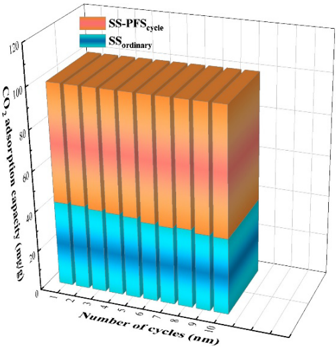
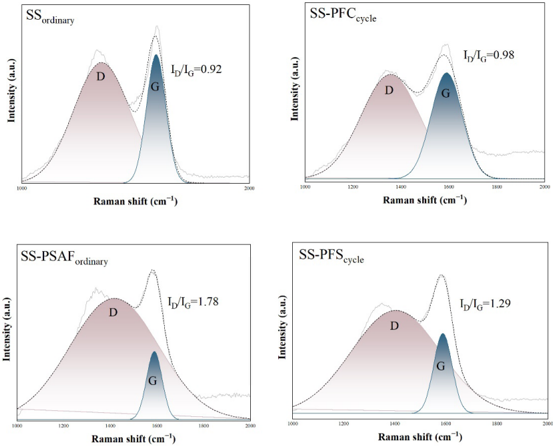
To address the limited understanding of how inorganic dehydrating conditioners affect the CO2 capture performance of sludge-derived biochar, this study investigated three representative conditioners: polyferric chloride, polyferric sulfate (PFS), and polyaluminosilicate ferric salt, and evaluated their influence on biochar properties and carbon dioxide (CO2) adsorption. The effects of conditioner dosage were first optimized, and two preparation routes, conventional ex situ pyrolysis and cyclic pyrolysis, were then compared. The resulting biochars were systematically characterized, and their adsorption behavior was analyzed using physicochemical characterization and adsorption kinetics modeling to elucidate the synergistic roles of conditioner type and pyrolysis mode. The results show that the biochar prepared from PFS-conditioned sludge by cyclic pyrolysis (SS-PFS cycle) exhibited the best performance at the optimal dosage ratio, achieving a CO2 adsorption capacity of 101.48 mg/g at 25 °C. Mechanistic analysis revealed that the SS-PFS cycle possessed a more developed pore structure, a richer surface functional group density, and a higher carbon defect density, all of which synergistically enhanced both physical and chemical adsorption of CO2. After 10 consecutive adsorption–desorption cycles, the material retained 58.94% of its initial adsorption capacity, indicating reasonable reusability. These findings confirm that combining PFS conditioning with cyclic pyrolysis is a viable strategy for improving the CO2 capture performance of sludge-derived biochar and provide both theoretical support and technical guidance for the high-value utilization of sewage sludge.
Overview
CoChat Summary
TL;DR
This study compares three inorganic dehydrating conditioners (PFC, PSAF, PFS) and two pyrolysis routes for sludge-derived biochar used in CO₂ capture. PFS conditioning combined with cyclic pyrolysis produced the best biochar, reaching 101.48 mg/g CO₂ adsorption at 25 °C.
Key findings
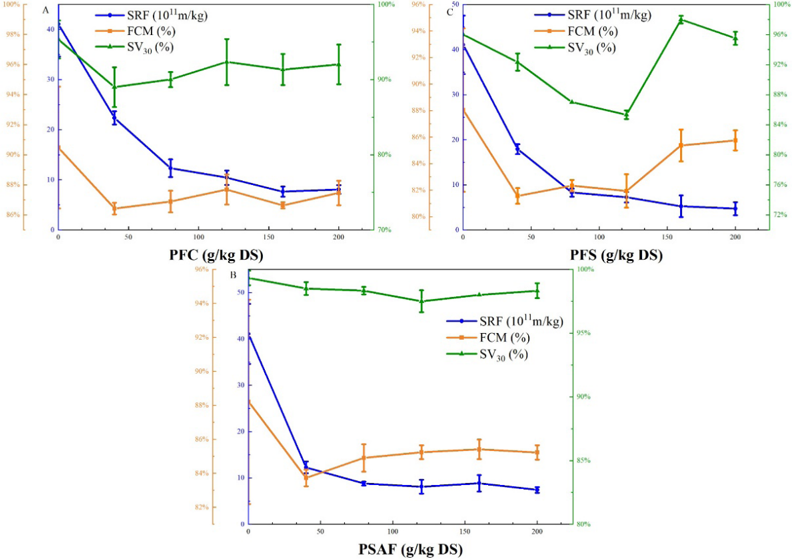
- The optimal conditioner dosages were 80 g/kg DS for PFC, 40 g/kg DS for PSAF, and 80 g/kg DS for PFS, determined mainly from the SRF turning point with FCM and SV₃₀ as secondary indices.
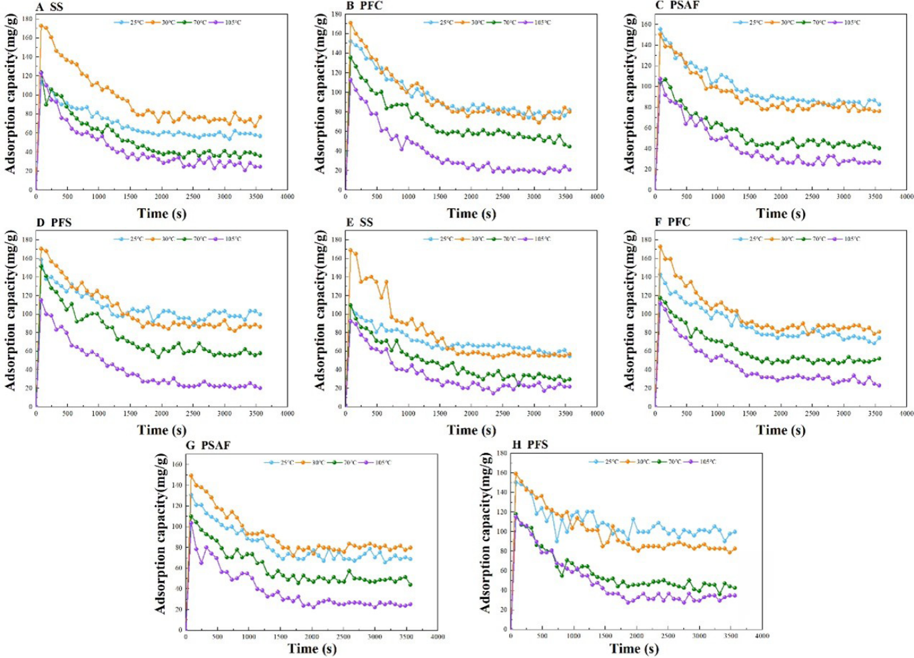
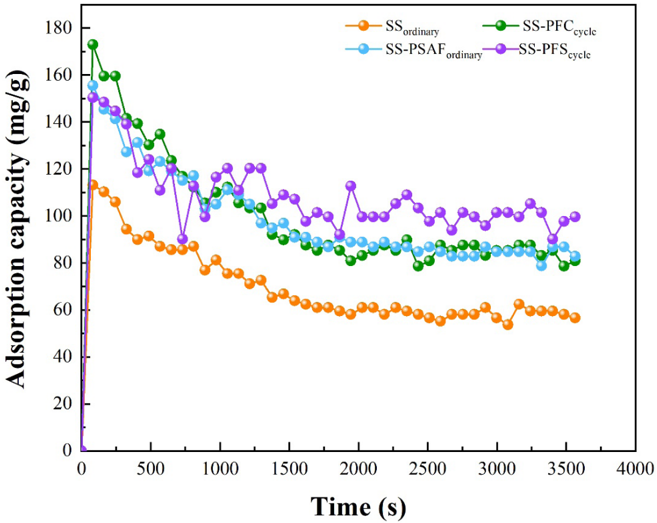
- SS-PFS cycle had the highest CO₂ adsorption capacity, 101.48 mg/g at 25 °C, exceeding SS-PFS ordinary (100.81 mg/g at 25 °C), SS-PSAF ordinary (85.85 mg/g), SS-PFC ordinary (79.71 mg/g), and unconditioned SS (73.35 mg/g at 30 °C).
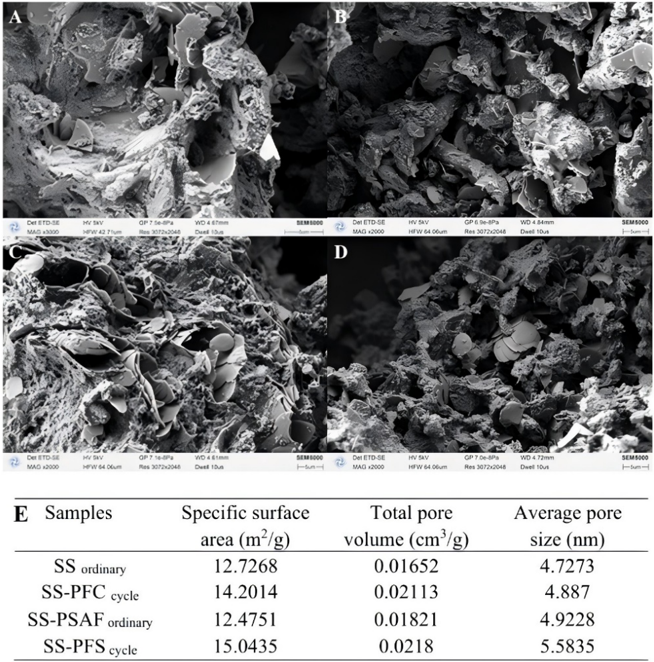
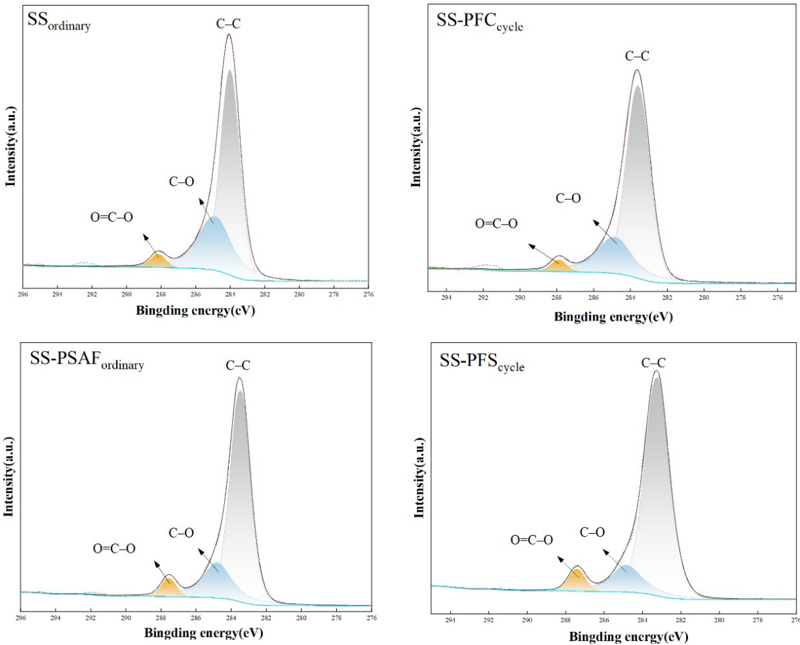
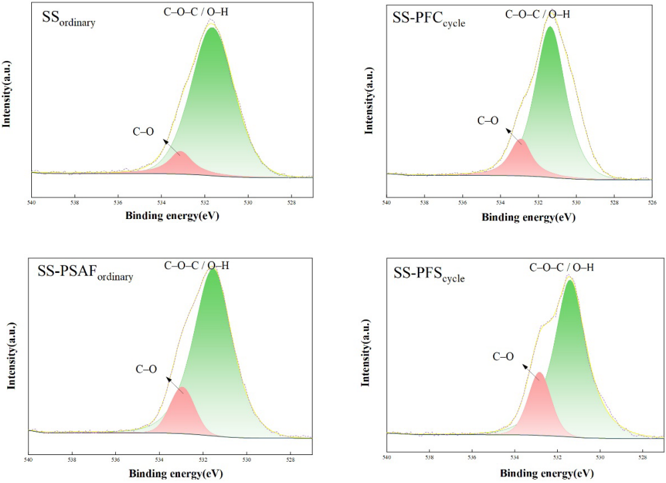
- Mechanistic characterization showed SS-PFS cycle had a specific surface area of 15.04 m²/g, total pore volume of 0.0218 cm³/g, average pore diameter of 5.58 nm, an ID/IG ratio of 1.29, and an increase in O=C-O groups from 8.5% in SS ordinary to 18.2%.
- After 10 adsorption-desorption cycles, SS-PFS cycle retained 58.94% of its initial capacity (decreasing by 41.06%, from 101.48 to 59.87 mg/g), while SS ordinary decreased by 48.92%, from 73.34 to 35.93 mg/g.
Methods
- Sludge was collected from the Xintian town municipal wastewater treatment plant in Wanzhou district, Chongqing, China; conditioned with PFC, PSAF, or PFS at 0–200 g/kg DS; and evaluated for dewatering by SRF, FCM, and SV₃₀.
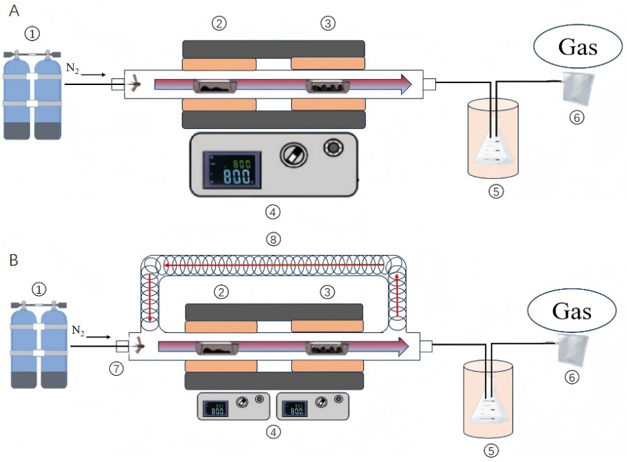
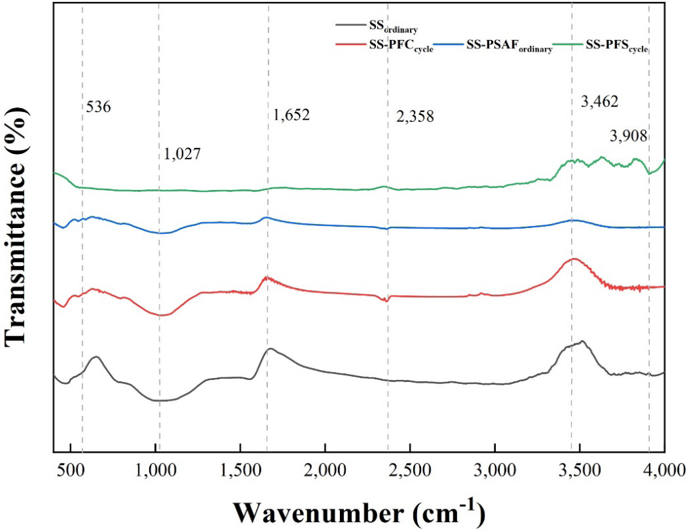
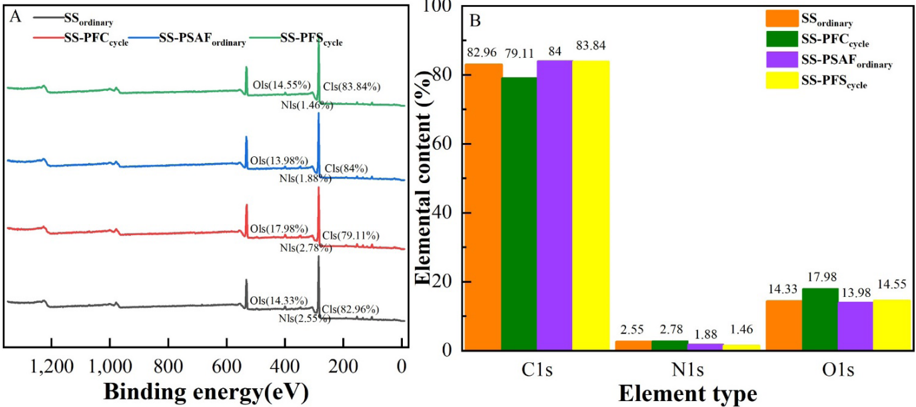
- Biochars were prepared at 600 °C by conventional ex situ pyrolysis or cyclic pyrolysis, then characterized by TG-DSC, BET, FTIR, SEM, XRD, Raman, and XPS.
- CO₂ adsorption was measured at 25, 30, 75, or 105 °C at 50 mL/min for 60 min, fitted with pseudo-first-order, pseudo-second-order, and Avrami kinetic models, and regeneration was tested over 10 adsorption-desorption cycles.
Limitations
- Stated: future work should further optimize CO₂ adsorption conditions, investigate the influence of pyrolysis temperature on SS-PFS cycle adsorption, and explore mixed conditioners and conditioner formulations.
- Evident: the study uses sludge from a single wastewater treatment plant and one pyrolysis temperature (600 °C), so broader generalizability across sludge types and pyrolysis conditions is not established; the paper does not frame this as a limitation.
- Evident: SS-PFS cycle loses about 41% of its initial adsorption capacity after 10 cycles, which the paper describes as acceptable reusability but still indicates regeneration stability limits.
Model-written summary. Check it against the paper before relying on it.
Integrity signals
Registry
Cites
Statistics
Figures
Verification
Claims the paper makes
0 Valid · 2 Not valid · 24 Not checked · 95 Own results and interpretations
The cited sources that could be checked couldn’t confirm or dispute this claim.
In the paper
“This advantage may be related to the ability of sulfate ions derived from PFS to retain part of the nitrogen in the sludge and to form thermally stable salts with metal ions, 24 as verified by the dense lamellar structure observed in the SEM image of the SS-PFS cycle.”
§ Comparative study on the CO 2 capture performance of sludge pyrolysis biochar prepared with different inorganic dehydrating conditioners > 3.2. Comparative effects of pyrolysis methods on carbon dioxide adsorption by sludge-derived biochar
What the sources say
- Could not verifycites [24] 24. Lei W, Li TT, Lv NQ, Liu H, Zhang Y, Xi BD. Study on adsorption of lead by biochar prepared from sludge of municipal wastewater treatment plant. In: Proceedings of the IOP Conference Series: Materials Science and Engineering. Bristol: IOP Publishing Ltd; 2019;479(1):012007. doi: 10.1088/1757-899X/479/1/012007 sourceExperimental — accuracy not yet measured
The Preparation of sludge Biochar (section 2.1) describes pyrolysis under nitrogen gas, while the SEM section (3.1) describes surface changes at different temperatures. Neither addresses PFS-derived sulfate ions, nitrogen retention in sludge, or thermally stable salts with metal ions (searched: PFS, sulfate, nitrogen retention, thermally stable salts). (LLM, conf=0.77)
hedgedstates a possible cause- Asserted: passes — The authors put it forward as true.
- Checkable: passes — It can be checked against evidence.
- Load-bearing: passes — The paper’s conclusions depend on it.
- Based: passes — The paper gives a reason why it holds.
- Could not verify
The cited sources that could be checked couldn’t confirm or dispute this claim.
In the paper
“Previous studies also indicate that Fe sulfate can modify biochar surface morphology by inducing the growth of dense lamellar crystals.28”
§ Comparative study on the CO 2 capture performance of sludge pyrolysis biochar prepared with different inorganic dehydrating conditioners > 3.2. Comparative effects of pyrolysis methods on carbon dioxide adsorption by sludge-derived biochar
What the sources say
- Could not verifycites [28] 28. Muñoz M, Garrido MA, Gomez-Rico MF, Font R. PCDD/F determination in sewage sludge composting. Influence of aeration and the presence of PCP. Sci Total Environ. 2018;616:763-773. doi: 10.1016/j.scitotenv.2017.10.249 sourceExperimental — accuracy not yet measured
The laboratory-runs passage (section 2.2; page unavailable) describes sewage-sludge composting under different aeration conditions, not biochar treatment. Searches for Fe sulfate, biochar morphology, and lamellar crystals found no passage addressing the claim in our copy. (LLM, conf=0.78)
hedgedstates a cause- Asserted: passes — The authors put it forward as true.
- Checkable: passes — It can be checked against evidence.
- Load-bearing: passes — The paper’s conclusions depend on it.
- Based: passes — The paper gives a reason why it holds.
- Could not verify
A result the paper reports from its own data — it cites no other source for it, so there is none to check. The quote shows it is in the paper.
In the paper
“SS showed its highest adsorption capacity at 30 °C, with an equilibrium adsorption capacity of approximately 73.35 mg/g.”
§ Comparative study on the CO 2 capture performance of sludge pyrolysis biochar prepared with different inorganic dehydrating conditioners > 3.2. Comparative effects of pyrolysis methods on carbon dioxide adsorption by sludge-derived biochar
plainstates an association- Asserted: passes — The authors put it forward as true.
- Checkable: passes — It can be checked against evidence.
- Load-bearing: unclear — It is unclear whether the paper’s conclusions depend on it.
- Based: passes — The paper gives a reason why it holds.
A result the paper reports from its own data — it cites no other source for it, so there is none to check. The quote shows it is in the paper.
In the paper
“SS-PSAF also showed the best adsorption at 25 °C, reaching approximately 85.85 mg/g.”
§ Comparative study on the CO 2 capture performance of sludge pyrolysis biochar prepared with different inorganic dehydrating conditioners > 3.2. Comparative effects of pyrolysis methods on carbon dioxide adsorption by sludge-derived biochar
plainstates an association- Asserted: passes — The authors put it forward as true.
- Checkable: passes — It can be checked against evidence.
- Load-bearing: unclear — It is unclear whether the paper’s conclusions depend on it.
- Based: passes — The paper gives a reason why it holds.
A result the paper reports from its own data — it cites no other source for it, so there is none to check. The quote shows it is in the paper.
In the paper
“The initial SRF was approximately 41 × 10 11 m/ kg (Figure 2B).”
§ Comparative study on the CO 2 capture performance of sludge pyrolysis biochar prepared with different inorganic dehydrating conditioners > 3.1. Effect of inorganic conditioner dosage on sludge dewaterability
plain- Asserted: passes — The authors put it forward as true.
- Checkable: passes — It can be checked against evidence.
- Load-bearing: unclear — It is unclear whether the paper’s conclusions depend on it.
- Based: passes — The paper gives a reason why it holds.
63 more claims
Create a free account to see all 121 claims and every source verdict.
- It may state two separate claims as one. 46
- Probably not a substantial claim. 10
- The quote only partly states this claim. 1
Self-check
Percentages, sums and reported differences re-computed from the paper’s own numbers.
Each contradiction between two passages listed here was confirmed by an independent check.
Rated minor: it would not touch a result — a value no result rests on, a p-value that stays on the same side of the significance level, or a conflict that is clerical, resolved elsewhere in the paper, or outside its own findings.
In the paper
§ Comparative study on the CO 2 capture performance of sludge pyrolysis biochar prepared with different inorganic dehydrating conditioners > 2.7. Characterization of physicochemical properties
“Surface area and pore-size distribution were measured using an Autosorb-iQ2 automatic specificsurface-area analyzer (Quantachrome Instruments, United States of America [USA]).”
§ Comparative study on the CO 2 capture performance of sludge pyrolysis biochar prepared with different inorganic dehydrating conditioners > 3.4.2. Morphological and pore-structure analysis
“To characterize structural properties, the optimal biochars prepared from raw sludge and from sludge conditioned with different inorganic agents were analyzed by SEM and the Brunauer-Emmett-Teller method (ASAP 246, Micromeritics, USA).”
Rated minor: it would not touch a result — a value no result rests on, a p-value that stays on the same side of the significance level, or a conflict that is clerical, resolved elsewhere in the paper, or outside its own findings.
In the paper
§ Comparative study on the CO 2 capture performance of sludge pyrolysis biochar prepared with different inorganic dehydrating conditioners > 4. Conclusion
“A-H shows the effect of CO 2 adsorption properties of biochar prepared with different inorganic conditioners under ordinary ex situ pyrolysis, respectively.”
§ Comparative study on the CO 2 capture performance of sludge pyrolysis biochar prepared with different inorganic dehydrating conditioners > 4. Conclusion
“E-H shows the effect of CO 2 adsorption properties of biochar prepared with different inorganic conditioners under cyclic pyrolysis SS.”
Citations
Cites
The publisher hasn’t deposited this paper’s reference list.
Metadata
- Authors
- Huang, Y., Zhang, Y., Dong, R., Fang, J., Li, Y., Yang, Y., Tang, T., & Deng, J.
- Affiliations
- Chongqing Three Gorges University (CN)
- Corresponding author
- Deng, Jiangdi
- Venue
- Asian Journal of Water, Environment and Pollution
- Publisher
- AccScience Publishing
- Published
- 2026-06-24
- Volume
- 23
- Issue
- 4
- Pages
- 026120081
- ISSN
- 0972-9860 (ISSN-L)
- 1875-8568
- OpenAlex
- W7165961704
- Cited by
- 0
- References
- 0
- FWCI
- 0.00
- Type
- journal article
- Language
- en
- Open access
- hybrid
- doi.org
- Licence
- Locations
- Asian Journal of Water Environment and Pollution (publishedVersion, cc-by)
- Topics
- Physical Sciences › Chemical Engineering › Filtration and Separation › Carbon Dioxide Capture Technologies
- Physical Sciences › Energy › Fuel Technology › Thermochemical Biomass Conversion Processes
- Physical Sciences › Environmental Science › Water Science and Technology › Adsorption and biosorption for pollutant removal
- Keywords
- CO2 capture, sewage sludge, biochar, pyrolysis, polyferric sulfate, polyferric chloride, CO2 adsorption, adsorption kinetics, pore structure, surface functional groups, carbon defects, adsorbent reusability, sewage sludge utilization
About these checks
Registry, retraction, Cites and statistics results are computed, not judged, with one exception: a printed reference that no index lists is read once by a model before it counts as a citation error. Claims are extracted by a model and kept only when their quote appears verbatim in the text; each cited source is then checked, with a model’s help, for whether it says what the claim relies on. Those verdicts can be wrong — read the claim’s quote and the cited source before relying on one.
The claim verdicts this report counts are experimental: their accuracy is not yet measured.
A language model drew the claims from the paper on 2026-09-28, under version 3 of the claim definition (prompt extract-v3).
A second model labelled each claim on 2026-09-28 (model jev-1.13-20260917, definition revision gold-guideline-v0.2).
Cited sources are checked with a language model’s help (gpt-6-sol).
Statistics and arithmetic are recomputed, not judged.
Confidence bands are shown only for fields calibrated on our annotated test set. None is calibrated yet, so no band is shown.
What counts as a claim ›How we measure confidence ›How we check this ›
Are you an author, or do you see a problem with this page? Request a review
How to cite
Cite CoChat for the checks on this page, and the paper for its own findings.
- This page
- CoChat. (2026). Citation check: Comparative study on the CO2 capture performance of sludge pyrolysis biochar prepared with different inorganic dehydrating conditioners. https://app.cochat.ai/papers/10.36922/ajwep026120081
- The paper
- Huang, Y., Zhang, Y., Dong, R., Fang, J., Li, Y., Yang, Y., Tang, T., & Deng, J. (2026). Comparative study on the CO2 capture performance of sludge pyrolysis biochar prepared with different inorganic dehydrating conditioners. Asian Journal of Water, Environment and Pollution. https://doi.org/10.36922/ajwep026120081
Data sources
Bibliographic data: Semantic Scholar, OpenAlex, Crossref.
Contains information from the Semantic Scholar Academic Graph Datasets, made available under the ODC Attribution License (ODC-BY 1.0).
Semantic Scholar’s data is described in: Kinney, R., et al. (2023). The Semantic Scholar Open Data Platform. arXiv:2301.10140.
